
Quick summary: Compare GS1 Digital Link vs. proprietary QR codes to choose the right DPP data carrier. Learn how interoperability, regulatory alignment, and scalability impact Digital Product Passport compliance and circular economy readiness.

Digital Product Passports don’t fail because of missing data—they fail because the data can’t be reliably accessed when it matters most. Choosing the right DPP Data Carrier is critical for scalable and compliant Digital Product Passports. As regulations like ESPR take shape, many brands focus on what information to store for DPP compliance but overlook a critical foundation: the DPP data carrier. The QR code, tag, or link on the product is the only gateway regulators, consumers, recyclers, and supply-chain partners have to that data. If the carrier is fragmented, proprietary, or not future-proof, the entire DPP system breaks down.
GS1 Digital Link uses globally recognized GS1 identifiers, enabling interoperability, regulatory alignment, and long-term data consistency across supply chains. Proprietary QR codes may offer faster deployment but often create data silos, limited partner compatibility, and higher future migration risk. For brands preparing for ESPR and cross-border compliance, GS1 Digital Link provides a standards-based, future-proof DPP Data Carrier, while proprietary QR solutions are better suited only for short-term or closed-loop use cases.
The wrong data carrier leads to poor interoperability across markets, limited reuse of data, higher integration costs, and serious compliance risk as regulations evolve. What works in a pilot or single market often fails at scale. This is why the DPP Data Carrier matters. It acts as the connective layer between the physical product and its digital record determining how securely, consistently, and globally product data can be accessed over its entire lifecycle. Choosing the right carrier is not a technical detail; it’s the foundation of a compliant, scalable Digital Product Passport strategy.
Key takeaways
A DPP Data Carrier is the physical or digital mechanism that links a product to its Digital Product Passport (DPP) by providing access to the product’s verified lifecycle data. It acts as the bridge between the physical item and its digital record, enabling stakeholders to retrieve information at any point in the product’s lifecycle.
In practice, DPP data carriers most commonly take the form of QR codes, web-based URLs, NFC tags, or standardized identifiers printed or embedded on the product, packaging, or accompanying documentation. When scanned or accessed, the carrier directs the user to a secure digital location where DPP data such as material composition, origin, carbon footprint, compliance status, repair instructions, or end-of-life guidance is stored.
The data carrier itself does not store all product information. Instead, it functions as a persistent, machine-readable pointer to dynamic, updatable data systems. This separation allows product data to evolve over time while maintaining a consistent access point.
Within Digital Product Passports, the data carrier is critical for regulatory access, interoperability, traceability, and lifecycle transparency. It ensures that regulators, consumers, recyclers, and supply-chain partners can reliably connect a physical product to its verified digital lifecycle data making the DPP usable, scalable, and compliant across markets.
Understand how DPP layers, data, identity, access, and governance work together.
Explore the Architecture Behind Compliant Digital Product Passports →
What Powers a Digital Product Passport?
Dive into the DPP technology stack—from GS1 Digital Link to traceability platforms.
DPP data carriers are facing increased scrutiny as regulators recognize that Digital Product Passport compliance depends not only on what data is shared, but how that data is accessed. Under the EU’s Ecodesign for Sustainable Products Regulation (ESPR), products placed on the EU market must provide reliable, long-term access to standardized product information across the entire lifecycle. This places the data carrier QR code, digital link, or identifier at the centre of regulatory compliance.
Regulators expect DPP data carriers to meet strict requirements around interoperability, accessibility, and durability. The carrier must work across devices, systems, and borders without locking data into proprietary platforms. It must remain accessible for years, even as IT systems evolve, and be usable by multiple stakeholders, consumers, regulators, repairers, recyclers, and customs authorities without technical barriers.
As a result, regulators increasingly favour open, standardized data carriers over proprietary QR codes or closed systems. Standards-based approaches (such as GS1 Digital Link) reduce vendor lock-in, ensure compatibility across supply chains, and support seamless data exchange between brands, regulators, and service providers. Proprietary carriers, by contrast, risk fragmentation, limited data portability, and future non-compliance.
Ultimately, scrutiny around DPP data carriers reflects a broader regulatory shift: transparency must be durable, interoperable, and future-proof. The data carrier is no longer a technical detail; it is a foundational compliance decision for Digital Product Passports.
GS1 Digital Link is a standards-based, URL-driven data carrier that connects physical products to their Digital Product Passport (DPP) data using globally recognized GS1 identifiers. At its core, it encodes identifiers such as the GTIN (Global Trade Item Number), along with optional batch, lot, or serial numbers, directly into a web-resolvable URL. When scanned, this URL dynamically redirects users to the appropriate DPP data source.
A key strength of GS1 Digital Link is its “one scan, multiple destinations” capability. The same QR code can deliver different information depending on the user or context consumers may see sustainability and care details, regulators can access compliance documentation, and recyclers can view material composition and disposal guidance. This role-based routing enables a single, unified data carrier across the product lifecycle.
GS1 Digital Link is backed by GS1, the global organization behind barcodes and supply chain standards, making it inherently trusted and widely adopted. Its standardized structure ensures interoperability across systems, industries, and borders, a critical requirement under EU DPP and ESPR regulations.
Because it is open and extensible, GS1 Digital Link is future proofed for evolving DPP requirements. New data attributes, regulatory disclosures, or stakeholder views can be added without changing the physical code on the product. It also supports multiple stakeholder views, enabling brands to manage access while maintaining a single source of truth.
Implementing GS1 Digital Link requires the use of GS1 identifiers, which means organizations must be part of the GS1 ecosystem and ensure identifier quality and governance. There is also an initial setup effort, including defining data ownership, access rules, and redirection logic. However, these are governance considerations rather than technical limitations and are often necessary for scalable, regulation-ready DPP implementations.
Overall, GS1 Digital Link offers a robust, compliant, and scalable foundation for Digital Product Passports when long-term interoperability and regulatory alignment are priorities.
Proprietary QR codes are brand- or vendor-controlled data carriers that typically link to a private database or application managed by a single company or technology provider. The QR code often resolves to a static or semi-dynamic URL that points users to brand-hosted content. These systems are commonly designed for marketing campaigns, basic product information, or limited internal traceability, rather than full lifecycle transparency.
In a DPP context, proprietary QR codes connect the physical product to digital data, but the structure, identifiers, and access logic are custom-built. This means how data is stored, accessed, and shared depends entirely on the vendor’s architecture, rather than a globally recognized standard.
One of the main benefits of proprietary QR systems is speed of deployment. Brands can implement them quickly without onboarding to external standards bodies or restructuring product identifiers. They also offer full control over the user experience, allowing companies to tightly manage branding, content presentation, and customer journeys.
From a short-term perspective, proprietary QR codes may appear more cost-effective, especially for pilots, limited product lines, or marketing-led initiatives where regulatory compliance is not yet a priority.
Despite their flexibility, proprietary QR codes present significant challenges for Digital Product Passport use cases. Limited interoperability is a core issue, as custom systems often struggle to integrate with regulators, recyclers, or downstream partners who expect standardized data access.
There is also a high risk of regulatory misalignment, particularly under EU ESPR requirements that emphasize openness, accessibility, and long-term durability. Vendor lock-in is another concern, as switching providers or scaling across regions can become complex and costly.
Finally, proprietary systems face scalability and cross-border challenges, making them less suitable for products moving through global, multi-stakeholder supply chains where DPP compliance and data continuity are critical.
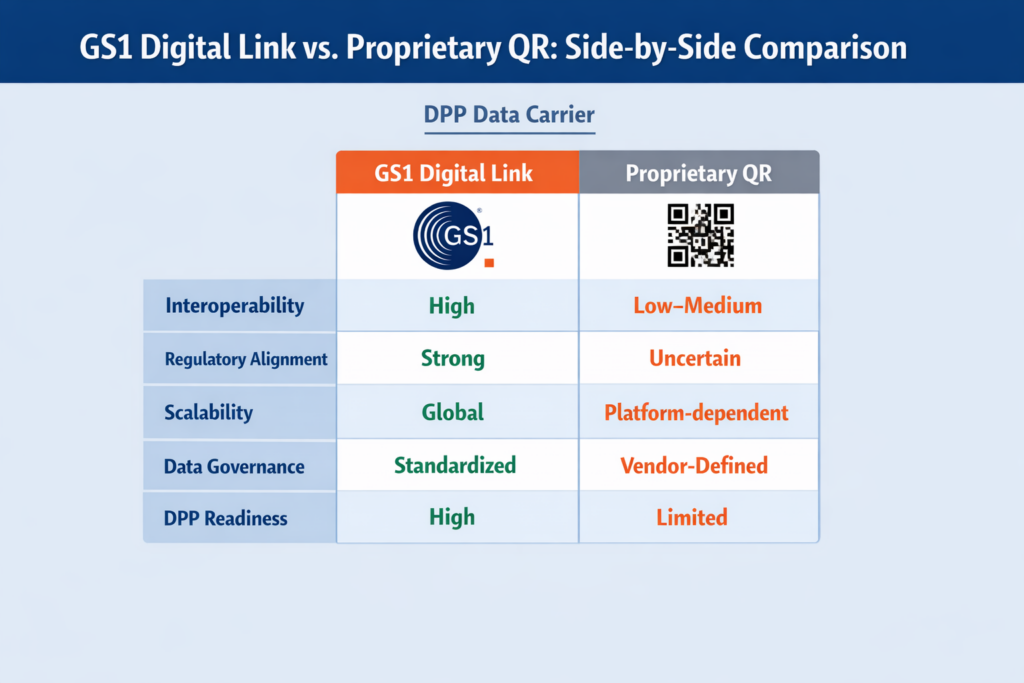
Choosing the right DPP data carrier is a strategic decision that affects regulatory compliance, scalability, and long-term digital transformation.
High-impact products such as batteries, electronics, textiles, and chemicals face stricter ESPR and DPP requirements. These categories benefit from standardized, regulation-ready carriers like GS1 Digital Link, which support detailed lifecycle data, durability, and regulator access.
If you sell into the EU, your DPP data carrier must meet interoperability, accessibility, and future-proofing expectations under EU regulations. For global brands, a carrier that works consistently across regions and systems reduces duplication and compliance complexity.
DPPs will evolve beyond basic compliance to support resale, repair, recycling, and circular business models. Open, standards-based carriers enable multiple stakeholder views, consumers, recyclers, and auditors without redesigning the system later.
The data carrier should integrate seamlessly with existing traceability, ESG, EPR, and carbon reporting platforms. This ensures the DPP becomes a live “truth layer,” not a static compliance artifact.
Digital platforms play a critical role in turning a DPP data carrier such as a GS1 Digital Link QR into a fully functional, regulation-ready Digital Product Passport.
Platforms automate the creation, governance, and lifecycle management of GS1 Digital Links across millions of SKUs, batches, or serialized items. This includes version control, access permissions, and updates as products move through manufacturing, distribution, use, and end-of-life without changing the physical QR code.
Digital platforms connect the QR code to dynamic datasets such as materials, origin, carbon footprint, repair instructions, and recycling guidance. Data from ERP, PLM, MES, supplier systems, and IoT devices is structured and mapped to the correct DPP endpoints for different stakeholders.
Built-in validation rules ensure data completeness, traceability, and alignment with ESPR and upcoming EU DPP requirements. Platforms maintain immutable logs, timestamps, and role-based access, making DPPs audit-ready for regulators and conformity assessments.
Regulatory Compliance Platform from TraceX provides end-to-end DPP enablement, combining GS1 Digital Link management, supplier data capture, ESG and carbon integration, and compliance reporting, allowing brands to deploy scalable, interoperable, and future-proof Digital Product Passports with confidence.
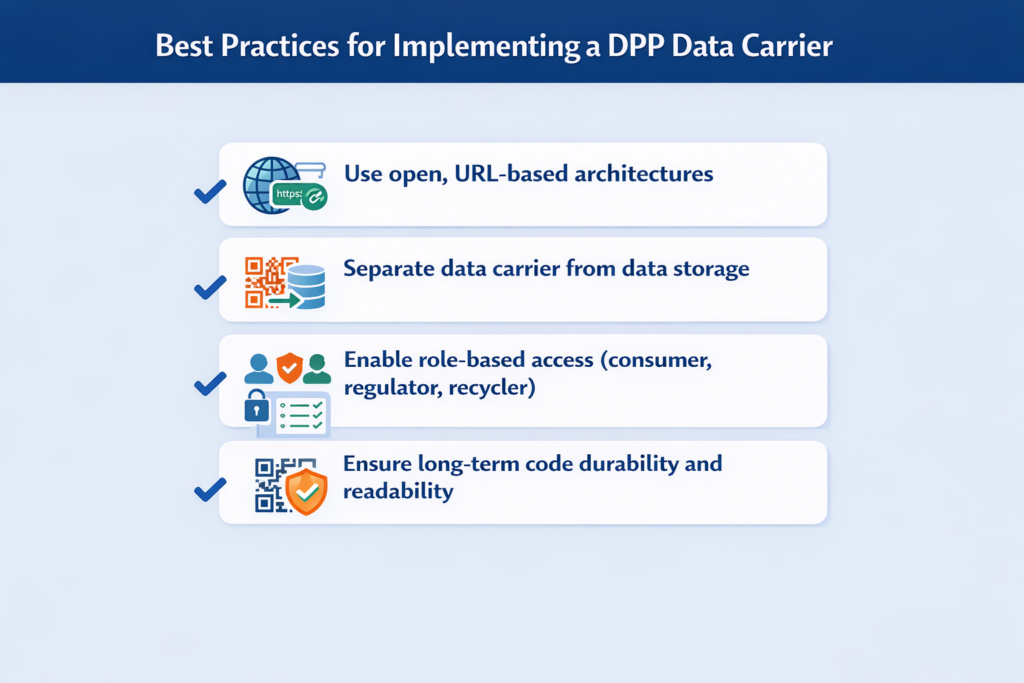
Your DPP data carrier is not a technical afterthought it is a strategic foundation for compliance, trust, and long-term scalability. As DPP becomes mandatory under EU regulations, the way product data is accessed will determine whether your DPPs are interoperable, audit-ready, and future-proof. GS1 Digital Link stands out as the most regulation-aligned option, enabling standardized, multi-stakeholder access across global markets. Proprietary QR codes may offer short-term speed, but they carry long-term risks around interoperability, regulatory fit, and vendor lock-in. Choosing the right DPP data carrier today directly shapes your ability to scale, comply, and compete tomorrow.
Explore how GTINs, batch, and serial IDs enable global traceability and compliance.
Why GS1 Identifiers Are the Foundation of DPPs
Learn what separates compliant, scalable QR systems from short-term fixes.
QR Code Traceability Done Right
Learn how interoperability ensures cross-border and cross-platform access.
Interoperable DPPs: The Key to EU-Ready Compliance
No. GS1 Digital Link is not legally mandatory, but it is widely recommended because it aligns with EU ESPR requirements for open, interoperable, and standardized DPP access.
Yes, but with limitations. Proprietary QR codes can support compliance initially, however they may face challenges around interoperability, long-term regulatory alignment, and cross-border scalability.
A QR code is a carrier, while GS1 Digital Link is a standardized, URL-based structure encoded within a QR code that connects product identifiers to multiple DPP data endpoints.
They connect physical products to lifecycle data, enabling repair, reuse, recycling, and verified recovery through accessible, trusted product information.
Highly future-proof. GS1 Digital Link supports evolving DPP regulations, multiple stakeholder views, and global interoperability, making it well-suited for long-term compliance and circular business models.