
Quick summary: DPP Data Requirements explained: learn what data is required under ESPR and how to structure Digital Product Passport data for scalable, audit-ready EU compliance.

Compliance failure is now a data problem, not a policy problem. DPP Data Requirements under ESPR mandate standardized digital product information covering product identification, manufacturer details, material composition, substances of concern, environmental and carbon footprint indicators, compliance declarations, and repairability and recyclability data.
ESPR compliance is no longer about understanding regulations it’s about managing data. Many companies assume policy awareness is enough, but the real risk lies in fragmented, incomplete, or unstructured product data. Under ESPR, compliance shifts from static documents and declarations to continuously updated, digital product data embedded across the supply chain.
The pain point is clear: if your data cannot be verified, structured, and accessed digitally, your products may be blocked from the EU market, regardless of intent or sustainability claims. DPP data readiness is now the deciding factor between seamless market access and regulatory disruption. Minimum DPP data is required for EU market access, while extended, product-specific data applies to sectors such as batteries, textiles, and electronics. To comply, companies must structure DPP data at product or batch level, link supplier and material inputs, and ensure interoperability through QR codes, APIs, and integration with ERP and sustainability systems.
Key Takeaways
Under the ESPR Digital Product Passport (DPP) framework, companies must provide standardized, verifiable, and digitally accessible product data to demonstrate compliance, sustainability, and circularity. The mandatory data requirements are designed to support regulatory enforcement, informed purchasing, and end-of-life management.
Explore the essentials of Digital Product Passports and stay ahead of ESPR compliance.
Learn how DPP regulations are shaping product traceability and sustainability in the EU.
1. Product Identification
Each product must have a unique digital identity, including model number, SKU, and serial or batch identifiers. This ensures traceability at product or batch level and enables regulators and market surveillance authorities to link physical products to their corresponding DPP records.
2. Manufacturer and Economic Operator Details
The DPP must clearly identify the manufacturer, importer, authorized representative, and other responsible economic operators. This establishes legal accountability and enables authorities to quickly determine responsibility in cases of non-compliance.
3. Material Composition and Substances of Concern
Detailed information on materials, components, and chemical substances is required, particularly substances of concern as defined under EU chemicals legislation. This supports safer product design, informed recycling, and compliance with REACH and related regulations.
4. Environmental and Carbon Footprint Indicators
Products must disclose environmental performance metrics, such as carbon footprint, energy use, or other lifecycle-based indicators defined in delegated acts. These metrics enable consistent sustainability assessment across the EU market.
5. Compliance Declarations and Certifications
The DPP must include declarations of conformity, test reports, and references to applicable EU or third-party certifications, providing verifiable proof that the product meets ESPR and related regulatory requirements.
6. Repairability, Durability, and Recyclability Information
Information on repair instructions, expected lifespan, spare part availability, and recycling pathways must be provided to support circular economy objectives and extend product life.
Together, these mandatory data categories transform the DPP into a single, authoritative source of truth for product compliance, sustainability, and traceability across the EU market.
Imagine a premium waterproof jacket manufactured by a global outdoor brand. Here is how the six mandatory data requirements manifest in its Digital Product Passport:
| DPP Requirement | Data Substantiation (Textile Use Case) | Why It Matters |
| 1. Product Identification | A unique GS1 Digital Link (QR Code) on the neck tag. Scanning it reveals Model: Summit-X, SKU: BLU-LG-2027, and Batch ID: VN-4492. | Allows a retailer to track a recall or a recycler to identify the specific production run. |
| 2. Economic Operator Details | Identifies Outdoor Brand AG (Germany) as the manufacturer and Logistics EuroCorp as the importer. | Establishes who is legally liable if the jacket is found to contain illegal dyes. |
| 3. Material Composition & Substances | Lists: $100\%$ Recycled Polyester (PET); Trims: $100\%$ Aluminium. Declares Zero PFAS (Per- and polyfluoroalkyl substances) in the DWR coating. | Recyclers see it is a “mono-material” shell, making it easier to shred and melt back into high-quality yarn. |
| 4. Environmental & Carbon Footprint | States: $12.4\text{ kg }CO_2e$ total footprint. Energy used in the fabric mill was $80\%$ wind-powered. | Consumers can compare two jackets and choose the one with the lower carbon intensity. |
| 5. Compliance & Certifications | Digital links to Global Recycled Standard (GRS) certificates and Oeko-Tex Standard 100 test reports. | Verifies the “recycled” claim is not “greenwashing” but a third-party audited fact. |
| 6. Repair, Durability & Recyclability | Includes a video link on how to patch a tear, a list of authorized repair centers, and instructions for removing the zip before recycling. | Extends the jacket’s life from 3 years to 10 years, drastically reducing its total environmental impact. |
The power of the DPP isn’t just in the information itself, but in who uses it across the product’s life:
The ESPR Digital Product Passport (DPP) framework distinguishes between minimum (baseline) data required for legal compliance and extended, sector-specific data that supports circularity, transparency, and market differentiation.
Minimum DPP data is required to legally place a product on the EU market. These are mandatory fields defined through ESPR delegated acts and must be provided in standardized digital formats to ensure interoperability and regulatory enforcement.
This baseline data typically includes:
Minimum DPP data is primarily regulator-facing, enabling market surveillance authorities to verify compliance efficiently. Some elements may also be visible to downstream buyers to support transparency, but the focus is legal conformity rather than differentiation.
Extended DPP data goes beyond baseline compliance and is tailored to the sustainability and circularity risks of specific product categories. While not always mandatory for initial market access, it is increasingly required by buyers, investors, and downstream partners.
Examples include:
Why Extended Data Matters
Extended DPP data drives circularity by enabling repair, reuse, and recycling, and it builds buyer trust through verified, transparent product information. Companies that capture extended data early are better positioned to meet future regulatory expansions, satisfy sustainability-conscious customers, and turn DPPs into a competitive advantage rather than a compliance cost.
Effective ESPR compliance depends not just on collecting the right data, but on structuring it correctly so it can be accessed, verified, and updated through a Digital Product Passport (DPP).
A robust DPP data architecture starts with deciding what level of granularity is required:
To function at scale, DPPs must be interoperable across systems, stakeholders, and borders:
By designing a structured, interoperable data architecture, businesses can ensure continuous ESPR compliance, reduce audit friction, and future-proof their DPP strategy as regulatory requirements evolve.
As ESPR shifts compliance toward digital, product-level data, many companies encounter structural data challenges that can delay or derail Digital Product Passport (DPP) implementation.
Addressing these challenges requires structured data models, supplier onboarding workflows, and digital DPP solutions that support continuous updates, validation, and audit readiness.
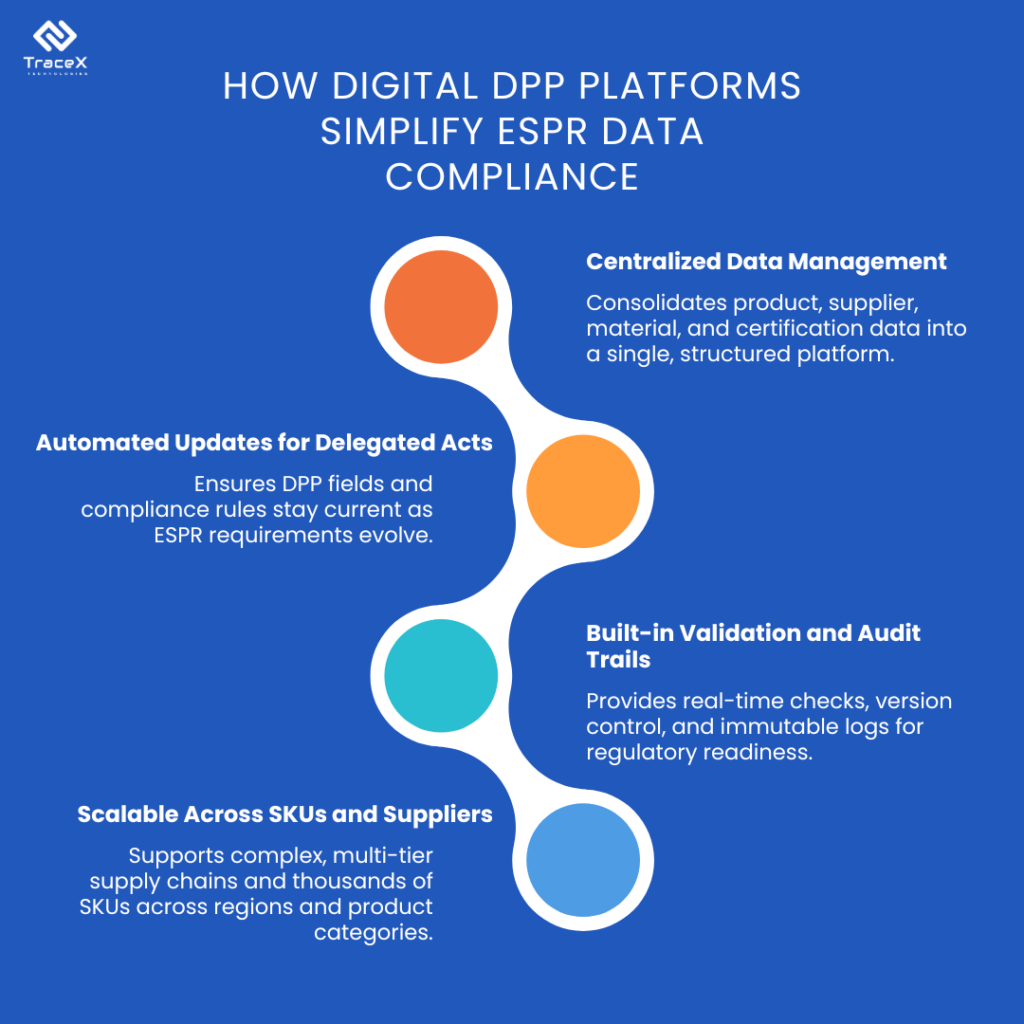
Digital DPP platforms are essential for managing the volume, complexity, and evolution of ESPR data requirements. Instead of relying on fragmented tools and manual processes, they create a single, trusted system of record for product compliance.
By embedding compliance into digital workflows, Digital Product Passport solutions transform ESPR DPP from a regulatory burden into a scalable, future-proof capability that supports transparency, resilience, and long-term competitiveness.
When structured correctly, DPP data becomes more than a compliance requirement; it becomes a strategic advantage. Standardized, verifiable data enables faster regulatory approvals, smoother audits, and greater trust from regulators, buyers, and consumers. Early adopters reduce compliance risk, avoid last-minute disruptions, and build systems that scale as ESPR requirements evolve. Most importantly, DPP data forms the digital foundation for future EU sustainability regulations, allowing businesses to adapt quickly, unlock operational insights, and position themselves as transparent, resilient leaders in an increasingly regulated market.
Understand how ESPR is transforming product compliance and sustainability in the EU
Learn how the Circular Economy drives sustainability and operational efficiency
Explore how the EU Green Deal impacts product regulations and market access.
Core DPP data includes product identification, manufacturer details, material composition, substances of concern, environmental and carbon footprint indicators, compliance declarations, and repairability and recyclability information.
DPP data should be structured at product or batch level, linked to materials, components, suppliers, and certifications, and integrated with ERP, PLM, and sustainability systems using interoperable standards such as QR codes and APIs
Minimum DPP data is required for EU market access and regulatory checks, while extended DPP data is product-specific and supports circularity, buyer transparency, and future regulatory requirements.