
Quick summary: How DPPs drive circular economy and sustainable compliance: ESPR requirements, lifecycle traceability, repairability, recycling, and verifiable sustainability claims explained.

The EU Ecodesign for Sustainable Products Regulation (ESPR) is transforming how companies manage product lifecycles. Digital Product Passports (DPPs) are no longer optional they are mandatory tools to enable repair, reuse, recycling, and verifiable sustainability claims. Digital Product Passports for Circular Economy turn product data into a living record enabling transparency, compliance, and circular value from design to reuse, recycling, and beyond.. DPPs enable repair, reuse, and recycling by tracking materials and transformation events, supporting Extended Producer Responsibility (EPR) obligations. They also prevent greenwashing by linking sustainability claims to auditable lifecycle data. Under regulations like ESPR, DPPs ensure traceability, transparency, and compliance across supply chains, turning circularity requirements into actionable, measurable, and legally defensible practices that benefit businesses, regulators, and consumers alike.
Yet many businesses struggle: incomplete or fragmented lifecycle data can lead to greenwashing accusations, regulatory penalties, and lost market access. Without a robust DPP strategy, companies risk compliance failures while competitors leverage lifecycle transparency to meet consumer expectations and circular economy goals. The solution lies in integrating end-to-end traceability and verified data into every stage of the product lifecycle.
Key Takeaways
Under ESPR, Digital Product Passports (DPPs) play a central role in improving product repairability by making critical lifecycle information accessible and verifiable. DPPs document standardized repair instructions, approved repair methods, spare-parts availability, component compatibility, and recommended maintenance schedules. This information is made available to authorized repairers, recyclers, and, in some cases, consumers via QR codes or digital access points.
Event-based traceability allows every repair, component replacement, or refurbishment to be recorded as a lifecycle event. Over time, this creates a verified maintenance and repair history, extending product lifespan and supporting ESPR’s right-to-repair objectives. In electronics, DPPs help identify replaceable components and firmware compatibility, while in batteries, they track state of health, module replacements, and safety compliance critical for reuse and second-life applications.
DPPs enable high-quality recycling by providing recyclers with precise, product-specific data on material composition, hazardous substances, and disassembly instructions. Instead of relying on generic assumptions, recyclers can access verified information on metals, polymers, and critical raw materials, improving sorting accuracy and recovery rates.
Batch-level traceability captures transformation events across manufacturing and use phases, ensuring that recycled materials can be linked back to original product batches. This is especially important for regulated materials such as lithium, cobalt, and rare earths. DPPs also integrate with Extended Producer Responsibility (EPR) schemes by supplying accurate data on volumes placed on the market, collected, reused, or recycled reducing reporting errors and compliance risk.
ESPR requires companies to provide clear, auditable end-of-life data through DPPs, including disposal instructions, recycling eligibility, material recovery potential, and environmental impact indicators. Regulators expect this data to be consistent, traceable, and verifiable across the entire lifecycle not reconstructed after the fact.
DPPs ensure end-of-life data integrity by linking disposal or recycling events directly to the product’s digital record. This supports accurate regulatory reporting, market surveillance, and enforcement while enabling companies to track circular economy KPIs such as reuse rates, recycling efficiency, and recovered material content. By turning end-of-life into a documented lifecycle stage, DPPs make circularity measurable, provable, and compliant under ESPR.
Understand the latest DPP regulations under ESPR—read our compliance guide →
See how DPPs track products across every lifecycle stage—read our lifecycle deep dive →
The biggest cost in repair isn’t the part; it’s the labour time spent identifying the problem and finding the solution.
The secondary market (resale) struggles with asymmetric information. The buyer doesn’t know if the product is authentic or how hard it was used.
Most recycling today is “downcycling” (turning high-quality materials into lower-quality ones) because we can’t efficiently separate complex materials.
Summary: The “Data-Impact” Table
| Stage | The Missing Link | The DPP Asset | The Business Outcome |
| Repair | Disassembly Knowledge | Digital Service Manuals | Lower Labor Costs |
| Reuse | Provenance & History | Verified Service Logs | Higher Resale Value |
| Recycling | Chemical/Material Specs | Automated Sorting Data | High-Purity Raw Materials |
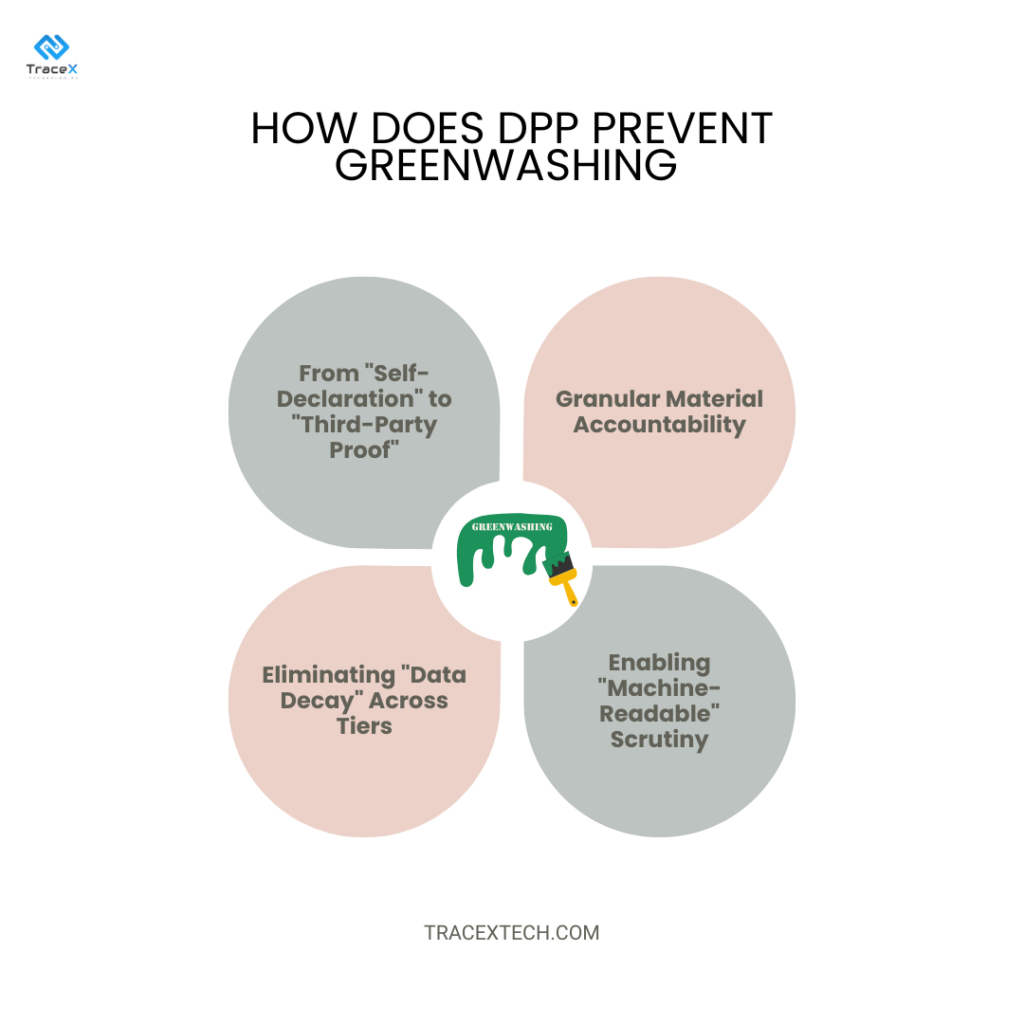
ESPR Digital Product Passports prevent greenwashing by forcing sustainability claims to be backed by verifiable, lifecycle-based data rather than marketing statements or self-declarations. Every claim such as “recyclable,” “low carbon,” or “sustainably sourced” must be linked to recorded lifecycle events captured in the DPP, including sourcing, manufacturing, use, repair, and end-of-life activities.
Standardized identifiers such as GTINs (product IDs) and GLNs (location and actor IDs) ensure that claims are consistently linked to the correct product, batch, supplier, and facility across the value chain. Persistent digital records make it impossible to selectively disclose or retroactively modify data, enabling regulators and buyers to verify claims against actual operational evidence. This shift from narrative-based sustainability to data-backed proof is central to ESPR’s anti-greenwashing objectives.
Digital Product Passports enable companies to demonstrate sustainability claims with precision and credibility. Circularity claims can be supported through documented repair events, reuse cycles, and recycling outcomes. Recycled content claims rely on traceable material inputs and transformation records that show where, when, and how recycled materials were introduced. Carbon footprint disclosures can be linked to verified production, transport, and energy-use data captured at each lifecycle stage.
Material traceability within DPPs allows regulators and buyers to trace critical raw materials back to approved sources, supporting deforestation-free, ethical sourcing, and ESG requirements. By providing structured, auditable data access via QR codes or digital interfaces, DPPs build trust with consumers while giving regulators confidence that sustainability claims are accurate, consistent, and enforceable.
In ESPR DPP audits, regulators focus on the completeness, consistency, and verifiability of lifecycle data. They assess whether required lifecycle events design, sourcing, manufacturing, distribution, repair, reuse, and end-of-life are fully documented and linked to the correct product or batch. Gaps, manual overrides, or unsupported claims are treated as compliance risks.
Regulators also examine material and transformation traceability, ensuring that inputs, processing steps, and outputs are clearly recorded and traceable across suppliers and facilities. Finally, audits evaluate alignment with ESPR obligations on repairability, recyclability, durability, and end-of-life reporting. Companies that treat DPPs as living lifecycle systems rather than static disclosures are far better positioned to pass audits, avoid penalties, and protect market access.
Digital platforms are the backbone of effective Digital Product Passports (DPPs) and circular economy enablement because they transform fragmented lifecycle data into a single, verifiable system of record.
At the core, digital platforms capture event-based lifecycle data from material sourcing and manufacturing to repair, reuse, and recycling. Instead of static documents, every transformation, ownership change, repair action, or end-of-life event is recorded as a time-stamped, auditable data point. This is essential for DPP compliance under ESPR, where regulators require proof of how products are designed, used, repaired, and recovered.
Digital platforms also enable persistent identifiers (product, batch, location, and actor IDs) that follow a product throughout its lifecycle. This continuity prevents data loss between stages and allows recyclers, repairers, and regulators to access the right information at the right time supporting repairability, material recovery, and Extended Producer Responsibility (EPR).
TraceX’s Solutions are built specifically for lifecycle-wide traceability. It digitizes supplier onboarding, maps materials and components at source, and records every lifecycle event across manufacturing, distribution, and post-use stages. By aligning with global standards (such as GS1 identifiers), TraceX ensures DPP data is interoperable, regulator-ready, and scalable across global supply chains.
For circular economy outcomes, TraceX platform enables:
In practice, digital platforms from TraceX shift DPPs from a compliance burden to circular infrastructure turning lifecycle data into actionable intelligence that reduces risk, prevents greenwashing, and unlocks long-term value from products beyond first use.
Digital Product Passports (DPPs) are no longer optional reporting tools they are the digital infrastructure that enables circular economy execution and sustainable compliance at scale. By linking design, sourcing, use, repair, and end-of-life data into a single, verifiable lifecycle record, DPPs help companies meet ESPR obligations while reducing greenwashing risk and improving material recovery, repairability, and reuse. Organizations that adopt lifecycle-ready DPPs early gain regulatory certainty, stronger market access, and a measurable sustainability advantage.
What does ESPR really require from your products?
What makes a DPP future-proof?
Dive into DPP architecture and data models →
From source to end-of-life: how DPPs eliminate traceability gaps
DPPs enable the circular economy by tracking materials, repairs, reuse, and recycling events across the full product lifecycle, allowing products and materials to stay in use longer and be recovered more efficiently.
ESPR requires verifiable lifecycle data on durability, repairability, recyclability, and sustainability claims. DPPs provide regulators with auditable, event-based evidence instead of static documentation.
Yes. DPPs link sustainability claims directly to verified lifecycle events and standardized identifiers, ensuring claims about recycled content, carbon footprint, or circularity can be independently checked by regulators and buyers.