
Quick summary: DPP Product Scope explained: understand ESPR timelines, product categories, and Digital Product Passport requirements to prepare for EU compliance and market access.

The Digital Product Passport (DPP) is no longer an optional compliance measure under the Ecodesign for Sustainable Products Regulation (ESPR); it is set to become a legal requirement across the EU. Companies that fail to adapt risk losing market access, facing penalties, and damaging brand reputation. The DPP product scope under ESPR defines which products require Digital Product Passports and the timelines for compliance. Priority categories include batteries, textiles and apparel, electronics and ICT products, furniture, and, in later phases, construction materials.
ESPR is a cornerstone of the EU Circular Economy Action Plan, designed to make products more durable, reparable, recyclable, and environmentally transparent throughout their lifecycle. Unlike prior Ecodesign directives, ESPR expands its scope to cover a wide range of products, from batteries and electronics to textiles and furniture. Compliance timelines are phased: delegated acts are finalized in 2024–2025, initial enforcement begins in 2026, and additional product groups are included through 2030. Delegated acts specify mandatory data fields, access rights, and verification requirements, ensuring that DPPs are tailored to each product’s environmental, circularity, and regulatory profile.
For many businesses, the challenge lies in regulatory complexity: understanding product-specific obligations, managing supplier data, and ensuring traceability can be overwhelming. Early adoption of DPPs not only ensures compliance but also provides a competitive advantage by improving supply chain transparency, sustainability reporting, and market credibility.
Key Takeaways
Under the ESPR framework, certain product categories are designated as priorities for Digital Product Passport (DPP) implementation due to their environmental impact, material intensity, and circularity potential. These categories include:
Batteries require DPP compliance under EU Battery Regulation from February 2027, with the sector generating €100B+ annual EU market value (39% global DPP share by 2030) and responsible for 7-11% of global CO₂ emissions from critical materials like cobalt/lithium mining DPPs enable 20-30% Scope 3 reductions via recycled sourcing tracking
Textiles & apparel, prioritized by 2027-2030, produce 92 million tonnes of waste yearly (projected 134M by 2030), ranking 4th in EU environmental impact after food/housing/mobility, with DPPs verifying fiber origins and recycled content to curb greenwashing and boost circularity
Electronics & ICT products (smartphones/laptops) face delegated acts by 2026-2030, featuring high material complexity and hazardous substances; DPPs provide repairability scores and e-waste recovery data, targeting sectors with substantial outsourced pollution burdens
Furniture generates 12.2 million tonnes of global waste annually (80% landfilled), with new rules by 2028 focusing on material efficiency and biodiversity impacts DPPs capture repair/recycling instructions for long-lifecycle products
Construction products (steel/cement/panels) in future phases consume 50% of EU raw materials and contribute 1/3 of emissions; DPPs under ESPR/CPR will track embodied carbon and recyclability, supporting sustainable builds amid high wastage
The EU focuses on these product groups because they have the highest potential environmental impact and complexity in supply chains, making them critical targets for traceability and circularity. Implementing DPPs in these categories maximizes regulatory effectiveness, supports sustainable product design, and encourages responsible consumer and business practices.
This phased approach allows businesses to focus on high-impact areas first while preparing systems and processes for broader DPP adoption across additional product categories.
Learn what a Digital Product Passport is and why it’s becoming mandatory.
The implementation of Digital Product Passports (DPPs) under ESPR follows a phased, category-specific timeline, allowing businesses to prepare and scale compliance effectively.
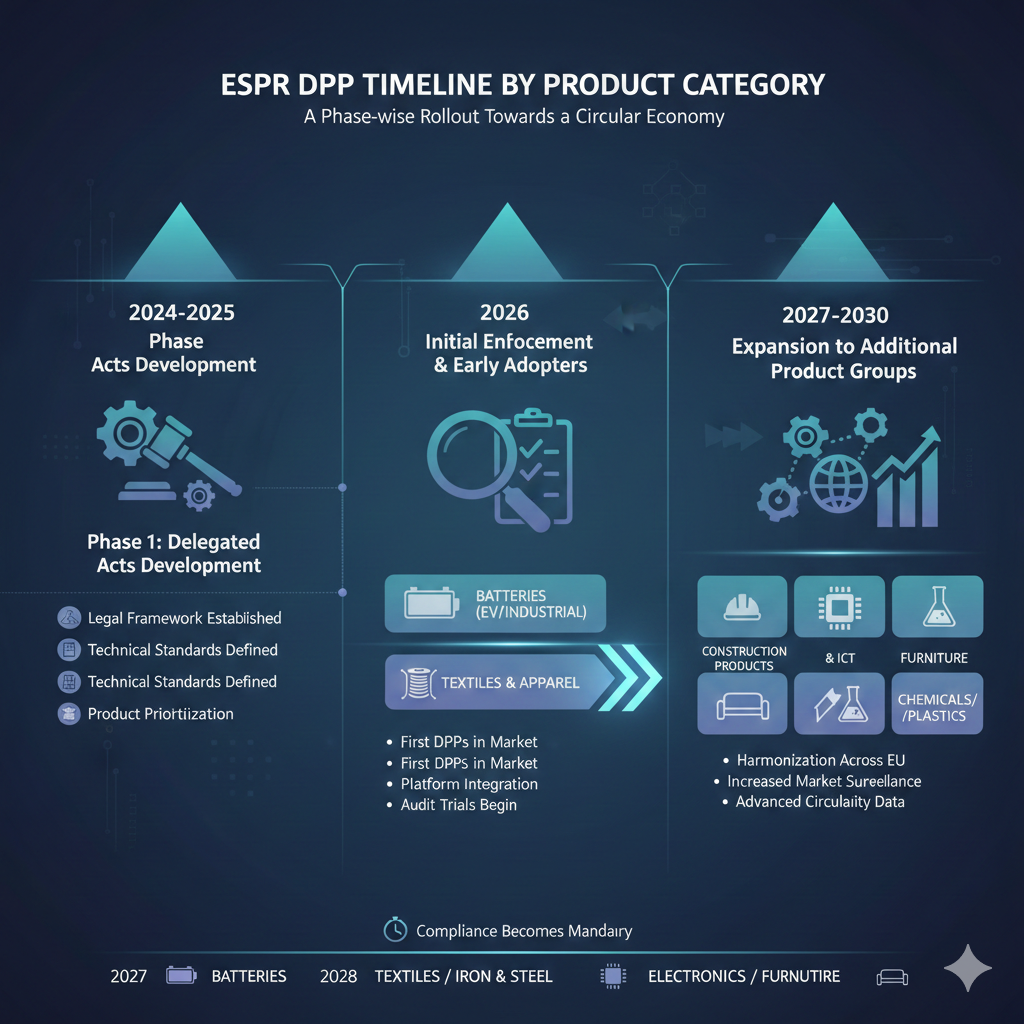
During this period, the EU will finalize delegated acts that define detailed DPP requirements for priority products. These acts specify the mandatory data fields, verification processes, and access rights for regulators, consumers, and other stakeholders. Businesses should use this time to assess data gaps, map suppliers, and evaluate internal systems, ensuring readiness for upcoming enforcement.
The first enforcement phase targets early-priority products such as batteries, textiles, and electronics. Companies must have digital systems in place to capture, validate, and share product and supply chain data. Early adoption provides advantages such as reduced risk of non-compliance, improved buyer trust, and smoother regulatory audits.
ESPR enforcement will gradually expand to other regulated categories, including furniture and construction materials. Businesses must ensure that their DPP platforms and workflows are scalable, capable of integrating additional products, suppliers, and geographies without operational disruption.
Practical Advice for Businesses:
A proactive, phased approach ensures continuous compliance, reduces last-minute operational pressure, and positions companies to leverage DPPs as a strategic tool for transparency, sustainability, and competitive advantage.
Consider each delegated act as the guideline for a specific product category. It can establish criteria for durability or reparability, limit or require disclosure of recycled materials, and dictate which data sets are included in the DPP. After its completion, it undergoes a parliamentary review lasting three months, extendable to six if necessary, prior to its implementation.
Delegated acts are legally binding instruments issued by the European Commission to provide detailed rules and specifications for implementing EU regulations, including the ESPR Digital Product Passport (DPP) requirements. While ESPR sets the overarching objectives and principles, delegated acts translate these into actionable, product-specific obligations that manufacturers, importers, and brand owners must follow.
Delegated acts define the exact data elements that must be included in a DPP. These typically cover:
By standardizing data fields, delegated acts ensure that DPPs are interoperable, consistent, and auditable across the EU market.
Delegated acts specify who can access which DPP data and under what conditions. Regulators need full visibility to enforce compliance, while consumers and downstream stakeholders may access selective sustainability, repairability, and recycling information. Clear access rights enable transparency without compromising confidential business information.
Delegated acts also define how data must be verified and audited. This includes third-party verification protocols, traceability checks, and procedures for maintaining audit-ready records. These requirements ensure data integrity, reliability, and regulatory trust, reducing the risk of misreporting or greenwashing.
Different products have unique environmental impacts, lifecycles, and circularity considerations. For example:
Delegated acts tailor DPP obligations to each product category’s sustainability and compliance needs, ensuring proportionality while maximizing environmental and circularity outcomes.
In summary, delegated acts are the operational backbone of ESPR DPP, providing the legal, technical, and verification framework that ensures Digital Product Passports are standardized, trustworthy, and aligned with the EU’s circular economy objectives.
At present, the ESPR framework requires product-specific delegated acts to define detailed Digital Product Passport (DPP) requirements for individual sectors; these delegated acts are still being developed by the European Commission and have not yet been fully published. Each delegated act will specify the mandatory DPP data fields and compliance obligations for that product group. Delegated acts are expected to be adopted for textiles and apparel, furniture, tyres and mattresses, iron & steel, aluminium and other intermediate products, with horizontal measures for repairability and recycled content also included in the first 2025–2030 ESPR Working Plan. Batteries are also subject to interoperable requirements through the EU Battery Regulation, which functions as a battery passport scheme aligned with DPP expectations
In summary:
As each delegated act becomes formally adopted, it will provide the specific legal text and data requirements that companies must comply with for that product category’s DPP.
The DPP Product Scope under ESPR defines not only which products must comply, but also when and how compliance will be enforced. With phased timelines starting in 2026 and product-specific requirements defined through delegated acts, early preparation is critical. Businesses that proactively map product scope, structure their data, and adopt a scalable digital DPP solution will reduce compliance risk, maintain EU market access, and gain a strategic advantage as sustainability regulations continue to expand.
Understand how ESPR is transforming product compliance in the EU
Discover how the Circular Economy is reshaping product design and sourcing
Explore the EU Green Deal’s impact on global supply chains.
Priority products include batteries, textiles and apparel, and electronics & ICT products, as these categories have high environmental impact and complex supply chains. These are expected to be among the first to face DPP enforcement starting in 2026.
Delegated acts define product-specific DPP obligations, including mandatory data fields, access rights, and verification rules. They ensure DPP requirements are tailored to each product’s sustainability, circularity, and compliance needs.
Delegated acts are finalized during 2024–2025, initial DPP enforcement begins in 2026, and coverage expands to additional product groups between 2027 and 2030.