
Quick summary: DPP Readiness for Manufacturers explained: ESPR data requirements, traceability obligations, common challenges, and how manufacturers can prepare for Digital Product Passport compliance.

Under ESPR, manufacturing sites become the backbone of Digital Product Passport compliance. DPP Readiness for Manufacturers means preparing to meet Digital Product Passport obligations under the EU Ecodesign for Sustainable Products Regulation (ESPR).
Manufacturers must generate accurate, auditable data on product composition, substances of concern, production processes, environmental performance, and circularity metrics. This data must be structured, machine-readable, and traceable to production sites and batches. Achieving DPP readiness requires digitizing bills of materials, aligning quality and compliance systems, and maintaining audit-ready documentation. Early preparation reduces compliance risk, supports importer and brand obligations, and ensures continued access to EU markets.
Key Takeaways
Under the EU Ecodesign for Sustainable Products Regulation (ESPR), manufacturers play a central role in Digital Product Passport (DPP) compliance. While multiple actors contribute to the passport, manufacturers are the primary source of the technical and production data that DPP relies on.
ESPR places responsibility on manufacturers to ensure that products placed on the EU market meet defined sustainability, safety, and performance requirements. Manufacturers are expected to:
In practice, this makes manufacturers a critical compliance enabler within the DPP ecosystem.
Most mandatory DPP data originates at the manufacturing stage. This includes:
If production data is incomplete or inconsistent, the DPP cannot be accurate—regardless of how well downstream actors manage disclosures. Manufacturing data forms the ground truth for all product-level claims.
Under ESPR, inaccurate or unverifiable data can trigger serious consequences:
Because DPP data is machine-readable and accessible to authorities, errors are easier to detect and harder to correct after products are placed on the market.
DPP shifts manufacturers from passive data providers to active compliance stakeholders. Manufacturers that digitize, verify, and govern production data will reduce regulatory risk, support their customers, and maintain uninterrupted access to EU markets.
Understand the mandatory and voluntary DPP data requirements, how they vary by product category, and what ESPR expects in practice.
Read the blog: DPP Data Requirements Explained
Explore which products fall under DPP product scope, how timelines apply, and what this means for brands, manufacturers, and importers.
Read the blog: DPP Product Scope Explained
Under the Digital Product Passport (DPP) requirements of the EU Ecodesign for Sustainable Products Regulation (ESPR), manufacturers are responsible for supplying the core technical and production data that underpins product compliance. This data must be accurate, structured, and traceable to withstand regulatory scrutiny.
Manufacturers must provide a complete and structured Bill of Materials (BoM) for each product or product model covered by DPP.
This includes:
The BoM enables regulators and downstream actors to assess environmental performance, circularity, and compliance with material restrictions. Inaccurate or incomplete material composition data undermines the credibility of the entire DPP.
Manufacturers must disclose the presence of regulated substances, particularly Substances of Very High Concern (SVHC) under the EU REACH regulation.
Key requirements include:
While confidential formulations can remain protected, the DPP must provide sufficient information to demonstrate regulatory compliance and support enforcement actions.
Manufacturers are required to document where and how products are made, ensuring traceability and accountability.
This includes:
Production site data supports market surveillance, traceability, and due-diligence checks, particularly when products are sourced from multiple facilities or regions.
Mandatory manufacturer data forms the technical backbone of the Digital Product Passport. If this data is inaccurate, outdated, or unverifiable, brands and importers cannot meet their own ESPR obligations. Manufacturers that digitize and govern this information early reduce compliance risk, simplify audits, and strengthen their position within EU supply chains.
Under the Digital Product Passport (DPP) framework of the EU Ecodesign for Sustainable Products Regulation (ESPR), manufacturers must provide environmental and circularity data that demonstrates how products are designed, used, and managed across their lifecycle. These data points support the EU’s shift toward a circular economy and enable enforcement, comparability, and informed decision-making.
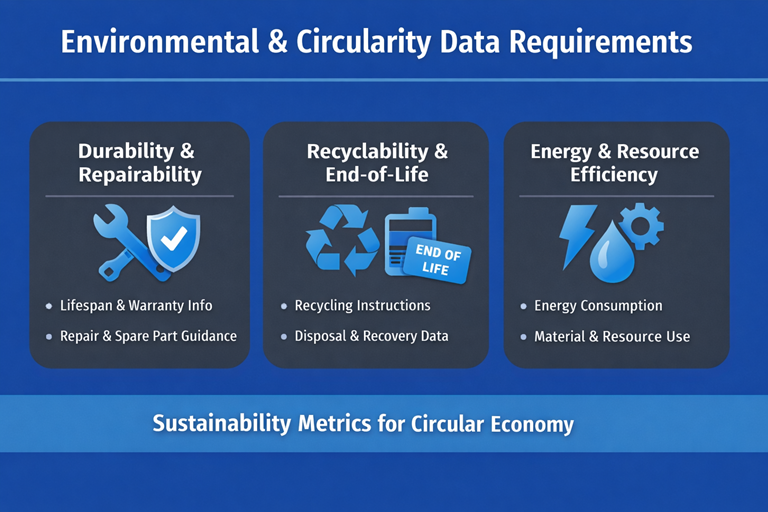
Manufacturers must disclose information that reflects how long a product is expected to last and how easily it can be repaired.
This may include:
Durability and repairability data help reduce premature product disposal and support regulatory requirements aimed at extending product life.
Manufacturers are required to provide guidance on how products should be handled at the end of their useful life.
This includes:
Clear end-of-life data supports waste management, recycling operations, and compliance with EU circular economy objectives.
Depending on the product category, manufacturers must also disclose energy and resource efficiency metrics.
This may involve:
These metrics allow regulators and buyers to compare products and enforce minimum performance requirements.
Environmental and circularity data shifts compliance from static declarations to lifecycle accountability. Manufacturers that capture and maintain accurate durability, recyclability, and efficiency data not only meet DPP requirements but also position themselves as reliable partners in sustainable EU supply chains.
Traceability and batch-level data are critical components of Digital Product Passport (DPP) compliance under the EU Ecodesign for Sustainable Products Regulation (ESPR). For manufacturers, this data connects production activities to individual products placed on the EU market, enabling verification, accountability, and enforcement.
Manufacturers must be able to identify which batches or lots a product originated from. This requires:
Batch-level traceability supports recalls, investigations, and compliance checks, and is essential when products are produced across multiple facilities or time periods.
DPP requires manufacturers to maintain a clear connection between production data and finished products. This means:
Without this linkage, DPP data becomes generic and cannot support regulatory enforcement or buyer due diligence.
Many manufacturers operate multiple systems ERP, MES, quality management, and compliance tools. DPP readiness requires that traceability data is:
Inconsistent or conflicting data across systems increases audit risk and undermines the reliability of the DPP.
Traceability and batch-level data transform DPP from a static dataset into a verifiable compliance mechanism. Manufacturers that establish strong batch traceability and data consistency reduce regulatory risk, support downstream compliance, and strengthen trust across EU supply chains.
As manufacturers prepare for Digital Product Passport (DPP) compliance under ESPR, several recurring challenges can delay readiness and increase regulatory risk. These challenges often stem from legacy processes and fragmented data management practices.
Many manufacturers rely on a patchwork of legacy IT systems, spreadsheets, and manual workflows to manage production, compliance, and sustainability data. These tools are not designed to support:
As a result, data becomes difficult to validate, scale, or audit—making DPP compliance slow and error-prone.
Manufacturers often lack full visibility into material composition, especially for components sourced from sub-suppliers. This can lead to:
Incomplete material transparency weakens the credibility of DPP data and increases the likelihood of non-compliance during audits or market surveillance.
DPP requires manufacturers to maintain audit-ready documentation that links product data back to source evidence. Common gaps include:
When audits occur, these gaps can result in corrective actions, delayed approvals, or restricted market access.
Manufacturers that do not address these challenges risk falling behind as DPP enforcement expands. Investing early in data digitization, material transparency, and audit readiness enables smoother compliance, reduces operational disruption, and strengthens manufacturer credibility within EU supply chains.
Achieving Digital Product Passport (DPP) readiness under ESPR requires manufacturers to modernize how production, compliance, and sustainability data is managed. Success depends on technology, governance, and cross-functional alignment.
Manufacturers must move away from paper records and spreadsheets to digitized, structured data systems. This includes:
Digitization enables accuracy, scalability, and real-time traceability—core requirements for DPP compliance.
DPP readiness is not owned by a single department. Quality assurance, ESG/sustainability, compliance, and IT teams must work together.
Effective alignment includes:
Cross-functional collaboration reduces data silos and ensures consistent, defensible DPP information.
Manual tools cannot support DPP requirements at scale. Manufacturers should adopt digital platforms built for traceability, verification, and regulatory compliance.
DPP-ready platforms enable manufacturers to:
Manufacturers that digitize early, align internal teams, and use DPP-ready platforms can transform DPP compliance from a regulatory burden into a structured, repeatable capability reducing risk and ensuring continued access to EU markets.
TraceX provides a purpose-built digital platform that helps manufacturers achieve DPP readiness with speed and confidence. By digitizing production, material, and batch-level data at source, TraceX enables manufacturers to maintain structured, machine-readable, and audit-ready records aligned with ESPR requirements. The platform connects bills of materials, substances of concern, production sites, and batch traceability into a single system, while ensuring data consistency across QA, ESG, and IT teams. With built-in verification, version control, and seamless data sharing with brands and importers, TraceX turns DPP compliance from a manual burden into a scalable, future-ready capability.
DPP Readiness for Manufacturers is a foundational requirement for meeting ESPR data and compliance obligations in the EU. By digitizing production and material data, ensuring batch-level traceability, and aligning QA, ESG, and IT teams, manufacturers can deliver accurate, verifiable information that downstream brands and importers rely on. Early DPP preparation reduces audit risk, prevents market disruptions, and positions manufacturers as trusted partners in regulated EU supply chains as Digital Product Passports become mandatory.
Understand the DPP regulatory framework under ESPR, enforcement expectations, and what compliance looks like in practice.
Read the blog: DPP Regulations Explained
Learn how to collect, validate, and govern supplier data for DPP compliance without increasing audit or liability risk.
Read the blog: Managing Supplier Data for DPP
Explore why interoperability is critical for Digital Product Passports, and how to avoid data silos across ERP, PLM, and compliance tools.
Read the blog: Interoperability in DPP Explained
DPP readiness for manufacturers means having accurate, structured, and auditable production, material, and environmental data that meets Digital Product Passport requirements under ESPR.
Manufacturers must provide bills of materials, substances of concern disclosures, production site and process data, environmental and circularity metrics, and batch-level traceability information.
Manufacturers are responsible for the accuracy of production and material data used in DPPs. While brands and importers place products on the market, manufacturers enable compliance through reliable data.
DPP increases audit expectations by requiring machine-readable, traceable, and continuously updated data. Inconsistent or incomplete records can lead to corrective actions or market restrictions.
Manufacturers should digitize production and compliance data, align internal teams, and adopt DPP-ready digital platforms that support traceability, verification, and audit readiness.