
Quick summary: Discover how spice brands can build ethical, transparent, and sustainable supply chains. Learn key risks, best practices, certifications, traceability tools, and technology solutions to ensure responsible sourcing from farm to packaging.

Ethical Sourcing for Spice Brands requires verifying that every ingredient is produced under fair, transparent, and environmentally responsible conditions. As global buyers demand proof of origin, labour practices, and sustainability, spice brands must ensure full visibility from farm onboarding to harvest, processing, and packaging. This includes traceability, ethical risk assessments, biodiversity checks, and supplier compliance with global standards. Implementing digital tools and verifiable documentation helps brands mitigate fraud, reduce environmental impact, strengthen certifications, and meet export regulations. Ethical sourcing enables spice brands to protect reputation, secure premium buyers, and build resilient, future-ready supply chains.
Ethical sourcing is no longer a “nice-to-have” for spice brands it’s becoming a survival requirement. As global buyers tighten standards around sustainability, traceability, and clean-label authenticity, brands face growing pressure to prove where their spices come from and how they are produced. New regulations like EUDR, CS3D, and Human Rights Due Diligence now require verified origin data, deforestation-free sourcing, and responsible labor practices putting non-compliant suppliers at risk of losing market access.
The real pain? Most spice supply chains are deeply fragmented, making it difficult to track farm origins, assess ethical risks, and verify purity or biodiversity impact.
This guide walks you through everything spice brands must know to build transparent, ethical, and regulation-ready sourcing systems.
Key Takeaways
Ethical sourcing for spice brands refers to the practice of procuring spices in a way that ensures environmental protection, fair labor conditions, transparent traceability, and responsible governance across the entire supply chain. It means that every spice from turmeric and pepper to cumin and cardamom is grown, harvested, processed, and traded in alignment with sustainability, human rights, and verified origin standards.
Ethical sourcing in spices is more complex than in many other commodities because:
Unlike bulk crops, spices carry higher vulnerability to fraud, mislabeling, and unethical labor practices, making authenticity and ethics inseparable. Brands must now prove both where spices come from and under what conditions they were produced to meet global regulations, retailer standards, and evolving consumer expectations.
Dive deeper into the practices that make sourcing fair, transparent, and sustainable.
Explore How Ethical Supply Chains Really Work →
Follow the journey from farm to pack with data-backed visibility.
See How End-to-End Traceability Works in the Spice Industry →
The global spice industry carries some of the highest ethical risk among agricultural commodities due to its fragmented, multi-layered sourcing structure and the dominance of smallholder farmers. Ethical lapses can remain hidden for years because spices move through numerous intermediaries, making transparency difficult without digital traceability. Below is a detailed, expert-level breakdown of the major risks plus a unique perspective on why spice supply chains require fundamentally different solutions than other crops.
In many spice-growing regions, harvesting is labour-intensive and often performed by families, including children. Low farmgate prices, limited mechanization, and seasonal income volatility push farmers into dependency on family labour. Unlike plantation crops, spices such as pepper, cardamom, and nutmeg often rely on daily-wage workers hired informally leaving them outside legal protections and wage standards.
Because spices are lightweight, high-value crops, exploitative labour practices are easier to hide compared to bulk commodities like cocoa or coffee. This makes digital worker documentation and ethical audits essential.
Certain spices like cinnamon, cloves, or nutmeg are cultivated in forest-adjacent environments where land conversion risks are high. In some countries, rising export demand has accelerated expansion into ecologically sensitive zones, threatening protected forests, customary lands, and indigenous territories.
Spice crops often masquerade as “low deforestation risk” because they grow on tree-based systems. But expansion pressure, shifting cultivation, and unrecorded smallholder plots mean hidden land-use change is a major compliance barrier under regulations.
Spices are among the world’s most adulterated food products. Turmeric spiked with lead chromate, chili powder cut with brick dust, and vanilla diluted with synthetics are common examples.
Why it happens:
Unlike grains or pulses, spices have high concentration value a small amount of adulterant can dramatically affect purity and safety. This exposes brands to severe recall and reputation risks.
Monocropping of pepper, vanilla, or nutmeg can degrade soil quality, reduce pollinator diversity, and increase vulnerability to pests and climate stress. Overharvesting of wild spices like wild cinnamon or forest-grown cardamom directly threatens ecosystems.
Spice biodiversity is critical not only for ecology but for flavour integrity. Genetic erosion reduces unique terroir characteristics that premium markets value.
Smallholder spice farmers face volatile market prices, weak bargaining power, and limited access to financing. Intermediary-driven supply chains often cut farmers out of value capture.
Spice value chains suffer from an “invisible farmer problem” brands celebrate exotic spices but rarely trace them back to individual producers. This disconnect perpetuates poverty and exposes brands to ethical scrutiny.
Each example shows how ethical risks manifest differently across crops, reinforcing the need for tailored, crop-specific traceability strategies not generic compliance checklists.
Building an ethical spice supply chain starts with verifiable farmer identity and land legitimacy. Spice brands must move beyond informal sourcing and ensure that every farmer is digitally onboarded with:
• Identity Validation
Capture verified farmer IDs, cooperative memberships, and contact details. This eliminates anonymous sourcing one of the biggest risks behind child labour, price exploitation, and misrepresentation.
• Land Documentation
Collect land titles, usage rights, and tenancy documents to confirm that spices are grown on legally managed farms. This prevents illegal land clearing and supports EUDR-aligned compliance.
• Ethical Assessments & Field Audits
Conduct on-ground audits covering labour conditions, involvement of women farmers, access to sanitation, and working hours. Ethical sourcing begins with human rights due diligence, not just product quality checks.
• Social Compliance Indicators
Monitor sensitive markers such as child labour risk, migrant labour practices, paid leave, and safety gear availability. This protects brands from reputational damage and helps suppliers meet international certification requirements.
Ethical sourcing isn’t only about detecting violations it’s about creating visibility where none existed. Digitally documented farmer identities create accountability and drive systemic improvements.
Traceability is the backbone of ethical sourcing for spices. High-value spices like vanilla, cinnamon, pepper, and saffron are prone to mixing, substitution, and fraud—making digital traceability mission-critical.
• Lot-Level Digital Traceability
Assign unique digital IDs to each batch of harvested spices. This ensures every product can be traced to a specific farmer, location, and harvest period.
• GPS / Farm Mapping
Map farm boundaries with GPS polygons to prove legal cultivation and demonstrate compliance with deforestation regulations like EUDR. This also helps detect encroachment into protected forest areas.
• Chain-of-Custody Monitoring
Track every handover from farmer to aggregator to processor to prevent mixing with uncertified or unethical sources. Timestamped digital logs create an unbroken audit trail.
• Preventing Adulteration & Mixing
Digital seals, batch integrity checks, and processing-level verification protect against adulteration, contamination, or dilution common risks in turmeric, chili, cumin, and ground spices.
In an era where buyers demand radical transparency, traceability is no longer a compliance add-on; it is a brand differentiator that directly impacts buyer trust and pricing power.
Ethical spice sourcing must go beyond “do no harm” to “actively regenerate.”
• Soil Health Tracking
Monitor soil organic carbon, nutrient levels, and erosion risk. Soil degradation in spice-growing belts threatens long-term supply security and farm profitability.
• Agroforestry Integration
Encourage intercropping and shade-grown systems—especially for spices like nutmeg, clove, and pepper. Agroforestry enhances biodiversity, improves yields, and supports climate adaptation.
• Water & Carbon Footprint Baselining
Establish baselines for irrigation patterns, water stress, emissions per kg of spice, and on-farm energy use. These metrics are required for sustainability certifications and ESG disclosures.
Biodiversity isn’t a “nice to have” it directly affects flavour quality, essential oil concentration, and product consistency. Ethical sourcing protects not just ecosystems but the sensory identity of spices themselves.
Fair pricing is one of the strongest indicators of an ethical supply chain.
• Digital Payout Records
Digitally record every payment to farmers amount, date, volume, quality grade—to eliminate underpayment or informal deductions. This builds trust and ensures fair compensation.
• Premium Distribution Visibility
Track whether sustainability or quality premiums actually reach farmers rather than being absorbed by intermediaries. Brands can demonstrate impact with verifiable payout data.
Ethical sourcing is not a marketing claim, it is a financial transaction. If farmers cannot see transparent, predictable income, no amount of certification can sustain ethical practices long-term.
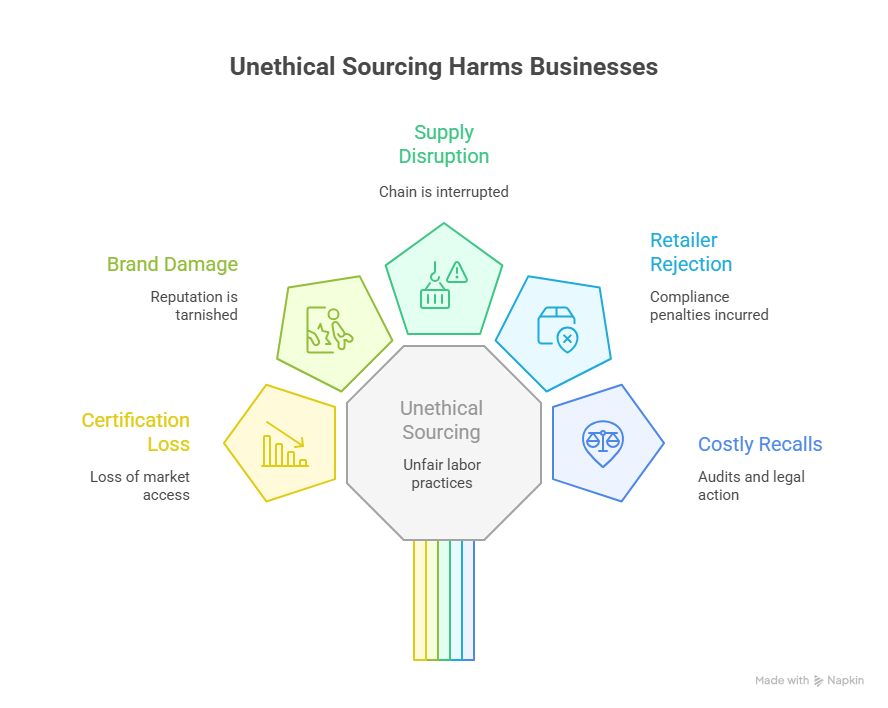
Spice brands increasingly face consumer demand for transparency, ethical sourcing, and sustainability. Certifications are a key way to communicate credibility, attract conscientious buyers, and open new market opportunities.
Organic certification ensures spices are grown without synthetic pesticides, herbicides, or GMOs. It also mandates sustainable farming practices that maintain soil fertility and biodiversity.
Requirements:
Who needs it:
Fairtrade ensures farmers receive fair prices, decent working conditions, and social premiums for community development.
Requirements:
Who needs it:
Rainforest Alliance certification focuses on biodiversity, ecosystem protection, and socially responsible farming practices. It often overlaps with environmental sustainability and climate-smart agriculture.
Requirements:
Who needs it:
Certification guarantees that the spice is free from genetically modified organisms (GMOs).
Requirements:
Who needs it:
UEBT certification verifies that companies source ingredients in ways that respect biodiversity and promote sustainable livelihoods.
Requirements:
Who needs it:
FSMA is a US food safety law ensuring safe processing, handling, and transportation of food products. While not a sustainability certification per se, it is critical for market access.
Requirements:
Who needs it:
Self-audit frameworks allow spice brands to evaluate their supply chain for labor, environmental, and ethical practices, often in preparation for formal certification.
Requirements:
Who needs it:
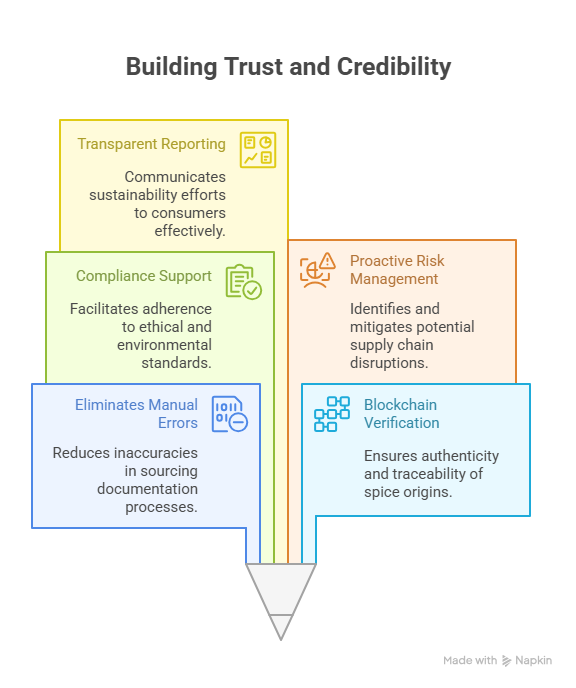
Sourcing spices ethically and sustainably is increasingly complex, requiring visibility across fragmented supply chains, remote farms, and global exporters. Traditional manual methods struggle to meet the transparency and compliance needs of today’s buyers. TraceX Sustainability solutions are transforming ethical spice sourcing by integrating digital traceability, AI, and satellite monitoring.
Manual record-keeping and paper-based systems have been the standard for decades, but they introduce significant gaps in traceability and risk management. Key challenges include:
Indian Products Private Limited (IPPL), a major entity under the Jayanti Group, is a leading spice processor known for its premium-quality pepper, cumin, chili, garlic, and turmeric. To uphold its commitment to authenticity, sustainability, and ethical sourcing, Jayanti Spices invested heavily in backward integration—working directly with farmers to ensure responsible practices from farm to fork.
By adopting TraceX’s Sustainable Sourcing Platform, Jayanti Spices gained end-to-end visibility across their supply chain. The platform enabled real-time traceability, digital documentation, farm-level monitoring, and sustainability insights, empowering Jayanti to maintain transparency, verify origin, and confidently meet global compliance standards. TraceX helped transform their traditional supply chain into a fully traceable, ethically aligned, and future-ready sourcing ecosystem.
Read the full case study to uncover the results, learnings, and transformation journey.
TraceX Sustainability Platform provides a digital-first solution to these challenges by connecting all stakeholders on a unified, cloud-based platform. Its features drive transparency, compliance, and actionable insights across the spice supply chain:
In today’s spice market, ethical sourcing is no longer just a compliance checkbox it’s a key differentiator. Brands that invest in transparency, sustainability, and traceable supply chains gain consumer trust, premium pricing power, and stronger retailer partnerships. Leveraging technologies from TraceX to digitize audits, track provenance, and monitor ESG risks transforms ethical sourcing from a cost center into a strategic advantage, ensuring your brand stands out in a crowded, conscientious marketplace. Ethical practices now directly translate into reputation, revenue, and resilience making sustainability a true competitive edge.
Understand what each certification means—and why it matters for your brand.
Explore the Top Sustainability Certifications Farmers Trust →
See how biodiversity, fairness, and traceability come together in one standard.
Learn Why UEBT Is Becoming a Global Benchmark for Ethical Sourcing →
Learn how to reduce risk, strengthen compliance, and build trust.
Read the Guide to Responsible Sourcing From Farm to Shelf →
Check for valid certification documents (Organic, Fairtrade, Rainforest Alliance, UEBT), confirm the farm or supplier’s certification ID with the issuing body, and use digital traceability platforms that provide batch-level proof of origin and audit trails.
Ensure all certifications, audit reports, and compliance documents are up-to-date, standardized, and digitally stored. Use a centralized traceability system that auto-flags missing paperwork and generates export-ready documentation.
Use a digital traceability or blockchain platform from TraceX that provides instant, tamper-proof origin data for each batch. Scanning a QR code or pulling a batch record delivers immediate verification from farm to packaging.