
Quick summary: A practical guide to EU Battery Regulation 2023/1542 and Digital Battery Passport implementation. Learn compliance timelines, key requirements, and how manufacturers can prepare for 2026–2027 mandates.

The clock is ticking. Under the EU Battery Regulation 2023/1542, manufacturers placing batteries on the EU market must meet strict new requirements, from carbon footprint reporting and supply chain due diligence to implementing a mandatory Digital Battery Passport.
For many, the challenge isn’t awareness; it’s execution. Fragmented supplier data, limited raw material traceability, unprepared IT systems, and unclear carbon calculation methods are slowing progress.
Compliance is no longer just a legal task. The EU Battery Regulation demands a cross-functional transformation across procurement, sustainability, IT, and operations. Manufacturers must act now to build a scalable, audit-ready Digital Battery Passport before enforcement deadlines arrive. TraceX DPP Solutions enables this transition with an integrated, compliance-ready platform that centralizes carbon data, supplier due diligence, and QR-linked lifecycle traceability across the battery value chain.
The EU Battery Regulation 2023/1542 is an EU law that replaces the 2006 directive and introduces mandatory sustainability, carbon footprint reporting, due diligence, and a Digital Battery Passport for EV and industrial batteries, with phased compliance between 2024 and 2027.
The regulation supports the EU Green Deal and circular economy objectives by ensuring batteries:
With battery demand accelerating due to electric mobility and energy storage growth, the EU aims to reduce environmental and social risks linked to lithium, cobalt, and nickel supply chains.
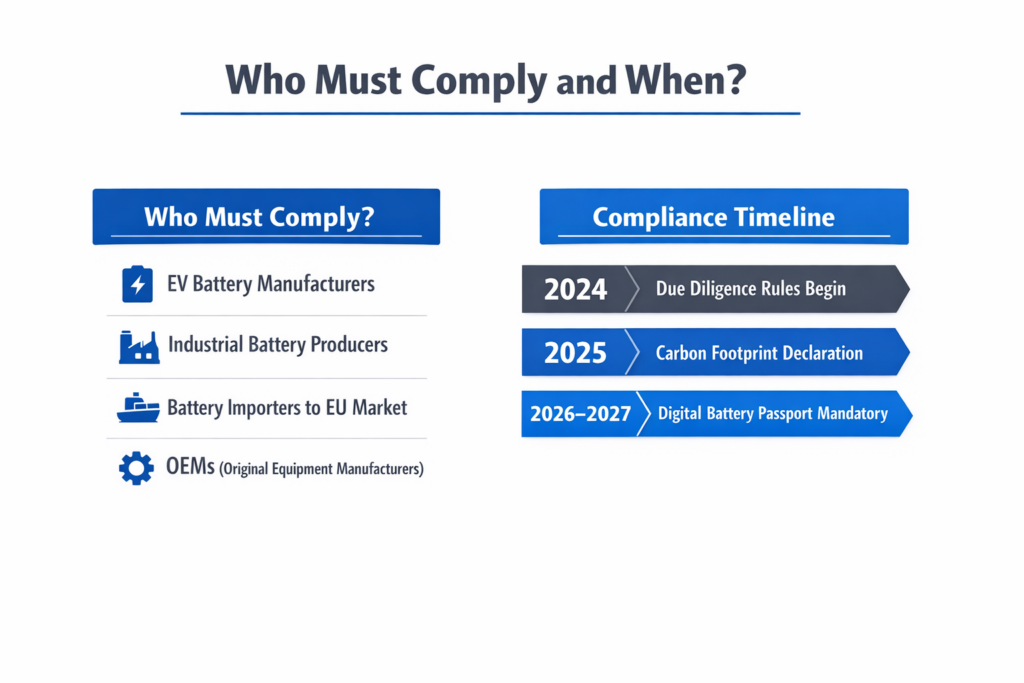
The regulation applies to batteries placed on the EU market, including:
However, the most stringent requirements—including the Digital Battery Passport—apply specifically to:
Manufacturers, importers, distributors, and authorized representatives placing these batteries on the EU market must comply.
Want a deeper breakdown of Battery Digital Passport requirements, compliance timelines, and real-world implementation steps?
Read Our Complete Guide to Battery Digital Battery Passport
Building your Digital Battery Passport? Start with the right infrastructure.
Read Our Guide to Digital Battery Passport Architecture
Key Requirements Manufacturers Must Meet
1. Lifecycle Transparency & Traceability
Manufacturers must ensure batteries can be tracked from raw material extraction through production, use, and end-of-life recycling. This includes:
Companies must implement supply chain due diligence policies aligned with international responsible sourcing standards. This includes:
EV and industrial battery manufacturers must:
Carbon footprint declarations become mandatory before performance class labelling and maximum carbon limits are introduced.
A Digital Battery Passport will be required for EV batteries and Industrial batteries above 2 kWh. The passport will store structured data including:
Each battery will be linked to a unique electronic record accessible via QR code.
The EU Battery Regulation follows a structured rollout:
Unlike the previous directive, the EU Battery Regulation 2023/1542 is:
For manufacturers, this is not simply a reporting update—it is an operational transformation requiring cross-functional coordination across procurement, sustainability, IT, and compliance teams.
A Digital Battery Passport is a structured digital record required under EU law that stores sustainability, carbon footprint, sourcing, technical performance, and lifecycle data for each battery placed on the EU market. It enables regulators, manufacturers, recyclers, and consumers to access standardized battery information through a secure digital system.
The Digital Battery Passport is a core requirement of EU Battery Regulation 2023/1542. Its purpose is to ensure:
Instead of static compliance documents, the passport creates a live, traceable digital identity for each qualifying battery.
The Digital Battery Passport will be mandatory for:
The Digital Battery Passport is not just a reporting tool. It requires:
Under the EU Battery Regulation 2023/1542, compliance is not limited to documentation. Manufacturers must establish structured systems, verified methodologies, and auditable data flows across the entire battery lifecycle.
Here’s what that means in practical terms:
One of the most immediate and technically demanding requirements is product-level carbon footprint reporting.
Manufacturers must:
This is not a company-wide sustainability report it is a battery model–specific calculation.
Carbon footprint declarations must be independently verified before batteries are placed on the EU market.
This requires:
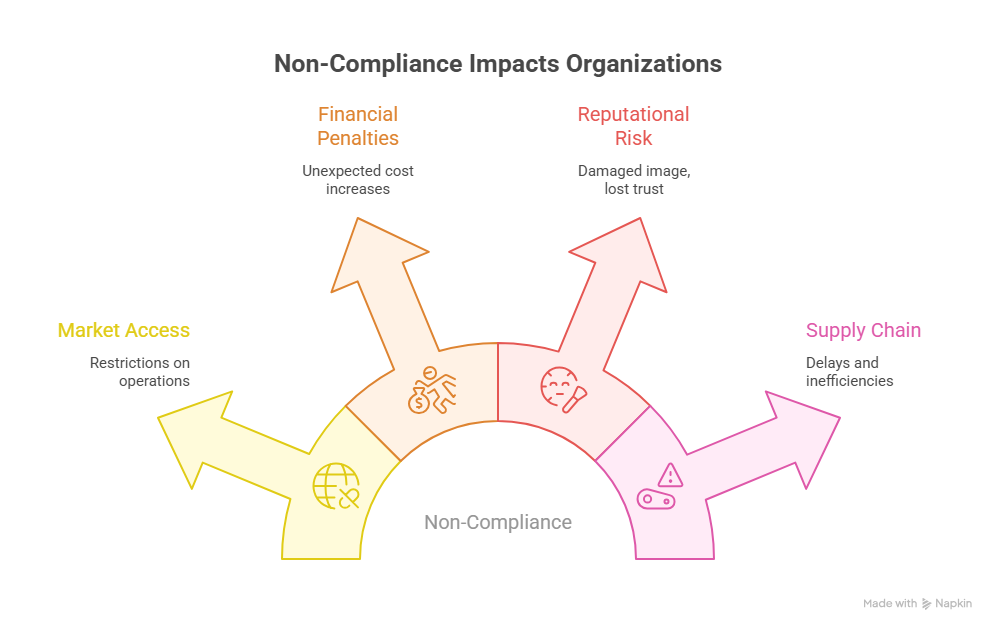
Over time, the EU will introduce carbon performance classes and maximum thresholds, meaning high-emission batteries could face market restrictions.
Manufacturers must implement supply chain due diligence policies, particularly for high-risk raw materials such as:
The goal is to reduce environmental harm and human rights risks associated with mining and processing.
This requires:
Simply relying on supplier declarations will not be sufficient. Companies must demonstrate active risk management and verification.
To support sustainability and circular economy goals, manufacturers must provide structured technical data related to:
This data supports:
The information must be digitally accessible, particularly for batteries requiring a Digital Battery Passport.
The regulation strengthens circular economy requirements by mandating detailed information about:
Manufacturers will also face minimum recycled content targets for certain materials in future phases.
This means companies must coordinate with:
End-of-life is no longer an afterthought it is a compliance obligation embedded in product design and data systems.
Together, these four pillars require manufacturers to move from fragmented compliance processes to:
The EU Battery Regulation effectively transforms battery compliance into a data infrastructure challenge not just a legal one.
Ready to implement a compliant Digital Battery Passport?
Discover how our DPP platform enables secure data integration, carbon reporting, and audit-ready traceability across your entire battery value chain.
Explore Our Digital Battery Passport Solutions
Implementing the requirements of EU Battery Regulation 2023/1542 particularly the Digital Battery Passport is not just a compliance exercise. It exposes operational, technical, and governance gaps across the organization.
Here are the most common challenges manufacturers face and how to address them strategically.
The Problem
Battery supply chains are global and multi-tiered. Data related to raw materials (lithium, cobalt, nickel), emissions, and ESG risks often sits:
This makes carbon footprint calculations and due diligence verification extremely difficult.
The Problem
Product-level carbon footprint calculation requires:
Many manufacturers rely on high-level corporate emissions data which is insufficient for battery-specific reporting.
Additionally, inconsistencies in supplier-provided emissions data can undermine calculation accuracy and audit readiness.
The Problem
Although the regulation is directly applicable across EU member states, manufacturers operating globally face complexity such as:
This creates uncertainty about responsibility, reporting boundaries, and documentation standards.
The Problem
Most manufacturers’ IT systems were not designed for:
Data often resides across:
Without integration, compliance becomes manual, risky, and inefficient.
Most compliance delays are not caused by regulatory misunderstanding they are caused by data fragmentation, governance gaps, and digital immaturity.
Manufacturers that approach implementation as a structured transformation integrating sustainability, IT, procurement, and compliance will move from reactive compliance to long-term competitive advantage.
Implementing a compliant Digital Battery Passport under EU Battery Regulation 2023/1542 requires more than a database. It demands a secure, interoperable, and scalable digital architecture capable of managing lifecycle, carbon, and due diligence data at product level.
Below are the core architectural considerations manufacturers must evaluate.
The Core Question: Should the Digital Battery Passport run on a blockchain-based architecture or a centralized cloud system?
Blockchain-Based Architecture
Advantages:
Challenges:
Blockchain is particularly useful where multi-party trust and tamper-proof verification are critical.
Centralized Cloud Architecture
Advantages:
Challenges:
For many manufacturers, a hybrid model (centralized infrastructure with cryptographic verification layers) offers a practical balance between performance and compliance.
The Digital Battery Passport must support secure and standardized data sharing across:
This requires:
Manual document exchange will not meet long-term regulatory expectations. The system must enable automated, structured, and auditable data exchange.
Battery supply chains are multi-system environments. The Digital Battery Passport must integrate with:
Interoperability ensures:
The architecture should follow open standards to avoid vendor lock-in and ensure future adaptability as EU delegated acts refine technical requirements.
Given the regulatory sensitivity of lifecycle and due diligence data, manufacturers must consider:
Failure to align infrastructure with EU data governance standards could expose companies to legal and reputational risk.
TraceX DPP Solutions provides a scalable, compliance-ready Digital Battery Passport infrastructure designed specifically for manufacturers navigating EU Battery Regulation 2023/1542.
The platform integrates directly with existing ERP, PLM, and supplier systems, enabling structured carbon footprint calculations, automated due diligence documentation, and secure QR-linked digital records at battery level.
Rather than forcing companies into rigid blockchain-only models, TraceX offers a flexible architecture that supports centralized, distributed, or hybrid deployments ensuring interoperability, EU-compliant hosting, and audit-ready traceability across the entire battery value chain.
This allows manufacturers to move from fragmented compliance processes to a unified digital ecosystem that supports both regulatory readiness and long-term ESG strategy.
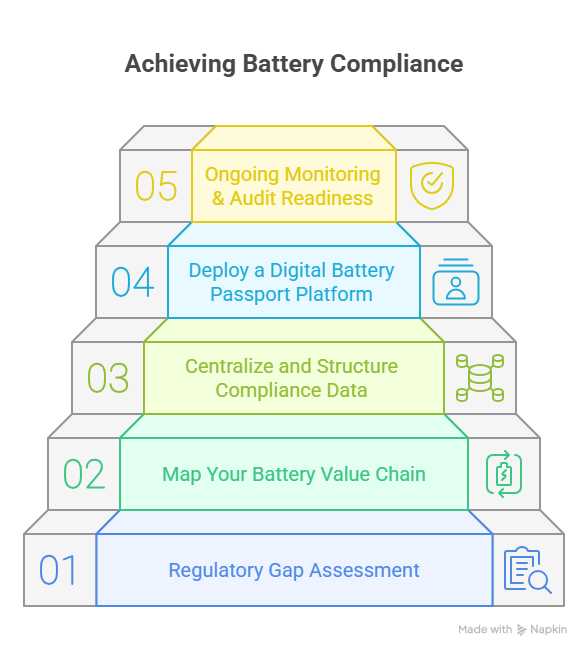
Turning Regulation into Competitive Advantage
The shift from EU Battery Regulation 2023/1542 to a fully operational Digital Battery Passport marks a structural transformation for battery manufacturers. Compliance is no longer limited to documentation it demands lifecycle transparency, verified carbon data, supply chain due diligence, and interoperable digital infrastructure.
Manufacturers that act early can move beyond reactive compliance and build scalable systems that enhance ESG credibility, strengthen supplier accountability, and unlock long-term competitive advantage in the EU market. The key is to treat Digital Battery Passport implementation as a strategic data and governance initiative not just a regulatory obligation.
Your Digital Product Passport is only as strong as the infrastructure behind it.
Explore the Complete DPP Technology Stack Guide
Learn how the Ecodesign for Sustainable Products Regulation (ESPR) expands Digital Product Passport requirements across industries.
Read Our ESPR & DPP Explained Guide
Learn how interoperability ensures seamless data exchange across suppliers, OEMs, and regulators.
Explore the DPP Interoperability Guide
EU Battery Regulation 2023/1542 is an EU law that mandates sustainability, carbon footprint reporting, supply chain due diligence, and Digital Battery Passports for certain batteries placed on the EU market.
The Digital Battery Passport becomes mandatory in 2026–2027 for EV batteries and rechargeable industrial batteries above 2 kWh.
EV battery manufacturers, industrial battery producers (above 2 kWh), importers, and OEMs placing regulated batteries on the EU market.
Using a product-level Life Cycle Assessment (LCA) covering emissions from raw material extraction to end-of-life, verified by a third party.
They may face market access restrictions, fines, product withdrawal, and reputational damage.









