
EU Green Deal Regulations Explained: What Businesses Must Do Now

Published
, 15 minute read

Quick summary: Discover the EU Green Deal regulations and what they mean for businesses. Learn about ESPR, DPP, ETS, compliance challenges, and practical steps to achieve sustainability and regulatory readiness.

The EU Green Deal regulations are a series of interconnected legal instruments, such as the Ecodesign for Sustainable Products Regulation (ESPR), the Digital Product Passport (DPP), and the Emissions Trading System (ETS) designed to force systemic change toward resource efficiency and decarbonization. They matter now because they create non-negotiable market access requirements. Non-compliant goods, whether manufactured inside or outside the EU, risk being barred from the EU market, subjecting companies to significant fines, and jeopardizing their brand reputation. This shift impacts every manufacturer, exporter, brand owner, and sustainability leader selling physical goods or services within the EU. 

The European Green Deal (EGD) is the EU’s flagship strategy to achieve climate neutrality by 2050. However, for businesses worldwide, it is much more immediate: it is a fast-approaching set of mandatory, enforceable rules that are fundamentally redefining global supply chains. 

The years 2024 to 2027 mark a crucial compliance turning point. The frameworks are now in place, and the specific sector-by-sector rules are rolling out, making regulatory readiness an urgent necessity. 

Key Takeaways 

  • A set of policies aimed at making the EU climate-neutral by 2050, covering emissions reduction, circular economy, energy efficiency, and sustainable product standards 
  • Sets requirements for products to be energy- and resource-efficient, durable, repairable, and recyclable. Expands traditional ecodesign rules to a wider range of goods. 
  • A digital record containing product information on materials, origin, repairability, and recyclability. Serves as the backbone for ESPR compliance and circular economy monitoring. 
  • A market-based mechanism that caps carbon emissions for industries. Companies must monitor, report, and trade allowances, directly impacting cost structures for manufacturing and energy-intensive sectors. 
  • Regulations covering sustainable batteries, packaging, energy labeling, and waste reduction. Companies must track evolving delegated acts to remain compliant. 
  • ESPR, DPP, and ETS collectively promote sustainability, transparency, and circularity in production and supply chains, creating a compliance ecosystem under the Green Deal. 
  • Companies face mandatory reporting, traceability, eco-design requirements, and emissions management. Non-compliance risks fines, restricted market access, and reputational damage. 
  • Key compliance challenges include managing complex supply chain data, integrating sustainability metrics, tracking product lifecycles and emissions, and keeping up with evolving regulations. 
  • Digital tools centralize data, automate reporting, track product materials, lifecycle impacts, and emissions, and ensure transparency for audits and inspections. 
  • TraceX provides end-to-end digital traceability, product passports, emissions tracking, and compliance reporting, helping companies meet ESPR, DPP, ETS, and broader Green Deal requirements efficiently. 

What Are the EU Green Deal Regulations?  

The European Green Deal is the EU’s commitment to making the European economy sustainable, transforming climate and environmental challenges into opportunities.6 

The EGD is essentially a blueprint for a transition to a circular, climate-neutral economy. It mandates reducing reliance on virgin resources, increasing the lifespan of products, and establishing an effective price on carbon emissions. 

How regulations translate climate goals into enforceable laws 

The EGD itself is a strategy, but its goals are enforced through binding legal acts: 

  • Regulations: Directly enforceable in all EU member states without national legislation (e.g., ESPR, EUDR). 
  • Directives: Require member states to achieve a certain result but allow them to choose how (e.g., Waste Framework Directive). 
  • Delegated Acts: Specific rules issued by the European Commission that define technical details, such as the exact data required for the DPP in the textiles sector. These are where the true, granular compliance requirements are defined. 

What is Ecodesign for Sustainable Products Regulation (ESPR) 

The ESPR is the foundational legal pillar that governs how physical goods are designed, manufactured, and managed at their end-of-life. 

The Ecodesign for Sustainable Products Regulation (ESPR) is the core EU law replacing the previous Ecodesign Directive. It grants the European Commission power to set mandatory requirements across nearly all physical products sold in the EU to make them more durable, reusable, and less environmentally harmful. 

How ESPR replaces the old Ecodesign Directive 

The previous directive focused mainly on the energy efficiency of a limited set of products (like appliances). The ESPR expands the scope to almost all physical goods and introduces new requirements centred on circularity and information transparency, not just energy. 

Key ESPR Requirements 

The ESPR introduces mandatory performance standards that ban wasteful and unsustainable practices: 

  • Durability, Reparability, and Recyclability: Products must be designed for longevity and easy disassembly. 
  • Ban on Planned Obsolescence: Practices that deliberately limit a product’s lifespan (e.g., non-removable batteries, software restrictions on repairs) will be prohibited. 
  • Mandatory Sustainability Information: Companies must provide verifiable data on a product’s sustainability attributes, which is delivered via the DPP. 

Who Must Comply 

The reach of the ESPR is global: 

  • EU Manufacturers: Companies producing goods within the European Economic Area. 
  • Non-EU Exporters Selling into the EU: Any company placing a regulated product on the EU market, regardless of where it was manufactured. 

What is the Digital Product Passport (DPP): The Backbone of Compliance 

The DPP is the digital tool designed by the EU to enforce the physical requirements set by the ESPR. It transforms physical products into data sources. 

What Is a Digital Product Passport? 

The DPP is a single source of verified, structured product lifecycle data accessible via a data carrier (like a QR code or NFC tag) attached to the product or its packaging. It acts as the product’s digital twin, recording its history from raw material sourcing to end-of-life. 

What Data Goes Into a DPP 

While the exact fields depend on the sector-specific Delegated Act, the DPP typically contains information across four core pillars:18 

  • Materials & Sourcing: Chemical composition, recycled content percentage, and origin verification (crucial for due diligence laws). 
  • Carbon Footprint: Product-level carbon intensity (often verified via LCA). 
  • Repair, Reuse, Recycling Info: Availability of spare parts, repair scores, and precise instructions for disassembly and automated sorting. 
  • Compliance & Certifications: Unique product identifier, manufacturing details, and proof of conformity with all EU regulations.  

Why DPP Is Critical for ESPR & Future Regulations 

The DPP is mandatory because it provides the auditable proof required by regulators: 

  • Link to Traceability: It forces companies to achieve end-to-end supply chain visibility to collect the required granular data. 
  • Audits and Market Access: Market surveillance authorities will use the DPP to instantly check compliance. Non-compliant products will be denied market entry. 

What is the EU Emissions Trading System (ETS) & Industrial Impact 

While the ESPR focuses on product design, the ETS tackles the financial cost of emissions. 

What Is ETS? 

The EU Emissions Trading System (ETS) is the world’s largest carbon market. It works on a cap-and-trade principle, placing a cap on the total amount of greenhouse gases that can be emitted by sectors like power generation, heavy industry, and aviation. Companies receive or buy emissions allowances, and must surrender enough allowances to cover all their verified emissions. 

Why ETS Matters Beyond Energy 

  • Indirect Impact on Supply Chains: As energy providers and key industrial suppliers (cement, aluminum, steel) face rising ETS costs, these costs are passed down the supply chain, increasing the price of material inputs for manufacturers. 
  • Carbon Cost Transparency: It forces companies to track their carbon footprint diligently to understand and mitigate these rising costs. 
  • Alignment with CBAM & Scope 3: The ETS directly aligns with the Carbon Border Adjustment Mechanism (CBAM), which places a comparable carbon price on imports to prevent “carbon leakage.” This focus elevates the importance of tracking Scope 3 emissions (emissions from purchased goods), which are impacted by the ETS. 

Other Key Green Deal Delegated Acts to Watch 

The devil is in the details, and the details are being published via Delegated Acts. 

Delegated Acts are where the European Commission defines the sector-specific, legally binding criteria. The speed and complexity of their rollout increase compliance risk. 

  • Product-Specific ESPR Rules: These will define durability and reparability scores for high-impact groups, such as consumer electronics. 
  • Sectoral DPP Rollouts: Mandatory data requirements for specific sectors: 
  • Batteries: Mandatory by January 2026. 
  • Textiles: Expected 2027. 
  • Electronics/ICT: Expected 2027-2028. 
  • Waste & Circularity-Related Acts: New rules on packaging, waste shipments, and the mandatory use of recycled content. 

Why delegated acts increase compliance complexity 

Companies must monitor multiple, simultaneous legislative streams. A firm selling electronics must track the ESPR (for reparability), the DPP (for data reporting), and potentially the Waste Directive (for packaging), all simultaneously. 
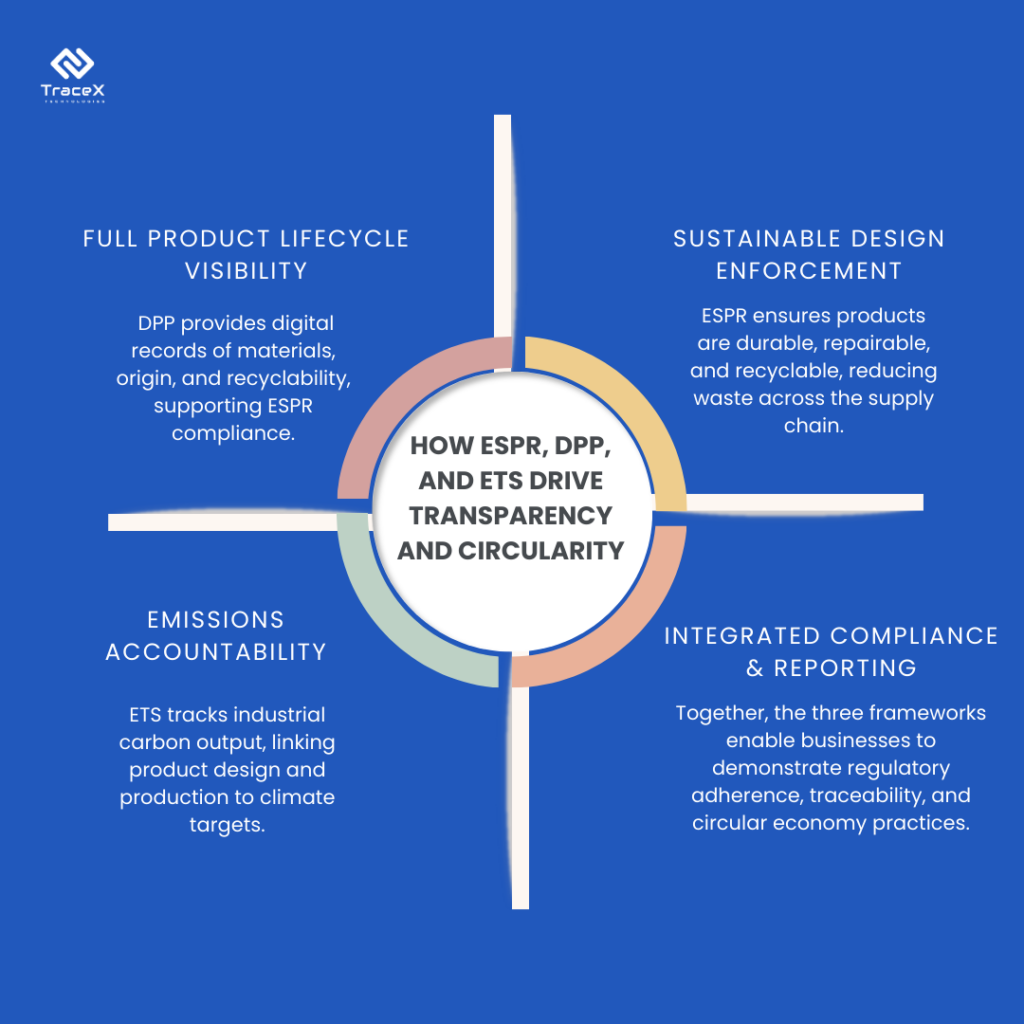
How are these Regulations Connected?

The Green Deal acts form a unified, circular compliance loop. They must be managed as one interconnected system. 

  • ESPR → Sets Product Rules: Mandates physical design changes (durability, reparability). 
  • DPP → Enables Data & Proof: Provides the digital mechanism to capture, verify, and share the data required by ESPR. 
  • ETS → Prices Emissions: Puts a financial cost on carbon, indirectly driving manufacturers toward less carbon-intensive materials and supply chains. 
  • Delegated Acts → Enforce at Sector Level: Translates the broad goals of ESPR into specific, technical, legally binding requirements for textiles, batteries, and other product groups. 

What EU Green Deal Regulations Mean for Businesses 

The implications vary slightly for EU and non-EU companies, but the need for digital data is universal. 

For EU Companies 

  • Product Redesign: Mandatory shift toward circular design principles to meet new ESPR standards. 
  • Lifecycle Reporting: Immediate investment in systems to track and calculate a product’s environmental impact across its entire lifespan. 
  • Supplier Data Collection: Pushing traceability requirements deep into the supply chain to gather the raw material data needed for the DPP. 

For Non-EU Exporters 

  • Traceability Expectations: Must provide the same plot-level or batch-level material traceability data as an EU producer. 
  • Digital Compliance Requirements: Must adopt systems capable of generating a standardized DPP format that links to the EU digital registry. 
  • Risk of Market Exclusion: Non-compliance means their products cannot legally be sold in the EU, effectively locking them out of one of the world’s largest consumer markets. 

What are the Common Compliance Challenges Companies Face 

As regulations shift from document-based compliance to lifecycle-driven, data-intensive requirements, many companies struggle to adapt their operating models. The most common challenges stem from fragmented data, limited traceability, and manual processes that cannot scale to meet modern regulatory expectations. 

Fragmented Supplier Data Across Tiers 

Supplier data is often dispersed across multiple systems, formats, and intermediaries, especially beyond Tier-1 suppliers. This fragmentation makes it difficult to establish a verified chain-of-custody, trace material origin, or demonstrate supplier-level compliance key requirements under regulations such as the Digital Product Passport (DPP), EUDR, and CSRD. 

Lack of Material-Level Traceability 

Most legacy systems focus on tracking finished products rather than the raw materials and inputs that go into them. As a result, companies cannot link specific material batches such as ethically sourced minerals, recycled content, or bio-based inputs to final products, creating blind spots in sustainability, legality, and risk assessments. 

Manual and Paper-Based Compliance Processes 

Spreadsheets, emails, and static documentation are no longer viable for managing the volume, frequency, and granularity of data required by EU regulations. Manual processes increase the risk of errors, inconsistencies, and audit failures, while significantly raising compliance costs and slowing time to market. 

Inconsistent and Unverifiable Sustainability Reporting 

Without a unified, verifiable data foundation, sustainability disclosures often rely on estimates, averages, or supplier self-declarations. This exposes companies to greenwashing risks, regulatory scrutiny, and reputational damage, as EU authorities increasingly demand auditable, data-backed sustainability claims. 

Together, these challenges highlight why companies must move toward integrated digital compliance platforms that enable end-to-end traceability, automated data validation, and consistent reporting across products, materials, and supply chains. 

How Digital Platforms Enable Green Deal Compliance 

The EU Green Deal introduces a dense web of interlinked regulations ESPR, Digital Product Passports (DPP), ETS, CSRD, and multiple delegated acts that cannot be managed through manual or siloed systems. Digital platforms are becoming the backbone of scalable, cost-effective compliance. 

Traceability, Automation, and Data Interoperability 

Modern compliance platforms integrate data from internal systems such as ERP, PLM, and MES, as well as external supplier databases, certifications, and geospatial sources. Automated workflows standardize, validate, and structure this data in real time. Blockchain or similar immutable ledgers are often used to ensure data integrity, provenance, and auditability critical for DPP and regulatory verification. 

Connecting ESPR, DPP, ETS, and Reporting Systems 

A unified digital platform acts as a single source of truth across regulations. Material composition and lifecycle data captured for the Digital Product Passport under ESPR can be reused for Scope 3 emissions calculations aligned with ETS and fed directly into CSRD sustainability disclosures. This interoperability eliminates duplicate data collection and ensures regulatory consistency. 

Reducing Compliance Cost and Audit Risk 

Automation significantly lowers compliance costs by replacing manual data gathering, spreadsheet reconciliation, and fragmented audits. Real-time, verified data reduces the risk of inconsistencies, regulatory penalties, and delayed market access. For both EU and non-EU businesses, digital platforms turn Green Deal compliance from a reactive obligation into a streamlined, auditable, and future-ready operational capability. 

How TraceX Supports ESPR, DPP & Green Deal Readiness 

TraceX solutions provide the end-to-end digital infrastructure necessary to navigate the compliance maze and unlock the value of the Green Deal. 

  • End-to-End Product & Material Traceability: We offer the crucial ability to map not just the final product, but the raw material inputs (material traceability) required for EUDR and DPP data fields. 
  • Digital Product Passport Enablement: Our platform automatically structures verified supply chain data into the standardized, audit-ready format required by the European Commission for various sectoral DPP rollouts. 
  • Supplier Mapping & Verified Data: We provide tools to digitally onboard and gather standardized, time-stamped data from multi-tier suppliers, establishing an immutable Chain-of-Custody (often leveraging blockchain).42 
  • Audit-Ready Compliance Workflows: Our system centralizes all necessary certificates, material flow records, and lifecycle data, drastically simplifying compliance reporting and reducing audit risk.

Assess Your ESPR & DPP Readiness

Book a Strategy Call with us »

From Regulation to Competitive Advantage 

The EU Green Deal is the most significant regulatory wave in decades, transforming compliance from a passive annual report into a constant, digital operational requirement. Companies that wait for mandatory deadlines (2026-2028) will face massive implementation backlogs and system integration challenges. 

The EU Green Deal is transforming compliance from a passive annual report into a constant, digital operational requirement. Companies that wait for mandatory deadlines (2026–2028) will face massive implementation backlogs.

Early adopters are using a digital product passport today to optimize circular design, secure green financing, and build unrivaled brand trust. The EU Green Deal is not just a regulatory burden; it is a growth and trust lever. It forces businesses to build resilient, transparent supply chains that modern consumers and investors demand.

Start your digital traceability assessment now. Ensure your products have the digital passport required for market access before the new rules slam the door shut. 

Explore Digital Transformation for Sustainability
Discover how digital tools are helping businesses achieve sustainability goals while boosting efficiency. 

[Read our blog →] 

Unlock the Power of Product Traceability 
Learn how end-to-end product traceability ensures compliance, reduces risk, and builds buyer trust.  

[Read our blog →] 

Master Material Traceability in Supply Chains 
See how tracking materials from source to shelf can enhance transparency, sustainability, and operational control. 

[Read our blog →]

Frequently Asked Questions (FAQ’s)


What are the key EU Green Deal regulations affecting businesses?

The Green Deal includes ESPR (Ecodesign for Sustainable Products Regulation), Digital Product Passports (DPP), the EU Emissions Trading System (ETS), and other delegated acts targeting sustainability, circularity, and emissions reduction.

How can businesses comply with ESPR and DPP requirements? 

Companies must track product materials, lifecycle impacts, repairability, recyclability, and maintain digital records via tools like digital product passports to demonstrate compliance.

What challenges do companies face under the EU Green Deal? 

Common hurdles include managing complex supply chain data, integrating sustainability metrics into operations, tracking emissions accurately, and adapting to evolving regulations.


Start using TraceX
Transparency, Trust, & Success for your Climate Journey.
Get the demo

Get your free trial

Request for a Demo Session

Download your EU Green Deal Regulations Explained: What Businesses Must Do Now here

Download your EU Green Deal Regulations Explained: What Businesses Must Do Now here

Download your EU Green Deal Regulations Explained: What Businesses Must Do Now here

[hubspot type=form portal=8343454 id=304874ea-d4e0-4653-9825-707360746edb]
[hubspot type=form portal=8343454 id=b8321ac0-687a-4075-8035-ce57dd47662a]
food traceability, food supply chain, blockchain traceability, agriculture traceability software

Is Your Supply Chain Audit-Ready for 2026?

Get the free TraceX Playbook — 10 traceability failures to fix before your next audit, a 10-point maturity scorecard.

Grab your Free Trial now

Ensure your supply chain is EUDR-ready with TraceX.

Don’t miss out on your chance to grab access to our early bird offer!

food traceability, food supply chain

Are you EUDR Due-Diligence Ready?

Your essential compliance guide

food traceability, food supply chain

Please leave your details with us and we will connect with you for relevant positions.

[hubspot type=form portal=8343454 id=e6eb5c02-8b9e-4194-85cc-7fe3f41fe0f4]
food traceability, food supply chain

Please fill the form for all Media Enquiries, we will contact you shortly.

[hubspot type=form portal=8343454 id=a77c8d9d-0f99-4aba-9ea6-3b5c5d2f53dd]
food traceability, food supply chain

Kindly fill the form and our Partnership team will get in touch with you!

[hubspot type=form portal=8343454 id=b8cad09c-2e22-404d-acd4-659b965205ec]