
Quick summary: The EU's PPWR & ESPR regulations are making sustainable packaging mandatory. Here's what agri-food companies must do and how TraceX automates compliance.

The EU packaging sustainability regulations is being mandated through the Packaging and Packaging Waste Regulation (PPWR) and Ecodesign for Sustainable Products Regulation (ESPR) because packaging waste generated by EU member states exceeded 84 million tonnes in 2022 a 6% rise in just two years. These regulations require all packaging placed on the EU market to be recyclable by 2030, embed verified environmental data in Digital Product Passports, and meet minimum recycled content thresholds. For agri-food exporters and food & beverage brands, non-compliance means market access loss, not just fines.
| Key Takeaways The EU’s new Packaging and Packaging Waste Regulation (PPWR) mandates recyclability, recycled content minimums, and waste reduction targets for all packaging placed on the EU market with enforcement rolling from 2025–2030. ESPR Digital Product Passports (DPPs) will require agri-food brands to embed verified sustainability data ingredients, carbon footprint, recyclability directly into product packaging by 2027. Companies that treat PPWR, ESPR, EUDR, and CSRD as separate silos risk duplicate compliance costs and audit failures a unified traceability platform is the most cost-efficient path to readiness. |
When the European Commission published its packaging waste data in late 2023, the number that landed hardest wasn’t the total tonnage. It was this: food and beverage packaging alone accounts for over 40% of all plastic packaging waste in the EU and less than half of it is actually recycled.
That’s the industrial reality that drove the EU to tear up its 1994 Packaging Directive and replace it with something with real teeth. The new Packaging and Packaging Waste Regulation (PPWR) combined with the Ecodesign for Sustainable Products Regulation (ESPR) and its Digital Product Passport (DPP) requirement doesn’t ask companies to try harder. It sets binding targets, mandatory data standards, and a compliance clock that’s already ticking.
If you’re an agri-food exporter, a food & beverage brand, or a sustainability manager inside an FMCG company with EU market exposure, this is the regulation you can’t outsource to a consultant and forget about. Here’s everything you need to know including why siloed compliance approaches will cost you twice.
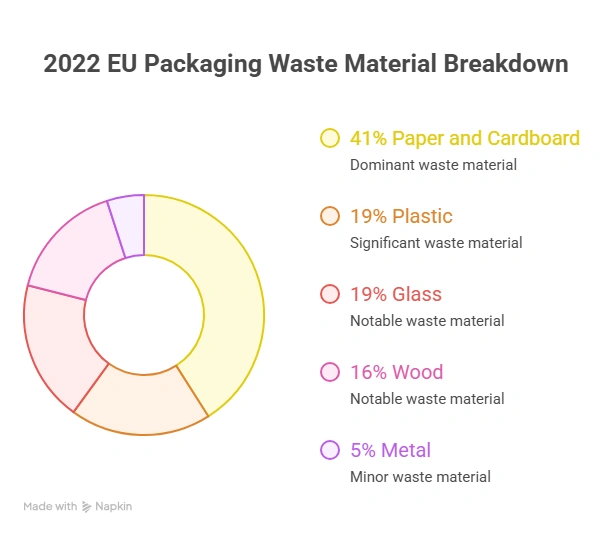
Read the blog to explore the environmental and economic impact driving new regulations.
The PPWR, formally adopted by the European Parliament in 2024, replaces the 1994 Packaging and Packaging Waste Directive. Unlike its predecessor which set targets that member states could implement inconsistently the PPWR is a Regulation, meaning it’s directly applicable law in all 27 EU member states without local transposition.
The scope is deliberately broad: any packaging used for or in connection with a product placed on the EU market is covered. That includes primary packaging (what touches the product), secondary packaging (shipping boxes), and tertiary packaging (pallets). There are no exemptions for small exporters.
Ready to rethink your packaging strategy?
Learn how sustainable packaging can reduce waste, meet regulations, and unlock long-term value.
The EU’s policy reasoning is straightforward: voluntary industry commitments have not moved fast enough. Between 2015 and 2022, EU packaging waste per capita actually increased in most member states. The Green Deal’s target of ‘making sustainable products the norm’ by 2030 can’t be achieved with guidance documents and voluntary pledges. Hard law is the only lever left.
Understand the driving forces behind the EU Packaging and Packaging Waste Regulation (PPWR).
Read the blog to explore why this regulation was introduced and what it aims to solve.
The PPWR imposes obligations across five distinct dimensions. Every food company with EU market exposure needs to understand what each demands operationally not just legally.
All packaging must meet minimum recyclability standards. By 2030, 100% of packaging must be recyclable. By 2035, 70% of that packaging must actually be recycled. This isn’t a design aspiration it’s a market access condition. Packaging that doesn’t meet the recyclability threshold can be banned from the EU market. [CITE: PPWR Article 6, European Commission]
The Regulation sets category-specific minimums for recycled content in plastic packaging. Contact-sensitive plastic packaging (food-grade) must achieve 10% recycled content by 2030, rising to 50% by 2040. Non-contact plastic packaging targets are even more aggressive: 30% by 2030. These targets apply to the entire EU-market product range you can’t cherry-pick packaging SKUs.
The PPWR introduces a ‘minimisation’ principle: packaging must not exceed what is strictly necessary for product protection and safety. By 2030, member states must reduce packaging waste by 5% per capita versus 2018 baselines. For food exporters with complex secondary packaging, this directly impacts cost-per-unit economics and cold-chain logistics design.
Specific packaging categories including beverage containers, transport packaging, and food-service packaging face mandatory reuse targets. By 2030, at least 10% of all beverages must be offered in reusable containers. For many agri-food brands, this requires a full rethink of go-to-market packaging strategy for the EU channel.
All producers placing packaging on the EU market must participate in EPR schemes funding the collection and recycling infrastructure. EPR fees are increasingly linked to recyclability performance: non-recyclable packaging attracts higher levies. For imported goods, this means your EU importer will pass EPR compliance obligations upstream. [CITE: Eurostat, 2024]
See how the EU Packaging and Packaging Waste Regulation (PPWR) tackles packaging waste.
Read the blog to understand the solutions driving reduction, reuse, and recyclability.
If the PPWR tells you what your packaging must achieve, the ESPR tells you how you’ll have to prove it. The Ecodesign for Sustainable Products Regulation which came into force in July 2024 introduces Digital Product Passports (DPPs): machine-readable, verifiable records of a product’s sustainability credentials, embedded in the product via QR code, RFID, or barcode.
For agri-food products, a DPP will need to contain: the product’s material composition and recyclability rating, carbon footprint data per functional unit, supplier chain information traceable to primary production, and end-of-life disposal instructions. The first DPP mandates are expected for textile and electronics products by 2026, with food and beverage categories following in the 2027–2028 window.
Explore how ESPR and Digital Product Passports (DPP) are transforming product transparency and sustainability.
Read the blog to understand what these regulations mean for your business.
Most sustainability and compliance teams instinctively reach for a database or spreadsheet when they hear ‘digital passport.’ That’s the wrong mental model. A DPP isn’t a static document it’s a live data record that must be accurate at the point of sale and auditable by EU market surveillance authorities on demand. That means the underlying supply chain data farm origin, processing inputs, emissions, certification status must be continuously maintained and verified.
TraceX’s ESPR Digital Product Passport module addresses exactly this challenge: it builds DPPs on GS1 standards with blockchain-backed data integrity, drawing verified sourcing data from the Sustainable Sourcing Platform and compliance data from the Regulatory Compliance layer so every QR code on a product pack points to a single, auditable chain of custody. Understand the key requirements of Digital Product Passports (DPP).
Read the blog to learn what data, systems, and processes your business needs to comply.
Of all the sectors affected by the EU’s packaging sustainability wave, agri-food exporters particularly those sourcing from emerging markets carry the steepest compliance burden. Here’s why.
First, the supply chain complexity is unmatched. A single SKU of spiced rice crackers sold in Germany might involve rice sourced from Indian smallholder farmers across four districts, spices traced through three processing intermediaries, and packaging materials sourced from two suppliers in Turkey and Vietnam. Each node in that chain needs to contribute verified data to a DPP.
Second, the data infrastructure at origin is weakest at exactly the point regulators care about most. Farm-level data land coordinates, input usage, deforestation status, carbon intensity is precisely what PPWR life-cycle assessments and ESPR DPPs require, and it’s precisely the data most likely to exist only on paper or in the memory of a field agent.
Third and this is the trap many exporters fall into EU buyers are shifting compliance obligations upstream. Retailers, food manufacturers, and private label brands increasingly require their suppliers to provide verified sustainability data as a condition of contract renewal. Compliance isn’t just a regulatory requirement; it’s a commercial one.
Check how TraceX helps food and agribusiness companies
Here’s the compliance picture most agri-food businesses are currently navigating and why the siloed approach is financially irrational.
| Regulation | Scope | Deadline | Penalty Risk | TraceX Module |
|---|---|---|---|---|
| PPWR | All EU packaging | 2025–2030 | Market ban, fines | Compliance Platform |
| ESPR / DPP | Product categories incl. agri-food | 2027 onwards | Recall, ban | Compliance Platform |
| EUDR | 7 forest-risk commodities | Dec 2025 / Jun 2026 | 4% revenue fine | Compliance Platform |
| CSRD | Large + listed EU co’s | 2025–2026 | Audit failure, reputational | MRV Platform |
| FSMA 204 | Food importers to US | Jan 2026 | Import refusal | Sourcing Platform |
All four of these regulations draw from the same underlying data pool: verified supply chain information from primary producers to final packaging. Yet most companies are running four separate data collection exercises sending different questionnaires to the same suppliers, maintaining four siloed databases, and paying four separate compliance vendors.
The smarter architecture: a single traceability layer that captures farm-to-packaging data once and maps it to PPWR life-cycle requirements, ESPR DPP fields, EUDR due diligence statements, and CSRD Scope 3 disclosures simultaneously.
Understand the true environmental cost of waste.
Read the blog to explore its impact on ecosystems, climate, and natural resources.
Compliance-ready packaging traceability isn’t about bolting on a QR code generator. It requires a connected data architecture that spans farm origination, processing, logistics, and retail. Here’s how it breaks down and where most companies have critical gaps.
| Challenge | Without TraceX | With TraceX |
|---|---|---|
| Supplier data collection | Manual spreadsheets, weeks of back-and-forth emails | Automated onboarding portals; GPS polygon capture in < 48 hrs |
| DPP data assembly | Fragmented across ERP, warehouse, farm records | Single source of truth blockchain-backed, audit-ready |
| EUDR DDS submission | Manual creation, error-prone, high rejection risk | AI auto-generates & submits DDS via TRACES API |
| Carbon footprint data | Industry averages fail CSRD primary data test | Primary supply chain emissions from farm to gate |
| Audit readiness | Weeks to compile documents for inspectors | One-click PDF/XML/CSV export audit in hours |
Whether you’re six months or two years from your first PPWR audit, here’s a practical sequence for building compliance capability:
Check out the TraceX Solutions
Why Packaging Sustainability Is No Longer Optional
Packaging sustainability in the EU has moved beyond voluntary commitments to become a regulatory necessity, driven by rising waste volumes, environmental impact, and the urgent need for a circular economy. Regulations like PPWR are not just policy responses they are structural shifts that require businesses to rethink how packaging is designed, used, and recovered. Companies that fail to adapt risk financial penalties, market restrictions, and reputational damage, while those that act early can unlock efficiency gains, meet consumer expectations, and strengthen their competitive position. In this new landscape, sustainability is not just about compliance it is a core business strategy shaping the future of packaging in Europe.
The PPWR is a EU Regulation (replacing the 1994 Packaging Directive) that mandates all packaging placed on the EU market must be recyclable by 2030, meet minimum recycled content thresholds, and comply with waste reduction and EPR requirements. Unlike a Directive, it applies directly in all 27 member states without local transposition.
PPWR requirements phase in from 2025 to 2040. Key milestones: recyclability labelling required by 2025; minimum recycled content for plastic packaging from 2030; 100% recyclability standard by 2030; higher recycled content targets by 2040. ESPR Digital Product Passport mandates for food categories are expected from 2027.
A Digital Product Passport (DPP) is a machine-readable, verifiable record of a product’s sustainability credentials material composition, carbon footprint, recyclability, and supply chain provenance linked to the physical product via QR code or RFID. All companies placing regulated product categories on the EU market will eventually need DPPs; food and beverage categories are expected in the 2027–2028 rollout.
Yes. The PPWR and ESPR apply to any packaging or product placed on the EU market regardless of where the manufacturer or exporter is based. Exporters in India, Africa, Southeast Asia, and South America who sell to EU buyers or to EU-based importers must ensure their packaging and products meet EU standards before entering the EU market.
While EUDR (EU Deforestation Regulation) covers sourcing of seven forest-risk commodities (not packaging directly), it shares the same underlying data requirement as ESPR DPPs: verified, geolocated supply chain provenance from primary production. Companies that build EUDR-compliant traceability infrastructure simultaneously satisfy a major portion of ESPR DPP data requirements making integrated traceability platforms significantly more cost-efficient than siloed compliance approaches.