Quick summary: Understand how the EU TRACES platform works for EUDR compliance. Learn who must submit DDS, what goes into it, and how tech tools simplify the process.

The EU Deforestation Regulation (EUDR) is no longer on the horizon it is here. For operators and traders dealing in cocoa, coffee, timber, palm oil, soy, rubber, and cattle, the window to prepare is closing fast. Yet the single biggest blind spot for most compliance teams is not traceability, it is EU TRACES NT.
EU TRACES and EUDR compliance often creates friction for companies struggling to align fragmented supplier data, geolocation inputs, and DDS submissions within tight regulatory timelines. TraceX EUDR Solutions simplifies this by digitizing supplier data collection, validating geolocation, and automating DDS-ready workflows, ensuring seamless TRACES integration and audit-ready compliance.
Key Takeaways
| 7 | Dec 30, 2026 | 5 years | 80% |
| Regulated commodity categories under EUDR | Enforcement deadline for large & medium operators | Mandatory DDS record retention period | Compliance time reduction with automation |
REGULATORY UPDATE – April 2026
An amending regulation was published in December 2025, introducing a 12-month delay for large/medium operators (now December 30, 2026) and June 30, 2027 for small and micro operators. However, core DDS obligations geolocation, risk assessment, and TRACES submission remain fully intact. Use this window to build audit-ready systems now, not later.
TRACES Trade Control and Expert System is the European Commission’s centralized digital platform for food, feed, animal, plant, and now commodity compliance. Under EUDR, TRACES NT is the mandatory submission interface for every Due Diligence Statement.
| Term | What It Means |
|---|---|
| Due Diligence Registry | The legal concept the compliance requirement that operators must fulfill under EUDR |
| TRACES NT | The actual technology platform the digital interface your team logs into, integrates with, and submits through |
| DDS Reference Number | The output of a successful TRACES submission without it, your shipment cannot legally enter the EU market |
| DDS Verification Number | Secondary identifier enabling customs authorities to validate your filing in real time |
Understanding this distinction is operational, not academic. TRACES is what your procurement lead, logistics manager, and sustainability officer interact with daily. Get it wrong and you don’t just fail a checklist you stop a shipment.
Must submit a full DDS per shipment including geolocation, risk assessment, and legality proof before placing goods on the EU market. Deadline: December 30, 2026.
Under the 2025 amendment, downstream operators no longer submit separate DDSs but must register in the system and pass DDS reference identifiers to maintain traceability.
Extended deadline to June 2027. Simplified one-time declarations available for micro and small primary operators in low-risk countries but traceability obligations remain.
Indirectly impacted must provide geolocation data, legality documentation, and compliance evidence to EU operators who will file the DDS on their behalf.
A DDS is not a form. It is a legally binding declaration your proof that everything upstream, from farm to port, is deforestation-free and legally sourced. No valid DDS reference number means no legal entry into the EU market. It is that binary.
What Every DDS Must Include (EUDR Annex II)
One missing field a single invalid polygon, an incorrect HS code, or an unsupported geolocation format can trigger a TRACES rejection, blocking your shipment at customs.
Based on patterns across commodity supply chains cocoa cooperatives in West Africa, coffee exporters in Colombia, timber operators across Southeast Asia these are the six most common pain points for operators, exporters, and compliance leads:
Most compliance teams are chasing GPS coordinates, land documents, and certifications across disconnected channels. By the time everything is compiled, data is stale, inconsistent, or incomplete and a single error fails the DDS validation.
Who feels it: Procurement leads, Compliance officers, Sustainability managers
Invalid GeoJSON polygons, CRS mismatches, geometry spikes, and farms that plot in the ocean are more common than operators expect. The TRACES system validates geolocation automatically and rejects filings that fail schema checks. Each rejection = manual rework + shipment risk.
Who feels it: Logistics managers, field data teams, export coordinators
Manually compiling risk scores, batch IDs, supplier declarations, and HS codes into a DDS format that TRACES accepts is a multi-day process. Copy-paste errors, outdated documents, and version mismatches create compliance gaps that surface only during audit or at the customs checkpoint.
Who feels it: Compliance leads, Operations teams, ESG officers
ERP systems hold procurement data. Traceability platforms hold farm data. TRACES holds compliance records. When these systems don’t talk to each other, your team spends hours re-entering data across platforms multiplying the risk of submission errors and audit gaps.
Who feels it: IT teams, Procurement leads, CFOs managing compliance costs
A large percentage of tropical commodities originate from smallholder farmers who lack digital literacy, formal land records, and GPS mapping capability. Onboarding thousands of smallholders with verified plot-level geolocation is operationally complex and a gap here means your DDS cannot be submitted.
Who feels it: Field data teams, Supplier managers, Cooperative coordinators
EUDR requires all DDS filings and supporting documents to be retained for five years and available on-demand for regulatory inspection. Companies storing records across shared drives, email folders, and PDF repositories cannot produce audit trails fast enough when a competent authority requests them.
Who feels it: Legal and compliance teams, CFOs, ESG directors
TraceX was built to solve exactly these six problems not by adding another compliance checklist, but by connecting your entire supply chain data flow into a single, TRACES-ready pipeline.
The TraceX Difference: From Verified to Submitted in Minutes
Instead of chasing spreadsheets, PDFs, and phone photos from field teams TraceX pulls real-time, validated data from your supply chain and consolidates it into a pre-formatted DDS, ready for direct API submission to EU TRACES NT.
Think of it as ‘one-click compliance.’ Your shipment data goes from verified to submitted in minutes, not days.
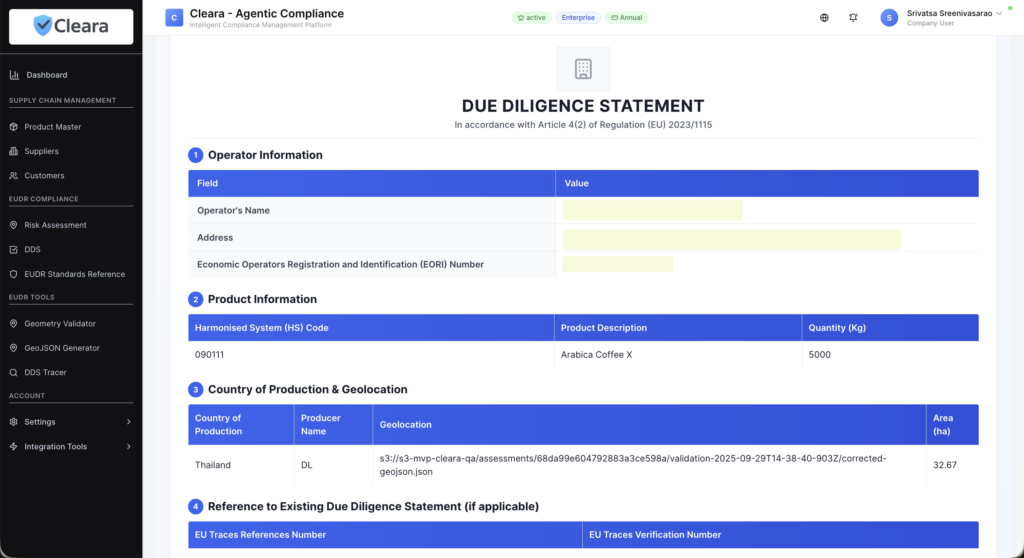
| STEP 1 | Field Data Capture – Mobile-first onboarding for smallholders with GPS-verified plot boundaries (points or polygons), KYC documentation, and land-use declarations. Works offline in remote regions. |
| STEP 2 | AI Risk Assessment – Satellite-powered deforestation risk analysis using JRC and Hansen datasets. Flags high-risk plots, land-use changes, and supplier score anomalies before DDS generation begins. |
| STEP 3 | Auto-DDS Generation – Rule engines mapped to EUDR Article 9 auto-generate DDS forms based on plot location, commodity type, supplier risk score, and legal documentation. No manual formatting. No duplication. |
| STEP 4 | Pre-Flight TRACES Validation – Every DDS runs through a schema validator that mirrors the EU Commission’s TRACES NT requirements. GeoJSON geometry, HS codes, and batch linkages are checked before submission. |
| STEP 5 | One-Click Submission – API-direct connection to EU TRACES NT portal. Push the DDS without logging into a separate platform or converting file formats. Receive DDS reference number instantly. |
| STEP 6 | 5-Year Audit Archive – All DDS filings, supporting documents, supplier records, and risk assessments stored in a secure, searchable cloud archive. Audit-ready on demand. |
Standardizes plantation polygons, detects CRS mismatches, and auto-corrects geometry errors before submission eliminating the number one cause of TRACES rejection.
Continuously monitors plot-level land history against JRC and Hansen datasets. Real-time alerts before a high-risk shipment reaches customs.
Native connectors for SAP, Microsoft Dynamics, and Odoo. Your batch IDs, procurement records, and shipment logs feed directly into the DDS no re-entry.
Real-time visibility into DDS status, supplier risk scores, country benchmarking, and audit trail across all shipments for procurement, logistics, and ESG teams.
SSO/OAuth, multi-tenancy, and role-based access. Procurement sees what they need. Compliance sees what they need. No data leaks.
Run this checklist against your current compliance setup. Every unchecked item is a shipment risk.
Pre-Submission Readiness
Submission and Post-Submission
EU TRACES NT is not just a submission portal it is the final checkpoint of your entire EUDR compliance system. Companies that treat DDS submission as a last-mile activity often face delays, rejections, and operational disruption. In contrast, those that build structured supplier data, validated geolocation, and integrated risk assessment workflows upstream can submit DDS seamlessly and maintain uninterrupted EU market access. As enforcement tightens, success will depend on how well your systems connect from supplier onboarding to TRACES NT submission. The future of EUDR compliance is not manual reporting, but automated, traceability-driven execution.
Master DDS submissions – explore best practices for accurate and compliant filing.
Strengthen your compliance foundation – learn how EUDR due diligence works end to end.
Connect systems, not spreadsheets – discover how EUDR integrations streamline compliance.
TRACES NT (Trade Control and Expert System) is the EU’s official digital platform for submitting Due Diligence Statements under EUDR. Every operator placing regulated commodities on the EU market must submit their DDS through TRACES NT before goods can enter. Without a valid DDS reference number from TRACES, your shipment is legally blocked at customs.
Non-SME operators (large and medium companies) must submit a full DDS per shipment as of December 30, 2026. Small and micro primary operators have until June 2027 under the 2025 amendment. Downstream operators and traders no longer submit separate DDSs but must register in the system and pass DDS reference identifiers to maintain traceability.
A rejected DDS means your shipment cannot enter the EU market. Common rejection reasons include invalid GeoJSON polygons, incorrect HS codes, missing supplier information, and batch traceability gaps. You must correct and resubmit and every day of delay is a day your shipment is held at the border.
Manual DDS preparation can take days to weeks per shipment due to data collection, supplier verification, geolocation validation, and document formatting. With an automated platform like TraceX, the same process takes minutes from verified supply chain data to submitted DDS with reference number.
Yes. TraceX has an API-ready integration with the EU TRACES NT portal, enabling direct DDS submission without manually logging into TRACES or converting file formats. This is what TraceX calls one-click compliance your shipment data goes from verified to submitted in minutes.
Smallholder compliance requires mobile-first field data capture tools that work offline, support multiple languages, and enable GPS-verified plot boundary mapping. TraceX provides a mobile app for field teams to onboard smallholders with plot coordinates, KYC documents, and land-use declarations all feeding automatically into the DDS workflow.