
Quick summary: EUDR Cocoa Compliance for Importers: Learn the requirements, due diligence steps, geolocation rules, and risk assessments needed to import deforestation-free cocoa into the EU.

A single missing cocoa farm geolocation can stall your entire shipment at EU customs. The EU Deforestation Regulation (EUDR) mandates that every cocoa product placed on the EU market must be deforestation-free, legally produced, and traceable to farm-level geolocation data or it will be rejected. For EUDR cocoa compliance for importers, this means transforming how supply chains are mapped, monitored, and documented before goods cross EU borders. Without a structured compliance strategy, importers face shipment delays, fines, and loss of EU market access.
TraceX EUDR solutions help importers streamline compliance by enabling farm-level geolocation mapping, satellite-based deforestation verification, automated risk assessments, and seamless Due Diligence Statement (DDS) preparation—all within a single digital platform.
The EU Deforestation Regulation (EUDR) requires importers to prove that every shipment of cocoa and cocoa-derived products placed on the EU market is deforestation-free, legally produced, and fully traceable to the exact production plot. Compliance is mandatory before products can be sold, distributed, or re-exported within the European Union, shifting accountability directly to operators and traders.
The regulation covers a wide range of cocoa-related commodities, including raw cocoa beans as well as processed and derived products such as cocoa butter, cocoa powder, chocolate, and other cocoa-containing goods. Any company importing these products into the EU must ensure their supply chains meet the environmental and legal standards set under EUDR.
A central obligation is the submission of a Due Diligence Statement (DDS) through the EU’s designated information system. This statement confirms that the importer has gathered supply chain information, conducted a structured risk assessment, and taken mitigation measures where required. Without a valid DDS, cocoa products cannot legally enter the EU market.
Traceability is another core requirement. Importers must collect plot-level geolocation data for every farm supplying cocoa. Small farms require GPS point coordinates (latitude and longitude), while farms larger than four hectares must provide polygon mapping that clearly defines production boundaries. This geospatial data allows authorities to verify sourcing locations using satellite monitoring systems.
EUDR also enforces a strict cut-off date of 31 December 2020. Cocoa grown on land that experienced deforestation after this date is ineligible for EU market access, even if local laws permitted land-use change.
Finally, companies must conduct a formal risk assessment and confirm that the risk of deforestation or illegality is negligible. If risk exceeds this threshold, importers must implement mitigation measures such as enhanced supplier verification, satellite analysis, or third-party audits before submitting their DDS.
Exporting cocoa to the EU?
Read our complete guide to EUDR cocoa complianceand avoid costly shipment delays.
Need help with farm mapping?
Learn how to meet EUDR geolocation requirements using GPS and polygon mapping.
The EU Deforestation Regulation (EUDR) shifts compliance liability from broad sustainability pledges to verifiable, plot-level evidence of deforestation-free sourcing. This fundamental shift is forcing companies to redesign how they engage suppliers, manage traceability, and govern supply chain risk. Instead of relying on high-level certifications or corporate sustainability commitments, businesses must now provide data-backed proof that cocoa originates from legally compliant, deforestation-free production areas.
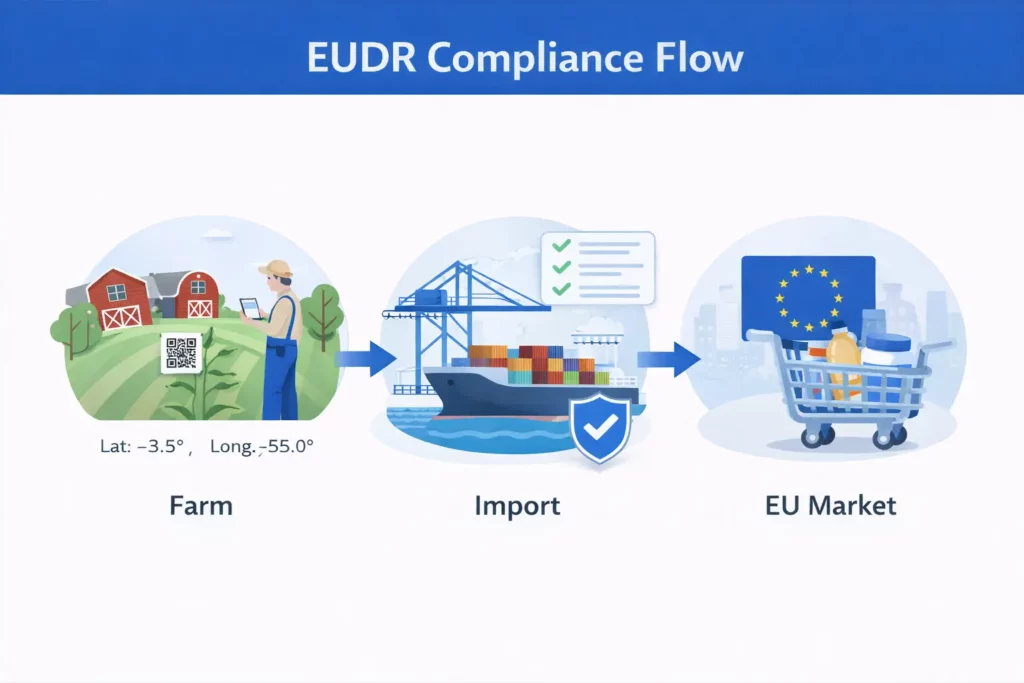
EUDR is also part of a broader trend toward regulatory harmonization across major markets. Similar legislation, such as the US Lacey Act and the UK Forest Risk Regulations, targets illegal or unsustainable sourcing practices. Together, these frameworks are pushing cocoa supply chains toward greater transparency, digital traceability, and stronger risk governance worldwide.
Plot-level traceability is a cornerstone of EUDR cocoa compliance. Without precise geographic coordinates for where cocoa is grown, importers cannot verify whether production areas are deforestation-free or demonstrate compliance with EU regulations. Geolocation data enables regulators and companies to trace cocoa from the farm to the final shipment, ensuring that sourcing is transparent and defensible.
EUDR requires different types of geolocation data depending on farm size. For small farms (typically under 4 hectares), importers must collect GPS point coordinates, latitude, and longitude that identify the farm’s central location. These coordinates provide a basic geographic reference that allows authorities to locate the production area.
For larger estates exceeding 4 hectares, companies must provide polygon mapping. Polygon mapping digitally outlines the exact boundaries of the production plot by connecting multiple GPS points around the farm’s perimeter. This creates an accurate digital representation of the land used for cocoa cultivation and supports more precise compliance checks.
Traceability goes beyond mapping farms. Importers must also link geolocation data to cocoa batches and supplier identities. Each shipment or lot of cocoa should be traceable back to verified production plots and specific suppliers. This linkage ensures that if compliance questions arise, companies can quickly identify the origin of the product and provide supporting documentation.
To manage this at scale, geolocation data must integrate with broader supply chain traceability systems and ERP platforms. Integration allows companies to connect farm data, supplier records, shipment details, and compliance documentation within a unified digital workflow. This reduces manual processes, minimizes data gaps, and improves audit readiness.
Polygon mapping is especially important for accurate EUDR compliance verification.
First, it enables precise satellite overlap checks. When farm boundaries are clearly mapped, satellite monitoring systems can accurately determine whether any portion of the production area overlaps with zones that experienced forest loss after the 31 December 2020 cut-off date.
Second, polygon mapping helps ensure farms do not intersect forest loss or protected zones. Clearly defined boundaries prevent unintentional sourcing from restricted areas, conservation regions, or recently deforested land.
Finally, polygon mapping enhances transparency and auditability. Regulators and certification bodies can clearly visualize production areas, verify land-use history, and validate supplier claims. This level of spatial accuracy strengthens trust, reduces compliance risk, and makes cocoa supply chains more accountable under EUDR.
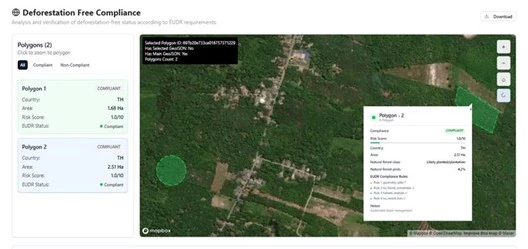
Importers must conduct a documented risk assessment for cocoa to determine whether sourcing areas pose deforestation or legality risks under EUDR. This assessment is a mandatory step before submitting a Due Diligence Statement and placing products on the EU market. The goal is to evaluate supply chain exposure and determine whether the risk level can be classified as negligible.
A key component of this process is country risk benchmarking. The European Commission categorizes producing countries as low, standard, or high risk based on deforestation trends, governance strength, and law enforcement capacity. Cocoa sourced from higher-risk regions may require enhanced due diligence, deeper verification, and stronger mitigation measures compared to low-risk origins.
Another major factor is supplier complexity and smallholder networks. Cocoa supply chains often involve thousands of smallholder farmers, cooperatives, aggregators, and exporters. The more fragmented the network, the greater the risk of traceability gaps, mixed commodity lots, and incomplete documentation. Importers must evaluate how many intermediaries are involved and whether traceability systems can reliably link cocoa batches back to production plots.
Risk assessments also rely on satellite-based deforestation verification. By overlaying farm geolocation data with satellite imagery and forest monitoring datasets, companies can determine whether cocoa farms overlap with areas that experienced deforestation after the 31 December 2020 cut-off date. This geospatial verification is central to confirming deforestation-free sourcing.
Additionally, platforms support supplier risk scoring, where suppliers are evaluated using standardized criteria such as origin risk level, documentation quality, geolocation accuracy, traceability maturity, and compliance history. Risk scoring helps companies prioritize high-risk suppliers and allocate mitigation resources effectively.
The final objective of the risk assessment is to determine whether deforestation and legality risks are negligible.
First, companies use geospatial analytics to verify that mapped production plots do not overlap with post-2020 forest loss zones. Satellite data and land-use change detection tools provide objective environmental evidence.
Second, operators evaluate governance and production documentation, including supplier declarations, land-use records, farm ownership or tenure information, and traceability documentation.
Finally, legal compliance verification ensures that cocoa production follows national laws related to land use, environmental protection, and agricultural operations.
When geospatial evidence, governance indicators, and documentation collectively demonstrate low exposure, importers can classify the supply chain as negligible risk and proceed with compliance submission.
A Due Diligence Statement (DDS) must be completed and submitted before placing cocoa on the EU market, tying together all compliance evidence collected across the supply chain. Without a valid DDS, cocoa shipments cannot legally enter or circulate within the European Union. The statement acts as a formal declaration that the importer has fulfilled all EUDR obligations and that the product meets deforestation-free and legality standards.

To prepare a DDS, companies must compile several categories of required data. This includes precise geolocation information for all production plots supplying cocoa, demonstrating farm-level traceability. Operators must also include evidence confirming the legality of production, such as land-use documentation and compliance with national environmental and agricultural laws. In addition, the DDS must reflect the results of a structured risk assessment, confirming that deforestation and illegality risks have been evaluated and determined to be negligible or that appropriate mitigation measures have been implemented.
The DDS must also provide detailed shipment information. Importers are required to specify the country of origin, production regions, supplier identities, and the quantities of cocoa or cocoa-derived products being placed on the EU market. Supporting documentation such as supplier declarations, satellite verification reports, and risk assessment summaries must be maintained to substantiate the submission.
Submission is carried out digitally through the EU Information System (TRACES). Operators must upload the DDS and associated data in the prescribed format before the shipment is marketed or distributed within the EU. This digital process ensures standardized reporting, improves regulatory oversight, and enables authorities to verify compliance efficiently.
By consolidating geolocation data, legality evidence, risk assessment results, and shipment details into a single submission, the DDS serves as the central compliance instrument under EUDR for cocoa importers.
Importers must retain cocoa due diligence records for at least five years, ready for audit by EU authorities at any time during this period. Under EUDR, compliance is not limited to one-time verification at import; companies must maintain complete, accessible evidence demonstrating that proper due diligence was conducted before products entered the EU market.
Companies must also retain traceability evidence linked to shipments. Each consignment placed on the EU market should be connected to production plots, supplier records, batch details, and compliance documentation. Linking shipment data to its underlying due diligence records allows authorities to verify that specific products meet EUDR requirements.
Strong digital recordkeeping systems make long-term compliance manageable by organizing documentation, enabling rapid retrieval, and ensuring audit readiness across complex cocoa supply chains.
Failure to manage cocoa supply chain data effectively can lead to shipment blocks, financial penalties, and serious reputational harm. Under EUDR, regulators expect precise, verifiable evidence for every consignment entering the EU market. When compliance systems are weak or fragmented, small data gaps can quickly escalate into major trade disruptions.
Avoiding these risks requires digital traceability platforms, standardized supplier processes, accurate geolocation mapping, and automated compliance workflows that ensure data integrity across the supply chain.
TraceX EUDR solutions help cocoa exporters eliminate compliance gaps by digitizing farm geolocation mapping, supplier onboarding, and batch-level traceability within a single platform. Exporters can automate satellite-based deforestation checks, enforce lot segregation, and maintain real-time compliance dashboards that keep supply chain data audit-ready. With structured risk scoring, automated documentation workflows, and secure five-year record retention, TraceX makes EUDR compliance simpler, faster, and scalable across complex cocoa sourcing networks.
EUDR cocoa compliance has become a business-critical priority for importers operating in EU markets. The regulation introduces strict obligations that require companies to prove deforestation-free sourcing, maintain farm-level traceability, conduct structured due diligence, and perform robust risk assessments before products can be placed on the market. These requirements demand far more than basic documentation they require verifiable data, geospatial validation, and audit-ready records across complex global supply chains.
Proactive preparation is essential. Importers that begin strengthening supplier traceability, improving geolocation accuracy, and formalizing risk governance processes today will avoid shipment disruptions and regulatory exposure tomorrow. Digital compliance platforms play a central role by enabling automated workflows, real-time verification, and secure recordkeeping at scale. With the right technology foundation, cocoa importers can meet EUDR obligations confidently while maintaining smooth, uninterrupted access to EU markets.
Preparing for EU deforestation rules?
Explore our complete guide to achieving full EUDR compliance.
Confused about due diligence obligations?
Read our step-by-step guide toEUDR due diligence requirements.
Need a structured evaluation framework?
Learn how to conduct anEUDR risk assessmentstep by step.
Yes. Under EUDR, the operator placing cocoa on the EU market is legally responsible for compliance. Importers must ensure due diligence is completed, risks are assessed, and a valid Due Diligence Statement is submitted before products can circulate.
Not fully. Supplier programs and certifications help, but importers must independently verify geolocation data, legality documentation, and deforestation-free status. Responsibility cannot be outsourced.
It is challenging but achievable with digital traceability systems. Technology platforms help gather geolocation data, map farms, link suppliers to batches, and manage compliance at scale.
EU authorities can delay, block, or reject shipments. Importers may also face financial penalties and reputational damage, making pre-shipment verification essential.
Yes. Building traceability, geolocation mapping, and risk assessment systems takes time. Early preparation prevents last-minute disruptions and ensures smooth market access once enforcement begins.