

EUDR Compliance for Soy Exporters in Tanzania is essential for accessing the EU market, as the regulation prohibits imports linked to deforestation or illegal land use. Tanzanian exporters must implement robust supply chain traceability, verify the legal and sustainable origin of soy, and maintain proper documentation to meet EU due diligence requirements. Compliance not only ensures uninterrupted market access but also strengthens credibility with international buyers, reduces legal and financial risks, and aligns Tanzanian soy exports with global sustainability standards, positioning exporters competitively in eco-conscious markets.
Tanzania’s Soy Export Landscape
Tanzania, while primarily a domestic soy producer for local consumption, is increasingly exporting soy-based products such as soymeal, soybean oil, tofu/tempeh derivatives, and specialty soy ingredients to markets in the EU, East Africa, and Asia. Soy cultivation is concentrated in regions like Morogoro, Ruvuma, and Mwanza, relying heavily on smallholder farmers and local processors supplying both food and feed sectors.
With rising global sustainability standards, Tanzania’s soy exporters must comply with the EU Deforestation Regulation (EUDR) to maintain access to high-value EU buyers. Under EUDR, soy and its derivatives fall under key HS codes:
- HS 1201 – Soybeans, whether or not broken
- HS 1507 – Soybean oil and its fractions
- HS 2304 – Soybean meal and solid residues
- HS 2106/3504 – Soy protein concentrates, isolates, and food-grade derivatives
- HS 2309 – Feed preparations containing soy
Effective from 29 June 2023, all large and medium Tanzanian soy exporters must implement full farm-level traceability, deforestation-free verification, and legality documentation by 30 December 2025, with small and micro enterprises complying by 30 June 2026.
To secure EU market access and strengthen long-term competitiveness, Tanzanian exporters should adopt digital traceability systems, geolocation mapping, and deforestation-risk monitoring, with blockchain-backed transparency and AI-driven land-use analytics enhancing verification. These measures position Tanzania as a credible, sustainable, and future-ready soy supplier in global markets.
Explore our in-depth blog on EUDR compliance for soy exporters to understand key requirements, challenges, and proven strategies for building traceable, deforestation-free soy supply chains.
Read the Full Blog on EUDR Soy Compliance
Read our expert blog on Deforestation Risk Assessment for EUDR, packed with practical frameworks, digital tools, and real-world guidance to help you identify, monitor, and mitigate deforestation risks across complex supply chains.
Read the Deforestation Risk Assessment Blog
What are the Key Challenges Faced by the Tanzanian Soy Export Sector Under the EUDR
Fragmented, Smallholder-Dominated Supply Chain
Tanzania’s soy production relies heavily on smallholder farmers, many cultivating less than 2 hectares. These producers often lack:
- digitized farm records,
- formal land ownership documentation,
- standardized agronomic practices, and
- awareness of EUDR requirements.
This fragmentation makes farm-level geolocation mapping and legality verification challenging at scale.
Lack of Precise Geolocation and Plot Mapping
EUDR mandates polygon-based geolocation for all farms supplying soy to the EU. Tanzanian exporters face obstacles such as:
- unmapped farm boundaries,
- inconsistent land tenure systems,
- incomplete cadastral records, and
- farmers’ limited familiarity with digital mapping tools.
Low Traceability in Domestic and Import-Based Supply Chains
Tanzania imports small volumes of soy for reprocessing, which, when mixed with local production, complicates origin verification. Challenges include:
- commingling at collection centers and mills,
- unclear origin for imported soy derivatives,
- weak documentation across multi-tier trader networks.
Inconsistent Legality Documentation
EUDR requires proof of legal production, including:
- land-use rights,
- compliance with environmental and forestry regulations.
Many smallholders and local aggregators lack standardized records, making legality verification time-consuming.
Limited Digital Readiness and Data Integration
Most cooperatives, traders, and processors lack:
- digital traceability systems,
- centralized data platforms,
- real-time monitoring tools.
Manual systems increase the risk of non-compliance, errors, and slow due diligence processes.
High Compliance Costs for MSMEs
Small and micro enterprises, dominant in Tanzania’s soy processing sector, face financial and operational constraints. EUDR compliance may raise costs and risk market exclusion without technical support.
Complex Documentation Requirements for Soy Derivatives
EUDR covers not only raw soybeans but also derivatives such as soymeal, soy oil, soy protein concentrates, and feed containing soy. Each batch requires a separate Due Diligence Statement (DDS), multiplying documentation demands.
How TraceX Simplifies EUDR Compliance for Soy Exporters in Tanzania
The EU Deforestation Regulation requires Tanzanian soy exporters to prove that all soybeans, soymeal, and derivatives are deforestation-free, legally produced, and traceable to the farm of origin. With Tanzania’s fragmented, smallholder-dominated supply chains and multi-tier aggregation networks, meeting EUDR standards is complex. The TraceX EUDR Compliance Platform, powered by AI, blockchain, and satellite intelligence, offers a comprehensive solution that automates due diligence, enhances supply chain transparency, and ensures smooth EU market access.
End-to-End Digital Traceability
TraceX platform connects farmers, cooperatives, aggregators, processors, and exporters into a unified digital ecosystem. Each soy batch receives a secure digital identity linked to verified farm polygons, land legality, and supplier documentation, ensuring a tamper-proof chain of custody.
Automated Data Capture and DDS Generation
Mobile-enabled tools capture farm GPS polygons, land-use legality, and crop data. TraceX automatically generates EUDR-compliant DDS for every shipment, reducing manual paperwork and providing audit-ready documentation.
Blockchain-Based Proof of Origin
All sourcing, aggregation, processing, and export events are recorded on TraceX’s blockchain ledger, ensuring verifiable proof of origin, building trust with EU importers, and supporting inspection readiness.
Farmer & Cooperative Onboarding and Geo-Mapping
Smallholders and cooperatives are onboarded through digital profiles capturing land legality, geolocation, sustainability credentials, and yield data, enabling visibility across Tanzania’s fragmented supply chains.
AI-Powered Deforestation Risk Monitoring
The platform integrates AI-driven risk scoring with satellite monitoring to detect deforestation or land-use changes. Real-time alerts allow exporters to mitigate risks and maintain continuous EUDR compliance.
Collaborative Compliance Ecosystem
TraceX provides a centralized environment for cooperatives, processors, exporters, certification bodies, and EU buyers, standardizing workflows, streamlining audits, and simplifying cross-border compliance coordination.
Turning Compliance Into a Competitive Advantage
By integrating blockchain traceability, AI-enabled risk monitoring, and automated DDS workflows, TraceX transforms EUDR compliance from a regulatory burden into a strategic differentiator. Tanzanian soy exporters can demonstrate deforestation-free, legally verified sourcing, strengthen EU buyer relationships, and position Tanzania as a credible, sustainable soy supplier.
Why EUDR Compliance Matters for Tanzania’s Soy Exporters
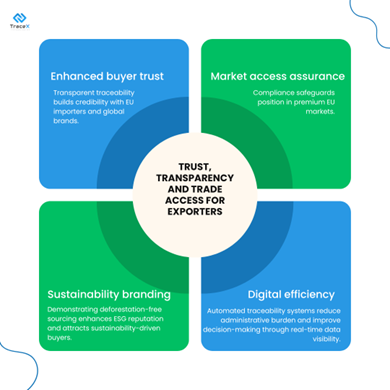
EUDR compliance is crucial for Tanzania’s soy exporters because the EU demands that all soy and soy-based products entering its market are deforestation-free, legally produced, and fully traceable to the exact farm of origin. For Tanzania, where soy production is dominated by smallholders and supply chains are often fragmented, meeting these requirements is essential to avoid shipment rejections, delays at EU borders, and loss of access to high-value European buyers.
Compliance strengthens Tanzania’s position in global markets by improving supply chain transparency, boosting buyer confidence, and aligning with tightening sustainability standards worldwide. It also reduces legal and financial risks for exporters, encourages digitalization and better documentation practices, and helps elevate Tanzania’s soy sector toward more efficient, responsible, and internationally competitive production.
In short, EUDR compliance is not just a regulatory requirement it is a strategic necessity for maintaining EU market access and securing long-term growth for Tanzania’s soy export sector.
EUDR Compliance as a Catalyst for Tanzania’s Soy Export Growth
EUDR Compliance for Soy Exporters in Tanzania is essential for sustaining access to the EU’s high-value market and building global competitiveness. By meeting strict requirements for traceability, legality, and deforestation-free sourcing, Tanzanian exporters can enhance transparency, reduce trade risks, and strengthen buyer confidence. Embracing digital tools and improved documentation not only supports compliance but also positions Tanzania as a credible, sustainable supplier in the evolving global soy value chain.
Understand the key components of EUDR compliance and how to streamline your DDS process efficiently.
Read the blog on EUDR Due Diligence
Learn how AI-driven automation and intelligent workflows simplify data collection, verification, and reporting.
Explore the blog on Agentic AI for EUDR
Discover how digital onboarding bridges the gap between smallholders and EUDR compliance.
Read our blog: Smallholder Onboarding for EUDR Compliance
Frequently Asked Questions (FAQ’s)
What is EUDR compliance for Tanzania’s soy exporters?
EUDR compliance requiresTtanzanian exporters to prove that all soy products are deforestation-free, legally sourced, and traceable to their plantation of origin before entering the EU market.
Why is EUDR compliance important for Tanzania’s soy industry?
The EU is a destination for Tanzania’s soy exports. Compliance ensures continued market access, strengthens buyer trust, and positions exporters as sustainability leaders in the global value chain.
What are the key requirements for Tanzanian exporters?
Tanzanian exporters must map supply chains to the farm level, capture geolocation coordinates (GeoJSON), verify legal sourcing, and submit a Due Diligence Statement (DDS) via the EU portal before shipment.
What challenges do Tanzanian soy exporters face with EUDR?
Common challenges include fragmented smallholder networks, limited digital infrastructure, manual documentation, and lack of standardized traceability frameworks across the value chain.
What are the long-term benefits of EUDR compliance for Tanzanian exporters?
Beyond meeting EU regulations, compliance drives supply chain transparency, builds brand credibility, enhances ESG performance, and opens access to premium global markets demanding sustainable soy for the Tanzanian exporters.