
Quick summary: EUDR for traders: do you need to submit a DDS or just verify compliance? Understand DDS obligations, SME exemptions, substantiated concern rules & recordkeeping.

Here’s a scenario that’s playing out in trading floors across Europe right now: a mid-size coffee trader in Hamburg sources from an exporter in Vietnam who has already gone through full EUDR due diligence. The Hamburg team assumes they’re covered. They’re not necessarily wrong but they don’t know for certain, and that uncertainty is exactly what gets businesses into trouble. EUDR Compliance for traders requires maintaining traceability, preserving Due Diligence Statement references, and ensuring compliant products move transparently across the EU supply chain.
Whether you need to submit a Due Diligence Statement (DDS) under EUDR depends on two things: your role in the supply chain and your company size. Operators importing EUDR-listed commodities into the EU must always submit a DDS. Traders those supplying within the EU market must submit a full DDS if they are not SMEs, or may rely on referencing an existing DDS if they are SMEs operating within the EU domestic supply chain. However, the ‘substantiated concern’ clause and any direct imports from outside the EU can trigger full DDS obligations for SME traders too.
Since EUDR (Regulation EU 2023/1115) enforcement began ramping up for large operators in late 2024 and will extend to SMEs by June 30, 2026, the pressure on traders has quietly intensified. Customs authorities, competent authorities, and EU buyers are all asking the same question: can you prove your supply chain is deforestation-free?
This guide cuts through the regulatory language and gives commodity traders, procurement leads, and compliance teams a clear answer to who submits what, when, and how.
| Key Takeaways Traders who source exclusively from EU-based operators are not required to submit a Due Diligence Statement (DDS) they only need to verify their supplier’s DDS reference number and keep records. Non-SME traders importing EUDR-listed commodities directly must conduct full due diligence AND submit a DDS to the EU TRACES system, just like operators. The ‘substantiated concern’ clause means any trader SME or not can be forced into active due diligence obligations if a competent authority flags a risk. |
EUDR stands for the EU Deforestation Regulation (Regulation EU 2023/1115). It prohibits the import, export, and trade of seven key commodities cattle, cocoa, coffee, palm oil, soy, wood, and rubber along with derived products, unless they can be proven to be:
For traders specifically, EUDR introduces a tiered obligation model that has caused significant confusion. Unlike operators who have clear duties to file DDS before placing goods on the EU market traders sit in a regulatory grey zone that this article will now map precisely.
| Most EUDR explainers treat ‘operators’ and ‘traders’ as near-synonymous. They aren’t. The distinction determines whether you spend 3 months building a traceability programme or simply need a supplier’s DDS reference number. Understanding this difference could save your compliance team 80% of the effort or expose a gap you didn’t know existed. |
This is the most misunderstood element of EUDR compliance for supply chain teams. Let’s define both roles precisely as per the regulation:
Whether you’re an operator, trader, downstream operator, or authorized representative, each role comes with specific responsibilities and obligations.
Read the blog to learn how EUDR defines supply chain actors and what your business needs to do to stay compliant.
An operator is any natural or legal person who, in the course of commercial activity, places relevant commodities or products on the EU market for the first time, or exports them. This includes:
A trader is any person in the supply chain (other than an operator) who makes relevant commodities or products available on the market i.e., they supply goods within the EU after initial market placement. Traders include:
Trader • Under Article 2(17) a trader is any person in the supply chain other than the operator or downstream operator: who makes relevant products available on the market; • in the course of a commercial activity. A trader is therefore any legal entity that does not fall under the definitions of operator or downstream operator (see above) and does not place but simply makes a product available on the market, as defined in Article 2(18).
The critical insight: operators face the full weight of EUDR due diligence. Traders face a lighter obligation that depends on their size and their position in the supply chain.
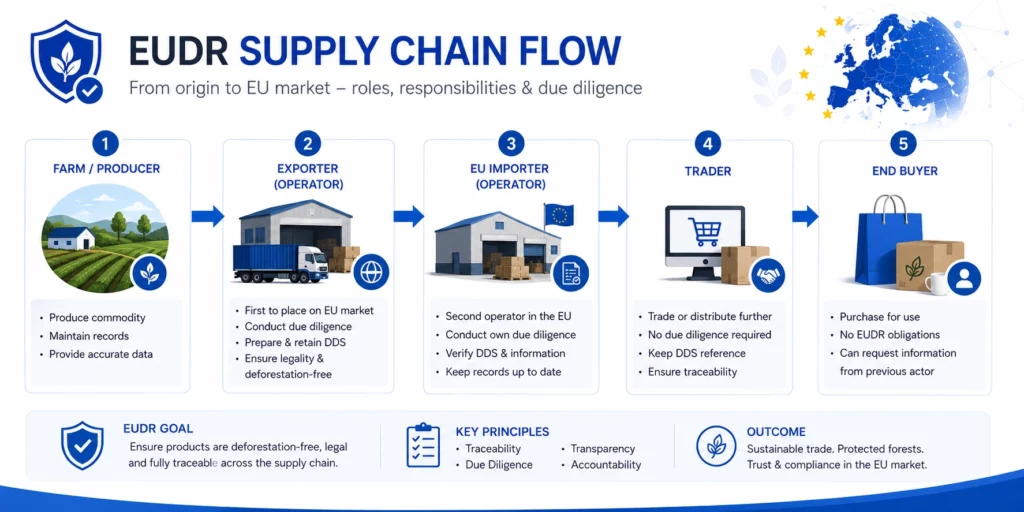
Here’s where the regulatory text gets granular and where most compliance guides stop short. Article 2 and Articles 4–9 of EUDR create different obligations depending on whether you are a trader and whether you qualify as an SME (Small and Medium-Sized Enterprise under EU definition: fewer than 250 employees and annual turnover under €50M).
| Role | Operator | Non-SME Trader | SME Trader |
|---|---|---|---|
| Definition | Places product on EU market | Supplies within supply chain (large) | Supplies within supply chain (small) |
| DDS Required? | ✅ Yes Full DDS | ✅ Yes Full DDS | ❌ No Reference DDS only |
| TRACES Submission? | ✅ Mandatory | ✅ Mandatory | ❌ Only reference number |
| Recordkeeping (years) | 5 years | 5 years | 5 years |
| Substantiated Concern? | Full re-assessment | Full re-assessment | Triggered into due diligence |
| Risk Classification applies? | ✅ Yes | ✅ Yes | ✅ Yes (indirectly) |
Key insight from the table: SME traders are the only category that can avoid full DDS submission provided they obtain and record the DDS reference number from their upstream operator. But this exemption has conditions and it has limits.
| Many SME traders assume the exemption is a blanket ‘get out of compliance free’ card. It isn’t. The exemption applies only when the upstream operator has already completed due diligence and filed a DDS. If your supplier hasn’t done this or is themselves a trader without a DDS reference the exemption collapses and you may be treated as an operator. |
Knowing your role is step one. Step two is understanding what the regulation actually requires of you operationally. Let’s break this down by scenario.
You must:
You must:
You must:
But watch for this trap: if your supplier is also a trader (not an operator) and doesn’t have a DDS reference to give you, you cannot rely on the SME exemption. You’d need to trace further upstream to find the originating DDS.
| Scenario | Must Submit DDS? | Recordkeeping? | Risk Assessment? |
|---|---|---|---|
| Operator importing coffee from Brazil | ✅ Yes | ✅ 5 years | ✅ Full |
| Large trader buying from EU operator | ✅ Yes (full DDS) | ✅ 5 years | ✅ Full |
| SME trader buying from EU operator | ❌ No (reference DDS) | ✅ 5 years | ⚠️ Partial |
| SME trader substantiated concern raised | ✅ Triggered obligation | ✅ 5 years | ✅ Full |
| SME trader buying from non-EU supplier | ✅ Treated as operator | ✅ 5 years | ✅ Full |
Learn the exact steps to prepare your data, validate geolocation requirements, and submit your DDS accurately through the EU system.
Read the blog to understand how to file your DDS efficiently and avoid costly compliance mistakes.
Regardless of whether you submit a DDS, all EUDR participants operators and traders must maintain records for 5 years. This is non-negotiable. Competent authorities in any EU member state can request records at any time.
| Record Type | Required For |
|---|---|
| Supplier name, address, contact | All traders & operators |
| Description, quantity, origin country of product | All traders & operators |
| Country of production / geolocation of plots | Operators + non-SME traders |
| DDS reference number (upstream operator) | SME traders |
| Due diligence procedure documentation | All entities submitting DDS |
| Evidence of deforestation-free sourcing | Operators + non-SME traders |
| Monitoring and risk mitigation measures | All entities submitting DDS |
Here’s what many traders underestimate: it’s not enough to store a DDS reference number in a spreadsheet. Competent authorities expect you to demonstrate that you understood and verified the provenance of those records. That means documented processes, not just data points.
Read the blog to learn how EUDR Competent Authorities impact your compliance obligations and what to expect during enforcement.
| EUDR entered into force in June 2023. That means the 5-year retention clock starts at first transaction not at enforcement date. Businesses that started trading EUDR-covered goods in 2023 and 2024 are already building a compliance record that can be audited. Retroactive gaps can’t be filled. Start clean now. |
‘Substantiated concern’ is the clause in EUDR that most traders overlook and it’s the one that can flip your compliance obligations overnight.
Under Article 9 of EUDR, if a competent authority receives credible information suggesting that a trader’s supply chain may carry deforestation risk even an SME trader that authority can require the trader to conduct a full due diligence assessment, even if they would normally rely on a DDS reference.
The regulation doesn’t provide an exhaustive list, but substantiated concerns can arise from:
The competent authority can:
The practical implication is stark: even if you’ve been operating as an SME trader with no DDS submission obligation, a substantiated concern can force you into operator-level compliance response. Your ability to respond quickly with documented risk assessments, supplier data, and geolocation evidence determines how fast you resolve the situation.
| Think of a substantiated concern trigger as a fire drill. The businesses that survive it quickly are those who already had supplier documentation, geolocation data, and risk assessment protocols in place. The ones that struggle are those treating recordkeeping as a checkbox rather than a live system. Proactive traceability infrastructure is your best insurance. |
A German SME coffee wholesaler (45 employees) sources roasted coffee from a Swiss operator who imports from Brazilian farms. The Swiss operator has submitted a valid DDS to TRACES. The German wholesaler needs to: (1) obtain the DDS reference number from the Swiss operator; (2) record it along with quantity, description, and origin data; (3) pass the reference number to their downstream café chain buyers. They do NOT need to submit a new DDS.
A Dutch palm oil trading company (320 employees, €180M turnover) buys refined palm oil from an Indonesian operator and resells it to food manufacturers across Europe. The Dutch company is a non-SME trader. They must conduct their own due diligence and submit a DDS even though the Indonesian operator has already done so because the Dutch company is large enough to carry full compliance responsibilities at their supply chain node.
A London-based cocoa broker sources from three operators: one in Ghana with a valid DDS, one in Côte d’Ivoire without a DDS, and one EU-based chocolate manufacturer. The broker is a non-SME. For the Ghanaian source, they can reference the existing DDS. For the Ivorian source, they must conduct due diligence and submit their own DDS. For the EU-based source, they collect the reference number. Mixed supply chains require commodity-by-commodity due diligence decisions.
A Belgian SME rubber trader (18 employees) has been operating on DDS references from a Thai operator for two years. An NGO publishes evidence of illegal land clearing in the Thai supplier’s sourcing region. The Belgian competent authority issues a notice triggering a full due diligence obligation for this trader. Now the trader must retroactively document supply chain evidence, geolocation data, and risk mitigation steps under deadline and under scrutiny.
This fourth example is why proactive compliance infrastructure matters even for SME traders. When a substantiated concern hits, you don’t have weeks to build your documentation system from scratch.
Whether you’re an SME trader managing DDS references or a large commodity trading house submitting full DDS packages across multiple commodities, the operational complexity is the same: you’re dealing with fragmented supplier data, multilingual documents, geolocation gaps, and fast-moving regulatory timelines.
TraceX’s EUDR Compliance Platform was built specifically for agri-food supply chains operating in these conditions. Here’s how it addresses trader-specific needs:
For commodity traders, EUDR is more than a regulatory obligation it’s a shift toward greater transparency, accountability, and data-driven trade. Traders that can maintain traceability, preserve Due Diligence Statement references, and confidently demonstrate compliant sourcing will be better positioned to retain EU market access and strengthen buyer trust. As supply chains become more scrutinized, the ability to manage compliance efficiently will separate reactive traders from resilient, future-ready businesses.
No SME traders are not required to submit a DDS themselves. Instead, they must collect and record the DDS reference numbers from their upstream operator(s) and keep supplier records for 5 years. However, if their upstream supplier cannot provide a DDS reference, the exemption may not apply, and the SME trader may need to conduct full due diligence.
An operator places EUDR-covered commodities on the EU market for the first time (typically importers or exporters). A trader supplies those same commodities within the EU after initial market placement. Operators always have full DDS obligations. Traders’ obligations depend on their size non-SMEs must submit full DDS; SMEs may rely on upstream DDS references.
Substantiated concern refers to credible information from NGOs, media, satellite data, or competent authorities suggesting a supply chain may carry deforestation risk. When a competent authority determines a substantiated concern exists, it can require any trader including SMEs to conduct full due diligence and suspend transactions. It overrides normal exemptions.
All operators and traders under EUDR must retain compliance records for a minimum of 5 years. This includes supplier information, product descriptions, DDS reference numbers, geolocation data (where applicable), and documentation of due diligence procedures. Records must be available for competent authority inspection upon request.
Generally no. The EUDR framework requires that SME trader exemptions be tied to a DDS that was filed by an operator the entity that originally placed goods on the EU market. If your upstream supplier is a trader who only holds a DDS reference (not a DDS they filed themselves), you’ll need to trace further upstream to the originating operator’s DDS to satisfy your recordkeeping obligations.









