
Quick summary: EUDR Compliance Tools for Cocoa Exporters: Discover the digital tools that simplify geolocation mapping, traceability, risk assessment, and reporting to meet EU deforestation compliance requirements.

A single missing farm boundary could stop your cocoa shipment at EU customs. The EU Deforestation Regulation (EUDR) has made exporters a critical link in proving that cocoa entering the EU is deforestation-free, legally produced, and traceable to the exact plot of origin. For businesses operating in complex, smallholder-driven cocoa supply chains, meeting these obligations manually is slow, costly, and highly error-prone. This is why adopting the right EUDR Compliance Tools for Cocoa Exporters is no longer optional; it’s essential for protecting market access and buyer relationships.
Without structured digital systems, exporters face operational bottlenecks, data gaps, and serious compliance exposure.
TraceX EUDR solutions help cocoa exporters streamline geolocation mapping, satellite-based deforestation checks, supplier traceability, risk assessments, and compliance reporting, making EUDR readiness faster, simpler, and scalable.
EUDR makes exporters responsible for proving their cocoa is deforestation-free, legally produced, and traceable to farm-level geolocation requirements that are nearly impossible to manage manually. Exporters are now expected to supply accurate, verifiable data that enables importers to meet strict EU compliance standards. Without digital systems, gathering, validating, and sharing this information across thousands of farms and suppliers becomes slow, fragmented, and highly risky.
One major reason compliance tools are essential is the EU’s position as one of the largest cocoa import markets in the world. A significant share of globally traded cocoa ultimately enters the European market, making EU regulatory requirements a commercial reality for exporters across Africa, Latin America, and Asia. If exporters cannot meet EUDR data expectations, their buyers may be unable to place products on the EU market.
Timing is another critical factor. Enforcement deadlines are approaching, and once active, EU authorities can block shipments that lack proper traceability and due diligence documentation. Exporters that delay digital readiness risk last-minute compliance gaps that disrupt trade flows and strain buyer relationships.
Relying on spreadsheets, emails, and paper records creates a high risk of shipment delays and data errors. Manual processes make it difficult to maintain farm geolocation records, verify deforestation status, track supplier documentation, and respond quickly to importer data requests.
Technology platforms significantly reduce cost and compliance burden by automating farm mapping, deforestation checks, supplier data management, and reporting workflows. Digital tools help exporters scale compliance across large supplier networks while improving accuracy, speed, and audit readiness.
EU imports ~60% of global cocoa exports (e.g., 58% of beans as the world’s top market, valued at $16.9B in 2024), fueling demand from the Netherlands (50%), Belgium (17%), and Germany. Agriculture drives ~90% of global deforestation (~10M ha/year lost, per Global Forest Watch), with cocoa heavily implicated in West Africa’s losses (e.g., Nigeria 96%, Ghana 80%)
Assess your EUDR readiness in 10 minutes.
Exporters must supply importers with verifiable data proving that cocoa is deforestation-free and legally produced. While importers are responsible for submitting Due Diligence Statements to EU authorities, they rely heavily on exporters to provide accurate, farm-level information that demonstrates compliance. This makes exporters a critical data source in the EUDR compliance chain.
Exporting cocoa to the EU?
Read our complete guide to EUDR cocoa compliance and avoid costly shipment delays.
Need help with farm mapping?
Learn how to meet EUDR geolocation requirements using GPS and polygon mapping.
Effective compliance requires a combination of geospatial, traceability, risk assessment, and reporting tools working together within an integrated digital ecosystem. Because EUDR obligations span farm mapping, deforestation verification, supplier due diligence, and regulatory reporting, no single tool is sufficient on its own. Cocoa exporters need a coordinated technology stack that supports end-to-end compliance workflows.
70–80% of cocoa farms worldwide are smallholder-based (primarily in West Africa, where Côte d’Ivoire and Ghana produce 60-70% of global supply via ~2-6 million smallholders on <2 ha plots), requiring digital traceability support for EUDR/DPP compliance.
These tools enable exporters to collect and manage farm-level geolocation data, which is a foundational EUDR requirement. They support GPS coordinate capture for smallholder farms and polygon boundary mapping for larger estates. Mobile field-mapping applications, GIS platforms, and boundary digitization tools help exporters create accurate digital farm records. This data becomes the basis for deforestation screening and traceability.
Satellite monitoring tools verify whether cocoa production areas have experienced forest loss after the 31 December 2020 cut-off date. These platforms use remote sensing imagery, historical forest cover datasets, and tree cover loss alerts to detect land-use changes. Exporters can overlay farm polygons on satellite maps to confirm deforestation-free sourcing and provide evidence to buyers and regulators.
Traceability platforms connect farm data to cocoa batches, suppliers, and export shipments. They help exporters onboard farmers and cooperatives, assign supplier IDs, maintain lot segregation, and track product movement through the supply chain. Integration with ERP and procurement systems ensures that geolocation, supplier records, and shipment data remain linked and audit-ready.
These tools support structured compliance analysis by evaluating sourcing risk across multiple dimensions. They assess country risk levels, supplier documentation quality, geolocation accuracy, deforestation exposure, and supply chain complexity. Risk scoring helps exporters prioritize high-risk suppliers and implement mitigation measures where needed.
Reporting tools consolidate compliance data into structured formats required by importers and regulators. They generate traceability reports, risk summaries, legality documentation packages, and audit-ready records. These systems also support secure storage and long-term recordkeeping, ensuring exporters can provide evidence quickly during compliance checks.
See how integrated platforms simplify compliance.
Farm-level geolocation is the backbone of EUDR compliance for cocoa exporters. Without precise information on where cocoa is grown, exporters cannot demonstrate deforestation-free sourcing or provide the traceability data importers need for regulatory filings. Geolocation tools make it possible to capture, store, and verify production plot data at scale across thousands of smallholder farms and estates.
One essential function is GPS point collection for small farms. Most cocoa producers operate small plots of land, often under four hectares. For these farms, handheld GPS devices and mobile mapping applications can capture latitude and longitude coordinates that pinpoint the farm’s location. These coordinates create a geographic reference that supports traceability and regulatory verification.
For larger estates exceeding four hectares, exporters must conduct polygon mapping. This involves recording multiple GPS points around the perimeter of the farm and connecting them to form a digital boundary. Polygon maps provide a more accurate representation of land use and enable precise spatial analysis during compliance checks.
Modern compliance tools also support mobile-based field data collection. Field officers, cooperatives, and extension workers can use smartphones or tablets to gather farm coordinates, farmer identities, crop data, and documentation directly at the source. This reduces paperwork, improves data accuracy, and speeds up onboarding of suppliers into digital traceability systems.
Another critical capability is boundary digitization. Paper maps and rough sketches can be converted into digital farm boundaries using GIS tools. Digitization standardizes spatial records and ensures compatibility with satellite monitoring platforms and compliance databases.
Polygon mapping plays a crucial role in EUDR verification.

Exporters must verify that cocoa farms have not caused deforestation after the 2020 cut-off date. Under EUDR, any cocoa produced on land that experienced forest loss after 31 December 2020 is ineligible for the EU market. Because on-ground verification across thousands of farms is impractical, exporters rely on satellite-based monitoring and geospatial analytics to confirm compliance.
A foundational resource is historical forest cover datasets. These datasets provide archived satellite imagery and land-use records that show what a production area looked like before and after the cut-off date. By comparing historical forest maps with current land-use data, exporters can determine whether cocoa farms were established on pre-existing agricultural land or on recently cleared forest areas.
Another critical tool is tree cover loss alerts. These systems use satellite imagery and change-detection algorithms to flag areas where vegetation loss occurs. Alerts are generated frequently often weekly or monthly allowing exporters to monitor sourcing regions and identify potential deforestation risks early. This proactive monitoring helps prevent non-compliant cocoa from entering the supply chain.
Remote sensing verification adds another layer of assurance. Advanced geospatial platforms analyze multispectral satellite imagery to detect land-use change, canopy density variation, and forest disturbance patterns. This technology provides objective, science-based evidence that supports deforestation-free claims and strengthens compliance documentation.
To connect satellite intelligence with real supply chains, exporters perform batch-to-plot overlay analysis. Farm boundaries mapped as GPS points or polygons are overlaid onto deforestation and forest cover datasets. This allows exporters to verify whether specific production plots intersect with areas of forest loss after the regulatory cut-off date.
By combining historical datasets, deforestation alerts, remote sensing tools, and polygon-based overlay analysis, cocoa exporters can confidently validate deforestation-free sourcing and provide importers with reliable compliance evidence.
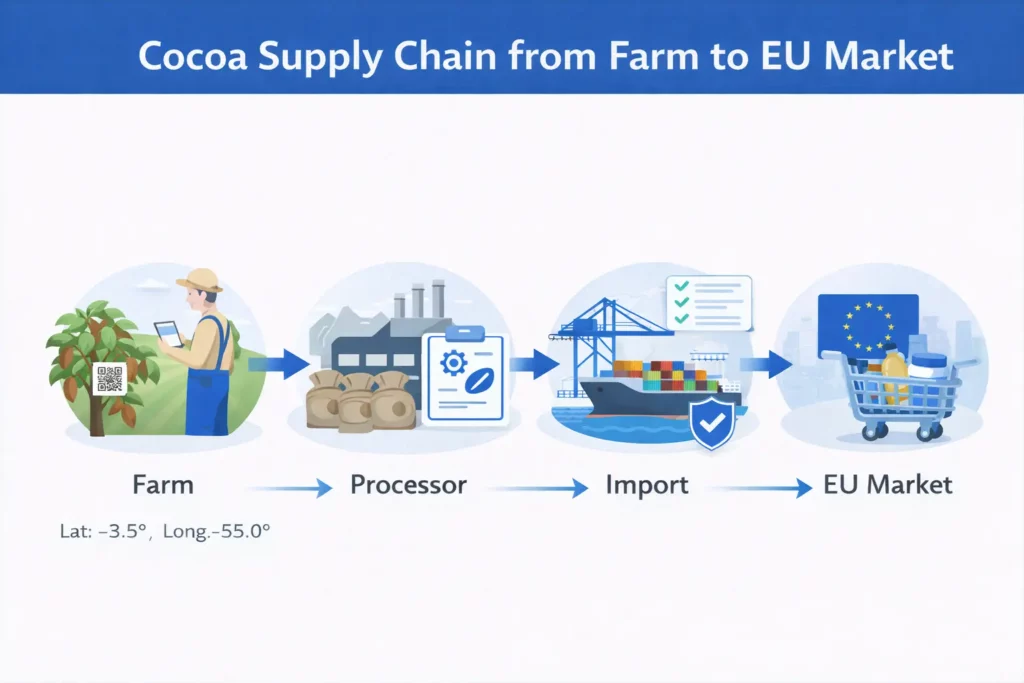
Traceability tools connect farm data to cocoa batches, shipments, and buyers. Under EUDR, exporters must demonstrate a clear chain of custody showing exactly where cocoa was produced and how it moved through the supply chain. Traceability platforms make this possible by digitizing supplier networks, linking production data to export lots, and ensuring that every shipment has verifiable origin records.
A foundational component is supplier onboarding systems. These tools help exporters register farmers, cooperatives, aggregators, and processors into a centralized database. Each supplier is assigned a unique digital identity linked to farm geolocation data, production details, and compliance documentation. Structured onboarding ensures that supplier information is standardized, validated, and ready for downstream reporting.
Another essential capability is batch-level tracking. Cocoa collected from farms is typically aggregated, processed, and exported in batches or lots. Traceability platforms assign unique batch IDs that connect each shipment to its source farms and suppliers. This enables exporters to trace cocoa backward from an export consignment to the production plots and forward to buyers and processors. If compliance issues arise, affected batches can be quickly identified and isolated.
Modern systems also support ERP and procurement integration. By connecting traceability platforms with enterprise resource planning and procurement tools, exporters can align operational workflows with compliance data. Farm sourcing records, purchase orders, inventory data, shipping documentation, and compliance reports remain synchronized, reducing manual entry and data inconsistencies.
Another critical feature is lot segregation controls. Cocoa from compliant and non-compliant sources must not be mixed. Traceability tools help manage physical and digital segregation of lots throughout storage, transport, and processing. This ensures that only verified cocoa enters export shipments and prevents contamination of compliant supply chains.
Together, these capabilities create a transparent digital chain of custody that strengthens EUDR compliance, improves supply chain visibility, and builds trust with international buyers.
TraceX solutions enhance cocoa supply chain transparency by digitizing supplier onboarding, farm geolocation records, and batch-level traceability within a unified platform. Exporters can link farm data directly to lots and shipments, maintain digital chain-of-custody records, and enforce lot segregation to prevent mixing compliant and non-compliant cocoa. With seamless ERP integration and real-time compliance dashboards, TraceX helps exporters deliver audit-ready traceability data that supports importer due diligence and EUDR requirements at scale.
EUDR requires exporters to support structured risk assessments that help importers determine whether cocoa supply chains present deforestation or legality risks. Exporters play a key role by providing reliable data, evaluating supplier exposure, and documenting mitigation efforts that strengthen importer due diligence submissions.
A core component is country risk benchmarking. Sourcing regions are evaluated based on deforestation trends, governance quality, and regulatory enforcement strength. Countries categorized as higher risk require enhanced due diligence, deeper supplier scrutiny, and stronger mitigation evidence. Exporters sourcing across multiple regions must segment supply chains accordingly and apply risk controls where exposure is higher.
Another critical step involves supplier documentation checks. Exporters must verify that suppliers provide accurate and complete records, including farm geolocation data, land-use documentation, legality declarations, and production details. Inconsistent, outdated, or missing documentation increases compliance risk and may delay importer filings.
Tools also support deforestation exposure scoring. By combining farm geolocation data with satellite-based forest monitoring systems, platforms assess whether production plots overlap with areas affected by forest loss after the 31 December 2020 cut-off date. Suppliers can then be scored based on spatial risk level, enabling exporters to prioritize high-risk areas for further verification.
Equally important is mitigation tracking. When risks are identified, exporters must document actions taken to reduce exposure such as conducting field audits, improving geolocation accuracy, strengthening supplier contracts, or implementing traceability controls. Digital systems help track mitigation measures, monitor progress, and maintain audit-ready records.
Together, these tools allow exporters to proactively manage supply chain risk, support importer compliance, and strengthen credibility under EUDR requirements.
Exporters must maintain verifiable records that support importer Due Diligence Statements under EUDR. Since importers depend on exporter-provided data to complete compliance filings, exporters need reliable systems to organize, preserve, and share documentation efficiently. Strong reporting and recordkeeping tools ensure that compliance evidence is complete, accessible, and audit-ready.

EUDR compliance is no longer manageable through fragmented spreadsheets and manual workflows it requires structured, digital systems that can handle complex supply chain data at scale. Core requirements such as farm-level geolocation, satellite-based deforestation monitoring, and end-to-end traceability now sit at the center of cocoa trade with the EU. Relying on manual processes increases the risk of data gaps, shipment delays, and costly compliance failures.
Technology platforms give cocoa exporters the ability to streamline mapping, automate risk checks, maintain audit-ready documentation, and collaborate seamlessly with EU importers. By adopting digital compliance tools early, exporters can reduce operational risk, control compliance costs, and scale confidently in an increasingly regulated global market.
Preparing for EU deforestation rules?
Explore our complete guide to achieving full EUDR compliance.
Confused about due diligence obligations?
Read our step-by-step guide to EUDR due diligence requirements.
Need a structured evaluation framework?
Learn how to conduct an EUDR risk assessment step by step.
Yes. Importers submit Due Diligence Statements, but they rely on exporters for accurate geolocation, traceability, legality, and risk data. Without exporter-side tools, compliance gaps are likely.
Not reliably. Manual systems struggle with farm mapping, satellite verification, batch traceability, and audit-ready reporting at scale.
No. Certifications support sustainability but do not replace mandatory geolocation data, deforestation checks, and structured due diligence.
Yes. Many platforms offer modular and SaaS-based solutions that reduce upfront IT investment while scaling with supply chain size.
Importers may delay shipments, request revalidation, or reject consignments. Inaccurate data can also trigger regulatory scrutiny and financial penalties.









