
Quick summary: Explore the best EUDR compliance tools for rubber exporters. Learn how geolocation mapping, deforestation risk screening, and digital traceability systems help exporters meet EU due diligence requirements and avoid shipment delays.
What You Actually Need in 2025-2026
Rubber exporters selling to the EU face a binary choice: prove deforestation-free sourcing with a compliant Due Diligence Statement or watch shipments get blocked at the border. This is why many exporters are turning to EUDR Compliance Tools for Rubber Exporters to automate geolocation mapping, supplier verification, and deforestation risk screening across their supply chains.
The EU Deforestation Regulation (EUDR) came into force in June 2023, with large operators required to comply from December 30, 2026, and SMEs following in June 2027 (European Commission, 2023). Rubber is explicitly listed among the seven regulated commodities. Every consignment of natural rubber, rubber products, and tyres entering the EU must be backed by verifiable, geo-referenced farm-level data and a submitted DDS.
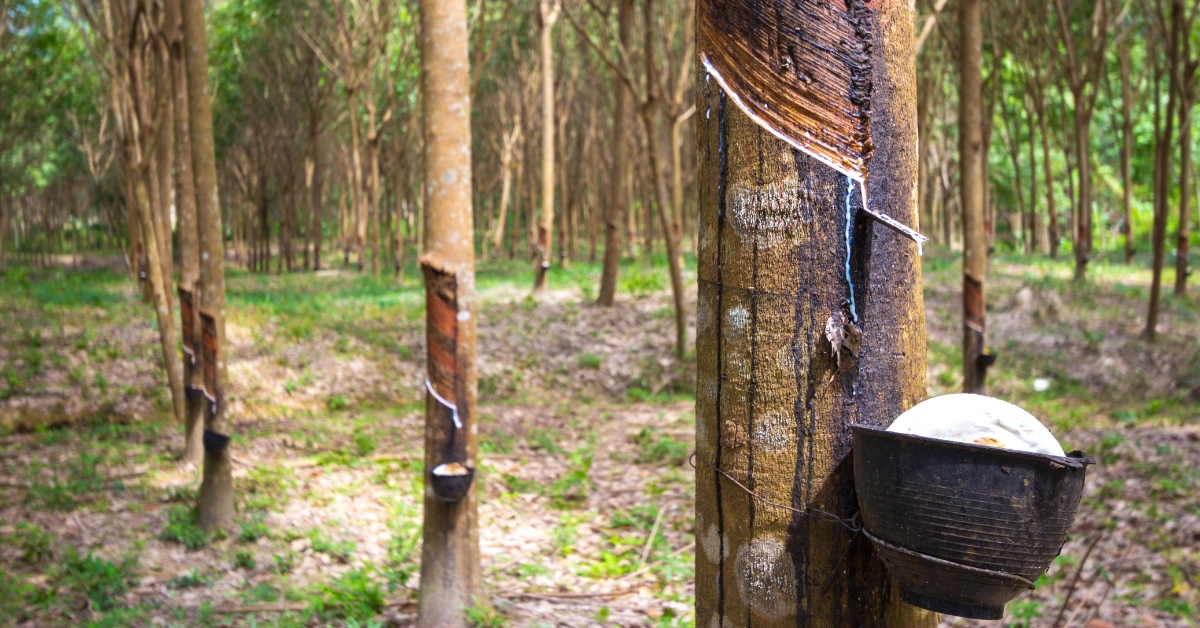
The problem? Most rubber exporters source from thousands of smallholder farmers across Thailand, Indonesia, Vietnam, and Côte d’Ivoire regions, where paper records are the norm and GPS coordinates don’t exist in any database. Manual compliance isn’t just slow. It’s structurally impossible at scale.
This guide cuts through the confusion. We’ll show you what EUDR actually demands from rubber exporters, what compliance tools must do to meet that demand, and the capabilities that separate a real solution like TraceX EUDR Compliance Solution from a checkbox product.
The EUDR doesn’t just ask exporters to declare their rubber is deforestation-free it requires proof, traceable to the plot of land where the rubber was grown. According to the European Commission’s implementing regulation, operators and traders must submit a DDS containing geolocated coordinates for every production plot, a risk assessment showing the commodity was not produced on land deforested after December 31, 2020, and documentation of compliance with the laws of the country of production.
EUDR covers natural rubber (HS code 4001), rubber products including tyres (HS 4011-4013), gloves, footwear components, and other manufactured rubber goods containing natural rubber. Synthetic rubber is not covered; only natural rubber sourced from Hevea brasiliensis trees. If your product contains any percentage of natural rubber and is destined for EU markets, the regulation applies.
A DDS is a formal declaration submitted to the EU’s TRACES system before goods enter the EU. It must include GPS polygon coordinates for every farm plot, satellite-verifiable land cover data confirming no deforestation after December 31, 2020, supplier KYC documentation, and a risk assessment confirming negligible deforestation risk.
EUDR Penalty Framework
Up to 4% of annual EU turnover
Plus: goods seizure, confiscation, and temporary EU market ban. Source: European Commission, Regulation (EU) 2023/1115
Unsure how the EUDR specifically affects rubber exporters?
Read our detailed guide on EUDR Rubber Regulations to understand compliance obligations, due diligence requirements, and how rubber supply chains must adapt before EU enforcement begins.
Plantation mapping is now mandatory under EUDR.
Explore our guide on EUDR Geolocation Requirements to learn how GPS coordinates, polygon mapping, and satellite verification prove your rubber is deforestation-free.
Rubber’s compliance challenge is fundamentally different from that of coffee or cocoa, and most EUDR guides miss this. Coffee and cocoa flow through more consolidated supply chains. Rubber, especially in Southeast Asia, moves through a four-to-five-tier chain: individual smallholders sell to village collectors, who consolidate to local dealers, who supply to processing mills, who export. By the time rubber leaves a mill, its plot-level origin data is typically gone.
Thailand alone has approximately 1.8 million rubber smallholder households, accounting for over 90% of the country’s natural rubber production (Rubber Authority of Thailand, 2024). The vast majority have no formal land title, no digital farm records, and no GPS boundary data on record. EUDR requires polygon-level geo-coordinates, meaning exporters must effectively build a geospatial database of their supply chain from scratch.
This isn’t a documentation gap. It’s a data infrastructure gap. And it can’t be closed with spreadsheets or questionnaires.
The multi-tier nature of rubber supply chains creates a compounding problem. An exporter working with 50 mills may be indirectly connected to 500,000+ individual farmers, none of whom have ever been digitally onboarded. EUDR’s due diligence obligation sits with the exporter, not the mill. The exporter must trace provenance all the way back to the farm plot, regardless of how many intermediaries sit between them.
See How It Works in Practice: Discover how a leading tire manufacturer implemented large-scale polygon mapping to achieve EUDR compliance and gain full plantation-level traceability.
Read the case study to learn how geolocation mapping at scale can accelerate your EUDR readiness.
A compliance tool for rubber exporters isn’t just a document management system. The regulation’s geo-referencing and satellite verification requirements demand a platform built around spatial data infrastructure, not just forms and workflows. According to a 2024 analysis by the Forest Trends Supply Change initiative, fewer than 15% of commodity companies currently have the digital infrastructure needed to meet EUDR’s traceability requirements at the farm plot level (Forest Trends, 2024).
The tool must capture GPS polygon boundaries, not just a single GPS point for every farm plot. Polygon mapping provides the area calculation needed to confirm land cover against satellite reference data. For smallholder-heavy supply chains, this requires mobile field capture tools that work offline, support multilingual interfaces for local field agents, and integrate directly into the compliance platform without manual re-entry.
Every geolocated plot must be cross-referenced against deforestation reference datasets. EUDR specifically references the EU’s JRC Global Surface Water and forest cover layers, as well as Hansen/University of Maryland high-resolution forest loss data. A compliant tool must validate each polygon against these datasets automatically and flag any plot showing forest clearing after December 31, 2020.
Once geolocation and risk data are verified, the tool must auto-populate the DDS, pulling supplier KYC, transaction data, and geo-verification outputs into the required format and submit directly via API to the EU’s TRACES NT system. Manual DDS creation for a mid-size rubber exporter handling 200+ shipments per year is not operationally viable.
EUDR requires country-of-production compliance documentation: land tenure records, permits, certifications, and supplier identity documents. AI-powered document parsing, automatically extracting relevant fields from uploaded supplier documents, is no longer a luxury feature. For rubber exporters sourcing across thousands of suppliers, it’s a compliance necessity.
FIGURE 1: EUDR Compliance Tool Capabilities – Manual vs. Digital vs. TraceX
| Capability | Manual Process | Digital Platform | TraceX |
|---|---|---|---|
| GPS Polygon Farm Mapping | Manual / None | Mobile Capture | Offline + API |
| Satellite Deforestation Check | Not Feasible | Automated | JRC + Hansen |
| DDS Auto-Generation | Manual / Hours | Template-Based | AI-Powered |
| TRACES NT API Submission | Manual Portal | Varies | API-First |
| Supplier Doc Parsing (KYC) | Manual Review | Upload + Tag | Agentic AI |
| Offline Field Data Capture | Paper Forms | Varies by Tool | Offline-First |
Based on TraceX’s operational experience across rubber, palm oil, and coffee supply chains in Southeast Asia and West Africa, these six capabilities determine whether a compliance tool actually works in real-world sourcing contexts, not just in a product demo.
Any tool that only records a single GPS point per farm is already non-compliant with EUDR’s polygon requirement for farms over 4 hectares. The field capture app must work without internet connectivity. In rubber smallholder regions is unreliable by definition.
The platform must cross-reference every geolocated plot against JRC and Hansen forest cover reference datasets without manual analyst intervention. Look for real-time deforestation alerts using Sentinel-2 satellite data that flag newly deforested areas as they’re detected, not just at the point of onboarding.
The DDS must be generated from structured data in the platform, not assembled manually from exports. The AI should auto-populate all required EUDR data fields, identify missing data gaps before submission, and produce audit-ready documentation in PDF, XML, and CSV formats.
Direct API connectivity to the EU’s TRACES NT system, not copy-paste into a web portal. Exporters handling 100+ shipments per year cannot manage manual TRACES submissions without compliance errors.
The platform should auto-parse incoming supplier documents, land tenure certificates, KYC forms, and certifications, extracting relevant data fields without manual re-entry. This is the capability that separates enterprise-grade compliance platforms from basic document repositories.
Rubber exporters in Southeast Asia and West Africa work with suppliers and field agents who don’t operate in English. The platform must support multilingual onboarding portals and field apps; otherwise, your data collection hits a wall at the village level.
TABLE 1: Capability Evaluation Guide for Rubber Exporters
| Capability | Why It Matters for Rubber | Red Flag If Missing |
|---|---|---|
| GPS Polygon + Offline Mobile | Smallholder plots in remote areas | Copy-paste into the portal only |
| Satellite Deforestation Validation | JRC/Hansen cross-reference required by EUDR | Manual upload for risk assessment |
| AI DDS Generation | 200+ shipments/year – manual isn’t viable | Template-based with manual data entry |
| TRACES NT API | Direct submission required at scale | Copy-paste into portal only |
| Agentic Document Parsing | Thousands of supplier KYC documents | Manual review / basic document storage |
| Multilingual Onboarding | Thai, Vietnamese, French, Indonesian agents | English-only interface |
TraceX’s Regulatory Compliance Platform was built specifically for the operational realities of emerging market commodity exporters, the companies that source from thousands of smallholders across fragmented, low-connectivity geographies.
For rubber exporters, TraceX addresses the compliance stack end-to-end. Field agents use TraceX’s offline-first mobile app to capture GPS polygon boundaries for individual farm plots even in zero-connectivity areas. Those polygons are automatically cross-referenced against JRC Global Surface Water and Hansen high-resolution forest loss datasets the moment connectivity is restored, generating a satellite-verified risk score for each plot.
On the document side, TraceX’s agentic AI parses supplier documents, land records, KYC submissions, and certifications directly from supplier emails, auto-extracting relevant compliance fields without manual review. This closes the KYC bottleneck for exporters managing hundreds of upstream suppliers.
When it’s time to file, TraceX’s AI generates the complete DDS from the verified dataset and submits it directly to the EU TRACES NT system via API. The entire workflow from farm plot data to submitted DDS happens within a single platform, with blockchain-backed data immutability ensuring the audit trail can’t be altered after the fact.
TraceX also integrates with existing ERP and procurement systems via API, so compliance data flows automatically into existing operational workflows rather than living in a separate compliance silo.
Based on TraceX deployments with agri-commodity exporters managing 500-5,000 smallholder suppliers, the following workflow reflects how compliant rubber exporters are structuring their operations in 2026-2027.
Field agents, either your own or third-party aggregators, visit farm plots with a GPS-enabled mobile device running the compliance platform’s offline app. They capture polygon boundaries for each plot, record land tenure details, and onboard the farmer into the supplier database. Multilingual support ensures this works whether the agent speaks Thai, Vietnamese, Bahasa Indonesia, or French.
Once plot coordinates are uploaded to the platform, each polygon is automatically cross-referenced against JRC and Hansen forest cover reference data. Plots showing forest clearing after December 31, 2020, are flagged immediately for review. Real-time Sentinel-2 satellite alerts monitor flagged areas for ongoing deforestation activity throughout the sourcing season.
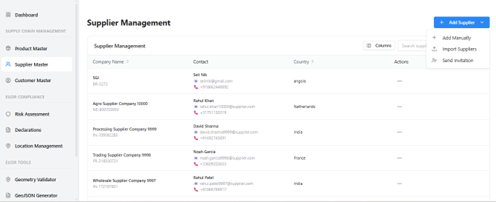
Suppliers submit land tenure records, KYC documentation, and applicable certifications. The platform’s document processing layer auto-extracts relevant fields, plot area, ownership status, and certification validity dates, populating the compliance record automatically.
The platform compiles the complete risk assessment for each sourcing area: geolocation data, satellite verification outputs, supplier documentation status, and country-level legal compliance indicators. This becomes the auditable evidence base supporting the DDS.
The AI-powered DDS engine pulls all verified data and generates the complete Due Diligence Statement. The operator reviews, approves, and submits directly to TRACES NT via API. A blockchain-backed record of the transaction is logged, providing an immutable audit trail.
The consequences of non-compliance aren’t abstract. EUDR Regulation (EU) 2023/1115 sets out a penalty framework requiring EU member states to impose effective, proportionate, and dissuasive penalties, including fines of no less than 4% of annual EU-wide turnover, seizure and confiscation of non-compliant goods, and temporary bans from placing further products on the EU market (European Commission, 2023).
EU Rubber Import Value
12 Billion+ EUR
Annual EU imports of natural rubber and rubber products in 2023. Source: Eurostat, 2024
Beyond regulatory penalties, the commercial risk is equally acute. EU buyers, tyre manufacturers, automotive OEMs, and medical device producers are already building DDS verification requirements into procurement contracts. Exporters without compliant DDS documentation face losing supply agreements before any regulatory enforcement action even begins.
The window for implementation is narrowing. Large operators who haven’t yet built a compliant data infrastructure have, at best, weeks, not months of runway remaining.
Citation Capsule
According to a 2025 survey by CDP and Forest Trends, 61% of commodity companies with EUDR obligations stated they lacked the digital traceability infrastructure to submit compliant DDS documentation as of mid-2025 (CDP, 2025). For rubber exporters, that’s not a compliance warning. It’s a market access warning.
EUDR isn’t a documentation exercise. For rubber exporters, it’s a data infrastructure challenge, one that requires GPS polygon mapping at the smallholder level, satellite-validated deforestation verification, and automated DDS generation to operate at any real scale.
The exporters who move now aren’t just avoiding penalties. They’re building the verified supply chain infrastructure that EU buyers are already requiring in procurement contracts, and that will increasingly define market access, not just regulatory standing.
The tools exist. The question is whether your compliance stack is built for your supply chain’s reality, thousands of smallholders, remote geographies, fragmented documentation, or whether it was designed for a simpler commodity world that rubber doesn’t inhabit.
Still figuring out what EUDR actually requires from your business?
Read our complete guide on EUDR Requirements to understand geolocation data rules, due diligence obligations, and documentation needed for EU market access.
Not sure if your supply chain is ready for EUDR enforcement?
Start with our EUDR Gap Analysis guide to identify compliance gaps and prioritize the changes needed before submitting your Due Diligence Statement.
Deforestation risk evaluation is the core of EUDR compliance.
Learn how companies conduct EUDR Risk Assessments using geolocation data, satellite monitoring, and supplier verification.
Yes. Natural rubber (Hevea brasiliensis) is one of the seven commodities explicitly regulated under EUDR (Regulation EU 2023/1115). Any product containing natural rubber including tyres, gloves, footwear, and industrial rubber goods that enters the EU market must be accompanied by a compliant Due Diligence Statement proving deforestation-free sourcing. Synthetic rubber is not in scope.
A compliant DDS must include GPS polygon coordinates for every production plot, satellite-verified confirmation of no deforestation after December 31, 2020, country-of-production legal compliance evidence, supplier KYC documentation, and a risk assessment concluding negligible deforestation risk all submitted via the EU TRACES NT system before the shipment enters the EU.
Large operators (above the EU SME threshold) were required to comply from December 30, 2025. SMEs have until June 30, 2026. Operators placing goods without a compliant DDS face fines of up to 4% of EU turnover, goods seizure, and temporary market access bans.
The most effective approach is deploying field agents with offline-capable GPS mobile apps that capture polygon boundaries at the farm level. Platforms like TraceX offer offline-first mobile tools that sync to the cloud when connectivity is available critical for remote rubber-growing regions in Thailand, Indonesia, Vietnam, and West Africa.
EU customs authorities will deny entry for shipments without a valid, submitted DDS in TRACES NT. Operators face confiscation of goods, financial penalties under member state frameworks, and reputational damage with EU buyers. Given rubber shipment logistics costs, a single blocked consignment can exceed the entire cost of a compliance platform implementation.