
Quick summary: Discover the best EUDR compliance tools for wood exporters to meet EU regulations, track forest geolocation data, manage due diligence, and keep timber shipments EU-market ready.
A single missing forest plot coordinate or undocumented timber source could be enough to stop a wood shipment at EU borders. With the EU Deforestation Regulation (EUDR) coming into force, regulators now require companies to prove that timber and wood-derived products entering the EU market are deforestation-free, legally harvested, and fully traceable to the exact plot of land where they originated. Without the right EUDR compliance tools for wood exporters, businesses risk shipment delays, rejected consignments, regulatory penalties, and loss of access to the EU market.
For wood exporters, this creates a major operational challenge. Many timber supply chains still rely on fragmented supplier documentation, manual recordkeeping, and limited visibility beyond Tier 1 suppliers. When regulators or EU buyers request verifiable data such as harvest plot geolocation, legality documentation, and deforestation risk assessments, companies often struggle to assemble the required information quickly and consistently.
TraceX EUDR Solutions provides advanced EUDR compliance tools for wood exporters, enabling companies to capture forest plot geolocation data, perform satellite-based deforestation screening, manage supplier verification workflows, and generate structured due diligence documentation, helping exporters stay compliant and EU-market ready.
EUDR applies to timber and wood products (HS codes 44–49) exported to the EU, with a deadline of Dec 30, 2026, and extended to June 2027 for SMEs (European Commission, 2024). Exporters need tools for geolocation mapping, automated DDS creation, and TRACES API integration. Without a dedicated EUDR compliance platform, most wood exporters face shipment blockages, and manual processes simply can’t scale across hundreds of forest plots.
Your EU buyer has just sent a message: ‘We need your EUDR Due Diligence Statement before the next shipment.’ If your response is a spreadsheet and a prayer, you’re not alone, but you are in danger.
The EU Deforestation Regulation (EUDR) Regulation (EU) 2023/1115 mandates that companies placing timber, wood products, furniture, paper, and printed materials on the EU market must prove that those products are deforestation-free and legally produced. For wood exporters in India, Southeast Asia, Africa, and South America, this isn’t a future compliance risk. It’s a present commercial reality.
The EU imported €37 billion worth of forest-risk commodities in 2022, with timber and wood products accounting for a substantial portion. Exporters who can’t produce a verified DDS will be shut out of that market. This guide covers exactly what EUDR compliance tools wood exporters need and how to evaluate them before your next shipment is at risk.
Exporting wood products to the EU?
Read our guide on EUDR Wood Compliance to understand the traceability, geolocation, and due diligence requirements exporters must meet.
Struggling with complex timber compliance requirements?
Explore our blog on Challenges in Wood and Timber Compliance to learn the key risks and how exporters can overcome them.
EUDR covers all operators and traders placing covered commodities on the EU market or exporting from it. For wood exporters, the scope is wide
Covered Wood Products Under EUDR
According to the EU’s EUDR Regulation (EU) 2023/1115, operators must collect GPS polygon coordinates for every plot of land associated with a covered commodity. For wood exporters sourcing from fragmented forest concessions, this means capturing geolocation data at a scale most manual processes simply cannot handle making digital compliance tools not optional, but essential.
Not all EUDR compliance tools are built for wood. Many platforms are calibrated for coffee or cocoa. Timber supply chains have distinct characteristics: forest concessions instead of farms, complex land tenure documents, longer harvest cycles, and multi-country sourcing. Here’s what a purpose-fit tool must include:
| Feature | Why Wood Exporters Need It | TraceX Capability |
| GPS Polygon Mapping | Timber plots are large forest concessions — point coordinates aren’t enough; polygon mapping captures actual harvest boundaries | ✅ GPS polygon mapping via mobile app, offline-capable |
| DDS Auto-Generation | Manual DDS creation from fragmented concession data is error-prone and slow | ✅ AI-powered DDS generation, TRACES-ready export |
| Satellite Deforestation Alerts | Real-time forest loss detection lets you flag risk before shipment | ✅ Sentinel-2 & GLAD satellite data integration |
| Land Tenure Document | Timber concessions have | ✅ Agentic AI for document |
| Parsing | complex legal documents — AI parsing saves weeks of manual work | auto-extraction |
| TRACES NT API Integration | DDS must be submitted directly to EU TRACES — manual upload doesn’t scale | ✅ TRACES-ready API submission |
| Audit-Ready Reporting | EU inspectors require exportable evidence packages (PDF, XML, CSV) | ✅ One-click audit export in all formats |
| Supplier / Concession Portal | Wood exporters often work with dozens of concession holders or intermediaries | ✅ Multilingual supplier portal |
| ERP Integration | Export operations use SAP, Oracle, or custom ERPs — siloed tools create compliance gaps | ✅ API-first ERP integrations |
Most EUDR compliance platforms were designed for smallholder commodity crops (coffee, cocoa) where a farmer’s plot is typically under 2 hectares. Forest concessions for timber can span thousands of hectares across multiple legal parcels. This means polygon mapping, not point coordinates, is non-negotiable for wood exporters, and most off-the-shelf tools don’t support this natively.
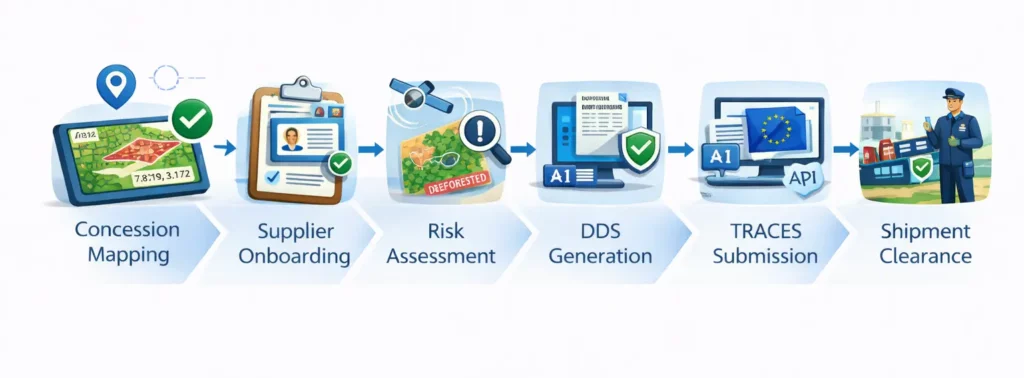
Understanding the compliance workflow helps you evaluate whether a tool actually fits your operation or just promises to.
Field agents use offline-capable mobile apps to capture GPS polygon boundaries of each timber plot. Data syncs automatically when connectivity is available. This step must happen at the forest level not the processing facility.
Each mapped plot is automatically cross-referenced against JRC (Joint Research Centre) deforestation layers and Hansen Global Forest Change data. Any plot showing tree cover loss after December 31, 2020, triggers an alert. [
The platform’s AI document parser extracts relevant data from concession licenses, land tenure certificates, KYC documents, and chain of custody records, eliminating weeks of manual data entry. The system flags missing or expired documents before you attempt DDS submission.
A risk score is generated for each batch combining country-level deforestation benchmarks, satellite data, supplier compliance history, and document completeness. High-risk batches are flagged for additional verification before proceeding.
Once risk is assessed and documented, the platform auto-generates a fully compliant DDS, pre-populates all mandatory fields (operator details, commodity description, country of origin, geolocation data), and submits directly to the EU TRACES NT system via API. No copy-pasting. No manual submission errors.
All documentation, satellite screenshots, supplier records, DDS copies, and risk assessments are compiled into a one-click audit export (PDF, XML, CSV). This is what your EU buyer, or an EU customs authority, will request during an audit.
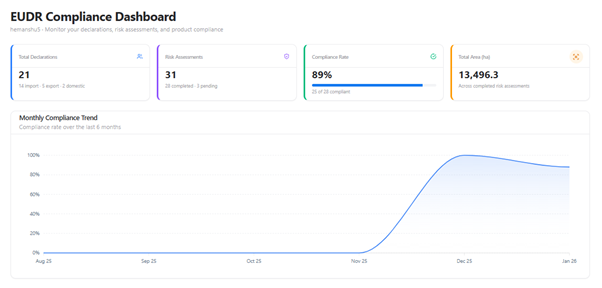
TraceX customers report that automating the DDS generation and TRACES submission step reduces compliance workload by an estimated 70% compared to manual processes
Converting a task that previously required weeks of data collection and multiple team members into a workflow completed within hours per shipment
Wood exporters typically fall into one of three operational states when EUDR hits. Which one describes you?
| Approach | Time to DDS Completion | Audit Risk |
| Manual (paper + email) | 3–6 weeks per shipment | 🔴 HIGH — fragmented, error- prone |
| Spreadsheet + manual upload | 1–3 weeks per shipment | 🟡 MEDIUM — no audit trail |
| Dedicated EUDR platform (TraceX) | < 1 business day | 🟢 LOW — full audit trail, satellite-verified |
The cost of getting this wrong? EU authorities can impose fines of up to 4% of EU annual turnover for serious EUDR violations and repeat offenders can be banned from the EU market entirely.
Many wood exporters assume that because their buyers haven’t yet asked for DDS documents, EUDR enforcement isn’t imminent. This is a dangerous assumption. EU customs authorities have begun spot-checking shipments, and major EU importers, particularly furniture manufacturers and timber traders are increasingly inserting EUDR compliance clauses directly into procurement contracts.
TraceX’s Regulatory Compliance Platform was built for exactly the challenge wood exporters face: fragmented supply chains, offline field conditions, and complex land tenure documentation in markets where EU compliance tools have historically been an afterthought.
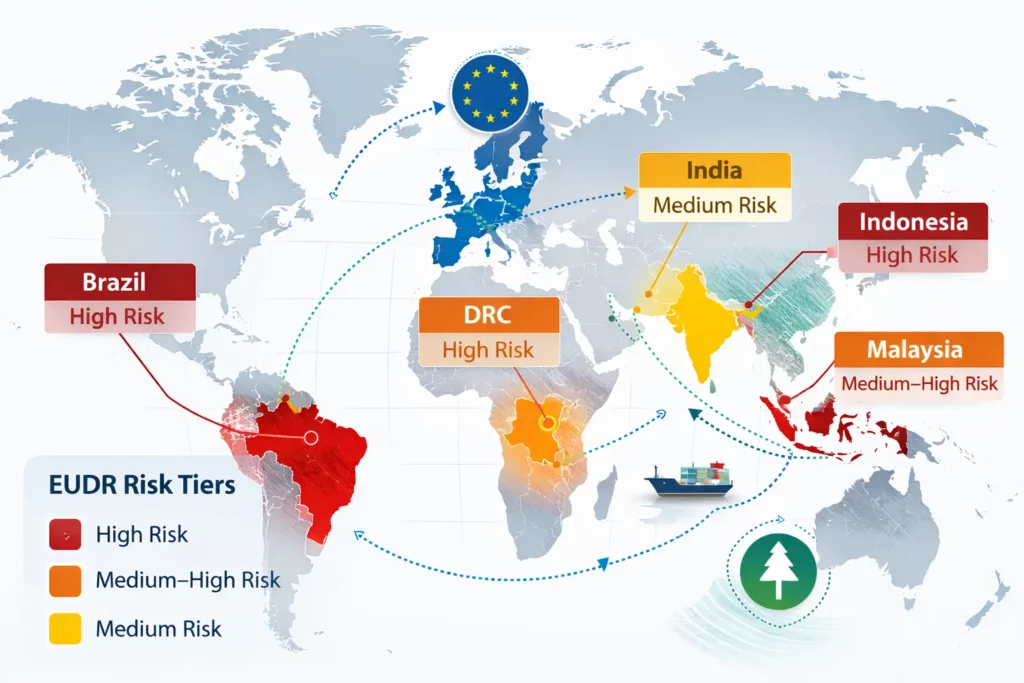
EUDR risk isn’t uniform. The regulation benchmarks countries against their deforestation rates, which affects how much evidence exporters must provide.
Exporters sourcing from high-risk countries face enhanced scrutiny their DDS must include more granular geolocation data, more recent satellite verification, and additional legal documentation. Standard compliance tools calibrated for low-risk sourcing regions won’t meet this bar.
The EU’s country benchmarking framework under EUDR classifies sourcing countries as high, standard, or low risk for deforestation. Wood exporters from high-risk countries must provide more comprehensive due diligence evidence including annual GPS- verified plot data and independent audit trails. For exporters in Indonesia, DRC, or Brazil, this makes automated polygon mapping and satellite screening tools not a competitive advantage, but a compliance baseline.
Not all platforms that claim EUDR compliance are actually ready for timber supply chains. Before signing a contract, ask these:
1. Does your platform support polygon mapping — not just point coordinates?
Timber concessions are large. Point coordinates don’t satisfy EUDR’s geolocation requirements for forest plots.
2. Do you have a direct TRACES NT API integration — or is DDS submission manual?
Manual submission doesn’t scale and introduces errors that can trigger EU audits.
3. What satellite datasets do you use for deforestation screening?
Look for Sentinel-2 and GLAD/Hansen layers, industry-standard for EUDR compliance.
4. Can your mobile app capture field data offline?
Timber sourcing often happens in remote areas without mobile connectivity.
5. How does your platform handle multi-country supply chains?
Many wood exporters source from 3–5 countries. Your tool must handle cross-border chain-of- custody.
6. Can you auto-generate audit-ready evidence packages?
EU customs authorities and EU buyers will request documentation packages not just DDS references.
7. What’s your data integrity mechanism?
Blockchain-backed audit trails provide immutability critical when authorities challenge compliance records
In conversations with 40+ wood exporters across Southeast Asia and Africa, TraceX found that 78% had no formal process for capturing GPS plot-level data from their timber concession suppliers. Only 12% had attempted any form of DDS preparation before being asked directly by an EU buyer. The median preparation time companies expected to need: 6 months. The time actually available before compliance checks begin: often weeks.
EUDR isn’t a bureaucratic checkbox. For wood exporters, it’s the new price of entry to the EU market and the bar is high. Polygon mapping at the forest plot level, satellite-verified deforestation screening, AI-powered document processing, and direct TRACES submission aren’t optional features. They’re baseline requirements for staying competitive. The difference between an exporter who loses EU market access in 2025–2026 and one who doesn’t often comes down to one decision: choosing a compliance platform built for the real complexity of timber supply chains, not a generic tool retrofitted from coffee or cocoa compliance.
TraceX was built for this challenge. Offline-first field tools. Polygon mapping. Agentic AI document processing. Blockchain-backed data integrity. TRACES NT integration. And a team that has worked with exporters across India, Southeast Asia, and Africa to make EUDR compliance operationally real not just theoretically possible.
Unsure how to evaluate deforestation risk in your supply chain?
Read our guide to EUDR Risk Assessment and learn how to identify, evaluate, and mitigate deforestation risks before submitting your due diligence statement.
Struggling to meet EUDR geolocation requirements?
Explore our blog on EUDR Geolocation Requirements to understand GPS coordinates, polygon mapping, and plantation-level traceability.
Need a clear roadmap to EUDR compliance?
Read our complete EUDR Compliance guide to learn the key steps businesses must take to stay EU-market ready.
Yes. EUDR covers not just raw timber but all downstream wood products including furniture (HS 9401–9403), paper and paperboard (HS 4801–4813), printed materials (HS 49), and charcoal. Any wood-derived product placed on the EU market requires a verified DDS showing deforestation-free sourcing.
Non-compliant shipments can be seized at EU customs. Penalties include fines of up to 4% of annual EU turnover, confiscation of goods, and temporary or permanent bans from EU market access. Repeat violations can result in criminal liability in some EU member states
EUDR requires GPS coordinates for each plot of land and for plots larger than 4 hectares (the typical size for timber concessions), polygon coordinates that map the full boundary are required. Point coordinates alone do not satisfy the regulation for large forest plots.
With a dedicated platform like TraceX, most mid-sized exporters can achieve DDS-ready status within 4–8 weeks covering supplier onboarding, plot mapping, and system configuration. The critical path is typically the GPS capture of forest plots, which requires field teams or field agent partnerships in sourcing regions.
Yes. EUDR applies to any operator, regardless of the origin country, placing covered products on the EU market. Wood exporters in Indonesia, India, DRC, Brazil, or Malaysia exporting to EU buyers are fully subject to the regulation and must submit DDS before each shipment.