
Quick summary: Learn how wood and wood product manufacturers can achieve EUDR compliance with end-to-end traceability, chain-of-custody systems, and shipment-level due diligence across complex global supply chains.

A finished chair, a flooring panel, or a sheet of MDF may pass through five countries and a dozen suppliers before reaching a buyer, but under EUDR, every fiber must be traceable back to a legal, deforestation-free source. EUDR Compliance for wood and wood product manufacturers is no longer just a sourcing concern; it’s a full-scale operational challenge that spans procurement, production, documentation, and cross-border trade. As regulators shift accountability downstream, manufacturers must now prove origin integrity across complex, multi-tier supply chains.
For furniture brands, engineered wood producers, exporters, and private-label manufacturers, the pressure shows up in critical operational pain points:
This is where TraceX EUDR Solutions help manufacturers build a digital chain-of-custody, unify supplier data, and achieve scalable, audit-ready compliance across global wood supply networks.
EUDR shifts compliance responsibility downstream; manufacturers must now prove that every wood input is legal, traceable, and deforestation-free. Unlike earlier regulations that focused mainly on raw material importers, the EU Deforestation Regulation extends accountability across the value chain. Companies that manufacture, assemble, or place wood-based products on the EU market are now directly responsible for validating the origin and compliance status of the materials they use.
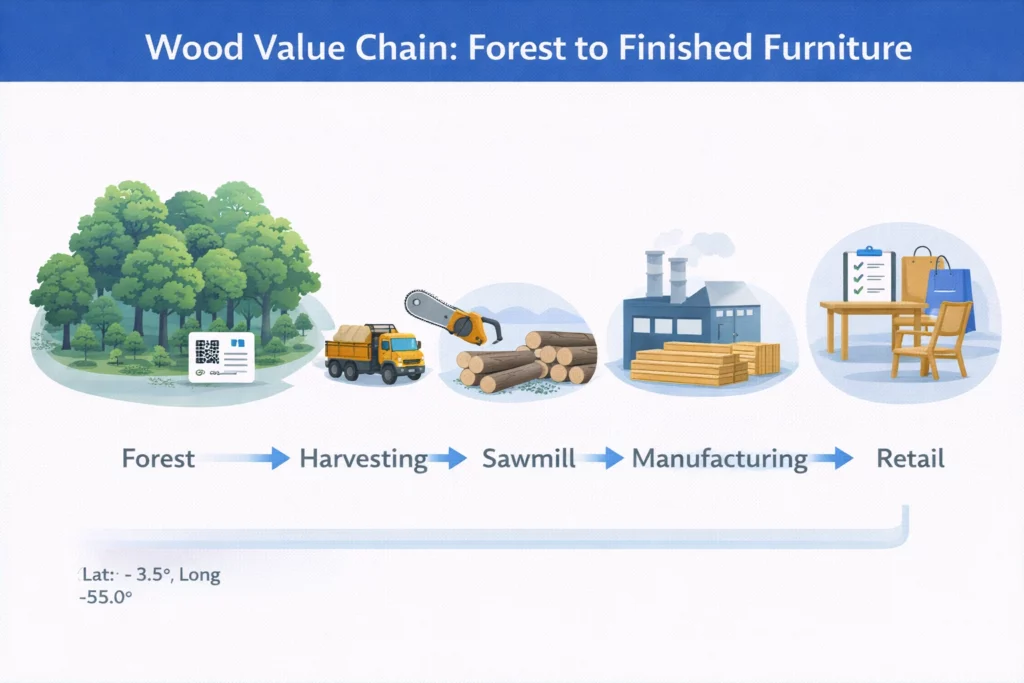
EU wood imports represent ~10-15% of global wood exports (e.g., $11.76B total in 2024, with tropical wood ~708K tons H1 2024, down 16% YoY). ~150,000+ downstream manufacturers (furniture, paper, construction) are impacted across EU, requiring full supply chain DDS under EUDR (all wood products covered)
Under EUDR, manufacturers are classified as either “operators” or “traders”, depending on their role in placing products on the EU market. Operators those introducing products for the first time carry the highest level of responsibility. They must conduct full due diligence, assess supply chain risks, and ensure that products meet all regulatory requirements. Traders, while subject to slightly lighter obligations, must still maintain traceability records and ensure that upstream operators have fulfilled compliance requirements.
| Feature | Operator | Trader (Large/Non-SME) | Trader (SME) |
|---|---|---|---|
| Definition | The first person/entity to place the product on the EU market or export it. | Entities further down the supply chain who are not SMEs. | Small or Medium Enterprises further down the supply chain. |
| Primary Obligation | Must perform Full Due Diligence (Data, Risk Assessment, Mitigation). | Same as the Operator (Full Due Diligence). | Must collect and provide info to downstream partners; record-keeping. |
| Due Diligence Statement (DDS) | Mandatory: Must submit to TRACES-NT before placing/exporting. | Mandatory: Must submit their own DDS (can reference previous ones). | Partial: Must provide Reference Numbers of previous DDSs. |
| Geolocation Data | Mandatory: Must collect and verify polygons/GPS for all plots. | Mandatory: Must ensure geolocation data is linked to the batch. | Mandatory: Must pass on the information; not necessarily the “collector.” |
| Liability | Fully liable for the legality and “deforestation-free” status of the product. | Fully liable for the product they handle. | Liable for providing accurate info; must cooperate with authorities. |
| Record Keeping | Must store evidence for 5 years. | Must store evidence for 5 years. | Must store evidence for 5 years. |
Manufacturers also have a clear obligation to ensure compliant sourcing before EU market placement. This means verifying that all wood inputs, whether logs, veneers, panels, pulp, or components, originate from legally harvested sources and are not linked to deforestation after the regulatory cutoff date. Supplier assurances alone are insufficient; companies must maintain verifiable documentation and risk assessment records.
A central requirement is the submission of Due Diligence Statements (DDS). For every relevant shipment or product batch entering the EU market, operators must file a formal declaration confirming compliance. These statements include origin data, geolocation information, risk evaluations, and mitigation actions where needed.
Critically, accountability extends to raw material origins, not just finished goods. Even when materials pass through multiple processors, manufacturers must preserve chain-of-custody records that link products back to forest plots, making traceability systems essential for regulatory readiness.
Need a complete picture of what compliance involves?
Read our comprehensive guide on EUDR Compliance to understand obligations, workflows, and what it takes to stay EU-market ready.
Facing traceability and sourcing hurdles in forest products?
Explore our deep dive on Challenges in Wood and Timber EUDR Compliance and learn how to overcome multi-tier supplier, transformation, and documentation barriers.
The more a product is processed, the harder it becomes to prove its origin. In upstream supply chains, materials are closer to their source, logs can be linked to specific forest plots, harvest permits are easier to verify, and fewer entities handle the material. But once wood moves into manufacturing ecosystems, traceability becomes exponentially more complex. Each transformation stage adds distance from origin, more stakeholders, and a higher risk of data loss.
Wood manufacturing supply chains typically involve 4-6 supplier tiers on average (Tier 1: direct assemblers/processors; Tier 2: primary sawmills; Tier 3: loggers/harvesters; plus brokers/transporters). Tier-2 Visibility Gap: 70-85% of manufacturers lack full Tier-2 (and deeper) visibility due to fragmented subcontractors and informal logging
| Stage | Role | Complexity Level | Data Burden | The 2026 “Technical Debt” |
|---|---|---|---|---|
| ▲ UPSTREAM (The Peak) | Forest / Land Owner | LOW (Structural) | Single Source: One plot, one polygon, one species list. | Capturing the data for the first time in a digital format. |
| ▰ MIDSTREAM | Sawmills & Pulpers | MEDIUM (Operational) | The Mixing Point: Tracking which logs from which plots went into which “Batch A.” | Solving the “Mass Balance” gap. Digital segregation of compliant logs. |
| ▼ DOWNSTREAM (The Base) | Furniture / Paper Mfrs | HIGH (Architectural) | Composite Hell: A single chair has legs (oak), a seat (plywood), and glue (chemicals). | Integrating 20+ DDS Reference Numbers into one Digital Product Passport (DPP). |
Together, these factors make downstream traceability far more complex than upstream sourcing verification.
EUDR compliance requires origin identity to survive every transformation stage. For wood and wood product manufacturers, traceability does not end at sourcing it must persist as materials are processed, reshaped, and assembled into finished goods. This demands a continuous chain of custody that preserves the link between final products and their original forest plots, even as the material changes form multiple times.
Processing stages see 20-40% traceability loss in wood supply chains (e.g., mixing logs, incomplete docs), dropping to 4.3% untraceable volume at origin per studies. Full traceability cuts recall expenses by 50-75% ($10M avg. food recall vs $2-5M with digital tracking), avoiding extended disruptions in wood/furniture.
Wood products typically move through a complex transformation journey: logs → veneer → boards → components → finished goods. Logs harvested from forests are cut into veneers or sawn timber, which are then processed into panels such as plywood, MDF, or particle board. These panels become parts and components that are assembled into furniture, flooring, paper products, or other finished goods. At each step, materials may be resized, treated, layered, pressed, or chemically processed—making physical origin identification impossible without structured traceability systems.
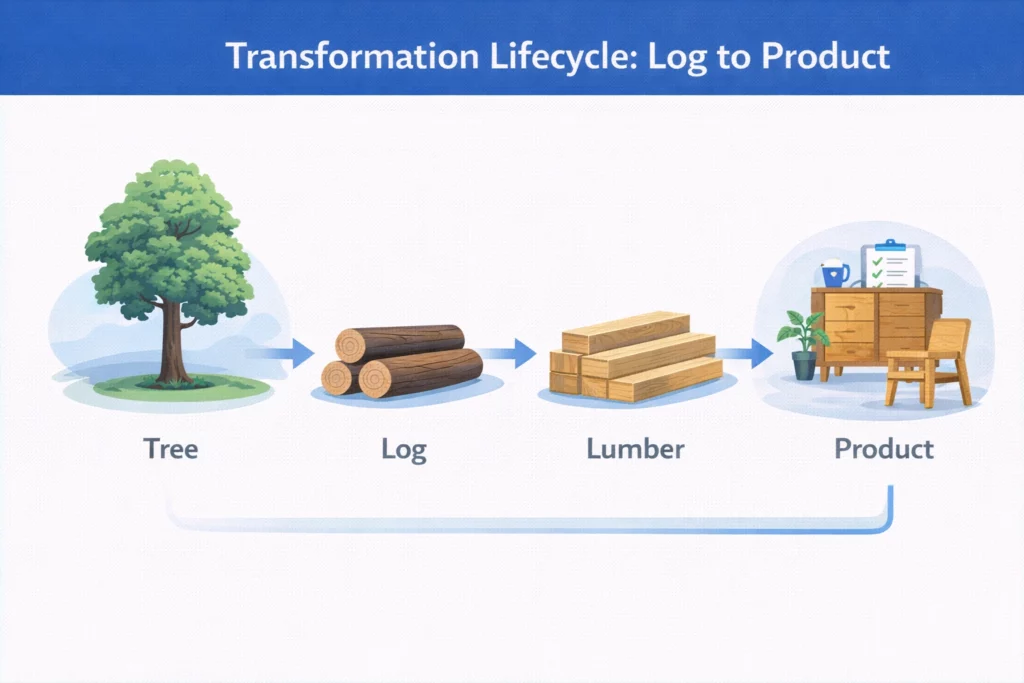
A critical compliance requirement is identity preservation versus material commingling. Identity preservation ensures that wood sourced from verified, compliant plots remains segregated throughout production, storage, and transport. In contrast, commingling mixing materials from different sources breaks origin linkage and makes it impossible to prove which portion of a finished product came from compliant forests. EUDR strongly favours identity-preserved supply chains because they provide defensible proof of origin.
To maintain continuity, manufacturers must implement batch genealogy tracking. This involves assigning unique digital identifiers to material lots and recording how they split, merge, or transform across production stages. Genealogy records create a material lineage tree that connects finished SKUs back to specific input batches and, ultimately, forest sources.
Equally important are transformation-level traceability records. Each processing stage must capture structured data on input materials, production runs, output volumes, timestamps, and facility details.
Together, these practices ensure that traceability survives transformation making compliance verifiable, scalable, and audit-ready.
Composite products create the toughest compliance scenarios. Unlike solid wood items that originate from a single identifiable source, engineered materials are manufactured by blending fibers, layers, and additives from multiple inputs. This mixing process makes it significantly harder to preserve origin identity and demonstrate deforestation-free sourcing under EUDR requirements.
Products such as MDF, plywood, and particle board contain mixed fiber sources. A single panel may include wood from different forests, suppliers, or even countries. Fibers are chipped, pulped, pressed, and bonded together, removing any physical distinction between source materials. Without robust input-level traceability, manufacturers cannot reliably determine which portion of the product came from which origin creating compliance uncertainty.
80-95% of engineered wood products (e.g., plywood, particleboard, glulam) use mixed inputs (multiple log sources, recycled wood, FSC Mix claims), per certification and production data. 50-70% higher in composite chains due to traceability dilution (20-40% loss per processing stage, 70-85% Tier-2 blindness)
Traceability complexity increases further because adhesives and non-wood inputs complicate classification. Resins, binders, laminates, coatings, and surface layers are often added during production. While EUDR focuses on wood-derived components, manufacturers must still map product composition accurately to determine which inputs fall within regulatory scope. Poor material mapping can lead to incomplete declarations or compliance gaps.
A major regulatory challenge is source attribution for blended materials. When inputs from multiple suppliers are combined, manufacturers must maintain detailed records linking each batch of raw material to its respective origin and compliance documentation. This requires digital systems capable of tracking proportions, batch mixing rules, and transformation records across production stages.
Finally, companies must navigate segregation versus mass balance limitations. Physical segregation keeps compliant and non-compliant materials separate, preserving origin integrity but increasing operational complexity. Mass balance accounting allows mixing while tracking volumes on paper, but it weakens proof of physical origin and may not satisfy strict chain-of-custody expectations.
For composite product manufacturers, compliance depends on advanced material mapping, batch-level traceability, and identity-preserved production workflows.
Compliance is verified at the shipment level, not just supplier level. Under EUDR, regulators assess whether each consignment placed on the EU market is backed by complete, verifiable proof of legal and deforestation-free sourcing. This means compliance cannot rely solely on general supplier approvals or annual certifications every shipment must stand on its own with documented evidence.
A core requirement is that each EU-bound shipment requires a Due Diligence Statement (DDS) submission. Before products enter the EU market, operators must file a formal declaration confirming that due diligence has been conducted and that risks have been assessed and mitigated. This statement is lodged in the EU information system and becomes a legally binding compliance record tied to that specific shipment.
To support DDS filings, manufacturers must enable linking product SKUs to compliant input sources. Finished goods in a shipment whether furniture units, flooring panels, paper reels, or engineered boards must be traceable back to the raw material batches used in production. This requires SKU-level traceability that connects product codes to batch genealogy records and upstream forest origin data.
DDS submissions must also include risk assessment and mitigation records. Companies are expected to evaluate deforestation risk, legality concerns, and supply chain integrity based on sourcing geography, supplier reliability, and available evidence. If risks are identified, documented mitigation measures such as additional verification, supplier audits, or alternative sourcing must be recorded.
Finally, regulators expect audit-ready documentation. This includes geolocation data, supplier records, harvest legality documents, chain-of-custody logs, production records, and compliance reports organized and accessible for inspection.
Shipment-level compliance ensures traceability is precise, defensible, and enforceable at the point of market entry.
| Feature | Manual / Legacy Systems | Digital / Automated Systems |
|---|---|---|
| Data Format | Paper, PDFs, and disconnected Excel sheets. | Structured Data: GeoJSON, APIs, and Blockchain ledgers. |
| Audit Speed | Weeks: Involves calling suppliers and chasing email trails. | Real-time: Audit-ready dashboards available 24/7. |
| Error Risk | High: Manual data entry and “fat-finger” errors are common. | Low: Automated validation and satellite cross-referencing. |
| Scalability | Linear Cost: More shipments require more compliance staff. | Exponential: Software handles 10 or 10,000 batches with the same effort. |
| Verification | Declarative: “Take the supplier’s word for it.” | Evidence-Based: Satellite DMRV and cryptographic proof. |
| Regulatory Filing | Manual entry into portals like TRACES-NT. | Automated Sync: Direct API submission of DDS. |
| Cost Structure | High OpEx (Human labor + potential fines). | Initial CapEx (Software) with significantly lower OpEx. |
Check your compliance readiness in minutes
Use our EUDR Readiness Check to identify traceability gaps, risk areas, and the steps needed to stay EU-market ready.
EUDR readiness requires alignment across sourcing, operations, and compliance teams. Because the regulation affects how materials are procured, processed, documented, and reported, preparedness cannot sit with a single department. Manufacturers need coordinated processes, reliable data systems, and clearly defined responsibilities across the organization to ensure smooth and defensible compliance.
Together, these readiness measures enable manufacturers to move from reactive compliance to structured, scalable EUDR execution.
Wood and wood product manufacturers face some of the most complex EUDR compliance challenges. Materials pass through multiple suppliers, processing stages, and countries before becoming finished goods, making origin verification and chain-of-custody preservation difficult. TraceX EUDR Solutions are purpose-built to help manufacturers achieve end-to-end compliance by digitizing traceability, due diligence, and supplier governance across the entire value chain.
At the sourcing stage, TraceX enables plot-level origin traceability by capturing geolocation data and linking raw material inputs logs, timber, pulp, and veneers to verified forest plots. Legal harvest permits, concession documents, and supplier credentials are digitized and mapped to source materials, ensuring legality and deforestation-free verification from the start.
As materials move through sawmills and processing facilities, the platform maintains digital chain-of-custody across transformations. Unique batch IDs track how inputs are converted into veneers, boards, engineered panels, components, and finished goods. This batch genealogy preserves origin identity even when materials are resized, layered, pressed, or assembled.
For engineered and blended products, TraceX supports composite material traceability. Manufacturers can map bills of materials, link each wood-derived input to compliant sources, and manage proportion-level tracking for MDF, plywood, particle board, and other mixed-fiber products.
Operationally, TraceX enables shipment-level compliance workflows. Product SKUs are digitally connected to upstream input batches, allowing automated creation of Due Diligence Statements (DDS) with linked origin, risk assessment, and mitigation records ready for EU submission.
The platform integrates with enterprise systems through ERP connectors and APIs, ensuring procurement, production, inventory, and compliance data stay synchronized without manual spreadsheets.
TraceX also strengthens supplier onboarding and monitoring, enabling multi-tier supplier mapping, documentation management, risk scoring, and continuous compliance verification.
By unifying traceability, documentation, and due diligence in one system, TraceX helps wood product manufacturers move from fragmented records to scalable, audit-ready EUDR compliance.
EUDR has fundamentally reshaped accountability in the wood value chain, extending compliance responsibility far beyond forest operators to downstream manufacturers and brands. Companies that transform, assemble, and place wood products on the EU market must now prove that every input is legally sourced and deforestation-free. Yet the very nature of manufacturing, where materials are processed, blended, resized, and combined, makes traceability far more complex than simple sourcing verification. Origin identity can easily be lost without structured controls. This is why digital chain-of-custody systems are no longer optional; they are essential infrastructure for scalable readiness. By preserving material lineage across suppliers, transformations, and shipments, digital traceability enables manufacturers to meet regulatory demands confidently while strengthening transparency, operational resilience, and long-term market access.
Struggling to preserve product origin across your supply chain?
Explore our guide on Chain of Custody in EUDR to understand identity preservation, segregation models, and audit-ready traceability.
Need technology to connect field data with compliance workflows?
Read our deep dive on Digital Traceability for EUDR and learn how end-to-end chain-of-custody platforms simplify regulatory readiness.
Unsure how to evaluate sourcing exposure and compliance gaps?
Discover our practical guide to EUDR Risk Assessment covering risk classification, supplier evaluation, and mitigation planning.
Yes. EUDR extends responsibility downstream, so manufacturers must ensure all wood inputs are legal, traceable, and deforestation-free.
No. Supplier declarations alone are insufficient verifiable origin data, risk assessments, and documented chain-of-custody are required.
Manufacturers must map material composition, track wood-derived inputs at batch level, and link each source to compliant origin records.
Spreadsheets struggle with multi-tier traceability and audit trails; digital chain-of-custody systems enable scalable, shipment-level compliance.
Yes. Each EU-bound consignment must be backed by a Due Diligence Statement with linked traceability and risk documentation.