
Quick summary: Simplify your EUDR compliance journey with TraceX's platform. Ensure transparency, monitor deforestation risks, and lead in sustainable practices. Learn more!

EUDR compliance refers to meeting the requirements of the EU Deforestation Regulation, which mandates that certain commodities like soy, cocoa, palm oil, and timber—must be proven to be deforestation-free and legally produced. Companies must collect geolocation data, verify land-use legality, and submit due diligence statements to EU authorities. Non-compliance can result in fines, blocked imports, and legal liability for both operators and traders.
EUDR compliance is entering a critical phase in 2025, with tighter enforcement and increased scrutiny on traceability and deforestation-free sourcing. This blog outlines key regulatory changes, industry challenges, and actionable steps to help your business stay ahead and audit-ready.
EUDR mandates that all products entering the EU market must be proven to be deforestation-free, legally produced, and fully traceable back to the plot of land where they were grown. This means businesses must provide accurate geolocation data (point or polygon), due diligence statements (DDS), and risk assessments for every shipment. And here’s the kicker—if even one data point is missing or flawed, the shipment could be blocked.
So, who’s impacted?
Key Takeaways
EUDR compliance is no longer just a policy to skim through—it’s a legal obligation for any business involved in importing, exporting, or trading key commodities like coffee, cocoa, soy, palm, wood, and rubber into the European Union. Starting December 30, 2025, if you can’t prove your product is deforestation-free and fully traceable—you don’t make it to the EU market. Full stop.

But what exactly does “compliance” mean under the EUDR system in 2025? Here’s what businesses need to get right:
Every batch of product must be traced to its origin, down to the exact piece of land it was grown or harvested on.

Every shipment must be accompanied by a digitally filed DDS proving that the goods are:
This document includes everything from GeoJSON files to supplier info, volume, product type, harvest date, and evidence of risk assessment.
Understanding risk assessment, documentation, and due diligence statements is critical for compliance. Dive into a detailed breakdown of how to structure your EUDR due diligence system effectively.
Read Our Guide to EUDR Due Diligence
Precise GPS coordinates and polygon mapping are at the heart of EUDR compliance. Learn exactly what geolocation data is required and how to collect it accurately at scale.
Explore EUDR Geolocation Requirements Explained
EUDR introduces a risk classification system—countries and regions are benchmarked into:
If you source from high-deforestation areas , you’ll face stricter checks, more documentation, and more frequent audits.
If you’re an exporter, cooperative manager, procurement officer, or compliance lead, EUDR is now part of your job description. You want to:
And what’s standing in your way? Disconnected supplier data. Manual traceability. Poor documentation. That’s where digital traceability platforms like TraceX help you turn EUDR compliance from a threat into a competitive edge.
A leading tyre manufacturer overcame EUDR compliance challenges by adopting GeoJSON mapping technology, ensuring a deforestation-free and sustainable natural rubber supply chain.
While the EU Deforestation Regulation (EUDR) sets clear legal requirements, implementation is far more complex in practice. Many companies face operational, technological, and structural barriers that make compliance challenging.
Commodities like coffee, cocoa, and rubber often pass through multiple intermediaries before reaching exporters or EU importers. Aggregators, cooperatives, and processors may maintain inconsistent or incomplete records.
Challenge:
Companies must trace products back to the exact plot of land not just to a supplier group or region.
Lack of Reliable Geolocation Data
Smallholder farmers who dominate coffee and cocoa production often lack digitized land records.
Challenge:
Obtaining accurate GPS coordinates or polygon mapping for thousands of small plots requires field-level digital infrastructure.
EUDR requires companies to:
Manual systems cannot handle this level of complexity at scale.
Risk:
Spreadsheet-based tracking increases the likelihood of data gaps, errors, and audit failures.
Suppliers may:
This creates onboarding delays and compliance bottlenecks.
As enforcement deadlines approach, companies that delay implementation may face rushed onboarding, incomplete data collection, and reactive compliance strategies.
EUDR compliance is not just a legal exercise it requires supply chain digitization and structured governance.
Different commodities present different traceability complexities. Below is how EUDR impacts key sectors.
| Commodity | Practice-Level Complexity | Key Data Points Required | Practical Impact on Operations |
| ☕ Coffee | Highly Fragmented: Millions of smallholders; beans are mixed early at local coops. | Plot geolocation, batch-level tagging, & mill/drying station IDs. | Moving from “Regional Sourcing” to Digital Farmer Ledgers to prevent mixing with unmapped beans. |
| 🍫 Cocoa | High Scrutiny: Overlaps with high-risk West African forest frontiers. | Polygon Mapping (Mandatory >4ha), Farmer ID, & harvest date range. | Physical segregation is now a must; “Laundering” risks mean every bag needs a digital twin from farm-to-port. |
| 🌴 Palm Oil | Complex Derivatives: Found in thousands of end-products (cosmetics, food). | Geolocation of plantations, Mill IDs, & Chain of Custody for fractions. | Operators must trace back through refineries and mills to the specific plantation plot for every fraction/derivative. |
| 🐄 Cattle | Indirect Risk: Tracking “Laundering” where cattle move between ranches. | Geolocation of all establishments (birth, rearing, & slaughter ranches). | For the first time, “Indirect Suppliers” (rearing ranches) must provide GPS data, not just the final fattening ranch. |
| 🪵 Wood | Degradation Focus: Beyond deforestation, it targets “Forest Degradation.” | Geolocation of harvest site, species list, & Legality of Tenure proof. | Repeals EUTR; requires proof that harvesting didn’t convert “Primary Forest” into “Plantation Forest.” |
| 🌿 Rubber | Aggregation Risk: Smallholders produce 85%; latex is pooled in large tanks. | GPS center-points (<4ha), monthly tapping logs, & processing yield data. | Factories must prove Mass Balance logic: Does the output weight match the biological capacity of the mapped plots? |
| 🌱 Soy | Large-Scale Polygons: Major production in South America (Amazon/Cerrado). | Large-scale GeoJSON polygons & satellite time-series analysis. | High-res satellite monitoring is the primary tool to verify that no forest-to-soy conversion happened post-Dec 2020. |
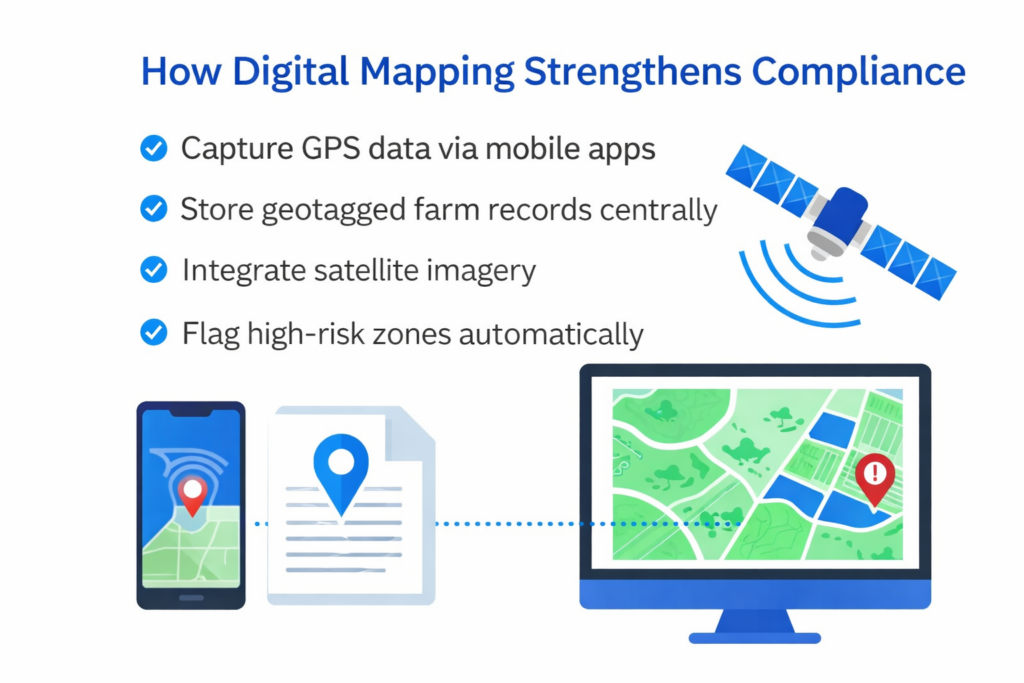
Geolocation is the backbone of EUDR.
Companies must collect:
This data allows authorities to verify that no deforestation occurred after 31 December 2020.
For small plots, point coordinates may suffice.
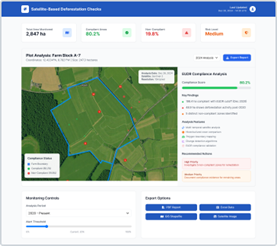
For larger areas, polygon mapping is required to define exact farm boundaries.
Polygon mapping enables:
Without structured geolocation systems, compliance becomes nearly impossible.
Under EUDR, companies must perform a documented risk assessment before placing products on the EU market.
Here’s how that process works in practice:
Step 1: Data Collection
Gather:
Step 2: Deforestation Risk Analysis
Evaluate:
Authorities may classify countries as low, standard, or high risk impacting due diligence intensity.
Step 3: Risk Mitigation
If risk is identified, companies must:
Failure to mitigate risk means products cannot be placed on the EU market.
Step 4: Due Diligence Statement Submission
Before market entry, companies must submit a due diligence statement confirming:
This statement becomes legally binding.
EUDR requires:
Manual documentation cannot reliably manage this at scale.
Digital compliance systems enable:
Companies that digitize early will reduce regulatory risk and gain a competitive edge in EU markets.
TraceX EUDR Compliance Solutions help organizations meet the EU Deforestation Regulation (EUDR) requirements through structured, end-to-end digital traceability.
The platform enables businesses to:
By centralizing geolocation data, supplier records, risk scoring, and documentation workflows, TraceX transforms EUDR compliance from a manual, reactive process into a scalable, transparent, and verifiable system.
The result: reduced regulatory risk, faster audit readiness, and stronger confidence when placing products on the EU market.
As 2026 approaches, EUDR compliance will shift from preparation to full enforcement, with regulators expecting structured due diligence, precise geolocation data, and verifiable proof that commodities are deforestation-free. Companies that rely on manual documentation or fragmented supplier records will face higher risk exposure, delays, and potential penalties. The key to staying ahead is proactive preparation digitizing supplier onboarding, implementing plot-level traceability, strengthening risk assessments, and ensuring audit-ready documentation across the supply chain. Organizations that act now will not only meet regulatory expectations but also build more transparent, resilient, and future-ready sourcing ecosystems.
Risk assessment is the backbone of EUDR compliance. Learn how to evaluate deforestation exposure, supplier risk, and mitigation measures before placing products on the EU market.
Read: EUDR Risk Assessments Explained
Filing a DDS incorrectly can delay market access and increase regulatory exposure. Understand what information is required, when to file, and how to ensure accuracy.
Explore: How to File a DDS Under EUDR
With enforcement deadlines approaching, preparation is no longer optional. Discover how businesses are accelerating traceability, geolocation mapping, and due diligence to stay competitive.
Read: Winning the EUDR Compliance Race
EUDR applies to operators and traders placing relevant commodities or derived products on the EU market or exporting them from the EU. This includes importers, exporters, manufacturers, processors, and large distributors involved in covered supply chains.
The EU Deforestation Regulation (EUDR) entered into force on 29 June 2023. Large and medium companies must comply from 30 December 2026, while micro and small enterprises have additional time until 30 June 2027.
EUDR covers seven key commodities and their derived products:
Products like leather, chocolate, furniture, paper, and palm oil derivatives are also included if linked to these commodities.
Companies must collect precise geolocation coordinates (latitude and longitude) of the plots of land where the commodities were produced. For larger areas, polygon mapping of farm boundaries is required to verify that production did not occur on deforested land after 31 December 2020.
Non-compliance can result in:
Penalties are enforced by EU Member States and are designed to be proportionate and dissuasive.
Ready to Go Deeper Into EUDR?
Get a clear overview of the regulation and who it affects.
Learn which commodities, geographies, and operators are covered.