
Quick summary: Explore how Cote D’Ivoire cocoa exporters can achieve EUDR compliance through digital traceability, geolocation mapping, and blockchain verification. Learn how platforms like TraceX simplify Due Diligence Statement (DDS) creation, ensure deforestation-free sourcing, and future-proof cocoa exports to the EU market.

EUDR Compliance for Cocoa Exporters in Cote d’Ivoire requires exporters to prove that all cocoa entering the EU is deforestation-free, legally sourced, and fully traceable to the exact farm or plot of origin. Ivorian exporters must collect geolocation polygons for all supplying farms, verify land-use legality, assess deforestation risk, and maintain a transparent chain of custody across cooperatives, buying centers, and processors. A complete Due Diligence Statement (DDS) must be submitted before each shipment. Robust digital traceability and supplier onboarding are essential to safeguard Cote d’Ivoire’s access to the EU cocoa market.
Cote d’Ivoire is the world’s largest cocoa producer and the backbone of the global chocolate supply chain. Cocoa cultivation spans major regions including Soubre, Daloa, San Pedro, Abengourou, and Bouafle, where rich soils and a tropical climate support production across an estimated one million smallholder farms. The country produces 2.0-2.2 million metric tonnes of cocoa annually, making cocoa its most economically significant export. The European Union is Cote d’Ivoire’s dominant market, followed by the United States and growing Asian demand.
Ivorian exports include raw cocoa beans (HS 1801), cocoa paste/liquor (HS 1803), cocoa butter (HS 1804), cocoa powder (HS 1805), and chocolate ingredients (HS 1806). Cote d’Ivoire is globally recognized for its robust flavor profile, consistent bean quality, and large-scale processing capacity, with major grinding companies operating in Abidjan and San Pedro positioning the country as both a top raw-bean exporter and Africa’s largest cocoa processor.
Sustainability initiatives led by the Coffee-Cocoa Council (CCC), exporters, NGOs, and public-private partnerships continue to expand replanting programs, agroforestry adoption, certification (Rainforest Alliance, Fairtrade), and farmer livelihood support systems. The introduction of the EU Deforestation Regulation (EUDR) has accelerated national efforts in farm mapping, GPS polygon data collection, land-tenure verification, and digital traceability to ensure uninterrupted access to EU markets. Cote d’Ivoire is advancing systems like the Systeme de Tracabilite du Cacao (STC) and satellite-based landscape monitoring to strengthen compliance and transparency.
With continued investment in digital traceability, climate-smart cocoa production, and farmer-level capacity building, Cote d’Ivoire is positioned to maintain its leadership as a reliable, high-volume, and sustainably driven origin for the global chocolate industry.
Want to see how digital technology is reshaping sustainability compliance? Explore our latest blog on Digital Traceability for EUDR
Curious how cocoa exporters can stay ahead of new EU deforestation rules? Our in-depth blog on EUDR Cocoa Compliance explains the regulation’s full impact
Cote d’Ivoire the world’s largest cocoa producer faces significant structural, operational, and data-integrity challenges as it adapts to the EU Deforestation Regulation (EUDR). Because the EU is the country’s top cocoa buyer, meeting EUDR standards is critical, yet several constraints complicate compliance.
Over one million smallholder farmers produce Ivorian cocoa, many farming on small plots without formal GPS mapping, polygon boundaries, or validated land ownership records. EUDR requires exact geolocation polygons for every supplying farm yet mapping such a vast and dispersed farmer population within the deadlines is a major logistical and financial challenge.
Many farmers lack formal land titles or documentation proving legal land use. Under EUDR, exporters must verify legality according to Ivorian law meaning land ownership, land-use rights, forest classification, and protected-area status. Ambiguous or missing documents make legality verification difficult and risk disqualifying compliant farmers.
Cote d’Ivoire has experienced decades of forest loss due to cocoa expansion. A significant number of farmers operate near or within former forest reserves or reclassified forest landscapes. EUDR prohibits cocoa grown on land deforested after 31 December 2020 meaning exporters must detect and exclude farms with even slight post-2020 land-use change, creating high-stakes compliance pressure.
Cocoa sourcing involves cooperatives, pisteurs (middlemen), buying centres, and aggregators. These multiple layers reduce traceability and create data breaks in the chain of custody. Ensuring a transparent, tamper-proof link from farm to warehouse is challenging without digitalization.
Many cooperatives still use paper records for farmer lists, delivery receipts, farm locations, and harvest quantities. EUDR requires digital, verifiable, and audit-ready documentation. Manual systems create accuracy risks, duplication, fraud, and missing data, slowing DDS preparation.
Many farmers and cooperatives lack GPS mapping skills, mobile data tools, digital literacy, and awareness of EUDR requirements. Exporters must invest in large-scale capacity building to ensure data quality and compliance readiness.
EUDR mandates risk assessment using satellite monitoring, historic land-use data, and deforestation alerts. Most exporters do not currently have access to reliable geospatial tools or AI-driven monitoring systems. Integrating these technologies is costly and time-intensive.
Large and medium operators must comply by 30 December 2025; small operators by 30 June 2026. With millions of farms to map and verify, the timeline poses a significant operational challenge for Cote d’Ivoire’s entire cocoa ecosystem.
Compliance requires investment in GPS mapping, digital traceability platforms, legality verification, cooperative onboarding, and blockchain or data-security systems. For many exporters especially medium-size traders the cost burden is substantial.
Farms lacking valid polygons or legality documents may be excluded from EU supply chains. Exporters risk losing volumes, renegotiating supplier networks, reduced competitiveness, and downward pressure on farmgate prices. This creates socio-economic challenges for farmers and exporters alike.
EUDR represents the most significant regulatory overhaul in Cote d’Ivoire’s cocoa history. Exporters must navigate massive-scale geolocation mapping, complex land-tenure realities, fragmented supply networks, technology adoption, and stringent timelines. Without rapid investments in digital traceability, remote sensing, farmer training, and legality verification, Cote d’Ivoire risks disruptions to its dominant cocoa export industry.
The EU Deforestation Regulation (EUDR) requires Ivorian cocoa exporters to prove that every shipment entering the EU is deforestation-free, legally produced, and traceable to the exact farm or plot of origin. With Cote d’Ivoire’s cocoa sector involving more than one million smallholder farmers across regions such as Soubre, Daloa, San Pedro, Abengourou, Bouafle, and Gagnoa, manual compliance processes cannot meet EUDR’s stringent requirements. Fragmented sourcing, undocumented land tenure, and non-digital record systems make traceability difficult. The TraceX EUDR Compliance Platform provides an integrated digital ecosystem that automates due diligence, ensures supply-chain transparency, and protects Cote d’Ivoire’s core access to EU cocoa markets.
TraceX platform connects cooperatives, pisteurs, buying centres, exporters, and processors into one unified platform. Each cocoa batch receives a unique digital identity linked to GPS-verified farm polygons, farmer profiles, and delivery records. This creates a tamper-proof, auditable chain of custody from the farmgate to the port of Abidjan or San Pedro, ensuring full compliance with EUDR traceability standards.
Using mobile field applications, TraceX solutions enable real-time capture of farm polygons, land-use legality documents, production records, and aggregation transactions. The platform automatically compiles these into an EUDR-compliant DDS, reducing manual labour, eliminating documentation errors, and accelerating EU submission from weeks to a matter of hours.
All activities harvesting, fermentation, drying, aggregation, transport, processing, and export are recorded on an immutable blockchain ledger. Exporters gain verifiable proof that their cocoa originates from legally compliant, deforestation-free farms in line with national guidelines from the Coffee-Cocoa Council (CCC) and environmental authorities.
Cote d’Ivoire’s cocoa value chain is highly fragmented, with millions of smallholders operating small plots often without formal mapping. TraceX simplifies onboarding using mobile-enabled GPS polygon mapping tools. Each farm is mapped, documents (land rights, certifications, contracts) are digitized, and sustainability credentials such as Rainforest Alliance or Fairtrade are stored securely ensuring comprehensive visibility across farmer networks.
TraceX platform integrates AI analytics and satellite imagery (forest loss, canopy change, boundary expansion) to detect potential non-compliance zones. Exporters access risk dashboards that identify land-use change since the EUDR cutoff date (31 Dec 2020), enabling proactive mitigation and ensuring every cocoa batch meets EUDR’s deforestation-free criteria.
TraceX platform acts as a centralized digital compliance hub supporting seamless collaboration among cooperatives and farmer groups, exporters and processors, pisteurs and aggregators, EU importers, certification bodies, and national regulators (CCC, Ministry of Water and Forests, Customs). Standardized workflows reduce documentation gaps, accelerate inspections, and build stronger trust with international buyers.
With AI-driven risk intelligence, blockchain-secured traceability, and automated DDS workflows, TraceX helps Ivorian exporters transform EUDR compliance into a competitive strength. Exporters can demonstrate transparent, sustainable sourcing; deepen EU buyer partnerships; and solidify Cote d’Ivoire’s leadership as the world’s most reliable supplier of high-quality, deforestation-free cocoa.
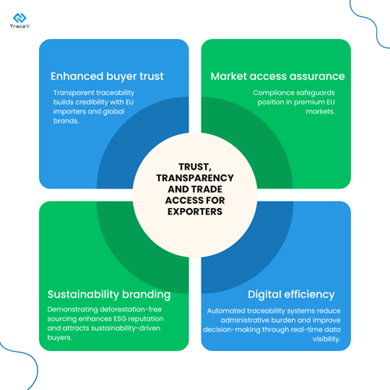
EUDR compliance is critical for Cote d’Ivoire because the European Union remains its largest cocoa buyer, absorbing the majority of its beans, semi-processed cocoa, and chocolate inputs. As the world’s leading cocoa producer, any disruption in EU market access would have major economic consequences impacting exporters, cooperatives, and more than one million smallholder farmers who depend on cocoa for their livelihoods.
The EUDR requires cocoa to be deforestation-free, legally sourced, and fully traceable to the exact farm polygon. Given Cote d’Ivoire’s history of forest loss and the presence of farms in or near classified forests, the regulation is reshaping how the entire sector operates. Compliance is no longer optional; it is now a prerequisite for sustaining exports, maintaining buyer confidence, and meeting global sustainability standards.
For Cote d’Ivoire, EUDR compliance also represents an opportunity. It accelerates farm mapping, land-tenure reform, and digital traceability, strengthening long-term supply-chain transparency. It enhances the country’s reputation as a responsible, sustainable origin, crucial for premium market positioning. It also supports climate and forest restoration efforts that align with CCC and national environmental policies.
By embracing EUDR requirements, Cote d’Ivoire can secure uninterrupted access to EU markets, protect farmer incomes, strengthen its global cocoa leadership, and transition toward a more sustainable, resilient cocoa economy.
EUDR Compliance for Cocoa Exporters in Cote d’Ivoire is essential to safeguarding the country’s dominant role in the global cocoa economy. By adopting digital traceability, farm-level geolocation mapping, robust legality verification, and automated DDS workflows, Ivorian exporters can ensure uninterrupted access to the EU’s highest-value markets. Compliance not only protects export revenues but also strengthens sustainability credentials, builds buyer confidence, and positions Cote d’Ivoire as a global leader in deforestation-free, transparent, and future-ready cocoa trade.
Understand the key components of EUDR compliance and how to streamline your DDS process efficiently. Read the blog on EUDR Due Diligence
Learn how AI-driven automation and intelligent workflows simplify data collection, verification, and reporting. Explore the blog on Agentic AI for EUDR
Discover how digital onboarding bridges the gap between smallholders and EUDR compliance. Read our blog: Smallholder Onboarding for EUDR Compliance
EUDR compliance requires Cote D’Ivoire cocoa exporters to prove that all cocoa exported to the EU is deforestation-free, legally produced, and traceable to the exact farm or cooperative where it was grown. Exporters must provide geolocation data, legality documents, and evidence that cocoa farms were not linked to deforestation after 31 December 2020.
The EU is one of Cote D’Ivoire’s largest cocoa markets, absorbing more than 65% of its cocoa exports. Compliance ensures continued EU market access, strengthens Cote D’Ivoire’s reputation as a sustainable cocoa origin, and aligns the sector with global demand for ethically sourced, environmentally responsible cocoa.
Exporters must:
Key challenges include:
Compliance enhances transparency, builds buyer confidence, improves sustainability credentials, and secures long-term access to premium EU markets. It also drives sector modernization, increases farmer inclusion, and positions Cote D’Ivoire as a trusted supplier of deforestation-free, high-quality cocoa.