
Quick summary: TraceX helps wood companies in Portugal meet EUDR requirements with automated Due Diligence Statement (DDS) generation, farm-level traceability, and deforestation risk verification.
EUDR DDS for Soy Supply Chain in Portugal requires Portuguese importers, crushers, feed manufacturers, and traders to prove that all soybeans, soymeal, and soy oil are legally sourced, deforestation-free, and traceable to their farm of origin. Companies must collect geolocation data for every plot, verify land-use legality, assess deforestation risks, and submit an EU-compliant Due Diligence Statement (DDS) before placing soy products on the market. With soy’s high-risk classification, operators in Portugal must implement robust digital traceability, supplier documentation workflows, and continuous risk monitoring to ensure full compliance and maintain access to the EU supply chain.
The EU Deforestation Regulation (EUDR) is reshaping how Portugal’s soy supply chain must function. As a key European importer of soybeans, soymeal, and soy oil used in livestock feed, aquaculture, food processing, and bio-based industries, Portugal must now ensure that all soy entering its territory is legally produced, deforestation-free (post-2020), and fully traceable to the exact farm or plot of origin.
Soy is classified as a high-risk commodity under the EUDR due to its strong links to deforestation in major producer countries such as Brazil, Argentina, and Paraguay. Because Portugal heavily relies on imported soy for poultry, swine, cattle, and aquaculture feed, operators must now demonstrate legality, verify deforestation-free status, and collect full geolocation coordinates for every sourcing plot associated with soybeans and soy derivatives.
Portugal is an important node in the EU’s soy value chain, with substantial volumes entering through the ports of Lisbon, Sines, and Leixoes. These imports supply national feed mills, crushers, food manufacturers, and traders. Under EUDR, any Portuguese operator placing soy or soy-based products on the EU market must map suppliers back to the farm level, verify land legality, conduct deforestation risk assessments, and submit a compliant Due Diligence Statement (DDS) for every batch.
EUDR deadlines for Portugal follow the EU-wide schedule:
This means Portuguese importers, feed manufacturers, and traders must rapidly adopt digital traceability tools and supplier verification workflows to maintain uninterrupted market access.
EUDR applies to:
Given Portugal’s reliance on soy-derived feed ingredients across poultry, swine, and dairy sectors, a wide range of operators fall within EUDR obligations.
For Portugal, the EUDR accelerates modernization across the entire soy supply chain. Importers, feed mills, and processors must adopt digital traceability, integrate farm-level geolocation data, and strengthen supplier compliance. By doing so, Portuguese soy operators can minimize regulatory risks, ensure business continuity, and reinforce their position as credible suppliers to EU buyers seeking deforestation-free, high-integrity supply chains.
Portugal’s soy importers, feed manufacturers, crushers, and traders face significant operational and documentation challenges as they transition to full compliance with the EU Deforestation Regulation (EUDR). Because Portugal relies almost entirely on imported soybeans, soymeal, and soy oil primarily from Brazil, Argentina, and Paraguay the complexity and opacity of global soy supply chains make compliance particularly demanding. The main challenges include:
EUDR requires precise polygon geolocation coordinates for every farm producing soy destined for Portugal. This poses several hurdles: large portions of Brazilian and Paraguayan soy come through traders and intermediaries, not directly from farms; small and mid-sized producers often lack digital mapping tools, making polygon collection slow and inconsistent; and large traders may hesitate to share sensitive farm-level data due to competitive or privacy concerns.
Portugal often imports soy via long, complex supply chains involving farmers, cooperatives, local aggregators, crushers, international merchants, and shipping brokers. This fragmentation makes end-to-end supplier mapping extremely difficult, especially when documentation is incomplete or inconsistent.
Key origin countries present risks such as lack of standardized documentation, limited access to official land legality records, variability in satellite-verifiable deforestation data, and difficulty tracing soy from multi-origin storage and blending facilities. For Portuguese importers, this creates uncertainty about whether consignments truly meet deforestation-free requirements.
The EUDR requires proof of compliance with local land-use laws, forest codes, and harvesting regulations. Portuguese operators often struggle to validate complex Brazilian legal documents, confirm land tenure, property rights, or CAR registrations, and assess legality for thousands of smallholders indirectly supplying large traders. This slows down DDS verification and increases administrative costs.
Operators must prove “no or negligible risk” of deforestation or illegality. This requires continuous satellite monitoring, evaluation of deforestation alerts, cross-checking with JRC risk maps, and documenting mitigation actions. For many Portuguese feed mills and traders, these tasks exceed internal technical capacity.
While Portuguese companies are modernizing, many upstream producers in South America still use paper-based records, manual farm documentation, and non-standardized data collection methods. This creates bottlenecks when assembling digital DDS files.
Portugal imports large volumes of soymeal, not just whole soybeans. Soymeal often comes from crushing plants that mix soy from hundreds of farms, operate in regions with deforestation risk, and provide aggregated certificates without farm-level granularity. This conflicts directly with EUDR’s requirement for plot-level traceability.
Creating an EUDR-compliant DDS requires collecting multiple documents, validating geolocation polygons, assessing risk, completing due diligence, and uploading everything to the EU IT system. Portuguese operators, especially SMEs, lack the resources to manage these tasks manually.
With limited compliant soy available from high-risk regions, Portuguese feed producers may face higher sourcing costs, supply shortages, re-negotiation with upstream partners, and increased dependence on certified or segregated supply streams. These disruptions could affect livestock, dairy, poultry, and aquaculture sectors that rely heavily on soy protein.
As Portugal strengthens its position as a key EU gateway for soy imports primarily for feed manufacturing, livestock production, and food processing EUDR compliance has become essential. Portuguese soy importers, crushers, feed mills, and traders must now ensure every shipment of soybeans, soymeal, or soy oil is deforestation-free, legally sourced, and traceable to the exact farm or plot of origin. The TraceX EUDR Compliance Platform delivers an integrated digital solution powered by AI, blockchain, and geospatial intelligence, enabling Portuguese soy operators to automate Due Diligence Statement (DDS) creation, streamline supplier onboarding, and meet the 2025-2026 compliance deadlines with confidence.
TraceX simplifies DDS preparation by automatically consolidating geolocation polygons, legality records, supplier declarations, and traceability data into a unified digital file. With direct links to the EU reporting portal, Portuguese importers and processors can generate submission-ready DDS reports within minutes reducing manual effort, minimizing documentation errors, and ensuring full audit readiness for all soy consignments entering or circulating within the EU.
Every soy batch arriving at Portuguese ports such as Lisbon, Sines, Leixoes, or Setubal receives a blockchain-secured digital identity, establishing a tamper-proof chain of custody from farms in Brazil, Argentina, or Paraguay to Portuguese feed mills and poultry/dairy operations. This immutable traceability enhances credibility with EU regulators and provides transparent proof of deforestation-free sourcing.
Using TraceX’s mobile-enabled onboarding tools, international suppliers, cooperatives, and traders can digitally upload documentation and capture accurate GPS coordinates of soy-producing plots. For Portuguese companies that rely heavily on imports from high-risk regions, this ensures inclusive geolocation coverage even for smallholders with low digital maturity while building a fully compliant supplier ecosystem.
TraceX’s AI-driven dashboards give Portuguese soy operators real-time insight into deforestation alerts, land-use change signals, supplier risk scoring, and documentation gaps. This allows feed manufacturers, livestock integrators, and traders to proactively identify high-risk sources and implement mitigation actions before imports reach Portugal. Predictive analytics also help businesses stay aligned with evolving EUDR classifications and enforcement requirements.
A Portuguese feed manufacturer importing soymeal from Brazil and Argentina can use TraceX to map supplier farms, verify land legality, capture GeoJSON plot data, and generate EUDR-compliant DDS files for each incoming shipment. Within a short period, the company can establish full traceability, reduce manual compliance workloads by up to 70%, and guarantee deforestation-free sourcing across all EU-facing supply chains.
By combining blockchain-secured transparency, AI-based risk analysis, and automated DDS workflows, TraceX helps Portugal’s soy sector convert EUDR compliance from a regulatory burden into a strategic differentiator. Portuguese importers, crushers, and feed processors can secure uninterrupted EU market access, meet ESG commitments, reduce regulatory risks, and position themselves as leaders in responsible, deforestation-free soy sourcing.
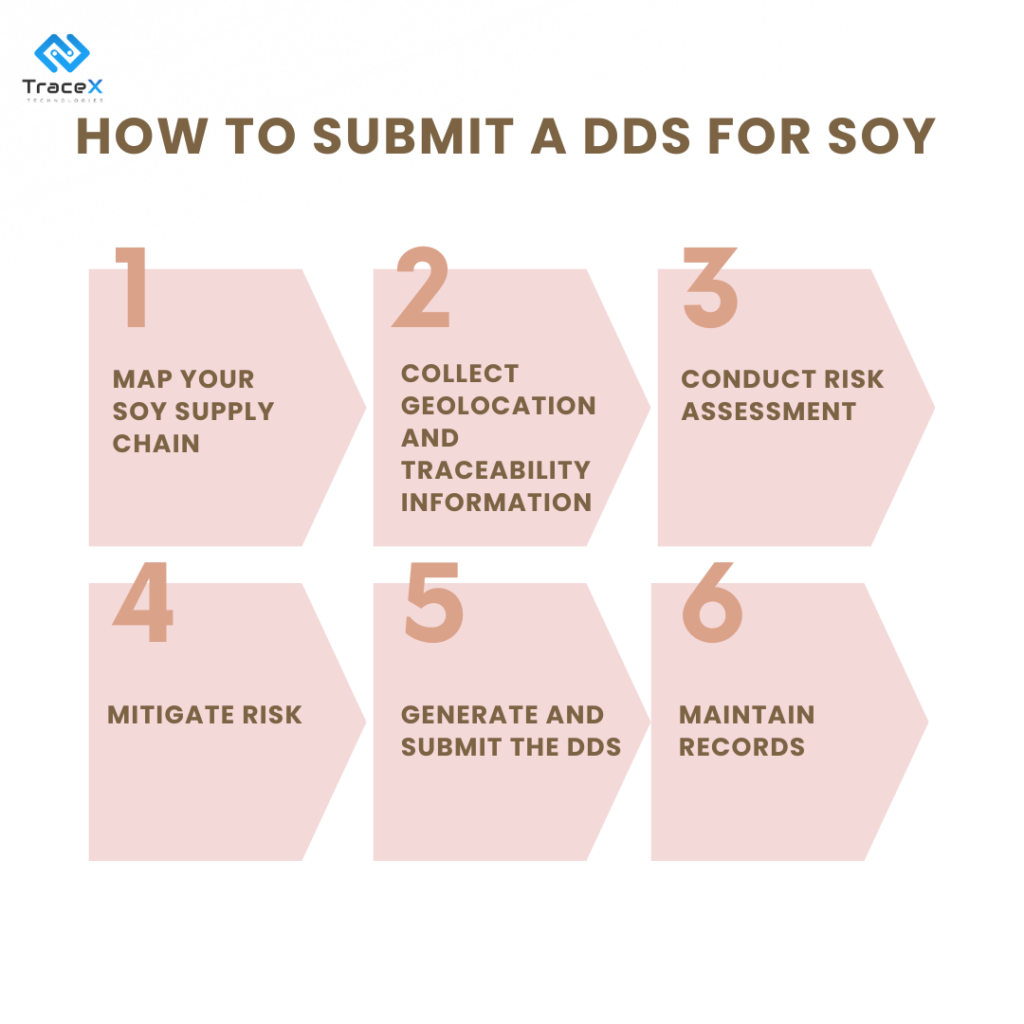
The EUDR introduces structural changes that directly affect Portugal’s soy-dependent industries particularly feed mills, livestock integrators, poultry and dairy producers, food processors, and soy importers. Because Portugal relies heavily on imported soymeal and soybeans from Brazil, Argentina, and Paraguay, EUDR compliance becomes mission-critical for maintaining uninterrupted supply. The regulation forces companies to shift from traditional documentation-based sourcing to precise, geolocation-verified, deforestation-free traceability, which requires new systems, upstream visibility, and supplier alignment.
For the feed sector where soymeal is a core ingredient non-compliance could result in shipment seizures, delays at ports, product withdrawal from the EU market, and severe cost impacts on animal production lines. Food processors using lecithin, refined soy oil, and protein ingredients must also ensure full traceability back to farm-level plots.
Beyond regulatory mandates, EUDR compliance shapes market competitiveness. Retailers, international buyers, and EU regulators increasingly require proof of sustainable, deforestation-free sourcing. Portuguese companies that adapt early can secure higher buyer trust, reduce ESG risks, and position themselves as preferred partners across EU markets. Those that delay risk supply chain disruptions, compliance penalties, rising operational costs, and reduced market access.
Ultimately, EUDR compliance is not just an obligation it is a strategic opportunity for Portugal’s soy, food, and feed industries to modernize sourcing systems, strengthen environmental accountability, and build resilient, future-proof supply chains aligned with EU climate and biodiversity goals.
EUDR DDS for the soy supply chain in Portugal marks a decisive shift toward full transparency, legality verification, and deforestation-free sourcing. For Portuguese importers, feed mills, and food manufacturers, compliance is not only a regulatory requirement but a long-term competitiveness driver. By investing in digital traceability, geolocation data capture, supplier onboarding, and continuous risk monitoring, Portugal’s soy sector can safeguard EU market access, reduce operational risks, and enhance sustainability credentials. Early adoption of robust DDS frameworks positions Portuguese companies as leaders in responsible sourcing, ensuring a resilient, future-ready soy value chain aligned with EU environmental standards.