
Quick summary: TraceX helps wood companies in Portugal meet EUDR requirements with automated Due Diligence Statement (DDS) generation, farm-level traceability, and deforestation risk verification.
EUDR DDS for Wood Supply Chain in Portugal requires exporters, processors, and traders to prove that all wood, pulp, and paper products are legally sourced, deforestation-free, and traceable to their forest of origin. Portugal’s operators must collect geolocation data for forest plots, verify land legality, assess deforestation risks, and generate an EUDR-compliant Due Diligence Statement (DDS) before placing products on the EU market. With the 2025/2026 deadlines approaching, implementing digital traceability, supplier verification, and chain-of-custody controls is essential for maintaining compliance and ensuring transparent, audit-ready wood supply chains in Portugal.
The EU Deforestation Regulation (EUDR) is transforming how Portugal’s wood, forestry, and pulp-and-paper industries operate within the European market. As one of Southern Europe’s most significant producers and exporters of wood, cork, pulp, and paper, Portugal now plays a crucial role in ensuring that all forest-derived products are legally sourced, deforestation-free, and fully traceable from forest to finished goods.
The regulation aims to eliminate global deforestation linked to high-risk commodities including wood, coffee, cocoa, soy, palm oil, rubber, and cattle. For Portugal with its strong forestry base in eucalyptus and pine, world-leading pulp and paper production, and growing timber export footprint the EUDR introduces a new era of environmental compliance, transparency, and supply-chain accountability across industries such as construction materials, pulp and paper, furniture, biomass, and packaging.
Wood is a high-priority commodity under the EUDR due to its global link to illegal logging and forest degradation. The regulation applies to both raw wood and processed derivatives including lumber, MDF, plywood, engineered wood, pulp, and paper.
For Portugal, this means operators handling domestic eucalyptus/pine or importing “at-risk” tropical wood must now prove that all materials are legally harvested under national land-use and forestry laws and deforestation-free, with no forest converted after 31 December 2020.
This directly affects Portugal’s major export categories such as pulp, kraft paper, packaging grades, wood panels, and sawn wood – core pillars of the country’s global market competitiveness.
Portugal is a strategic European hub for pulp, paper, and engineered wood products, with major industrial clusters concentrated in Aveiro, Setubal, Leiria, Coimbra, and Porto. The ports of Leixoes, Sines, and Lisbon serve as vital gateways for importing wood raw materials and exporting finished products to EU and global markets.
Under the EUDR, every operator placing wood or wood-derived products on the EU market must implement a Due Diligence System (DDS) that collects geolocation coordinates for forest plots where wood is harvested, verifies legality under Portuguese forestry laws and international standards, and demonstrates deforestation-free status through risk assessments, supporting documents, and continuous monitoring.
This framework replaces the EU Timber Regulation (EUTR), expanding oversight from legality alone to full proof of deforestation-free sourcing ushering in stricter compliance and deeper supply-chain transparency.
The EUDR applies uniformly across the EU, including Portugal, with key deadlines:
To meet the deadlines, companies must begin geolocating forests, mapping suppliers, digitizing records, and establishing traceability workflows now to avoid disruptions.
The EUDR applies to a broad range of wood and wood-derived products manufactured or traded in Portugal, including:
Accurate HS classification is critical for customs, risk filtering, and EUDR DDS submission.
To comply with EUDR, Portugal’s wood and pulp industries must modernize their traceability infrastructure. This includes integrating forest geolocation mapping, digital chain-of-custody tracking, legality documentation, and deforestation-risk analytics.
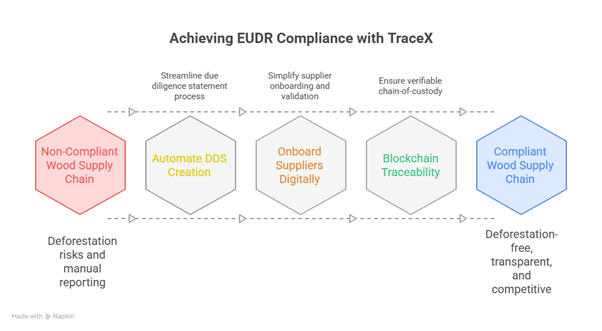
Digital platforms from TraceX can automate DDS creation, validate geospatial data, onboard suppliers, and monitor risks reducing compliance workloads and strengthening Portugal’s position as a trusted, sustainable producer of forest-based products.
Portugal’s wood, pulp, paper, and timber-processing industries face a transformative compliance shift under the EUDR. Although Portugal has a strong legal forestry framework and one of Europe’s most organized plantation systems (primarily eucalyptus and maritime pine), meeting EUDR standards presents significant operational, technical, and data-management challenges across the value chain.
Portugal has one of the most fragmented forest ownership structures in Europe. More than 90% of forests are privately owned, often in small, dispersed parcels. Challenges include collecting polygon geolocation data for thousands of micro-plots, limited digital literacy among small forest owners, and incomplete or outdated cadastral records in some rural regions. This makes achieving full traceability from forest to mill extremely complex.
Portuguese mills source wood from plantations, community forests, small private plots, and imported tropical timber. Difficulties arise when verifying land-use rights and harvesting permits across multiple owners, compliance with national forestry laws and sustainable management plans, and legality of imported wood from Africa or Latin America, which carries higher EUDR risk. Multi-origin sourcing increases verification workload and risk scoring.
Portugal is a global leader in pulp and kraft paper, and mills often blend wood from eucalyptus plantations, pine forests, imported hardwood chips, and recovered fiber streams. EUDR demands full traceability for each input batch, making fiber mixing points a major compliance bottleneck for Portuguese mills.
Many forest owners, timber traders, and transporters still operate with paper-based or informal documentation. This results in missing or inconsistent harvest records, difficulty proving deforestation-free status, and high manual workload for mills and exporters building DDS. Digitization across the supply chain is uneven and often costly for smaller players.
Wood transported from forest plots to mills passes through multiple intermediaries, cooperative yards, transport contractors, and regional aggregation points. Every transfer must be traceable under EUDR, but fragmented documentation makes chain-of-custody continuity challenging.
Portuguese operators must ensure every supplier local forest owners, cooperatives, sawmills, chip suppliers, and traders meets EUDR data requirements. Key hurdles include suppliers unfamiliar with geolocation and legality documentation, resistance to digital platforms, and high onboarding effort for mills handling hundreds of small suppliers. Ensuring uniform compliance readiness across such a distributed ecosystem is resource intensive.
Portugal imports tropical hardwood, softwood, and pulp from Brazil, Mozambique, Congo, Chile, and other regions. Under EUDR, companies must assess country/region risk levels, verify plantation legality, and conduct enhanced due diligence for high-risk regions. This significantly increases administrative complexity and potential shipment delays.
Portuguese companies must integrate EUDR compliance with FSC/PEFC certification, ESG reporting, carbon sequestration targets, and biodiversity requirements. Aligning these systems creates operational strain, especially for mid-sized mills and manufacturers.
As the EU Deforestation Regulation (EUDR) approaches full enforcement, Portugal’s forestry operators, pulp and paper companies, sawmills, furniture manufacturers, and wood exporters must ensure that every timber consignment is legally sourced, deforestation-free, and traceable back to its exact forest plot. The TraceX EUDR Compliance Platform provides an integrated digital ecosystem that helps Portuguese companies automate Due Diligence Statement (DDS) creation, centralize supplier data, and maintain continuous compliance for EU and global wood markets.
TraceX automates the complete DDS lifecycle data capture, validation, and submission directly to the EU’s central reporting portal. The platform consolidates all required EUDR inputs, including geolocation polygons of forest plots, harvesting permits, land-use legality documents, and FSC/PEFC certification. For Portuguese exporters, this automation eliminates manual documentation errors, reduces administrative burden, prevents shipment delays or non-compliance penalties, and ensures seamless trade with EU buyers.
Every log, chip, pulp batch, panel, or furniture component receives a blockchain-secured digital identity, creating a tamper-proof chain of custody from forest to final product. TraceX links verified data across privately owned forests and cooperatives in Tras-os-Montes, Ribatejo, and Alentejo; sawmills, pulp mills, and furniture clusters in Aveiro, Leiria, and Setubal; and export channels through ports such as Leixoes, Sines, and Lisbon. This immutable ledger strengthens transparency, builds buyer trust, and simplifies EUDR audits for Portuguese operators.
Portugal’s forest landscape is highly fragmented; millions of small landowners supply wood to mills and traders. TraceX enables rapid digital onboarding through mobile tools that capture GPS-verified forest boundaries, land legality documentation, grower/supplier identity (KYC), and harvesting permits and management plans. This ensures that even small private forest owners can participate in EUDR-compliant supply chains, promoting inclusive digitization across Portugal’s forestry sector.
TraceX’s AI engine integrates satellite imagery, historical land-use data, and deforestation indicators to continuously assess risk across every supplier and sourcing region. Portuguese companies benefit from real-time risk scoring for domestic and imported wood, alerts on land-use changes or potential non-compliance, automated audit-ready reports aligned with ICNF (Instituto da Conservacao da Natureza e das Florestas) oversight, and predictive compliance analytics to support strategic sourcing. This allows mills, traders, and exporters to stay ahead of EUDR enforcement and reputational risks.
A Portuguese pulp manufacturer in Setubal sourcing eucalyptus from local smallholders and pine from Galicia can use TraceX to map all forest polygon geolocations, verify harvesting legality and land-use rights, track fiber mixing and mill intake batches, and auto-generate EUDR DDS for shipments to France, Belgium, or Germany. Within weeks, the company can achieve end-to-end digital traceability, reduce manual compliance work by 70%, and secure deforestation-free assurance across its EU supply chain.
By combining blockchain-secured traceability, AI-powered risk assessment, and automated DDS workflows, TraceX helps Portugal’s wood, pulp, and furniture industries convert EUDR compliance into a powerful competitive edge. Companies strengthen supply chain transparency, improve data accuracy, and protect their export reputation reinforcing Portugal’s leadership in sustainable forest product markets.
The EU Deforestation Regulation (EUDR) marks a turning point for Portugal’s wood, forestry, pulp, and furniture industries, sectors that rely heavily on both domestic forests and imported timber. As a major European hub for pulp and paper production, engineered wood panels, furniture manufacturing, and biomass energy, Portugal must now demonstrate unprecedented levels of transparency, legality verification, and environmental accountability across its entire forest supply chain.
EUDR compliance is particularly significant for Portugal because its forestry ecosystem is uniquely fragmented, millions of small forest owners supply eucalyptus, pine, and hardwood to mills and processors. This fragmentation increases the complexity of mapping forest geolocation, verifying land legality, and ensuring deforestation-free sourcing. Companies that fail to comply risk disrupted exports, shipment rejections, penalties, and weakened global competitiveness especially among top markets such as Spain, France, Germany, and the Netherlands.
At the same time, EUDR presents a strategic opportunity for Portugal. By strengthening digital traceability systems, enhancing supply chain governance, and integrating geospatial and blockchain tools, Portuguese companies can reinforce their reputation as leaders in sustainable forest management. This positions the sector to attract sustainability-focused buyers, reduce reliance on high-risk imports, and improve overall resilience in the face of climate-driven regulatory changes.
Ultimately, EUDR is not just a compliance burden it is a catalyst pushing Portugal’s wood sector toward greater modernization, market credibility, and environmental stewardship. Companies that embrace this shift early will gain a decisive competitive advantage in the evolving global forest products market.
EUDR DDS for Wood Supply Chain in Portugal is more than a regulatory mandate it is a transformative opportunity for the country’s forestry, pulp, timber, and furniture sectors to build transparent, resilient, and globally competitive supply chains. By adopting geolocation-based traceability, digitizing supplier documentation, and implementing continuous risk assessment, Portuguese companies can ensure deforestation-free and legally sourced wood products across every export consignment. Early readiness will not only secure uninterrupted EU market access but also reinforce Portugal’s leadership in sustainable forest management. Embracing digital compliance systems now is the key to thriving in the EUDR era.
The EUDR is a regulation by the European Union aimed at preventing deforestation-linked commodities like wood from entering the EU market. It requires full supply chain traceability and submission of Due Diligence Statements (DDS) proving compliance.
A DDS is a formal declaration confirming that wood imported or sold in Portugal is deforestation-free and legally sourced. It must include farm-level geolocation data and risk assessment documentation.
All Portuguese importers, traders, processors and retailers handling wood are required to comply. Both large corporations and small operators must provide DDS documentation for their supply chains.
Common difficulties include gathering farm-level data, verifying deforestation-free claims, managing multiple smallholders, and preparing DDS documents manually.
TraceX digitizes the entire process mapping wood plantations, verifying deforestation risks via satellite data, and auto-generating compliant DDS reports ready for submission.
Yes. TraceX is built for scalability and ease of use. It supports both large enterprises and smallholder networks, enabling simple data collection via mobile apps