
Quick summary: TraceX helps soy companies in Hungary meet EUDR requirements with automated Due Diligence Statement (DDS) generation, farm-level traceability, and deforestation risk verification.

EUDR DDS for Soy Supply Chain in Hungary requires operators to prove that all soy imported or placed on the Hungarian market is deforestation-free, legally produced, and fully traceable to the farm or plot of origin. Companies must collect polygon-level geolocation data, verify legality documents, conduct deforestation-risk assessments, and maintain a transparent chain of custody for every soy batch. A complete, accurate Due Diligence Statement (DDS) must be submitted to the EU Information System before market entry. Robust supplier onboarding, data validation, and digital traceability systems are essential for meeting Hungary’s EUDR compliance requirements.
Stay ahead of the 2025 regulation with our expert guide on Due Diligence Statements, traceability workflows, and category-specific obligations for operators, traders, and downstream entities. Download the EUDR Handbook Now
The EU Deforestation Regulation (EUDR) is transforming how Hungary’s soy supply chain must operate. As a key Central European importer of soybeans, soymeal, and soy oil primarily used in livestock feed, poultry and swine production, dairy systems, food ingredients, and industrial applications Hungary must now ensure that all soy entering its market is legally produced, deforestation-free (post-2020), and traceable to the exact farm or plot of origin.
Soy is classified as a high-risk EUDR commodity due to its strong links to deforestation and ecosystem conversion in major producer countries such as Brazil, Argentina, Paraguay, and Bolivia. Because Hungary relies heavily on imported soy for feed mills, meat production systems, and food processing sectors, Hungarian operators must now verify deforestation-free origin, demonstrate legal land use, collect and store geolocation polygons for each supplying farm, and maintain transparent chain-of-custody documentation.
Hungary serves as a strategic node in the EU’s agricultural and feed manufacturing network. Large volumes of soy and soy-derived inputs flow into Hungary through regional logistics channels and supply critical segments of the domestic livestock, poultry, and food industries. Under EUDR, any Hungarian operator placing soy or soy-based products on the EU market must map suppliers to the farm level, validate land legality and production compliance, perform detailed deforestation-risk assessments, and submit an EUDR-compliant Due Diligence Statement (DDS) for each batch.
Non-compliant soy cannot legally enter the Hungarian market after the enforcement deadlines.
Hungary follows the EU-wide EUDR compliance schedule:
This makes early adoption of digital traceability systems and supplier-verification workflows essential for Hungarian importers, feed producers, and food manufacturers.
EUDR applies to all soy and soy-derived products placed on the Hungarian market, including:
This broad scope means a wide spectrum of Hungarian industries fall under EUDR obligations.
For Hungary, the EUDR accelerates modernization across the entire soy value chain. Importers, feed mills, crushers, livestock integrators, and food manufacturers must adopt digital traceability tools, farm-level geolocation verification, and supplier risk-assessment frameworks to ensure compliance. Companies that upgrade early will reduce regulatory exposure, avoid supply interruptions, and reinforce their reliability as trusted contributors to Europe’s deforestation-free, high-integrity soy ecosystem.
Hungary’s soy imports originate largely from Brazil, Argentina, Paraguay, and the United States regions with highly fragmented farming systems, limited geospatial data, and inconsistent transparency. EUDR requires polygon-level geolocation for every farm supplying soy, but many exporters and traders in these origins cannot currently provide accurate farm boundaries. This creates a fundamental traceability gap for Hungarian operators.
Hungarian importers must prove that soy was legally produced under origin-country land, environmental, and forest-use laws. However, land tenure in Latin America is often informal or disputed, legality documentation is inconsistent across regions, and many small and medium farms lack digitized proof of land rights. This creates major delays and uncertainties in DDS preparation.
Soy from multiple farms is typically aggregated at grain elevators, crushing mills, storage silos, and logistic hubs. Once blended, it becomes extremely challenging to trace which supplying plots contributed to which consignment. Yet EUDR requires operators to identify and submit all contributing polygons for each batch placed on the market. Hungarian feed mills and importers must redesign procurement systems or adopt mass-balance-friendly digital platforms.
A significant share of Hungary’s soy imports originate from regions with ongoing deforestation or ecosystem conversion. Hungarian operators must perform historical deforestation analysis, satellite-based monitoring, and risk scoring per farm, region, or supplier. This requires technical capabilities many feed mills, traders, and food manufacturers do not currently possess.
To place soy on the Hungarian market, companies must collect, maintain, and verify polygon geolocation coordinates, legality documents, supplier declarations, chain-of-custody records, deforestation-risk assessments, and batch traceability logs. These requirements create a major administrative burden, especially for SMEs in Hungary’s feed and livestock sectors.
Most soy suppliers especially in South America are not yet EUDR-ready. Common challenges include lack of GPS mapping, insufficient digital infrastructure, inconsistent document quality, and minimal understanding of EUDR requirements. Hungarian companies must invest in supplier education, digital onboarding, and verification processes far outside their domestic footprint.
Incorrect or incomplete DDS submissions may lead to shipment delays at EU borders, mandatory inspections, increased scrutiny for Hungarian operators, and temporary or permanent restrictions on placing soy on the market. These operational disruptions can affect feed production, livestock operations, and downstream food supply chains.
EUDR practically forces Hungarian soy operators many of whom rely on legacy procurement and documentation systems to adopt digital traceability platforms, blockchain or secure chain-of-custody systems, geospatial mapping tools, and supplier risk dashboards. This digital shift requires significant investment, new workflows, and internal capability building.
Compliance requires upgrading IT systems, hiring compliance staff, conducting audits, accessing satellite data, and supporting supplier mapping efforts. For small and medium enterprises in Hungary’s feed and processing sectors, these costs can be substantial.
Retailers, livestock integrators, and food manufacturers across Europe are demanding verified deforestation-free soy, standardized compliance reporting, and supplier performance visibility. Hungarian operators must meet these expectations to remain competitive and maintain access to high-value buyers.
Hungarian soy operators face significant challenges under EUDR from global traceability gaps and legality verification hurdles to multi-tier blending systems, high-risk sourcing regions, and substantial documentation demands. Overcoming these barriers requires strong supplier engagement, digital traceability systems, and automated DDS workflows to ensure compliance and protect market access.
As Hungary strengthens its role within the EU’s agricultural and livestock ecosystem, EUDR compliance has become non-negotiable for soy importers, feed manufacturers, crushers, and traders. Since the country relies heavily on imported soybeans, soymeal, and soy oil for poultry, swine, cattle, and dairy production, Hungarian operators must now ensure every consignment entering the market is deforestation-free, legally sourced, and fully traceable to the exact farm or plot of origin. The TraceX EUDR Compliance Platform provides an integrated digital solution powered by AI, blockchain, satellite intelligence, and geospatial automation, enabling Hungarian soy companies to streamline Due Diligence Statement (DDS) workflows and meet the 2025-2026 compliance timelines with confidence.
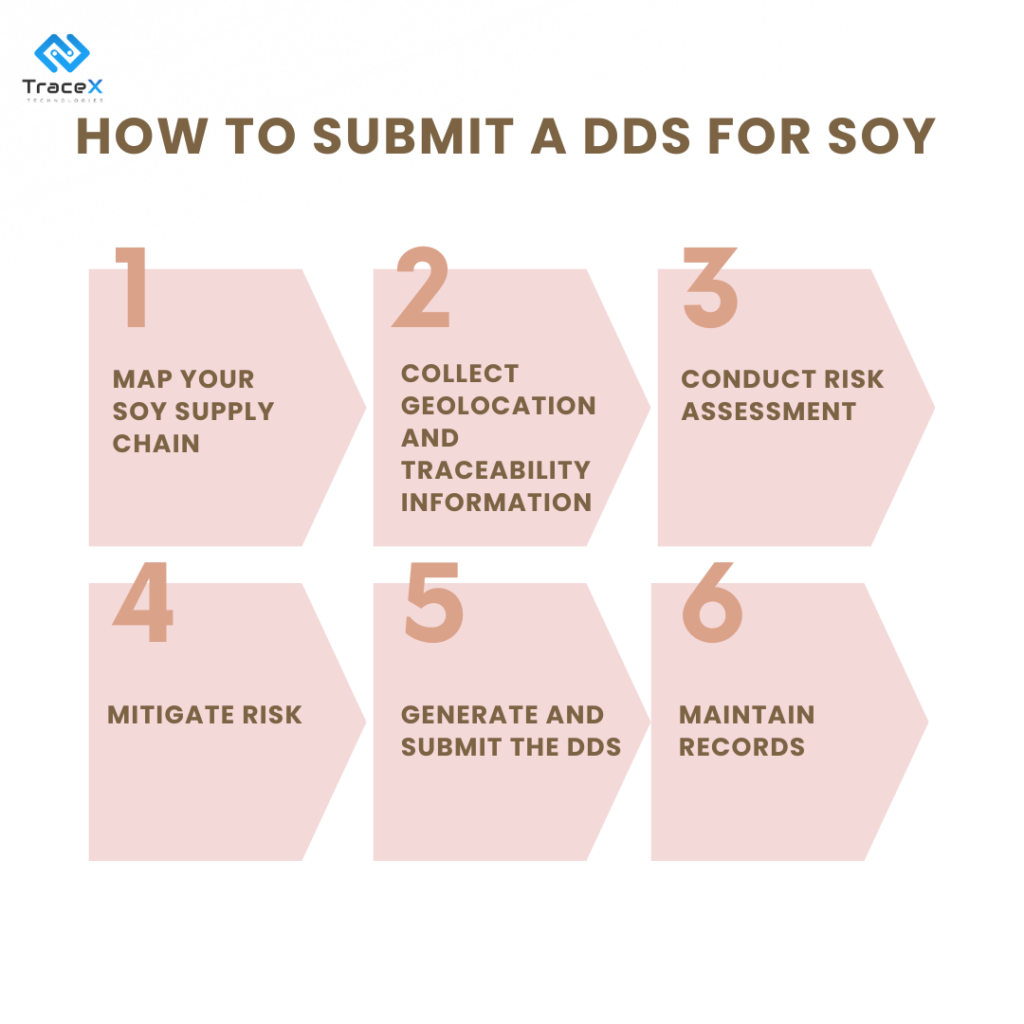
TraceX automates the complex DDS workflow by aggregating polygon-level geolocation data, legality documents, supplier declarations, and chain-of-custody evidence into a single, compliant file. Integrated directly with the EU Information System, the platform enables Hungarian importers, feed mills, and crushers to generate submission-ready DDS reports in minutes reducing manual preparation time, eliminating documentation inconsistencies, and ensuring full audit readiness for every soy batch placed on the EU market.
Every soy lot received through Hungary’s logistics corridors serving feed hubs in regions such as Budapest, Debrecen, and Gyor is assigned a traceable, blockchain-secured identity. This immutable digital chain of custody tracks each shipment from high-risk sourcing regions like Brazil, Argentina, and Paraguay all the way to Hungarian feed mills and livestock operations. This tamper-proof record strengthens regulatory credibility, supports transparent sourcing, and provides verifiable proof of deforestation-free compliance.
Through TraceX’s mobile-enabled onboarding suite, cooperatives, exporters, and traders across South America can be digitally onboarded and mapped at plot level, regardless of their digital maturity. Hungarian soy operators can seamlessly capture farm polygons (GeoJSON), land legality evidence, and supplier documents, ensuring geospatial completeness and reducing EUDR risk even when sourcing from complex, multi-tier global supply chains.
TraceX’s AI-powered risk analytics provide Hungarian companies with real-time visibility into deforestation alerts, land-use change patterns, supplier risk scores, and missing documentation. Feed manufacturers and traders can quickly identify high-risk farms, trigger corrective actions, and ensure that only negligible-risk soy enters Hungarian supply chains. Predictive analytics also help companies adapt to evolving EUDR enforcement rules and potential changes in high-risk classifications.
A Hungarian feed producer importing soymeal from Brazil and Argentina can use TraceX to map supplier farms, validate land-rights documentation, collect GeoJSON-based plot data, and auto-generate EUDR-compliant DDS files for each inbound shipment. Within weeks, the company can achieve end-to-end digital traceability, reduce compliance workload by up to 70%, and demonstrate deforestation-free sourcing to EU regulators and livestock customers.
By uniting blockchain-backed traceability, AI-driven risk scoring, geospatial verification, and automated DDS workflows, TraceX converts EUDR compliance from a regulatory burden into a strategic differentiator. Hungarian importers, feed mills, and agribusinesses can secure uninterrupted EU market access, strengthen ESG credentials, minimize regulatory exposure, and position themselves as leaders in responsible, deforestation-free soy sourcing across Europe.
EUDR compliance is critical for Hungary because soy sits at the centre of the country’s livestock, food processing, and feed manufacturing ecosystem. Hungary imports large volumes of soybeans, soymeal, and soy oil primarily from Brazil, Argentina, Paraguay, and the U.S. to sustain intensive poultry, swine, cattle, aquaculture, and dairy systems. With the EUDR now mandating deforestation-free, legally sourced, and geolocated soy, every actor in Hungary’s supply chain must upgrade procurement practices or risk losing access to the EU market.
Soymeal is the primary protein source for Hungarian feed mills. Any disruption due to non-compliant imports could cause feed shortages, rising production costs, reduced livestock output, and instability across poultry, pork, and dairy supply chains. EUDR compliance ensures feed availability and price stability for one of Hungary’s strongest agri-industrial sectors.
From December 2025 onward, soy that lacks verified farm-level geolocation, legality proof, or DDS approval cannot legally be imported or placed on the Hungarian market. Non-compliant shipments may face customs delays, EU-level inspections, seizure or rejection, and increased regulatory scrutiny. Ensuring full compliance protects continuity for Hungary’s feed mills, crushers, livestock integrators, and food manufacturers.
Hungary exports meat, dairy, eggs, processed foods, and consumer products to EU markets that increasingly demand deforestation-free soy footprints. Without EUDR-aligned sourcing, exporters face contract losses, reduced buyer confidence, and exclusion from sustainability-focused EU retail chains. Compliance strengthens Hungary’s value proposition as a trusted, responsible agri-food supplier.
European retailers and food-service companies require proof of responsible raw-material sourcing. Hungarian food manufacturers and livestock producers must demonstrate transparent supply chains, zero-deforestation protein inputs, and verifiable legality and traceability. EUDR compliance helps safeguard brand credibility and align with ESG reporting frameworks.
Most soy-producing areas in Latin America continue to experience land-use change, making them high-risk under the EUDR. Hungarian companies must adopt geospatial monitoring, supplier risk scoring, and farm-level mapping. This leads to more responsible sourcing and reduces dependency on high-risk suppliers.
The regulation forces modernization of historically paper-based systems. Hungarian operators must adopt digital traceability, geo-mapping tools, blockchain-based chain of custody, and automated DDS workflows. This shift improves operational efficiency and future-proofs supply chains.
EUDR compliance encourages sustainability across global soy systems, which supports long-term supply stability, more resilient sourcing networks, reduced environmental risks, and alignment with EU climate objectives. This creates a more predictable environment for Hungary’s feed and livestock sectors.
EUDR readiness is not just a regulatory obligation for Hungary it is central to protecting national food security, preserving export competitiveness, stabilizing livestock production, and building resilient, transparent, and sustainable agri-food supply chains. Companies that adopt compliant, digital traceability frameworks early will gain a long-term strategic advantage within the EU market.
EUDR DDS for the Soy Supply Chain in Hungary is now essential for ensuring that every soy shipment entering the country is deforestation-free, legally sourced, and traceable to the exact farm of origin. By adopting structured DDS workflows, digitizing supplier onboarding, and integrating geolocation-based traceability, Hungarian soy importers, feed mills, and processors can maintain uninterrupted EU market access while reducing compliance risks. A robust, digital EUDR framework not only strengthens regulatory alignment but also enhances transparency, protects national feed security, and positions Hungary as a leader in sustainable, responsible soy sourcing across Europe.
The EUDR is a regulation by the European Union aimed at preventing deforestation-linked commodities like soy from entering the EU market. It requires full supply chain traceability and submission of Due Diligence Statements (DDS) proving compliance.
A DDS is a formal declaration confirming that soy imported or sold in Hungary is deforestation-free and legally sourced. It must include farm-level geolocation data and risk assessment documentation.
All Hungarian importers, traders, processors and retailers handling soy are required to comply. Both large corporations and small operators must provide DDS documentation for their supply chains.
Common difficulties include gathering farm-level data, verifying deforestation-free claims, managing multiple smallholders, and preparing DDS documents manually.
TraceX digitizes the entire process mapping soy farms, verifying deforestation risks via satellite data, and auto-generating compliant DDS reports ready for submission.
Yes. TraceX is built for scalability and ease of use. It supports both large enterprises and smallholder networks, enabling simple data collection via mobile apps