
Quick summary: Learn how EUDR Due Diligence (DDS) affects Germany’s gloves supply chain. Understand traceability, risk assessment, origin verification, and compliance requirements for importers.
EUDR DDS for Gloves Supply Chain in Germany requires companies to implement strict due-diligence systems to prove that all natural-rubber-based gloves entering the German market are deforestation-free and fully traceable to plantation level. Importers must collect geolocation data, assess deforestation risks, verify supplier compliance, and maintain a digital chain-of-custody from rubber plantations to manufacturing and distribution. For Germany’s large medical and industrial glove market, robust EUDR DDS is now essential to secure EU market access, avoid penalties, and meet rising buyer expectations for transparent, sustainable sourcing.
Germany is a major importer and distributor of rubber, latex, and nitrile gloves for healthcare, food processing, industrial safety, and consumer markets. Because Germany relies heavily on upstream raw materials such as natural rubber from West Africa and Southeast Asia, as well as processed nitrile materials from Malaysia, Thailand, Vietnam, and China, the sector faces high exposure to variable traceability and legality standards. These countries operate under different land-use regulations, forest governance systems, and documentation practices, making uniform EUDR-aligned origin verification extremely difficult.
Germany also imports large volumes of rubber-based gloves as finished goods. In 2023, Germany’s imports of “Rubber surgical gloves, rubber gloves, nes” (HS 401511 & 401519 combined) were valued at over US$1.3–1.5 billion (UN Comtrade), reflecting the size and complexity of its supply chain.
The complexity increases risk. Natural rubber frequently passes through smallholder farmers, local aggregators, processors, traders, and exporters often without consistent geolocation mapping, land-use evidence, or deforestation verification. In many producing countries, small rubber farms are unmapped, lack polygon boundaries, and operate under informal systems where latex is pooled, making plot-level traceability extremely challenging.
Under the EUDR, Germany’s glove importers must provide a fully compliant Due Diligence Statement (DDS) with precise plantation coordinates, risk assessment, and proof that rubber originates from deforestation-free land. Fragmented supply chains, commingling of latex, undocumented intermediaries, and incomplete legality records significantly increase non-compliance risks. Without robust origin data, glove shipments face delays, supply disruptions, penalties, or potential denial of market access.
These vulnerabilities make end-to-end digital traceability, supplier onboarding, and geolocation mapping essential for Germany’s gloves industry as it prepares for full EUDR enforcement.
• Market size: Germany is one of Europe’s largest importers and distributors of medical, protective, industrial, and household gloves, with a market valued at $2.5–3B annually.
• Import dependence: Over 85–90% of gloves consumed or re-exported in Germany are imported primarily from Malaysia, Thailand, China, Vietnam, and Sri Lanka.
• Export value: Germany’s exports of “Protective gloves & mittens” (HS 4015 & 3926 categories combined) exceeded $1.3–1.5B in 2023, supplying the EU, Switzerland, the U.K., and North America.
• High-volume usage: Healthcare, food processing, chemicals, automotive, electronics, and household goods drive steady demand.
Germany’s gloves sector supports a wide ecosystem:
• Medical supply distributors, importers, wholesalers, and PPE logistics hubs
• Tens of thousands of jobs in sorting, warehousing, medical device distribution, and industrial supply chains
• Downstream SMEs in healthcare, manufacturing, and retail heavily dependent on secure glove availability
Upstream, sourcing touches millions of workers in latex plantations, rubber processing plants, and glove factories mainly in Southeast Asia.
Germany’s glove supply chain is dominated by:
Major importers/distributors:
• Hartmann, Fentex, Franz Mensch, KCL, Honeywell, and global medical supply giants
Manufacturers/OEM suppliers (overseas):
• Top Glove, Hartalega, Sri Trang, Ansell, SHOWA, and multiple Chinese manufacturers
Retail & B2B buyers:
• Hospitals, clinics, laboratories
• Industrial safety distributors
• Food & beverage processors
• E-commerce and retail chains
Upstream:
• Natural rubber plantations (Thailand, Malaysia, Indonesia)
• Nitrile raw material manufacturers
• Rubber processors & chemical suppliers
• OEM glove factories and contract manufacturers
Midstream:
• Importers, PPE distributors, certification bodies
• Warehousing & logistics hubs
• Quality testing labs (EN standards, ISO, PPE Regulation assessments)
Downstream:
• Healthcare systems
• Industrial buyers (automotive, chemical, electronics)
• Retail & e-commerce channels
• EU re-export networks
Germany re-exports gloves widely to:
• EU neighbors: France, Austria, Netherlands, Belgium, Switzerland
• High-standard medical markets: U.K., U.S., Scandinavia
• Industrial hubs across Central and Eastern Europe
Germany’s strong distribution infrastructure makes it a PPE gateway for Europe.
• Exports (2023): ~$1.3–1.5B across rubber, nitrile, and plastic gloves
• Imports: Significantly higher due to strong domestic consumption and re-export activity
Germany is a critical PPE redistribution hub in Europe turning global imports into certified, value-added, compliant medical and industrial supply flows.
Although gloves are not a primary EUDR commodity, rubber the main raw material for medical and household gloves is fully regulated under EUDR. This makes Germany’s glove supply chain one of the most exposed industrial PPE categories.
• Germany’s glove industry depends heavily on natural rubber from high-risk deforestation zones in Southeast Asia and West Africa.
• EUDR now requires plot-level geolocation for rubber plantations, legality proof, and deforestation-free verification before gloves can enter the EU market.
• Importers must submit a Due Diligence Statement (DDS) for every shipment containing natural rubber-based gloves.
• Complex multi-tier supply chains—plantation → latex cup lumps → rubber processors → glove factories → traders → EU importers—create high risk of missing farm data, mixed sourcing, and unverified origins.
• Companies with poor traceability risk border delays, rejected shipments, penalties, and loss of market access.
• Early adopters of digital traceability, supplier mapping, and geolocation compliance gain a strategic edge.
• Buyers increasingly prefer suppliers offering verified, deforestation-free rubber gloves.
• Exporters and distributors that document their rubber origins can strengthen ESG, reduce procurement risk, and appeal to sustainability-conscious healthcare and industrial clients.
In a market where reliability and compliance are critical, EUDR DDS readiness is now a strategic requirement for Germany’s glove importers and distributors.
Master the step-by-step process of submitting Due Diligence Statements under the new EUDR rules.
Read the blog on filing DDS for EUDR compliance
Stay Ahead of EUDR in Healthcare Supply Chains
Germany’s medical and PPE sector is entering a new era of transparency. Don’t wait for regulatory audits or shipment blocks—learn how healthcare manufacturers and importers can streamline EUDR DDS, secure supplier data, and protect market access.
Read the full guide on EUDR compliance for the healthcare sector
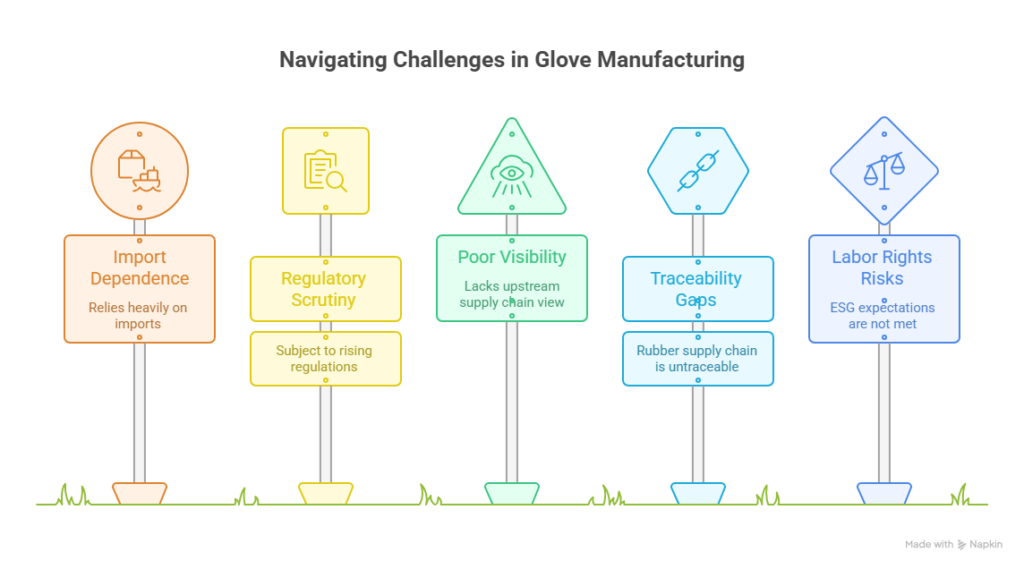
Germany is one of Europe’s largest importers of medical, industrial, and household gloves, sourcing predominantly from Malaysia, Thailand, China, Vietnam, and Sri Lanka. However, the sector faces growing compliance, supply chain, and operational challenges that directly affect market access and cost structures.
Over 70–80% of Germany’s disposable medical and nitrile gloves come from Southeast Asia, where production involves:
This dependence makes German importers vulnerable to disruptions, inconsistent documentation, and compliance gaps.
German companies must comply with:
These require proof of:
Most Asian suppliers currently lack the digital traceability systems needed to meet these standards.
Glove manufacturers typically outsource:
This creates high traceability opacity, making it difficult for German buyers to verify:
Because gloves contain natural rubber (a regulated commodity), German importers must submit DDS documentation proving:
Missing or unreliable data from suppliers can lead to:
Glove manufacturers have faced extreme volatility since 2020 due to:
German buyers face unpredictable procurement costs and renegotiation of long-term contracts.
NGO reports have highlighted labor rights concerns in glove factories in Malaysia and Thailand.
German companies now face:
This increases the need for transparent, verifiable social compliance data.
Medical and industrial gloves often contain:
This complicates:
Many suppliers still operate with:
This creates bottlenecks for German importers required to produce digital due diligence statements.
To remain compliant and competitive, the sector must adopt digital traceability, supplier onboarding systems, geolocation mapping, and risk assessment tools especially as EUDR enforcement tightens across all natural rubber–based products.
TraceX provides a unified digital compliance infrastructure that enables German glove importers, manufacturers, and distributors to meet emerging EUDR-aligned due diligence expectations particularly for natural rubber–based gloves. With global sourcing spread across Asia, Africa, and Latin America, the glove industry faces complex raw-material traceability challenges. TraceX EUDR Compliance Platform digitizes supplier data, farm geolocation, processing records, and risk intelligence, helping German companies generate complete Due Diligence Statements (DDS) with minimal operational disruption.
Natural rubber gloves depend on latex sourced from smallholders, plantations, and multiple regional aggregators. TraceX allows suppliers to upload:
This ensures German importers receive accurate, verifiable geolocation data required for legality and sustainability due diligence.
The platform links every transformation stage:rubber tree → latex collection → coagulum → processing (RSS, TSR) → compounders → glove manufacturers → exporters → German importers.
Each batch receives a digital ID, eliminating blind spots caused by aggregation, mixing, and re-processing—critical for validating deforestation-free rubber sourcing.
TraceX automates the capture and verification of:
Its validation engine flags inconsistent or missing documents, reducing manual workload and compliance failures.
Using GIS, satellite imagery, and AI models, TraceX conducts continuous monitoring to detect:
German importers can instantly generate risk assessments for every shipment or supplier cluster.
The platform consolidates geolocation data, supplier records, risk assessments, and chain-of-custody information into a complete, submission-ready DDS. This eliminates manual consolidation and ensures every glove shipment meets EU due diligence expectations.
TraceX includes multilingual mobile tools, templates, and training modules for suppliers in Thailand, Malaysia, Indonesia, Côte d’Ivoire, and other rubber-producing countries. This accelerates onboarding for smallholders, latex aggregators, and midstream processors.
All supply chain data is time-stamped and stored on blockchain, providing tamper-proof records essential for audits, investigations, and regulatory inspections.
Compliance teams gain access to:
This helps companies proactively resolve issues before goods arrive in Germany.
TraceX integrates with SAP, Microsoft Dynamics, Oracle, and procurement platforms, ensuring compliance workflows run alongside normal purchasing, quality, and inventory processes.
For German glove importers and manufacturers, EUDR DDS is no longer just a regulatory requirement it is a strategic necessity. With complex, multi-country supply chains spanning latex, rubber, and composite materials, only digital traceability systems can provide the plot-level geolocation, legality verification, and deforestation-free evidence required under EUDR. Companies that modernize early with end-to-end digital due diligence will reduce compliance risks, avoid shipment disruptions, and position themselves as preferred suppliers in a tightening EU regulatory environment. In a market where supply assurance and transparency define competitiveness, digital DDS readiness has become a critical differentiator for Germany’s glove sector.
Understand the key components of EUDR compliance and how to streamline your DDS process efficiently.
Read the blog on EUDR Due Diligence
Learn how AI-driven automation and intelligent workflows simplify data collection, verification, and reporting.
Explore the blog on Agentic AI for EUDR
Unpack the biggest hurdles faced by importers under EUDR and how technology can turn compliance into a competitive edge.
Read blog on Challenges for EU Importers
Gloves made from natural rubber fall under EUDR because rubber is a regulated commodity. Germany’s glove importers must prove deforestation-free, legally sourced rubber.
Importers must collect plot-level geolocation of rubber farms, verify legal harvesting, assess deforestation risk, and submit a Digital Due Diligence Statement before placing gloves on the EU market.
Most natural rubber comes from smallholder farmers in Southeast Asia and Africa, where limited mapping, informal trade, and supply commingling create traceability gaps.
Manufacturers must ensure full traceability for rubber used in surgical, household, and industrial gloves. Non-compliance risks shipment delays, fines, and market restrictions
They must provide farm geolocation, legality records, land-use rights, supply chain traceability documents, and proof of deforestation-free sourcing.
Yes. Platforms like TraceX automate origin mapping, supplier data collection, risk scoring, and DDS generation, reducing manual compliance efforts and ensuring audit-ready records.