
Quick summary: Discover essential strategies for achieving compliance with the EU Deforestation Regulation (EUDR). Our blog covers key due diligence requirements, practical steps for navigating regulatory complexities, and tips for ensuring your supply chain meets the EU's sustainability standards. Stay ahead in the evolving landscape of environmental regulations.
Think your products are safe because they come from a “low-risk” country? Think again. Under EUDR, it’s not about where you source from—it’s about what you can prove. Many businesses are blindsided when they realize that EUDR compliance isn’t just a one-time document or a checkbox exercise. It requires continuous, verifiable evidence—and failure to deliver it could cost them their market access, fast.
Due diligence is the backbone of EUDR compliance. It’s not enough to say your products are deforestation-free—you must prove it with verified data, geolocation, and legal documentation. Whether you’re sourcing from high-risk regions or low-risk countries, submitting a Due Diligence Statement (DDS) is mandatory. Without it, your products can’t legally enter the EU market. In short, due diligence isn’t a formality—it’s your license to trade.
Key Takeaways
Due diligence under EUDR system is the legal process of proving that products are deforestation-free and legally produced, backed by geolocation, documentation, and risk assessment.
You’ve probably heard the term “due diligence” tossed around a lot lately — especially if you’re sourcing commodities like coffee, cocoa, soy, palm oil, or rubber.
But under the EU Deforestation Regulation (EUDR), due diligence isn’t just a best practice.
It’s the legal line between being market-ready and market-blocked.
Due diligence under EUDR means one thing: being able to prove your product didn’t come from deforested land and was legally produced.
It’s not about trusting your supplier. It’s not about paperwork filed years ago.
It’s about current, traceable, verifiable data — tied to the land, the farmer, and the shipment.
At its core, due diligence is your way of saying to the EU:
“Here’s exactly where my product came from, when it was grown, and why it meets every rule you’ve laid out.”
Every company subject to EUDR — whether you’re an exporter, importer, trader, or retailer — must submit a Due Diligence Statement through the EU’s TRACES system before placing a product on the EU market.
That statement must include:
Even if your product contains just 5% coffee, cocoa, or soy — you still need to file a DDS.
In the past, “sustainability” often meant voluntary certifications, nice-looking dashboards, and hopeful stories in ESG reports.
EUDR is different.
It’s mandatory, data-driven, and legally enforceable.
The EU doesn’t want promises.
It wants proof.
This is a mindset shift — especially for companies that have relied on trust-based supply chains or external certifications alone.
Now, you need traceability back to the source — and the tech to manage it.
You’re likely here because you’re either:
Your goals are valid:
What do you actually need to get right under EUDR? Here’s what matters—and why it’s more than just ticking boxes.
Most exporters, importers, and procurement teams don’t wake up thinking,
“How do I build a gold-standard due diligence process today?”
What they’re actually thinking is:
These are fair, high-stakes questions—and most existing resources don’t explain it clearly.
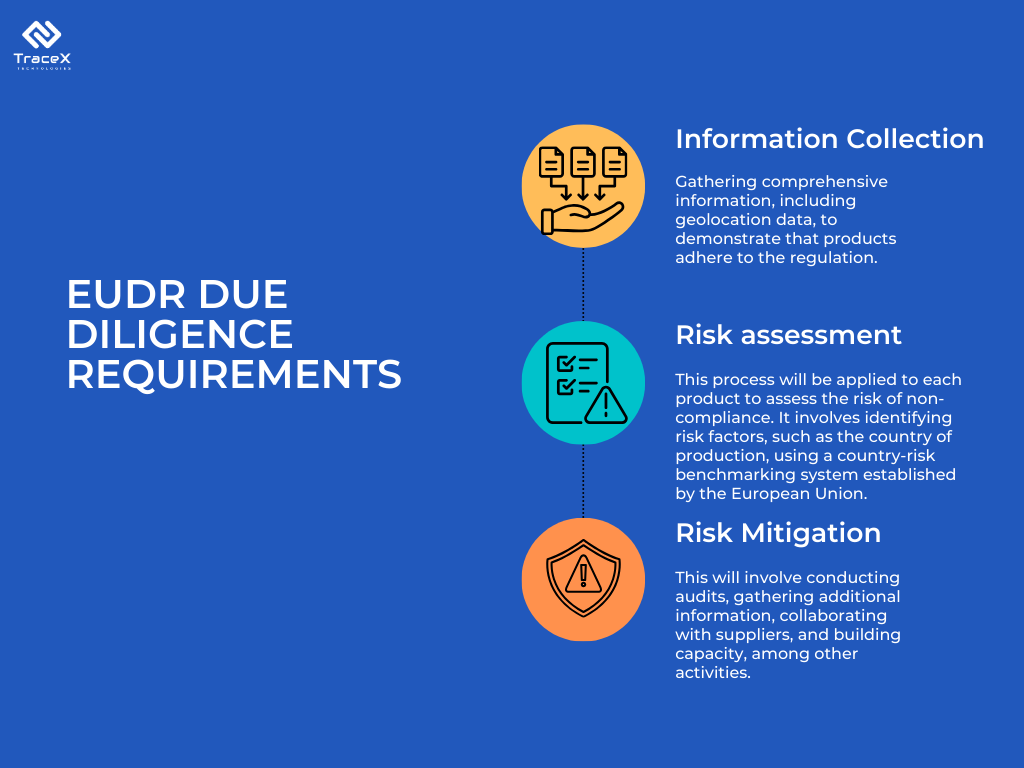
So let’s walk through the 5 core things your due diligence process must include to protect your exports, your reputation, and your peace of mind.
This is where it all starts. You need to pinpoint every production plot used to grow your product.
Why it matters:
No geolocation = no traceability = no compliance. It’s your map to proving your supply chain is real, clean, and verifiable.
EUDR sets a clear line: no commodities can come from land deforested after December 31, 2020.
Why it matters:
This is the heart of the regulation. If deforestation is detected post-2020 and linked to your shipment—even unknowingly—you could face serious legal and financial consequences.
It’s not enough to prove where the product was grown—you also have to prove it was grown legally.
That means documentation like:
Why it matters:
The EU wants to know the land wasn’t grabbed, misused, or illegally cultivated. If it was, you’re out of compliance—even if the land looks forest-friendly.
If you’re sourcing from a country not classified as “low-risk,” you must go deeper.
Why it matters:
Even one high-risk supplier can drag your entire DDS into question. This is your opportunity to show that you saw the risk—and handled it proactively.
Once all the boxes are checked, you must officially submit a Due Diligence Statement in the EU TRACES system before placing your product on the EU market.
Why it matters:
No DDS = no trade. If you can’t submit your statement or back it with data, your goods won’t clear customs. It’s that simple.
At the end of the day, your goal is to continue exporting, stay trusted by buyers, and avoid compliance nightmares. But your intention is deeper: you want to build a responsible, future-proof supply chain that’s good for business and good for the planet.
And the biggest thing standing in your way?
A fragmented, manual, unclear due diligence process.
Platforms like TraceX simplify everything—so your team can capture the data, validate it, generate the DDS, and submit it without chaos.
“If I didn’t grow it, process it, or sell it to the end consumer… am I responsible for filing the DDS?”
Answer: It depends where you are in the chain—and what you’re doing with the product.

→ These are the companies that first place a product on the EU market or export it from the EU.
They carry the full legal responsibility for performing due diligence and submitting the DDS.
Examples of Operators:
→ These are companies who buy and sell within the EU without significantly modifying the product.
They don’t have to submit a DDS, but they must be able to:
Examples of Traders:

Many ask:
The answer comes down to your function in the chain, not just your business type.
If you intend to place the product on the EU market (even if you’re not the original producer)—you’re the one who must prove it’s compliant.
And if you’re just passing it along? You still need the proof trail.
That’s where digital platforms like TraceX simplify the headache:
The cost of non-compliance under EUDR isn’t just paperwork—it’s your business, brand, and buyer trust on the line.
Imagine this: your container of cocoa or coffee arrives in Rotterdam or Hamburg. Your buyer’s waiting. The product is clean. But the DDS is incomplete or missing key farm data.
Result?
Blocked.
Held.
Potentially rejected.
And yes, even one missing polygon or invalid geolocation can trigger this.
If the EU regulator deems your due diligence to be negligent, you may face:
And guess what?
You’re responsible—even if it was your supplier’s data that failed.
Let’s say you’re a long-standing exporter of cocoa, coffee, or soy. You’ve built strong buyer relationships. Now the buyer needs proof you’re compliant.
You stall. You scramble. You can’t produce a DDS.
Result?
They walk away.
They find another supplier with clean traceability and confidence in their data.
If your product ends up on shelves and later fails a traceability audit, it’s not just about that one shipment; it’s your brand name in the headlines.
In the era of ESG, sustainability, and conscious consumers, getting exposed for non-compliance looks like greenwashing, and once the trust is gone, it’s hard to earn it back.
Your goal isn’t just to avoid penalties—it’s to keep trade flowing, protect your buyer relationships, and future-proof your reputation in a changing regulatory world. Your intention is to do the right thing, but without breaking your operations or drowning in spreadsheets.
What’s missing for most?
A simple, digital way to validate data, generate DDS, and stay alert to risks before they hit.
If you get it right with the right tools—you gain speed, trust, and control.
Due diligence under EUDR is clear in theory—but chaotic in practice.
From mapping remote farms to submitting a DDS in EU TRACES, the process is data-heavy, high-stakes, and unforgiving if you get it wrong.
That’s exactly why digital platforms like TraceX’s EUDR Compliance Platform are becoming essential tools—not just for compliance, but for operational sanity.
TraceX allows you to digitally onboard farmers with precise geolocation—whether point or polygon—ensuring every plot is mapped, logged, and stored.
With farm-level mapping done right from day one, you avoid gaps that derail DDS later.
TraceX integrates AI-backed satellite imagery to confirm that plots haven’t been deforested post-2020—the critical EUDR compliance threshold.
No need to source and interpret satellite data manually—TraceX makes deforestation verification a built-in feature, not a separate project.
Once your data is in the system, TraceX compiles and auto-generates the Due Diligence Statement (DDS)—complete with:
Whether you’re an exporter, importer, certifier, or internal compliance lead, TraceX offers role-specific views so every stakeholder sees only what they need to act.
No more email chains or lost documents—just centralized compliance clarity.
Finally, TraceX connects directly with EU TRACES, so once your DDS is complete, it can be submitted instantly—no formatting errors, no rekeying.
Skip the manual upload grind. Let TraceX be your compliance co-pilot.
EUDR due diligence isn’t just about checking boxes—it’s about protecting access to the EU market with verified data.
EUDR due diligence isn’t just about documentation—it’s about demonstrating responsibility, transparency, and long-term readiness for global trade. Whether you’re exporting raw materials or importing finished goods, understanding your due diligence obligations is essential to keeping your supply chain open, trusted, and audit-ready. With the right systems in place, like a tech-enabled platform for traceability and DDS management, you can move from risk to readiness—without slowing down your business.
It’s a legal declaration submitted in the EU TRACES system proving your product is deforestation-free, legally produced, and fully traceable.
Yes—submission of a DDS is still mandatory, even for low-risk countries, though the risk assessment may be simplified.
Yes, under EUDR, you’re legally responsible for verifying supplier data before submitting a DDS. If the information is false or incomplete, you—the operator—can face penalties, not the supplier.









