Quick summary: Explore how Kenyan coffee exporters can achieve EUDR compliance through digital traceability, geolocation mapping, and blockchain verification. Learn how platforms like TraceX simplify Due Diligence Statement (DDS) creation, ensure deforestation-free sourcing, and future-proof coffee exports to the EU market.

EUDR Compliance for Coffee Exporters in Kenya requires proving that all coffee exported to the EU is deforestation-free, legally sourced, and traceable to the exact farm of origin. Kenyan exporters must collect geolocation data for coffee plots, verify land legality, assess deforestation risk, and maintain a transparent chain of custody across cooperatives, factories, and mills. A complete Due Diligence Statement (DDS) must be submitted through the EU system before shipment. Robust traceability systems, supplier onboarding, and accurate documentation are essential for meeting EU requirements and safeguarding market access.
Stay ahead of the 2025 regulation with our expert guide on Due Diligence Statements, traceability workflows, and category-specific obligations for operators, traders, and downstream entities. Download the EUDR Handbook Now
Kenya is one of Africa’s most established and globally recognized coffee origins, celebrated for its high-quality Arabica grown in the fertile highland regions of Central, Eastern, and Rift Valley counties including Kiambu, Nyeri, Kirinyaga, Embu, Meru, Nakuru, and parts of Bungoma. With ideal volcanic soils, high altitudes, and well-organized cooperative systems, Kenya produces between 750,000-900,000 60-kg bags of coffee annually, according to the Coffee Directorate and international trade data.
Kenya’s coffee sector generates US$150-200 million in export earnings each year, with the European Union, United States, Japan, and Middle East serving as key destinations. Renowned for its bright acidity, berry notes, and complex cup profiles, Kenyan AA and AB grades consistently command premium prices in global specialty markets. While green bean exports dominate, Kenya’s domestic roasting and value-addition capacity is gradually expanding through private-sector investment, SME roasters, and government support programs.
The country’s coffee value chain is anchored by thousands of smallholder farmers organized under cooperatives and estate producers who supply the auction and direct-export channels. Sector reforms led by the Agriculture and Food Authority (AFA), county governments, and producer organizations are increasingly emphasizing digital traceability, quality improvement, and farmer-centric market access.
With the EU Deforestation Regulation (EUDR) introducing new requirements for farm-level geolocation, legality verification, and transparent due diligence, Kenya is actively prioritizing digital transformation of its coffee supply chain. Initiatives promoting sustainability certifications such as Fairtrade and Rainforest Alliance, climate-smart production, and cooperative digitization are helping Kenya align with evolving global standards.
As investments in farmer training, digital traceability, and value-addition continue to grow, Kenya is well-positioned to reinforce its reputation as a source of high-quality, traceable, and sustainably produced coffee, strengthening its competitiveness in premium global markets.
Kenya’s coffee sector is dominated by hundreds of thousands of smallholders, most farming 0.5-2 hectares. EUDR requires precise polygon-level mapping of all coffee plots, but smallholders rarely have GPS tools, many plots lack formal boundaries, no centralized farm registry exists, and cooperatives aggregate cherry from thousands of farmers. Capturing accurate geolocation data at this scale is a major operational burden.
In Kenya, coffee cherries from many farms enter a shared wet mill (factory) where they are mixed before pulping, washing, and drying. This creates loss of farm identity, batch mixing across hundreds of growers, and difficulty linking final parchment or green coffee to individual farms. EUDR, however, requires exact identification of all farms contributing to each consignment.
Kenyan coffee growers operate under multiple tenure arrangements: freehold land, family land, community land, cooperative-managed farms, and county-administered lands. Exporters must verify land ownership or legal right-to-farm for each supplier, which is challenging due to informal inheritance, missing title deeds, and inconsistent county-level land records.
Most smallholders, cooperatives, and mills still operate using paper-based systems, leading to unstandardized farmer records, missing documentation, difficulty capturing real-time data, and low supplier onboarding capacity. Exporters must digitize a large supplier base before achieving full EUDR compliance.
Kenyan coffee grows in landscapes with mixed land use including farms, forests, riparian zones, and settlements. Exporters must conduct satellite-based forest change analysis, verify no post-2020 deforestation, and produce geo-risk scoring for each plot. This requires GIS expertise, satellite data interpretation, and technology that cooperatives typically lack.
To export into the EU, Kenyan exporters must compile farm polygons, ownership and tenure documents, cooperative farmer lists, chain-of-custody logs, milling and drying records, risk assessments, legality evidence, and shipment data. This administrative load is especially challenging for SMEs and cooperatives with limited staffing.
Incomplete or inaccurate DDS filings may trigger EU border inspections, shipment delays, rejection or re-export, and higher scrutiny for future consignments. This threatens continuity for Kenyan exporters and risks losing buyers in premium EU markets.
Kenyan exporters must invest in digital traceability systems, farm mapping, supplier onboarding programs, training for cooperatives and farmers, and data storage and monitoring tools. The cost of compliance can be prohibitive, especially for small- and medium-scale exporters.
EU roasters and traders increasingly require granular traceability data, sustainability metrics, verified legality records, and farm-level transparency. Kenyan exporters must meet these buyer expectations to remain competitive.
Kenyan coffee exporters face structural, technical, and operational challenges under EUDR from fragmented smallholder systems and cooperative aggregation to limited digital readiness, legality verification gaps, and complex deforestation-risk assessment needs. Achieving compliance will require digital transformation, geolocation mapping, supplier engagement, and automated DDS workflows to safeguard Kenya’s premium EU market access.
The EU Deforestation Regulation (EUDR) requires Kenyan coffee exporters to prove that every shipment entering the EU is deforestation-free, legally sourced, and fully traceable to the farm of origin. With Kenya’s coffee value chain spread across regions like Kiambu, Nyeri, Kirinyaga, Embu, Meru, Nakuru, Bungoma, and Kericho, and dominated by thousands of smallholder farmers supplying cooperative factories, manual documentation systems can no longer meet the EU’s strict traceability and legality expectations. The TraceX EUDR Compliance Platform offers an end-to-end digital solution that automates due diligence workflows, enhances transparency, and protects Kenya’s long-standing access to premium EU coffee markets.
TraceX connects smallholders, cooperatives, wet mills, dry mills, marketers, and exporters through a unified digital ecosystem. Every parchment or green coffee batch is assigned a unique digital ID linked to verified farm polygons and grower credentials. This creates a tamper-proof chain of custody from farm to warehouse to export, ensuring precise alignment with EUDR’s traceability and audit requirements.
Using mobile-enabled field apps, TraceX allows real-time capture of farm geolocation (polygons), land-tenure documentation, cooperative farmer lists, and production data at factory level. The platform automatically compiles this into an EUDR-ready Due Diligence Statement (DDS) for each consignment, eliminating manual paperwork, reducing errors, and cutting documentation timelines from weeks to hours.
TraceX immutably records every transaction from cherry intake at the factory through drying, milling, bulking, and export logistics on a blockchain ledger. This ensures that each export shipment can be confidently traced back to deforestation-free, legally compliant farms across Kenya’s coffee zones, boosting trust with EU buyers and regulators.
Kenya’s coffee sector is built on a vast network of smallholders. TraceX simplifies their onboarding with intuitive mobile tools for GPS mapping, farmer profiling, land document digitization, and certification tracking. This inclusive digital approach ensures comprehensive data coverage for cooperatives, estates, and independent growers even in remote regions.
By integrating satellite imagery with AI-driven analytics, TraceX identifies land-use change, encroachment into forest areas, and potential deforestation risks around Kenyan coffee farms. Exporters benefit from real-time dashboards that highlight compliance gaps early, ensuring proactive mitigation before shipments enter the EU compliance funnel.
TraceX functions as a secure, centralized hub where exporters, cooperative societies, millers, EU importers, and regulators share verified data. Standardized workflows streamline audits, accelerate EU border approvals, and foster deeper buyer confidence in the integrity of Kenyan coffee.
With blockchain-secured traceability, AI-enabled risk intelligence, and automated due diligence, TraceX transforms EUDR compliance from a regulatory hurdle into a strategic differentiator. Kenyan coffee exporters can demonstrate sustainable, traceable sourcing, strengthen EU partnerships, and enhance Kenya’s global reputation for premium, deforestation-free coffee.
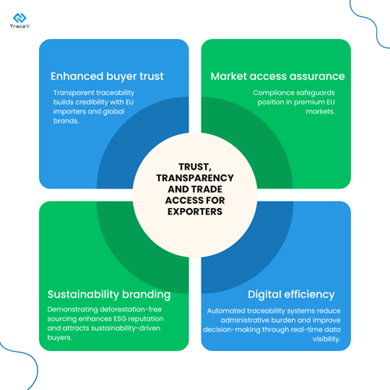
The EU Deforestation Regulation (EUDR) is critically important for Kenya’s coffee sector because the European Union remains one of Kenya’s largest and highest-value coffee markets, especially for specialty grades. Any disruption in EU market access directly affects export earnings, cooperative revenues, and farmer livelihoods. EUDR raises the bar by requiring deforestation-free, legally sourced, and fully traceable coffee, pushing Kenya to modernize its entire supply chain to remain competitive.
Over 30-35% of Kenya’s coffee exports go to EU buyers who value traceability, quality, and sustainability. Non-compliance could result in shipment delays, increased inspections, rejection at EU entry points, or complete loss of buyer contracts. EUDR compliance is therefore essential for protecting Kenya’s premium price advantage.
Kenyan coffee, especially AA and AB grades, commands some of the world’s highest specialty coffee prices. EUDR makes traceability and sustainability proof mandatory, aligning perfectly with what specialty buyers demand. Compliance strengthens Kenya’s brand as transparent, high-quality, ethically produced, and climate-conscious, enhancing long-term competitiveness.
Kenya’s coffee system built on cooperative factories, smallholder farmers, and millers has traditionally used manual workflows. EUDR creates strong incentives for digital farmer registries, plot-level GPS mapping, digital chain-of-custody systems, blockchain-enabled traceability, and satellite-based risk monitoring. This modernization improves efficiency, record integrity, and market readiness.
EUDR requires proof of legal production, which indirectly pushes Kenya to improve land documentation, cooperative governance, transparency in milling and marketing, and documentation consistency across counties. Such structural improvements benefit the sector beyond the EU market.
With EUDR-aligned systems, farmers and cooperatives gain better market access, stronger buyer relationships, potential price premiums, improved sustainability credentials, and more structured production data. This lifts farmer income and resilience across Kenya’s coffee-growing regions.
Climate-conscious consumers and regulators increasingly demand proof of sustainability. EUDR compliance helps Kenya avoid negative publicity, ESG-related market exclusion, and stricter future regulations. It positions Kenya as a leader in responsible production within Africa’s coffee belt.
By adopting EUDR-compliant practices early, Kenya can secure uninterrupted EU market access, long-term supply agreements with major roasters, stronger export confidence, and reduced risk exposure for exporters. This stability is essential for a sector that supports hundreds of thousands of Kenyan households.
EUDR matters for Kenyan coffee exports because it directly influences market access, price competitiveness, traceability expectations, sustainability credentials, and supply-chain modernization. Compliance will not only protect Kenya’s position in the EU market but also elevate the entire industry toward greater transparency, efficiency, and global competitiveness.
EUDR Compliance for Coffee Exporters in Kenya is no longer just a regulatory obligation it is a strategic pathway to secure premium EU market access, strengthen buyer confidence, and reinforce Kenya’s global reputation for high-quality, sustainably produced Arabica coffee. By adopting digital traceability tools, mapping farm-level geolocations, verifying legality, and generating accurate DDS submissions, Kenyan exporters can transform compliance into competitive advantage. Embracing EUDR today ensures long-term market stability, improved value for smallholders, and a future-ready coffee sector that thrives in an increasingly sustainability-driven global marketplace.
Understand the key components of EUDR compliance and how to streamline your DDS process efficiently. Read the blog on EUDR Due Diligence
Learn how AI-driven automation and intelligent workflows simplify data collection, verification, and reporting. Explore the blog on Agentic AI for EUDR
Discover how digital onboarding bridges the gap between smallholders and EUDR compliance. Read our blog: Smallholder Onboarding for EUDR Compliance
EUDR compliance requires Kenyan coffee exporters to demonstrate that all coffee exported to the EU is deforestation-free, legally produced, and fully traceable to its exact farm or plantation of origin. Exporters must provide verifiable data showing that coffee farms did not contribute to deforestation after December 31, 2020.
The European Union is one of Kenya’s largest coffee markets, accounting for roughly 40% of total exports. Compliance ensures continued market access, protects the country’s reputation as a sustainable coffee origin, and aligns the sector with growing global demand for ethically and environmentally responsible sourcing.
Exporters must ensure full traceability to the farm level, record accurate geolocation data, verify legal and deforestation-free sourcing, and submit an EUDR-compliant Due Diligence Statement (DDS) before exporting to the EU.
Exporters face hurdles such as fragmented smallholder networks, limited digital traceability systems, incomplete land-use records, and high compliance costs for data collection and verification.
Compliance boosts transparency, strengthens buyer trust, enhances sustainability credentials, and secures continued access to high-value EU and global markets.