

EUDR Compliance for Coffee Exporters in Tanzania requires exporters to prove that all coffee entering the EU is deforestation-free, legally produced, and traceable to the exact farm of origin. Tanzanian exporters must collect geolocation polygons for coffee plots, verify land-use legality, assess deforestation risk, and maintain a transparent chain of custody across cooperatives, AMCOS groups, mills, and exporters. A complete Due Diligence Statement (DDS) must be submitted before shipment. Robust digital traceability, supplier onboarding, and accurate documentation are essential for meeting EU requirements and safeguarding access to high-value EU coffee markets.
Tanzania is a well-established coffee producer in East Africa, exporting both Arabica and Robusta varieties to global markets. Coffee production is concentrated in regions such as Kilimanjaro, Arusha, Mbeya, Songwe, Ruvuma, Kagera, and Kigoma, where high-altitude volcanic soils and favourable climate conditions support high-quality Arabica, while the western and northwestern zones supply Robusta. According to Tanzania Coffee Board (TCB) and international trade data, the country produces 650,000–900,000 60-kg bags annually, generating US$150–220 million in export revenue.
Tanzania exports most of its coffee as green beans, with key destinations including the European Union, Japan, the United States, and the Middle East. Tanzanian Arabica especially from Mbeya and Kilimanjaro is prized for its rich body, balanced acidity, and mild flavour profile, making it a consistent favourite within specialty markets. While green coffee dominates exports, domestic roasting and value addition are gradually increasing, driven by rising investment, SME innovation, and government-backed reforms.
Sector transformation is being led by the Tanzania Coffee Board (TCB), Tanzania Agricultural Development Bank (TADB), and regional farmer cooperatives focused on productivity improvement, replanting programs, quality upgrades, and certifications such as Fairtrade, Rainforest Alliance, and Organic. A growing emphasis on digital traceability and farmer data systems is aligning Tanzania with emerging global sustainability expectations.
With the introduction of the EU Deforestation Regulation (EUDR) which applies to coffee under HS Code 0901 Tanzania’s exporters must now ensure farm-level geolocation mapping, legality verification, and deforestation-free sourcing for all coffee destined for the EU. Under EUDR timelines, large and medium operators must comply by 30 December 2025, while small and micro enterprises have until 30 June 2026 to meet due diligence requirements.
As Tanzania expands investment in processing infrastructure, strengthens sustainability partnerships, and accelerates digital supply-chain transformation, the country is well-positioned to reinforce its role as a supplier of high-quality, traceable, and responsibly sourced coffee unlocking new opportunities in premium global markets.
Want to see how digital technology is reshaping sustainability compliance?
Explore our latest blog on Digital Traceability for EUDR
Curious how Nigeria’s coffee exporters can stay ahead of new EU deforestation rules?
Our in-depth blog on EUDR Coffee Compliance explains the regulation’s full impact
What are the Key Challenges Faced by Tanzanian Coffee Exporters Under the EU Deforestation Regulation (EUDR)
1. Highly Fragmented Smallholder Supply Base
Tanzania’s coffee sector is dominated by hundreds of thousands of smallholder farmers organized under AMCOS groups. EUDR requires precise polygon mapping for each contributing farm plot. Key challenges include:
- limited GPS access and digital literacy,
- scattered small farms across remote terrains,
- lack of centralized farm registries,
- incomplete farmer records within AMCOS systems.
This makes comprehensive geolocation capture slow, costly, and logistically demanding.
2. AMCOS Aggregation Results in Loss of Batch-Level Traceability
Coffee from hundreds of farmers is aggregated at AMCOS washing stations/central pulperies. This creates:
- batch mixing,
- blending across producers,
- no data link between final parchment/green coffee and individual farms,
yet EUDR demands farm-of-origin identification for every shipment, which AMCOS structures were not designed to support.
3. Land Tenure and Documentation Gaps
Tanzania’s land ownership landscape includes:
- village land,
- customary land,
- leased estates,
- family-held plots,
- communal holdings.
Many smallholders lack formal titles or Certificates of Customary Rights of Occupancy (CCROs). For EUDR, exporters must verify land legality challenging when:
- land documentation is incomplete,
- records vary across districts,
- historical boundaries are not digitized.
4. Limited Digital Readiness Across the Value Chain
Many AMCOS, mills, and intermediaries still rely heavily on paper-based processes. This leads to:
- inconsistent farmer data,
- missing legality documents,
- gaps in production records,
- no digital chain-of-custody systems.
Exporters must invest heavily in digitization to build an EUDR-ready workflow.
5. Deforestation-Risk Analysis Requires Advanced GIS Capacity
EUDR requires exporters to prove that no deforestation occurred after 31 December 2020. This requires:
- satellite-based monitoring,
- detecting land-use change,
- interpreting forest degradation alerts,
- performing regional risk scoring.
Most AMCOS and exporters lack in-house GIS expertise and access to real-time geospatial data.
6. High Administrative Load for Due Diligence Statements (DDS)
EUDR demands a complete DDS for every consignment, requiring:
- polygons of all contributing farms,
- legality checks,
- risk assessments,
- chain-of-custody records,
- supplier declarations.
For exporters handling thousands of farmers across multiple AMCOS groups, documentation becomes extremely time-intensive without automation.
7. Risk of Shipment Delays or Rejection at EU Borders
Non-compliant or incomplete DDS filings may result in:
- shipment holds,
- increased EU customs checks,
- rejection or re-export,
- reputational risk with EU buyers.
Given Tanzania’s dependence on the EU market, this risk is significant.
8. Cost of Compliance Transformation
To meet EUDR expectations, exporters must invest in:
- digital traceability platforms,
- farm mapping campaigns,
- staff and AMCOS training,
- data management systems,
- blockchain or digital chain-of-custody workflows.
This transformation is expensive for both exporters and farmer groups.
9. Upstream Supplier Engagement Is Complex
Exporters must ensure that:
- AMCOS maintain detailed farmer registers,
- cooperatives capture accurate field data,
- village leaders validate land legality,
- mills document processing steps.
Fragmented supplier structures make training and standardizing compliance difficult.
10. High-Risk Origins Require Additional Mitigation
Some Tanzanian regions especially near forest reserves or protected areas require enhanced due diligence. Exporters must:
- conduct region-specific risk mitigation,
- obtain stronger legality evidence,
- justify “negligible risk” in DDS submissions.
This adds layers of compliance complexity.
Tanzanian coffee exporters face significant structural, technical, and administrative challenges under EUDR from fragmented smallholder systems and AMCOS aggregation to land-tenure complexities, limited digital readiness, and the need for advanced geospatial monitoring. Achieving compliance requires digital transformation, coordinated supplier onboarding, geolocation mapping, and robust due diligence systems to protect EU market access and sustain Tanzania’s global competitiveness.
GeoJSON Errors Can Delay EU Shipments
Verify farm boundaries, fix formatting issues, and ensure your data is ready for DDS submission.
How Digital Platforms from TraceX Simplify EUDR Compliance for Coffee Exporters in Tanzania
The EU Deforestation Regulation (EUDR) requires Tanzanian coffee exporters to prove that every shipment entering the EU is deforestation-free, legally produced, and fully traceable to the exact farm of origin. With Tanzania’s coffee sector spanning regions such as Kilimanjaro, Arusha, Mbeya, Songwe, Ruvuma, Kagera, and Kigoma and dominated by AMCOS-based smallholder systems manual data collection, paper records, and fragmented workflows can no longer meet EU traceability and legality standards. The TraceX EUDR Compliance Platform provides a unified, digital-first solution that automates due diligence, strengthens visibility, and ensures uninterrupted access to the EU market.
End-to-End Digital Traceability
TraceX links smallholders, AMCOS groups, washing stations, mills, traders, and exporters into a single traceability ecosystem. Each coffee lot receives a unique digital ID tied to verified farm polygons and grower credentials, creating a transparent and tamper-proof chain of custody from harvest through milling and export. This ensures full alignment with EUDR’s traceability and audit standards.
Automated Data Capture and DDS Generation
Using mobile-based field tools, TraceX enables real-time capture of geolocation coordinates, land legality documentation, cooperative farmer lists, and farm-level production data. The system automatically generates an EUDR-compliant Due Diligence Statement (DDS) for every shipment eliminating manual paperwork and cutting compliance timelines from weeks to hours.
Blockchain-Backed Proof of Origin
Every activity from cherry intake at AMCOS wet mills to processing, sorting, bulking, and export logistics is immutably recorded on the TraceX blockchain ledger. This creates a verifiable and tamper-proof origin trail, ensuring that Tanzanian coffee exported to the EU meets legal and deforestation-free requirements.
Smallholder Onboarding and GPS Farm Mapping
With most Tanzanian coffee coming from smallholder farmers, TraceX simplifies onboarding through mobile-enabled GPS mapping tools. Each farm is polygon-mapped, and associated land documents, farmer profiles, and sustainability certifications are digitized ensuring complete transparency across Tanzania’s decentralized supply network.
AI-Powered Deforestation Risk Detection
TraceX integrates AI analytics and satellite monitoring to detect deforestation alerts, land-use changes, and potential non-compliance risks. Exporters access interactive dashboards that highlight high-risk plots and suppliers, enabling proactive mitigation to maintain full EUDR compliance.
Seamless Stakeholder Collaboration
TraceX acts as a centralized compliance and documentation hub for exporters, AMCOS groups, EU importers, and regulators. Standardized workflows simplify audits, accelerate EU border approvals, and enhance trust across the supply chain.
Transforming Compliance into Competitive Advantage
By merging blockchain transparency, AI-driven risk intelligence, and automated due diligence workflows, TraceX transforms EUDR compliance from a regulatory burden into a strategic advantage. Tanzanian exporters can demonstrate responsible sourcing, strengthen long-term EU relationships, and elevate Tanzania’s reputation as a producer of high-quality, deforestation-free coffee.
Why EUDR Matters for Tanzanian Coffee Exports
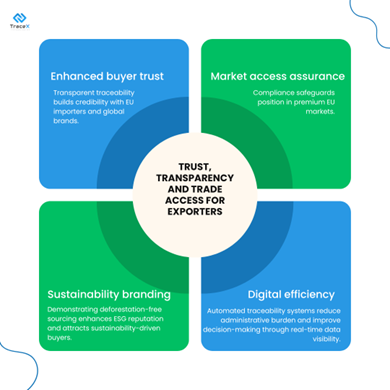
The EU Deforestation Regulation (EUDR) has major implications for Tanzania’s coffee sector, reshaping how exporters access, manage, and compete in the EU market. As the EU remains one of Tanzania’s most important destinations for Arabica and Robusta coffee, compliance with EUDR is now essential for sustaining export volumes, price competitiveness, and long-term market relationships.
Protecting Access to Tanzania’s Largest Premium Coffee Market
A significant share of Tanzania’s specialty and commercial-grade coffee is exported to the EU. Under EUDR, any coffee lacking farm-level geolocation, legality verification, or deforestation-free proof may face:
- shipment delays or detentions,
- rejection at EU ports,
- loss of long-term buyer contracts,
- downgraded market credibility.
Ensuring compliance safeguards Tanzania’s export earnings and protects the livelihoods of thousands of smallholders.
Strengthening Tanzania’s Standing in the Global Specialty Coffee Industry
Tanzania is known for its high-grown Arabica from Mbeya, Kilimanjaro, and Arusha, valued for complex acidity and clean cup profiles. Specialty buyers increasingly demand:
- complete traceability,
- sustainability assurance,
- transparent supply chains.
EUDR aligns with these expectations, making compliance essential for Tanzania to maintain and grow its premium market reputation.
Driving Digitization Across AMCOS and Cooperative Systems
Most Tanzanian cooperatives and AMCOS groups still rely on manual registers and paper-based processes. EUDR requires:
- mapping every farm plot (polygon geolocation),
- digitizing land legality documents,
- recording chain-of-custody from cherry to export.
This accelerates modernization, enabling more accurate pricing, improved farmer data, and better quality control.
Enhancing Governance, Legality, and Transparency
EUDR mandates that all coffee entering the EU must be legally produced according to Tanzanian law. This improves:
- land rights documentation,
- cooperative governance,
- processing transparency at washing stations,
- compliance across the marketing and milling system.
It strengthens institutional robustness and reduces risks linked to informal sourcing.
Reducing Deforestation Risk and Strengthening Environmental Integrity
While Tanzania’s coffee is often grown in landscapes near forest reserves, EUDR requires confirming no deforestation after 31 December 2020. This encourages:
- better land-use planning,
- satellite-based monitoring,
- sustainable farming near protected ecosystems.
It helps Tanzania balance agricultural growth with forest conservation goals.
Providing Long-Term Stability for Exporters and Farmers
Markets are shifting toward verified sustainable products. Early EUDR compliance helps exporters:
- secure long-term EU trade relationships,
- reduce exposure to regulatory change,
- position Tanzania as a reliable, future-ready origin.
Over time, this promotes stable prices and better income security for farmers.
Creating Opportunities for Price Premiums and Market Differentiation
Buyers increasingly pay premiums for:
- traceable,
- climate-resilient,
- deforestation-free coffee.
EUDR allows Tanzania to stand out as a transparent and sustainable origin, attracting responsible roasters and specialty buyers.
EUDR matters for Tanzanian coffee exports because it determines market access, brand reputation, sustainability leadership, and long-term competitiveness. By embracing traceability, legality verification, and environmental stewardship, Tanzania can secure its position in premium EU markets and strengthen the future of its coffee sector.
Strengthening Tanzania’s Coffee Competitiveness Through EUDR-Ready Supply Chains
EUDR Compliance for Coffee Exporters in Tanzania is essential for protecting access to the EU’s high-value coffee market and ensuring long-term sector resilience. By adopting digital traceability, farm-level geolocation mapping, legality verification, and automated DDS workflows, Tanzanian exporters can meet stringent EU requirements while enhancing transparency and buyer confidence. Embracing EUDR now not only safeguards Tanzania’s premium coffee reputation but also positions the country as a leader in sustainable, deforestation-free production benefiting exporters, AMCOS groups, and smallholder farmers for years to come.
Understand the key components of EUDR compliance and how to streamline your DDS process efficiently.
Read the blog on EUDR Due Diligence
Learn how AI-driven automation and intelligent workflows simplify data collection, verification, and reporting.
Explore the blog on Agentic AI for EUDR
Discover how digital onboarding bridges the gap between smallholders and EUDR compliance.
Read our blog: Smallholder Onboarding for EUDR Compliance
Frequently Asked Questions (FAQ’s)
What is EUDR compliance for Tanzania’s coffee exporters?
EUDR compliance requires Tanzanian coffee exporters to demonstrate that all coffee exported to the EU is deforestation-free, legally produced, and fully traceable to its exact farm or plantation of origin. Exporters must provide verifiable data showing that coffee farms did not contribute to deforestation after December 31, 2020.
Why is EUDR compliance important for Tanzania’s coffee industry?
The European Union is one of Tanzania’s largest coffee markets, accounting for roughly 40% of total exports. Compliance ensures continued market access, protects the country’s reputation as a sustainable coffee origin, and aligns the sector with growing global demand for ethically and environmentally responsible sourcing.
What are the key requirements for Tanzanian coffee exporters?
Exporters must ensure full traceability to the farm level, record accurate geolocation data, verify legal and deforestation-free sourcing, and submit an EUDR-compliant Due Diligence Statement (DDS) before exporting to the EU.
What challenges do Tanzanian coffee exporters face under EUDR?
Exporters face hurdles such as fragmented smallholder networks, limited digital traceability systems, incomplete land-use records, and high compliance costs for data collection and verification.
What are the long-term benefits of EUDR compliance for Tanzania’s coffee exporters?
Compliance boosts transparency, strengthens buyer trust, enhances sustainability credentials, and secures continued access to high-value EU and global markets.