
Quick summary: Explore how Indonesia cocoa exporters can achieve EUDR compliance through digital traceability, geolocation mapping, and blockchain verification. Learn how platforms like TraceX simplify Due Diligence Statement (DDS) creation, ensure deforestation-free sourcing, and future-proof cocoa exports to the EU market.

EUDR Compliance for Cocoa Exporters in Indonesia requires exporters to prove that all cocoa shipped to the EU is fully traceable, legally sourced, and free from post-2020 deforestation. Indonesia’s fragmented smallholder-based sector, mixed land-use systems, and ongoing forest-conversion risks make compliance complex. Exporters must adopt precise GPS polygon mapping, digital supply-chain traceability, and verified legality documentation. Strengthening data systems, farmer onboarding, and satellite-based monitoring is essential for ensuring conformity with EU requirements. Robust EUDR compliance will protect Indonesia’s cocoa market access, enhance buyer confidence, and position the country as a sustainable, high-quality cocoa origin.
Stay ahead of the 2025 regulation with our expert guide on Due Diligence Statements, traceability workflows, and category-specific obligations for operators, traders, and downstream entities. Download the EUDR Handbook Now
Indonesia is one of the world’s leading cocoa producers, supplying global markets with beans primarily cultivated by smallholder farmers across Sulawesi, Sumatra, Maluku, and Papua. The country produces between 180,000-250,000 metric tonnes of cocoa annually, with Sulawesi accounting for more than 60% of national output. While Indonesia exports raw cocoa beans (HS 1801), its expanding processing sector produces significant volumes of cocoa liquor (HS 1803), cocoa butter (HS 1804), cocoa powder (HS 1805), and chocolate ingredients (HS 1806), positioning the country as a major value-added supplier in Asia.
Indonesian cocoa is known for its distinct flavor profiles and increasing quality improvements driven by farmer training, fermentation programs, and sustainability initiatives supported by government agencies, private exporters, and NGOs. Certification schemes and replanting programs aim to rehabilitate aging farms and promote climate-resilient practices across the supply base.
With the implementation of the EU Deforestation Regulation (EUDR), Indonesia’s cocoa industry is intensifying efforts in farm mapping, GPS polygon data collection, digital traceability, and legality verification to maintain uninterrupted access to the EU, one of its most important premium markets. Initiatives involving satellite monitoring, supply-chain digitization, and farmer capacity building are strengthening transparency and compliance readiness across the sector.
Through continued investment in technology, sustainable farming, and coordinated national programs, Indonesia is well-positioned to remain a competitive, reliable, and environmentally responsible cocoa origin for global chocolate manufacturers.
EUDR mandates precise geolocation of every cocoa farm linked to EU-bound shipments. Indonesia’s cocoa sector, dominated by over 1.6 million smallholder farmers especially in Sulawesi, Sumatra, Papua, and Maluku, faces significant mapping challenges. Many farms lack formal boundaries or digital records, and polygon GPS data collection is constrained by remote geographies, limited infrastructure, and inconsistent farmer documentation. Exporters must integrate advanced traceability systems and reconcile fragmented datasets across multiple regions and intermediaries.
Exporters must prove that no cocoa originates from land deforested after 31 December 2020. Key challenges include historical land-use maps that vary across provinces, overlapping forest boundaries and unclear zoning in Sulawesi and Papua, encroachment into conservation or community forest areas, and complex legacy farming patterns that lack recorded land-use history. Compliance requires advanced satellite monitoring, GIS analysis, and third-party verification, driving up operational costs.
Indonesia’s land governance system, spanning state land, customary (adat) land, community-managed concessions, private holdings, and social forestry schemes, creates major documentation gaps. Many smallholders lack formal land certificates, clear land-use rights, and consistent legality documentation. Exporters must ensure legal sourcing under EUDR, which demands rigorous verification of land rights, often requiring significant farmer support and administrative processing.
Indonesia’s supply chain is deeply decentralized, with smallholders selling beans through local collectors (tengkulak), cooperatives, and district-level aggregators. Challenges include limited digital literacy, low awareness of EUDR requirements, dependence on informal buyers, and resistance to providing land and personal data. Exporters must make substantial investments in training, digital onboarding, and change management.
Meeting EUDR standards adds significant financial pressure: large-scale farm polygon mapping, procurement of satellite verification tools, investments in traceability technology hardware and data storage, training of field officers and cooperatives and farmers, and legal due-diligence and audit expenses. These costs are especially challenging given the price volatility and declining national cocoa output.
EUDR requires exporters to fully segregate compliant cocoa from non-compliant and high-risk cocoa. This impacts procurement models, warehousing, transportation, and blending practices, replacing long-used mass-balance systems. Supply-chain redesign disproportionately affects exporters sourcing from multiple islands and intermediaries.
Exporters must maintain comprehensive supply-chain data and generate a Due Diligence Statement (DDS) for every EU shipment. Challenges include integrating data from collectors, cooperatives, processors, and farmers; managing accuracy across thousands of intermediated sourcing points; preparing for EU audits and investigations; and ensuring GDPR-compliant handling of farmer data. Exporters must overhaul data governance systems to avoid compliance risks.
Regions near forest zones, especially in Papua, West Sulawesi, and parts of Sumatra, may be classified as high-risk. Exporters face difficult choices: excluding high-risk farmers and villages or investing in corrective actions such as replanting, documentation support, and monitoring. Failure to balance compliance and inclusion may disrupt livelihoods and create supply deficits.
Although Indonesia is advancing digital agriculture and land-governance reforms, exporters face fragmented systems across ministries (MoA, MoEF, ATR/BPN), delayed harmonization between national traceability systems, limited adoption of digital tools by cooperatives, and unclear long-term cost-sharing mechanisms. Any national-level delays directly impact exporter readiness.
EUDR introduces extensive legal, technical, financial, and operational challenges for Indonesia’s cocoa ecosystem. While Indonesia is progressing with traceability pilots, land-digitization efforts, and sustainability programs, full compliance requires coordinated transformation across farmers, cooperatives, collectors, processors, and exporters.
The EU Deforestation Regulation (EUDR) requires Indonesian cocoa exporters to guarantee that every EU-bound shipment is fully traceable, legally sourced, and deforestation-free. Given Indonesia’s decentralized supply chain spanning thousands of smallholders across Sulawesi, Sumatra, Papua, and Maluku, manual compliance is not feasible. TraceX provides a unified digital platform that automates due diligence, strengthens traceability, and ensures exporters meet EUDR requirements efficiently.
TraceX platform links farmers, collectors, cooperatives, processors, and exporters through a single digital ecosystem. Each cocoa lot receives a unique digital identity tied to farmer credentials and GPS-verified farm polygons, enabling a tamper-proof chain of custody from farmgate to export terminal.
Mobile-enabled field tools capture farm polygons, land-use documentation, transaction records, fermentation and drying logs, and warehouse data in real time. The platform automatically compiles all inputs into an EUDR-compliant Due Diligence Statement (DDS), cutting preparation time from weeks to hours.
All harvesting, aggregation, transport, processing, and export transactions are stored on a secure blockchain ledger. Exporters gain irrefutable proof that their cocoa originates from legal, deforestation-free farms aligned with Indonesian regulatory frameworks and EU requirements.
TraceX’s mobile tools streamline farm mapping across dispersed regions. Field officers can capture polygon boundaries, digitize land documents, and upload certification details such as Rainforest Alliance and UTZ. This is crucial given Indonesia’s smallholder-dominated, multi-intermediary supply network.
TraceX platform integrates satellite imagery and AI analytics to detect land-use changes, forest encroachment, and high-risk sourcing zones. Exporters receive real-time alerts, enabling proactive risk management and adherence to EUDR’s deforestation-free mandate.
The platform facilitates coordinated data exchange among farmers and cooperatives, collectors and aggregators, processors and exporters, government agencies, and certification bodies. This reduces data inconsistencies, shortens audit timelines, and builds trust with EU buyers.
TraceX provides exporters with high-resolution traceability, risk intelligence, and automated due diligence, transforming compliance into a differentiator. Exporters can secure premium EU partnerships, enhance sustainability credentials, and strengthen long-term market competitiveness.
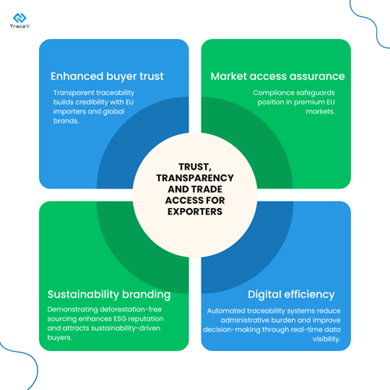
EUDR compliance is critical for Indonesia’s cocoa industry because the European Union remains one of its most valuable and stable premium markets. The EU Deforestation Regulation requires every cocoa shipment to be fully traceable to deforestation-free, legally cultivated plots, placing direct expectations on Indonesia’s millions of smallholder farmers, cooperatives, and exporters. Without compliance, Indonesian cocoa, derivatives, and chocolate ingredients risk facing border rejections, stricter inspections, contract losses, and declining price competitiveness compared to origins already advanced in traceability systems.
For Indonesia, the stakes are particularly high. Although the country is one of the world’s major cocoa origins, production has declined over the past decade due to aging trees, pests, and farm abandonment. Access to the EU market provides essential price incentives and demand stability, especially for Sulawesi and Papua regions that supply most export-grade beans and semi-processed products. Losing this market would reduce foreign exchange earnings and weaken rural livelihoods.
EUDR compliance also aligns with Indonesia’s national sustainability agenda. It encourages more accurate land-use data, supports smallholder formalization, accelerates digital farm mapping, and promotes replanting and agroforestry initiatives. Compliance helps improve productivity, quality differentiation, and long-term environmental stewardship, strengthening Indonesia’s competitiveness against Ghana, Cote d’Ivoire, and Latin American suppliers.
Ultimately, meeting EUDR requirements is not only about retaining market access; it is a strategic opportunity for Indonesia to modernize its cocoa value chain, attract investment in sustainable production, and position itself as a reliable, transparent, and premium-origin supplier to global chocolate manufacturers.
Understand the key components of EUDR compliance and how to streamline your DDS process efficiently. Read the blog on EUDR Due Diligence
Learn how AI-driven automation and intelligent workflows simplify data collection, verification, and reporting. Explore the blog on Agentic AI for EUDR
Discover how digital onboarding bridges the gap between smallholders and EUDR compliance. Read our blog: Smallholder Onboarding for EUDR Compliance
EUDR compliance requires Indonesia cocoa exporters to prove that all cocoa exported to the EU is deforestation-free, legally produced, and traceable to the exact farm or cooperative where it was grown. Exporters must provide geolocation data, legality documents, and evidence that cocoa farms were not linked to deforestation after 31 December 2020.
The EU is one of Indonesia’s largest cocoa markets, absorbing more than 65% of its cocoa exports. Compliance ensures continued EU market access, strengthens Indonesia’s reputation as a sustainable cocoa origin, and aligns the sector with global demand for ethically sourced, environmentally responsible cocoa.
Exporters must:
Key challenges include:
Compliance enhances transparency, builds buyer confidence, improves sustainability credentials, and secures long-term access to premium EU markets. It also drives sector modernization, increases farmer inclusion, and positions Indonesia as a trusted supplier of deforestation-free, high-quality cocoa.