
Quick summary: Explore how Indonesia’s gloves exporters can achieve EUDR compliance through digital traceability, geolocation mapping, and blockchain verification. Learn how digital platforms simplify Due Diligence Statement (DDS) creation, ensure deforestation-free sourcing, and future-proof rubber exports to the EU market.

EUDR Compliance for Gloves Exporters in Indonesia requires demonstrating that all natural rubber used in glove manufacturing is deforestation-free, legally sourced, and fully traceable to the plantation of origin. Given Indonesia’s reliance on smallholder rubber production and multi-tier supply chains, exporters must implement robust digital traceability systems, supplier verification, and automated due diligence reporting. Compliance involves capturing geolocation data, legality documentation, and processing histories, ensuring an unbroken chain of custody from plantation to export. Meeting EUDR standards protects EU market access, reduces audit risks, and positions Indonesian glove exporters as reliable, sustainable, and competitive suppliers.
Indonesia’s glove export sector, encompassing medical, industrial, and household rubber gloves, contributes significantly to the country’s expanding rubber product portfolio, with exports valued at approximately $1.2 billion in 2024, making Indonesia one of the world’s top rubber glove suppliers. In the first half of 2025, Indonesia shipped over 15,000 consignments of medical gloves and 1,200 industrial glove shipments, driven by strong demand from North America, Europe, and Asia-Pacific markets. The industry is concentrated in industrial clusters across West Java, East Java, and Sumatra, with over 65% of natural rubber sourced from smallholder plantations, predominantly in Sumatra, creating challenges for traceability compliance under the EU Deforestation Regulation (EUDR). With the December 30, 2025 deadline for large exporters, Indonesian glove manufacturers must implement robust digital traceability solutions, including geospatial farm mapping, blockchain-based origin verification, and compliance monitoring systems to demonstrate deforestation-free sourcing, legality, and chain-of-custody. These digital interventions bolster Indonesia’s position as a compliant global supplier, projected to reach $1.4 billion in rubber glove exports by year-end 2025, ensuring continued market access in the EU, US, Japan, and other regulated regions while mitigating shipment rejections and regulatory risks.
EUDR requires proof that all natural rubber used is deforestation-free and traceable to the plantation of origin. Indonesia’s rubber supply is dominated by smallholders and fragmented multi-tier supply chains, making it extremely difficult to track latex from individual farms to finished gloves.
Rubber passes through collectors, processors, and compounders before reaching glove manufacturers. Each intermediary adds complexity, increasing the risk of incomplete documentation or non-compliant sourcing, which can prevent EU market access.
EUDR mandates exporters implement robust due diligence systems, including risk assessment, documentation, and mitigation measures for potential deforestation risks. Many Indonesian glove SMEs lack digital tools and expertise to meet these requirements efficiently.
Exporters must maintain detailed records proving legality and deforestation-free sourcing. Missing or inconsistent data, especially from smallholder suppliers, can lead to shipment rejections, fines, or audit failures.
Tens of thousands of smallholders supply raw rubber. Onboarding and verifying each farmer for EUDR compliance is resource-intensive, and non-compliant suppliers can jeopardize the entire supply chain.
Compliance often requires investing in digital traceability systems, certifications, and auditing. Higher operational costs can reduce competitiveness in the EU glove market compared to exporters with fully traceable and certified supply chains.
Non-compliance can result in shipment delays, fines, or denial of entry to the EU. Since the EU is a major market for Indonesian gloves, even small lapses in compliance can have significant financial consequences.
Indonesian glove exporters face challenges in traceability, supply chain complexity, smallholder integration, documentation, and cost pressures under the EUDR. Achieving full compliance requires digital tools, supplier cooperation, and robust due diligence, which are critical to protect EU market access and maintain competitiveness.
The EU Deforestation Regulation (EUDR) requires Indonesian exporters of gloves ranging from medical, industrial, to household types to demonstrate that all natural rubber used in manufacturing is deforestation-free, legally sourced, and fully traceable to the plantation of origin. Given Indonesia’s reliance on smallholder rubber production, multi-tier aggregators, and complex compound-processing networks, achieving end-to-end traceability manually is extremely challenging.
The TraceX EUDR Compliance Platform provides a unified, digital-first solution that automates compliance workflows while enhancing Indonesia’s competitiveness in EU healthcare markets.
TraceX platform links smallholder plantations, collectors, processors, compounders, and glove manufacturers into a single, integrated digital ecosystem. Each batch of latex, block rubber, or glove-ready compound is assigned a unique digital ID linked to verified farm polygons, legality documentation, and processing histories, ensuring an unbroken chain of custody from plantation to exported gloves.
Sourcing teams can digitally record plantation geolocations, land-use documents, supplier declarations, and batch processing data using mobile tools. The platform automatically compiles these inputs into a fully EUDR-compliant Due Diligence Statement (DDS) for each shipment, eliminating paper bottlenecks and enabling fast, accurate submission to the EU’s central DDS system.
Every transaction from latex tapping in Sumatra and Kalimantan to compound preparation in Java to glove assembly in West Java or Jakarta is recorded on TraceX’s immutable blockchain ledger. This provides EU buyers and regulators with verifiable proof that all natural-rubber inputs are legal, traceable, and deforestation-free, simplifying audits and border inspections.
Indonesia’s glove sector depends on tens of thousands of smallholders across Sumatra, Kalimantan, and Sulawesi. TraceX streamlines onboarding with mobile-first KYC and polygon mapping tools, making even micro-suppliers EUDR-visible and verifiable. Each farmer profile includes ownership details, production records, and compliance data.
Using satellite imagery and machine learning analytics, TraceX monitors plantations for post-2020 land-use changes, encroachment, and deforestation alerts. Automated risk scores allow glove exporters to identify and resolve issues proactively, preventing shipments from being flagged or rejected by EU authorities.
TraceX acts as a secure, collaborative data layer where manufacturers, processors, suppliers, auditors, logistics partners, and EU buyers can access verified documentation. This accelerates audits, reduces compliance risks, and ensures uninterrupted movement of Indonesian gloves across EU supply chains.
With blockchain-secured traceability, AI-driven risk analytics, supplier onboarding workflows, and automated DDS generation, TraceX empowers Indonesian glove exporters to transform compliance from a challenge into a market differentiator. Exporters can build stronger buyer confidence, protect EU market access, and elevate Indonesia’s reputation as a trusted source of sustainable, EUDR-ready gloves.
EUDR compliance is vital for Indonesia’s rubber glove exporters, as the EU constitutes a key market for their $166 million in medical vulcanized rubber glove exports in 2023 (4th globally), with total gloves (HS 401511) reaching $127.5 million (13.5 million kg) primarily to the US ($82.6 million) and Germany, amid broader rubber glove valuations of $3.2 billion in 2023 driven by healthcare and industrial demand. Facing the December 30, 2026 deadline for large operators, non-compliance threatens rejections for EUDR-covered rubber inputs (HS 4001), sourced from smallholder plantations (more than 70% of output in Sumatra), requiring geolocation polygons, legality verification, and chain-of-custody proofs to confirm deforestation-free status. With a projected market growth of 12.61% by 2027, digitized traceability via geospatial mapping and blockchain safeguards Indonesia’s position, averting disruptions in EU, US, and Japan markets and sustaining $1.4 billion+ annual glove export potential amid global rubber glove demand rising to $30.08 billion in 2025.
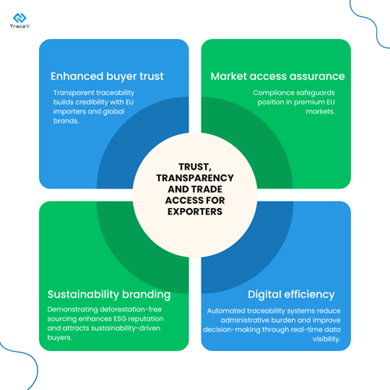
For EUDR Compliance for Gloves Exporters in Indonesia, establishing full traceability of natural rubber from plantation to finished gloves is now essential. Exporters that adopt structured due diligence, geolocation mapping, and deforestation-risk monitoring can reduce regulatory exposure while maintaining uninterrupted access to the EU market. Beyond compliance, EUDR readiness strengthens buyer confidence, supports long-term supplier relationships, and positions Indonesian glove manufacturers as credible, sustainable partners in global healthcare and industrial supply chains.
Understand the key components of EUDR compliance and how to streamline your DDS process efficiently. Read the blog on EUDR Due Diligence
Learn how AI-driven automation and intelligent workflows simplify data collection, verification, and reporting. Explore the blog on Agentic AI for EUDR
Discover how digital onboarding bridges the gap between smallholders and EUDR compliance. Read our blog: Smallholder Onboarding for EUDR Compliance
EUDR compliance requires Indonesian exporters to prove that all rubber products are deforestation-free, legally sourced, and traceable to their plantation of origin before entering the EU market.
The EU is a major destination for Indonesia’s gloves exports. Compliance ensures continued market access, strengthens buyer trust, and positions exporters as sustainability leaders in the global value chain.
Indonesian exporters must map supply chains to the farm level, capture geolocation coordinates (GeoJSON), verify legal sourcing, and submit a Due Diligence Statement (DDS) via the EU portal before shipment.
Common challenges include fragmented smallholder networks, limited digital infrastructure, manual documentation, and lack of standardized traceability frameworks across the value chain.
Beyond meeting EU regulations, compliance drives supply chain transparency, builds brand credibility, enhances ESG performance, and opens access to premium global markets demanding sustainable rubber for the Indonesian exporters.









