
Quick summary: Explore how Malaysia’s gloves exporters can achieve EUDR compliance through digital traceability, geolocation mapping, and blockchain verification. Learn how platforms like TraceX simplify Due Diligence Statement (DDS) creation, ensure deforestation-free sourcing, and future-proof rubber exports to the EU market.

EUDR Compliance for Gloves Exporters in Malaysia requires exporters to prove that all natural rubber used in glove manufacturing is deforestation-free, legally sourced, and traceable to plantation-level origin, in line with EU regulations. Despite Malaysia’s advanced glove manufacturing capacity, reliance on regional rubber smallholders and multi-tier sourcing networks creates traceability challenges. Compliance demands plot-level geolocation data, verified legality documents, and robust due diligence statements (DDS) for each EU shipment. Meeting EUDR requirements is essential to maintain uninterrupted access to EU markets, avoid enforcement risks, and sustain Malaysia’s position as a leading global glove supplier.
Complex supplier networks? Missing geolocation data? High audit pressure?
TraceX enables EUDR exporters with plot-level geolocation mapping, automated deforestation risk assessments, and verified land-use validation across their supply chains. Take control of your compliance today. Start Your Free TraceX Trial and Go EUDR-Ready.
Malaysia remains the global leader in rubber glove exports. In 2023, Malaysia exported rubber gloves worth over RM 11.8 billion (approximately 45% of global market share). For 2024, export revenue for rubber gloves was reported as RM 15.4 billion. In the first half of 2024 alone, glove export trade reached RM 6.8 billion, up from RM 5.8 billion in the same period in 2023. Rubber glove exports remain the single largest contributor to Malaysia’s rubber product export basket. In 2022, gloves contributed approximately RM 19.04 billion, representing about 70.1% of rubber product exports that year.
According to a 2023 dataset (HS 401511 surgical rubber gloves), Malaysia’s glove exports totalled about USD 1,886.1 million. Significant export destinations in 2023 included the United States (largest share by value), Japan, Germany, UK, China, and Brazil, reflecting diversified global demand. Additional glove types (other rubber gloves, HS 401519) contributed USD 710.3 million in 2023.
Malaysia’s rubber glove segment (medical, industrial, other rubber gloves) already commands a very large share of global glove demand. Given Malaysia’s established manufacturing base, integrated supply chains, and global market reach, its glove exports form a far larger proportion of its overall rubber product exports than is the case for comparable producing nations. In a risk and traceability regulatory context like EUDR or supply chain due diligence, Malaysian producers may already have more established compliance or certification frameworks given their global footprint and scrutiny. The resilience and scale of Malaysia’s glove industry, especially with growing demand and trade rebalancing, make it a major global hub with robust projected export growth.
Master the step-by-step process of submitting Due Diligence Statements under the new EUDR rules. Read the blog on filing DDS for EUDR compliance
Stay Ahead of EUDR in Healthcare Supply Chains. Germany’s medical and PPE sector is entering a new era of transparency. Read the full guide on EUDR compliance for the healthcare sector
In Malaysia, a large share of natural rubber originates from smallholders. Some estimates point to approximately 75-80% of rubber coming from small farms rather than large estates. That fragmentation makes it very difficult to trace every batch of natural rubber back to the plantation of origin especially when latex and rubber changes hands via multiple intermediaries (collectors, processors, traders) before reaching glove manufacturers.
Under EUDR, exporters must prove that rubber originates from land that has not been deforested since the cut-off date and that the land is legally owned or used. In many cases, smallholder plantations may lack formal land titles, or records may be outdated, incomplete, or non-digitized especially in rural zones. Without accurate GPS mapping or land-use legality documentation, glove exporters risk non-compliance or rejection of EU shipments.
Historically, many parts of Malaysia’s rubber supply chain have relied on manual paperwork: paper-based records from farms, collectors, cooperatives, and traders. This makes consolidation, verification, and audit-readiness very cumbersome. Low digital adoption among smallholder farmers due to limited access to smartphones, internet, or digital tools further complicates efforts to trace and record data consistently across the supply chain.
Meeting EUDR’s due diligence requirements (geolocation mapping, legality checks, documentation, risk assessments) imposes administrative overhead on exporters. For firms heavily reliant on latex gloves, this could exacerbate existing financial pressures. For smaller manufacturers or processors, compliance-related costs may reduce competitiveness, especially relative to firms and countries already having robust traceability systems in place.
Exporters depend on upstream actors including smallholders, collectors, and mid-chain processors to supply geolocation and land-use data. If suppliers are unwilling or unable to provide this data due to poor records, reluctance, or technical incapacity, traceability breaks down. Because so many smallholders are separately managed and decentralized, establishing standardized compliance across a wide supplier base is difficult.
Non-compliance could lead to shipments being rejected by EU importers or regulatory fines, which is particularly risky given the EU is a major market for Malaysian rubber products. Adding EUDR compliance on top of existing industry pressures could worsen margin pressure for latex-heavy glove producers.
There are concerns among stakeholders that stringent EUDR compliance will disproportionately disadvantage smallholders who lack documentation, digital tools, or capital to upgrade, thereby marginalizing them. Without national-level, inclusive traceability frameworks, small producers may be cut off from supply chains destined for the EU, even if their rubber is sustainably produced.
Even as the industry and regulators in Malaysia recognize EUDR implications, frameworks for traceability, data-sharing, and compliance are still evolving. Exporters face uncertainty about what counts as acceptable geolocation and legality data, how granular mapping must be, and how to integrate data from disparate suppliers, leading to hesitancy or delays. The same structural characteristics that give Malaysia global strength in glove exports, including smallholder-based supply, decentralized sourcing, and high production volume, also make EUDR compliance extremely challenging without major traceability upgrades.
The TraceX EUDR Compliance Platform provides a unified, digital-first solution that automates compliance workflows while enhancing Malaysia’s competitiveness in EU healthcare markets.
The platform onboards smallholder farmers, collectors, processors, and glove manufacturers into a unified digital network. Each batch of latex and natural rubber receives a unique digital ID tied to the verified geolocation of the plantation, land-use legality documents, and transaction history, ensuring a clear chain of custody. This ensures that rubber inputs used in glove manufacturing are traceable to plantation level, satisfying EUDR’s requirement for plantation-level traceability and legal land-use documentation.
Field agents or smallholders use mobile tools to record farm coordinates (GPS polygons), land-title or ownership documents, harvest and latex collection data, and seller-buyer transfers. The system standardizes document formats and enforces completeness, eliminating fragmented paper-based record-keeping and reducing human error.
From the captured data, the platform automatically compiles the compliance documentation required under EUDR: geolocation, legality, supply chain history, and risk assessment. Exporters have ready-to-submit DDS documents for each shipment to the EU, simplifying regulatory compliance and reducing administrative burden.
By recording every transaction from smallholder to glove manufacturer on an immutable ledger, the platform ensures tamper-proof traceability. This gives confidence to EU buyers and regulators that rubber inputs come from deforestation-free, legally compliant plantations. It also helps prevent greenwashing or false claims about origin, building trust and protecting brand reputation.
The platform’s onboarding tools, designed mobile-first with a simple UI, can help bring even micro rubber farms into the traceability ecosystem, an essential step in a smallholder-heavy sector like Malaysia’s. Government or industry bodies can support training, capacity-building, or subsidize mobile tools to reduce the digital divide and ensure broad compliance.
Advanced features including satellite-based monitoring and AI-driven analytics detect land-use changes, deforestation risks, or irregularities, enabling exporters to flag and mitigate issues before shipments are prepared. This proactive risk detection helps prevent potential rejection of shipments or compliance violations, especially as EU scrutiny increases.
The traceability platform serves as a collaborative data layer where all stakeholders, including smallholders, processors, exporters, auditors, and EU buyers, access verified, standardized compliance data. This reduces friction, improves transparency, and streamlines audits and inspections.
Glove exporters who adopt full traceability and EUDR compliance early can market themselves as sustainable, deforestation-free suppliers, a strong selling point for European buyers increasingly conscious of ESG (environmental, social, governance) standards. Over time, this can help preserve and even expand Malaysia’s market share in EU healthcare, industrial, and consumer glove markets.
By integrating smallholders into a shared digital compliance network, traceability platforms can prevent marginalization. Rubber farmers who may otherwise be excluded due to lack of documentation can continue to participate in the supply chain and maintain their access to EU-bound markets.
Book a Free Demo with TraceX
Digitize your compliance workflows, safeguard EU glove exports, and position Malaysia’s glove industry at the forefront of deforestation-free global manufacturing.
Malaysia remains the global leader in rubber glove production and exports, producing a major share of the world’s medical, industrial, and nitrile gloves. Export data underlines the scale: in 2023 Malaysia exported rubber gloves worth over RM 11.8 billion, and in 2024 total glove export revenue was estimated at RM 15.41 billion, representing a substantial portion of the country’s rubber and rubber product export basket. Demand remains strong: global demand for gloves is projected to reach up to 450 billion pieces by 2027, driven by markets such as the EU, US, Japan, and increasing non-medical glove demand including industrial, food service, and semiconductor applications. The EU remains a significant market: as of 2023, the EU accounted for an estimated 28-30% of Malaysia’s total glove exports. Maintaining access to EU markets is therefore vital to sustaining Malaysia’s glove export volumes, revenues, and global competitiveness.
Under EUDR, exporters of natural rubber and rubber-derived products including gloves must demonstrate that their rubber inputs comply with deforestation-free sourcing, legality, and traceability requirements. For Malaysia’s glove exporters to continue selling to EU buyers, they must satisfy these obligations: plantation geolocation, proof of legal land-use and tenure, evidence of no deforestation post cut-off, and full traceability through all supply chain layers from smallholders to processors to glove manufacturers. Malaysia has been placed by EU authorities in the “standard risk” category under EUDR, which means at least a subset of consignments will be subject to documentary and identity checks. Non-compliance or inability to provide required documentation may result in shipments being rejected, fines, or even exclusion from EU procurement contracts.
For Malaysia’s glove industry, the world’s leading exporter of medical and industrial gloves, EUDR compliance is more than a regulatory requirement; it is a strategic imperative. By adopting robust traceability systems, documenting deforestation-free and legally sourced rubber, and integrating smallholder suppliers into transparent supply chains, Malaysian exporters can safeguard EU market access, enhance global competitiveness, and strengthen ESG credentials. Proactive compliance not only mitigates the risk of shipment rejections or fines but also positions Malaysia as a trusted, sustainable supplier in an increasingly environmentally conscious global market, ensuring the long-term resilience and growth of its glove export sector.
Understand the key components of EUDR compliance and how to streamline your DDS process efficiently. Read the blog on EUDR Due Diligence
Learn how AI-driven automation and intelligent workflows simplify data collection, verification, and reporting. Explore the blog on Agentic AI for EUDR
Discover how digital onboarding bridges the gap between smallholders and EUDR compliance. Read our blog: Smallholder Onboarding for EUDR Compliance
EUDR compliance requires Malaysian exporters to prove that all rubber products are deforestation-free, legally sourced, and traceable to their plantation of origin before entering the EU market.
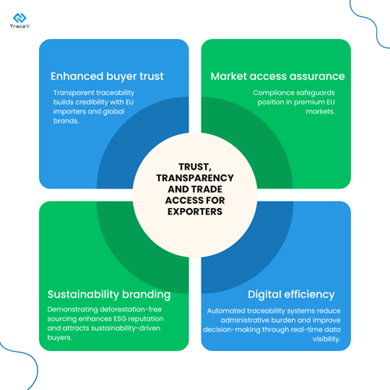
The EU is a major destination for Malaysia’s gloves exports. Compliance ensures continued market access, strengthens buyer trust, and positions exporters as sustainability leaders in the global value chain.
Malaysian exporters must map supply chains to the farm level, capture geolocation coordinates (GeoJSON), verify legal sourcing, and submit a Due Diligence Statement (DDS) via the EU portal before shipment.
Common challenges include fragmented smallholder networks, limited digital infrastructure, manual documentation, and lack of standardized traceability frameworks across the value chain.
Beyond meeting EU regulations, compliance drives supply chain transparency, builds brand credibility, enhances ESG performance, and opens access to premium global markets demanding sustainable rubber for the Malaysian exporters.









