
Quick summary: Explore how Cote D’Ivoire’s rubber exporters can achieve EUDR compliance through digital traceability, geolocation mapping, and blockchain verification. Learn how platforms like TraceX simplify Due Diligence Statement (DDS) creation, ensure deforestation-free sourcing, and future-proof rubber exports to the EU market.
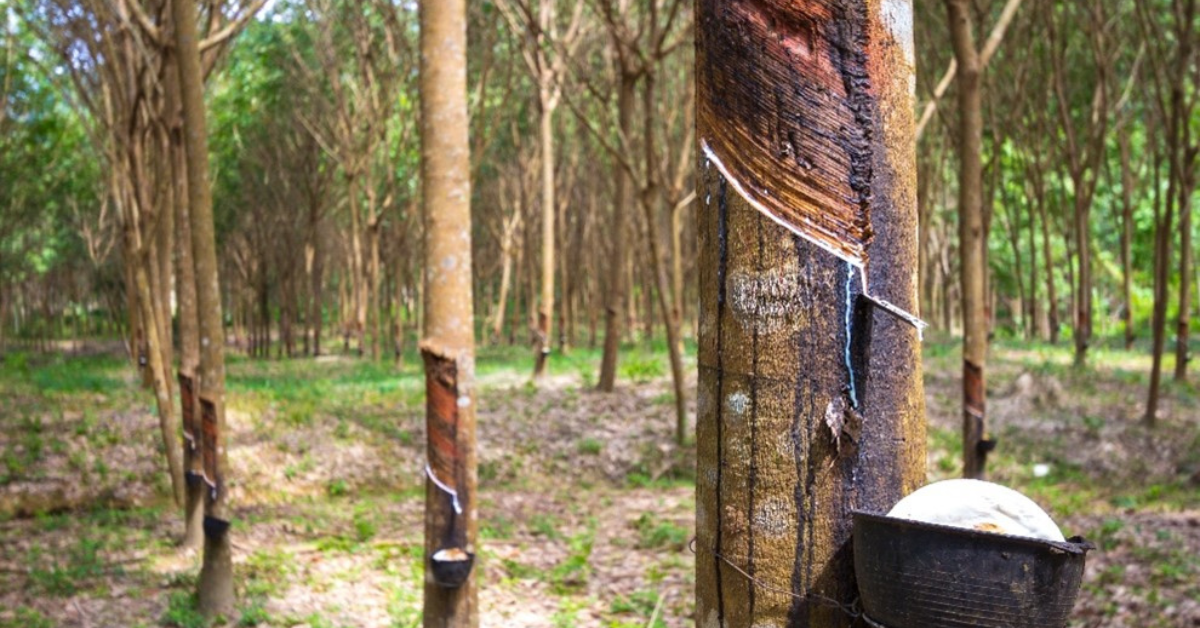
EUDR Compliance for Rubber Exporters in Cote d’Ivoire requires exporters to demonstrate that all natural rubber and rubber-derived products entering the EU are deforestation-free, legally sourced, and fully traceable to the plantation of origin. Ivorian exporters must capture farm-level geolocation polygons, verify land-use legality, assess deforestation risk, and maintain a transparent chain of custody from smallholder farms to processing plants and export terminals. A complete EUDR-aligned Due Diligence Statement (DDS) must accompany every shipment. Robust digital traceability and supplier onboarding are now essential to protect Cote d’Ivoire’s access to EU rubber markets.
Stay ahead of the 2025 regulation with our expert guide on Due Diligence Statements, traceability workflows, and category-specific obligations for operators, traders, and downstream entities. Download the EUDR Handbook Now
Cote d’Ivoire is the leading natural rubber producer in Africa and the world’s seventh-largest exporter, supplying major global markets including the EU, China, and Southeast Asia. Rubber cultivation is concentrated in the southern and eastern regions such as Gagnoa, Aboisso, San Pedro, Soubre, and Agboville where favourable climatic conditions support rapid plantation expansion. The country produces over 1.2 million tonnes of natural rubber annually, with exports exceeding USD 950 million, making rubber one of Cote d’Ivoire’s fastest-growing agricultural export sectors after cocoa and cashew.
The rubber value chain includes smallholder tapping, cooperative aggregation, processing into TSR grades and smoked sheets, and downstream manufacturing. However, more than 80% of Ivorian rubber comes from smallholder farmers, creating significant traceability and legality-verification challenges. Rapid plantation expansion into forested zones and proximity to sensitive ecosystems have raised concerns around historical and recent deforestation issues that directly intersect with the EU’s sustainability expectations.
As the EU pushes for deforestation-free supply chains, global tyre, automotive, and industrial buyers are intensifying scrutiny of raw rubber origins. This is accelerating Cote d’Ivoire’s adoption of digital traceability tools, geospatial mapping, and sustainability monitoring systems to maintain competitiveness and meet evolving market standards.
Under the EU Deforestation Regulation (EUDR), natural rubber and key derivatives fall under regulated HS codes, including HS 4001 (natural rubber, balata, and similar gums), HS 4005 (compounded, unvulcanised rubber), HS 4006 (other unvulcanised rubber forms), HS 4008 (vulcanised rubber sheets, plates, strips), and HS 4011 (new pneumatic tyres made from natural rubber).
The regulation entered into force on 29 June 2023, with full due-diligence obligations effective 30 December 2025 for large and medium operators, and 30 June 2026 for small and micro enterprises.
For Cote d’Ivoire’s rubber exporters, EUDR compliance requires accurate geolocation mapping of plantations, verification of land legality, inclusive onboarding of smallholders, and end-to-end chain-of-custody documentation. Early investment in digital traceability, satellite-based risk detection, and automated due-diligence systems is essential to maintain EU market access and strengthen the country’s position as a global leader in sustainable natural rubber production.
Master the step-by-step process of submitting Due Diligence Statements under the new EUDR rules. Read the blog on filing DDS for EUDR compliance
Don’t wait until deadlines tighten. Learn how traceability, digital documentation, and risk intelligence can keep your exports compliant and competitive. Read our latest blog on EUDR rubber regulations
Cote d’Ivoire, the largest natural rubber producer in Africa, faces significant structural and operational challenges as it prepares to comply with the EU Deforestation Regulation (EUDR). Because over 40% of its rubber exports go to the EU (directly or indirectly through tyre manufacturers), compliance is critical. However, several sector-specific constraints make the transition difficult.
More than 80% of Ivorian rubber is produced by smallholders, often farming 1-3 hectares with limited documentation. This creates major EUDR challenges: farms lack formal GPS polygon mapping, supplier identities are often undocumented, and rubber delivery is mixed at cooperative or processing-unit level. Mapping thousands of smallholders within a tight timeline remains one of the biggest compliance hurdles.
Many smallholders operate without formal land titles or verified usufruct rights. EUDR requires exporters to prove legal land ownership or usage rights, compliance with national forest laws, and non-overlap with protected forests. Incomplete or missing land documentation exposes exporters to legality risk and potential shipment rejection.
Cote d’Ivoire has seen rapid expansion of rubber into degraded forests, classified forest reserves, and agroforestry areas. EUDR prohibits sourcing rubber from land deforested after 31 December 2020. Detecting deforestation in mosaic landscapes and mixed-farming zones makes risk assessment extremely complex.
Rubber flow is highly aggregated: latex from hundreds of farmers is combined in tanks, cup lumps are bulked during collection, and processors receive mixed-origin material. Once mixed, tracing back to individual farms becomes nearly impossible without digital batch-segregation systems, something most exporters currently lack.
Many cooperatives and processors rely on paper receipts, manual logbooks, and non-standardized farmer lists. EUDR demands digital, auditable, tamper-proof data. The leap from manual systems to fully digital traceability is a major operational shift.
Geospatial verification is mandatory under EUDR, yet challenges include lack of polygon boundaries, outdated satellite monitoring, limited access to remote-sensing tools, and insufficient expertise to detect forest loss or overlapping farm claims. Without modern GIS tools, exporters cannot reliably assess deforestation risk.
Cooperatives play a central role but face limited digital literacy, weak record-keeping practices, and inadequate training on EUDR requirements. Scaling capacity building to hundreds of cooperatives is resource intensive.
Rubber processing mills must separate compliant from non-compliant batches, ensure chain-of-custody continuity, and maintain digital batch-level proof. Most Ivorian mills lack systems to segregate or digitally track inputs.
Compliance deadlines are 30 December 2025 for medium and large exporters and 30 June 2026 for small and micro operators. Mapping farms, validating legality, setting up DDS workflows, and training cooperatives within this timeline is challenging.
EUDR requires investments in GPS mapping, mobile data tools, traceability software, satellite monitoring, blockchain ledgers, audits, and legality verification. This poses a significant cost burden for both exporters and smallholder networks.
EUDR creates unprecedented demands on Cote d’Ivoire’s rubber sector. Exporters must rapidly modernize traceability, legality verification, and risk monitoring systems while onboarding thousands of smallholders and cooperatives into a compliant digital ecosystem. Without large-scale digital transformation, the sector risks losing access to its most important market, the EU.
The EU Deforestation Regulation (EUDR) requires Ivorian rubber exporters to prove that all natural rubber and rubber-derived products entering the EU are fully traceable, legally sourced, and verified as deforestation-free. With Cote d’Ivoire’s rubber industry dominated by thousands of smallholder farmers and complex cooperative-driven supply networks, meeting these requirements through manual systems is nearly impossible. The TraceX EUDR Compliance Platform provides a digital, automated, and transparent solution that helps exporters streamline due diligence, strengthen documentation integrity, and protect access to the EU market.
TraceX platform connects smallholders, cooperatives, collection centers, processors, and exporters into one unified digital ecosystem. Every batch of latex or cup lumps receives a unique digital identity linked to verified geolocation polygons, legality documents, and chain-of-custody data. This ensures complete, audit-proof traceability from plantation to processing facility to export port (Abidjan or San Pedro).
Field officers and cooperative leaders can capture farm coordinates, land-rights documentation, yield data, and supplier compliance information directly via mobile devices. TraceX solution automatically compiles this data into EUDR-compliant Due Diligence Statements (DDS), eliminating paperwork, reducing human error, and enabling timely submission to the EU’s central reporting system.
Every transaction from tapping to collection, processing, storage, transport, and export is securely recorded on TraceX’s blockchain ledger. This immutable, tamper-proof digital trail provides verifiable proof of origin and legality, giving EU regulators and buyers full confidence in Cote d’Ivoire’s rubber supply chains.
Cote d’Ivoire’s rubber supply base is highly fragmented, with over 80% of production coming from smallholders across Gagnoa, Aboisso, San Pedro, Soubre, and Agboville. TraceX enables rapid digitization and onboarding of these farmers by capturing GPS polygons, verifying land-use legality, and linking each plot to compliant supply batches, ensuring inclusive and complete visibility.
TraceX platform integrates satellite monitoring, AI analytics, and geospatial modeling to detect deforestation risks, land-use changes post-2020, and sourcing irregularities. Exporters receive automated risk alerts, enabling early intervention and ensuring that only compliant material is routed to the EU.
TraceX platform serves as a secure, transparent data hub connecting exporters, cooperatives, processors, customs authorities, certification bodies, and EU importers. This shared architecture improves data accuracy, accelerates audits, and reinforces Cote d’Ivoire’s credibility in the EU’s sustainability ecosystem.
With blockchain-secured traceability, advanced risk intelligence, and automated DDS workflows, TraceX helps Cote d’Ivoire transform EUDR compliance from a regulatory challenge into a strategic opportunity. Exporters can strengthen transparency, secure EU market access, unlock premium buyer relationships, and enhance the livelihoods of smallholder farmers.
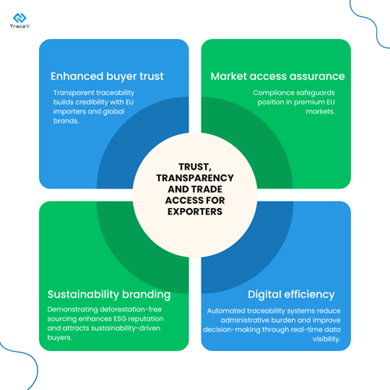
EUDR compliance is critical for Cote d’Ivoire because the European Union is one of the largest end-markets for natural rubber, directly through raw material imports and indirectly through tyre and industrial manufacturers operating within the EU. As Africa’s leading producer of natural rubber and a major global supplier, Cote d’Ivoire risks significant trade disruption if its rubber cannot meet the EU’s strict deforestation-free and legality requirements.
Cote d’Ivoire’s rubber sector is dominated by smallholder farmers (over 80% of production), many of whom lack formal land titles, GPS-mapped plantations, or digital documentation. Without EUDR alignment including geolocation polygons, proof of legal land use, and transparent chain-of-custody records, exporters may face shipment rejections, delays, or exclusion from EU supply chains.
Beyond protecting market access, EUDR compliance drives sector modernization, pushing Cote d’Ivoire toward digital traceability, improved land-use governance, and stronger environmental stewardship. It also strengthens the country’s credibility with global tyre manufacturers and sustainability-focused buyers demanding ethically sourced, deforestation-free natural rubber.
Ultimately, achieving EUDR compliance is not just a regulatory obligation it is a strategic necessity for safeguarding export revenues, protecting smallholder livelihoods, enhancing global competitiveness, and positioning Cote d’Ivoire as a trusted leader in the sustainable natural rubber economy.
EUDR Compliance for Rubber Exporters in Cote d’Ivoire is essential to protecting the country’s role as Africa’s leading natural rubber supplier and maintaining access to the EU’s high-value markets. By adopting digital traceability, GPS-based plantation mapping, legality verification, and automated DDS workflows, exporters can meet the EU’s stringent requirements while strengthening transparency and reducing regulatory risk. Embracing EUDR now not only safeguards export revenues and smallholder livelihoods but also positions Cote d’Ivoire as a global leader in sustainable, deforestation-free natural rubber production.
Understand the key components of EUDR compliance and how to streamline your DDS process efficiently. Read the blog on EUDR Due Diligence
Learn how AI-driven automation and intelligent workflows simplify data collection, verification, and reporting. Explore the blog on Agentic AI for EUDR
Discover how digital onboarding bridges the gap between smallholders and EUDR compliance. Read our blog: Smallholder Onboarding for EUDR Compliance
EUDR compliance requires Cote D’Ivoire exporters to prove that all rubber products are deforestation-free, legally sourced, and traceable to their plantation of origin before entering the EU market.
The EU is a major destination for Cote D’Ivoire’s rubber exports. Compliance ensures continued market access, strengthens buyer trust, and positions exporters as sustainability leaders in the global value chain.
Cote D’Ivoire exporters must map supply chains to the farm level, capture geolocation coordinates (GeoJSON), verify legal sourcing, and submit a Due Diligence Statement (DDS) via the EU portal before shipment.
Common challenges include fragmented smallholder networks, limited digital infrastructure, manual documentation, and lack of standardized traceability frameworks across the value chain.
Beyond meeting EU regulations, compliance drives supply chain transparency, builds brand credibility, enhances ESG performance, and opens access to premium global markets demanding sustainable rubber for the Cote D’Ivoire exporters.









