
Quick summary: Explore how Indonesia’s rubber parts exporters can achieve EUDR compliance through digital traceability, geolocation mapping, and blockchain verification. Learn how platforms like TraceX simplify Due Diligence Statement (DDS) creation, ensure deforestation-free sourcing, and future-proof rubber exports to the EU market.

EUDR Compliance for Rubber Parts Exporters in Indonesia requires Indonesian manufacturers and traders to prove that all natural rubber used in rubber parts is deforestation-free, legally sourced, and fully traceable to its plantation of origin. Exporters must collect polygon-level geolocation data, verify land legality, assess deforestation risk, and submit an accurate Due Diligence Statement (DDS) before shipments enter the EU. Given Indonesia’s complex smallholder-dominated supply chain, digital traceability, supplier onboarding, and risk-scoring systems are essential to meet requirements and avoid customs rejection. Strengthening EUDR compliance for rubber parts exporters in Indonesia is now critical to maintaining EU market access.
Indonesia is a major global hub for natural rubber and a rapidly expanding exporter of automotive and industrial rubber parts. Its export portfolio includes hoses, belts, bushings, engine mounts, gaskets, seals, O-rings, tyre components, conveyor belts, and vibration-control parts supplied to leading markets such as the EU, the United States, Japan, South Korea, and the Middle East. Backed by one of the world’s largest natural rubber bases, Indonesia’s rubber parts industry contributes billions annually to global automotive, machinery, and engineering supply chains.
Rubber sourcing, however, is highly complex. Indonesia’s plantation landscape spans industrial timber estates (HTI), large private concessions, and millions of smallholder farmers across Sumatra, Kalimantan, Sulawesi, and Java. Over 80% of natural rubber originates from smallholders, creating significant gaps in traceability, legality verification, and geolocation mapping, now central requirements under the EU Deforestation Regulation (EUDR).
Under EUDR, all rubber and rubber-derived components including HS 4001, 4002, 4005-4008, 4010-4012, 4016, and 4017 must be proven deforestation-free, legally produced, and traceable to plantation polygons. This affects both raw rubber inputs and finished rubber assemblies exported to the EU.
With enforcement deadlines set for 30 December 2025 for large and medium enterprises and 30 June 2026 for SMEs and micro-operators, Indonesian manufacturers must digitize compliance workflows, integrate supplier-level geolocation data, and establish transparent chain-of-custody systems capable of linking thousands of smallholders to each export shipment.
By adopting GeoJSON-based farm mapping, blockchain-secured origin verification, AI-enabled deforestation risk monitoring, and automated Due Diligence Statement (DDS) generation, Indonesia’s rubber parts exporters can meet EUDR obligations, reduce compliance risks, and reinforce their position as preferred suppliers in a sustainability-driven global automotive and industrial ecosystem.
Indonesia’s rubber parts industry, from automotive components to industrial engineering products, faces substantial compliance pressure under the EU Deforestation Regulation (EUDR). Because the sector relies heavily on smallholder-sourced natural rubber and multi-tier supply chains, meeting plot-level traceability and legality verification is significantly complex. The major challenges include:
Over 80% of Indonesia’s natural rubber comes from millions of smallholder farmers across Sumatra, Kalimantan, and Sulawesi. Farms are unmapped, undocumented, and often without clear land titles. Capturing consistent geolocation polygons (required under EUDR) is difficult. Limited digital literacy slows data collection and onboarding.
Rubber parts manufacturers source rubber sheets, latex, or TSR rubber through cooperatives, aggregators, processors, and traders. Raw materials get mixed across villages and intermediaries. It is impossible to manually trace rubber batches back to specific plots. Chain-of-custody documentation is inconsistent or paper-based.
EUDR requires proof that rubber originates from land legally used and harvested. Many farms lack formal land titles or proper land-use permits. There is variation in documentation across regions and concession types. Smallholders rarely maintain auditable compliance records.
EUDR mandates polygon geolocation, not just point coordinates. Incorrect or incomplete mapping leads to DDS rejection. Remote areas with poor connectivity hinder accurate GPS capture. Mixed land-use zones require continuous satellite verification.
Rubber cultivation overlaps with sensitive landscapes in Sumatra and Kalimantan. Identifying post-2020 land-use change requires satellite and AI tools. Manual monitoring cannot detect micro-encroachment or illegal expansion. EU importers may classify Indonesia as higher-risk, increasing scrutiny.
Most manufacturers rely on spreadsheets, paper documents, and WhatsApp communication. There is no centralized farm master or digital data repository. High error rates occur in manually assembling Due Diligence Statements. There is no audit trail to satisfy EU regulators or downstream OEMs.
Thousands of upstream suppliers need onboarding into a digital compliance framework. Many smallholders lack smartphones or familiarity with compliance workflows. Cooperatives may resist change due to operational overhead. Training, field verification, and document standardization require time and cost.
Rubber compounds and parts often use blended materials from multiple origins. Multi-origin batches complicate source attribution. Ensuring EUDR compliance for every ingredient in the compound is difficult. Manufacturers must reconcile volumes versus plantation yield, which is manually impossible.
EUDR requires investments in tech, field mapping, legal validation, and risk assessment. MSME rubber-part producers struggle to bear upfront compliance costs. Without digital systems, EU buyers may shift sourcing to more compliant regions. Delays in readiness threaten market access and revenue stability.
Any mismatch in polygons, legality documents, or DDS data can block EU shipments. Customs holds increase lead times and operational costs. OEMs demand full documentation before procurement. Non-compliance could jeopardize long-term contracts.
The EU Deforestation Regulation (EUDR) requires Indonesian exporters of rubber components such as hoses, seals, belts, gaskets, O-rings, vibration-control parts, and industrial rubber assemblies to prove that every natural rubber input used in manufacturing is traceable to its plantation of origin, legally harvested, and deforestation-free. For Indonesia’s rubber parts industry, which relies heavily on smallholder-dominated raw material networks across Sumatra, Kalimantan, and Sulawesi, meeting these requirements is complex. The TraceX EUDR Compliance Platform provides a unified, digital-first, automated solution that simplifies end-to-end compliance while strengthening Indonesia’s competitiveness in EU markets.
TraceX platform connects smallholders, cooperatives, crumb rubber producers, compounders, processors, and rubber parts manufacturers into a single digital ecosystem. Each batch of natural rubber or compound used in a component is assigned a unique digital ID linked to plantation polygons, legality evidence, and processing records, ensuring complete chain-of-custody visibility from farm to finished HS 4016 and 4017 product.
Field teams and manufacturers can capture geolocation polygons, land documentation, supplier data, and compound batch records directly through mobile-enabled tools. The platform automatically generates an EUDR-compliant Due Diligence Statement (DDS) for every shipment, eliminating manual paperwork and enabling fast, error-free submissions to the EU’s central DDS system.
Each transaction from latex tapping to crumb rubber processing to compounding and final part production is logged on the TraceX blockchain ledger. This immutable, tamper-proof record offers verifiable proof that Indonesian natural rubber inputs meet EU legality and deforestation-free requirements, increasing trust among EU automotive, machinery, and industrial buyers.
Indonesia’s rubber parts sector depends on thousands of smallholder farms scattered across Sumatra, Kalimantan, and Sulawesi. TraceX enables rapid onboarding and GPS polygon mapping of these suppliers. Each farmer profile includes ownership evidence, production data, certifications, and compliance status, bringing transparency to even the most fragmented upstream networks.
TraceX platform integrates satellite imagery, deforestation alerts, and machine-learning analytics to monitor land-use change around plantations. Exporters receive automated risk flags for potential post-2020 deforestation, illegal land clearing, or encroachment, allowing proactive mitigation before EU authorities detect non-compliance.
TraceX acts as a secure compliance hub where suppliers, processors, manufacturers, auditors, and EU buyers can exchange verified data. Standardized workflows reduce audit time, accelerate customs clearance, and minimize regulatory risk across Indonesia’s rubber parts supply chain.
With blockchain-backed transparency, AI-driven risk intelligence, supplier onboarding at scale, and automated DDS workflows, TraceX helps Indonesian rubber parts exporters transform regulatory pressure into a strategic edge. Exporters strengthen ESG credentials, protect EU market access, and position Indonesia as a trusted origin for fully traceable, deforestation-free rubber components.
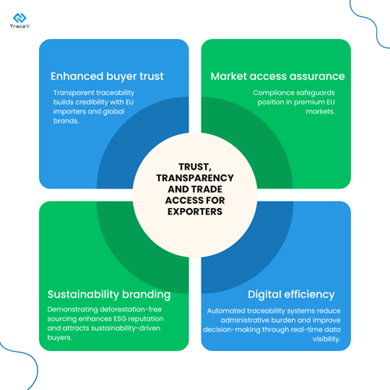
EUDR compliance is mission-critical for Indonesia’s rubber parts exporters because the EU is one of the largest global consumers of automotive, industrial, and engineered rubber components, many of which rely heavily on natural rubber sourced from Indonesia. Beginning in 2025-2026, no rubber-based product containing natural rubber can enter the EU without verified, plantation-level traceability, legality documentation, and deforestation-free proof. This makes compliance a direct determinant of market access.
For Indonesia, where natural rubber supply chains are deeply fragmented across millions of smallholders in Sumatra, Kalimantan, Sulawesi, and Papua, failure to comply could lead to shipment delays, customs rejections, contract cancellations, and long-term loss of EU buyers. Global automotive and industrial OEMs increasingly require EUDR-aligned transparency as part of their ESG and Scope 3 reporting, meaning Indonesian suppliers who can demonstrate compliant supply chains gain a competitive advantage.
EUDR compliance also accelerates needed modernization across the industry: improved supplier onboarding and governance, digital traceability and geolocation mapping, stronger quality and sustainability credentials, and reduced reputational and regulatory risk. By adopting EUDR-ready systems early, Indonesian rubber parts manufacturers can strengthen export reliability, meet global sustainability expectations, and position themselves as preferred, long-term partners in the EU’s automotive, engineering, and industrial sectors.
EUDR Compliance for Rubber Parts Exporters in Indonesia is no longer just a regulatory requirement it is a strategic differentiator. As the EU tightens expectations around traceability, legality, and deforestation-free sourcing, Indonesian exporters must adopt digital systems that provide plantation-level geolocation, transparent chain of custody, and reliable due-diligence documentation. By investing in scalable traceability tools and supplier-mapping workflows, Indonesia’s rubber parts industry can safeguard EU market access, build stronger buyer confidence, and position itself as a future-ready, sustainable manufacturing hub in the global automotive and industrial supply chain.
Understand the key components of EUDR compliance and how to streamline your DDS process efficiently. Read the blog on EUDR Due Diligence
Learn how AI-driven automation and intelligent workflows simplify data collection, verification, and reporting. Explore the blog on Agentic AI for EUDR
Discover how digital onboarding bridges the gap between smallholders and EUDR compliance. Read our blog: Smallholder Onboarding for EUDR Compliance
EUDR compliance requires Indonesian exporters to prove that all rubber products are deforestation-free, legally sourced, and traceable to their plantation of origin before entering the EU market.
The EU is a major destination for Indonesian’s rubber parts exports. Compliance ensures continued market access, strengthens buyer trust, and positions exporters as sustainability leaders in the global value chain.
Indonesian exporters must map supply chains to the farm level, capture geolocation coordinates (GeoJSON), verify legal sourcing, and submit a Due Diligence Statement (DDS) via the EU portal before shipment.
Common challenges include fragmented smallholder networks, limited digital infrastructure, manual documentation, and lack of standardized traceability frameworks across the value chain.
Beyond meeting EU regulations, compliance drives supply chain transparency, builds brand credibility, enhances ESG performance, and opens access to premium global markets demanding sustainable rubber for the Indonesian exporters.