
Quick summary: Explore how Vietnam’s coffee exporters can achieve EUDR compliance through digital traceability, geolocation mapping, and blockchain verification. Learn how platforms like TraceX simplify Due Diligence Statement (DDS) creation, ensure deforestation-free sourcing, and future-proof rubber exports to the EU market.

The EUDR Compliance for Coffee Exporters in Vietnam requires that all coffee exported to the EU be deforestation-free, legally produced, and traceable to the farm level. Vietnamese exporters must collect geolocation data for all sourcing plots, verify legality under local land and environmental laws, and submit a Due Diligence Statement (DDS) before export. The regulation applies to green coffee beans and processed products, with deadlines of 30 December 2025 for large operators and 30 December 2026 for SMEs. Implementing digital traceability systems ensures audit readiness, market access, and alignment with EU sustainability standards.
Vietnam is one of the world’s major coffee producers. It is the world’s top producer of Robusta coffee beans, and the second-largest overall coffee exporter after Brazil. In marketing year 2022/23, production was estimated at approximately 29.75 million bags (green bean equivalent) by the USDA. Around 90% of Vietnam’s coffee output is produced in the Central Highlands region (provinces such as Dak Lak, Gia Lai, and Lam Dong) due to suitable basalt soils and climate. The vast majority of the crop is Robusta, which is less sensitive to altitude and temperature than Arabica but generally commands lower prices.
In 2023, Vietnam exported about US$4.14 billion worth of coffee. Europe remains a major destination: Germany, Italy, and Belgium are top importers of Vietnamese coffee. The EU accounts for roughly 40% of total coffee exports from Vietnam. The bulk of exported beans are green (unroasted) Robusta beans, with green bean exports dominating at approximately 85% of volume for MY2023/24. Value-added exports (processed coffee: soluble and instant, roasted) are growing, albeit from a smaller base.
The Vietnamese government, through the Ministry of Agriculture and Rural Development (MARD), has set targets under a “Development Plan for Key Industrial Crops by 2030” which includes coffee. Goals include reducing area, improving quality, adopting certified varieties, and ensuring traceability (aiming for 70% of coffee area to have implemented traceability codes). The push toward certifications (such as 4C, Rainforest Alliance) and traceability is driven by export market demands, especially Europe, and by the need to add value rather than just export raw beans. There is growing investment in processing capacity as Vietnam tries to capture more value-added rather than just exporting raw beans.
One of the biggest obstacles is gathering sufficiently detailed data from the origin farms, especially smallholders. The EUDR requires accurate geolocation (coordinates or polygons) of the production site, and robust traceability from farm to exporter to EU importer. Many Vietnamese coffee farms are smallholdings, often fragmented, averaging approximately 1.9-2.3 ha in some survey data, split across a number of plots. A large share of producers do not maintain harvest records, cannot easily provide legal documents of land use, or initial farm mapping. Supply chain blending and mixing of beans from multiple small farms may be aggregated, making it difficult to trace a specific batch back to a defined plot. The need to map and digitize these farms and integrate them into a common traceability system is a heavy lift, and many exporters, cooperatives, and farms are only just initiating this process.
The EUDR demands that the land where the commodity was produced complies with local laws, and that no deforestation occurred after the cutoff. For coffee, this means proving that the farm or plot has not been derived from deforested land (after 2020), or forest-degraded land, and that land usage and conversion were lawful. Many Vietnamese coffee farms may not have well-documented land-use histories or all required legal paperwork. The need for forest-reference maps, plantation maps, and the tracing of conversion histories poses administrative, technical, and cost burdens. If a farm was established by clearing forest land, even some years back, or converting land but cannot be properly documented, that coffee might face rejection under the regulation even if the exporter is unaware. Compliance risk is elevated, particularly for older farms or fragmented holdings where records are weak.
These traceability and compliance requirements translate into extra cost and need for capacity building for exporters, cooperatives, and smallholders. Relevant costs and constraints include investment in digital infrastructure (mapping tools, databases, satellite and drone imagery, farm-level registration systems), training of farmers and staff, and administrative and audit costs for conducting due diligence, audits, ensuring documentation compliance, and liaising with buyers. Smallholder fragmentation means that coordinating and aligning them with compliant supply chains is more complex and costly than for larger estates. Smaller exporters or those sourcing from many smallholders may find compliance disproportionately burdensome.
The entire supply chain from farmer to cooperative to collector to exporter to importer must be aligned, transparent, and compliant. Collectors or intermediaries may not have complete data, or may source from non-compliant plots, leading to weakest-link risks. Blending and mixing of beans from various farms are often aggregated, making traceability complex and increasing risk of non-compliant origin entering the chain. Aligning incentives is also difficult: farmers may not be willing or able to bear full compliance costs, and exporters must incentivize or support them. If exporters push cost onto farmers unsustainably, there is risk of exclusion of smallholders. Exporters might also face delays or rejections in EU shipments if due diligence is incomplete.
An important social and market challenge: if compliance costs and technical requirements are too high, some farmers and supply chains may be excluded from the EU market, effectively losing market access. Smallholder farmers face technological and financial barriers to providing the data that roasters and coffee buyers will require under EUDR. If exporters cannot structure compliant supply chains with smallholders, they may shift to sourcing elsewhere, or smallholders may be sidelined. This has potential unintended consequences for livelihoods and for Vietnam’s overall coffee export ecosystem, creating a real risk of social and economic exclusion if not managed carefully.
Although EUDR is already in force (June 2023) and obligations apply from December 2024/2025 (depending on size of operator), the schedule and enforcement details bring uncertainty. Exporters must navigate evolving guidance, audit frequencies, risk categories (country risk classification), and integrate new workflows. The regulations also bring liability: non-compliance can lead to rejected shipments, fines, and bans from EU market. The regulatory burden is non-trivial, and exporters must build capacity ahead of full enforcement.
Compliance may raise costs (mapping, audits, tracing, possibly premium paid to farmers for compliant origin). These costs may be passed back to farmers (reduced margin) or absorbed by exporters (squeezed margins). Some segments of the Vietnamese coffee industry (bulk Robusta) may find it more challenging to capture premium for “deforestation-free” certified origin unless value addition and branding upgrade happen. The risk is that some exporters may choose to bypass EU market or focus on non-EU markets rather than invest in compliance, which could lead to loss of premium market share.
For Vietnamese coffee exporters, complying with EUDR means transforming how their supply chains operate: from farm-level mapping and traceability, documentation of legal land use, coordination of many smallholders, investments in digital systems, training, and audit capacity. If they don’t meet these requirements, they risk losing access to the EU market (approximately 40% of exports), which is a considerable risk. On the flip side, doing it well gives them a competitive advantage and positions them for more sustainable value chains.
The EU Deforestation Regulation (EUDR) mandates coffee exporters to prove that every bean entering the EU is deforestation-free, legally sourced, and fully traceable to its farm of origin. For Vietnam’s coffee sector, powered by thousands of smallholder farmers across the Central Highlands, manual record-keeping and fragmented systems can no longer meet EU traceability and legality demands. TraceX’s EUDR Compliance Platform offers a robust, end-to-end digital solution that automates compliance, enhances transparency, and secures uninterrupted access to European markets.
TraceX establishes a unified digital ecosystem connecting farmers, cooperatives, collectors, processors, and exporters. Each coffee lot receives a unique digital ID linked to verified farm geolocation, crop data, and supplier credentials. This creates a transparent, tamper-proof chain of custody from coffee cherries at origin to exported green beans, ensuring readiness for any EUDR due diligence audit.
With TraceX’s mobile field applications, cooperatives and exporters can capture farm GPS data, land-use legality, and harvest details directly from the field. The platform automatically generates EUDR-compliant Due Diligence Statements (DDS) for each shipment, replacing manual documentation with real-time, error-free digital reporting, cutting compliance cycles from weeks to hours.
Every movement of coffee from harvesting and milling to warehousing and export is logged on TraceX’s blockchain ledger, creating an immutable proof of origin. Exporters can demonstrate with confidence that each shipment originates from deforestation-free, legally registered farms, fulfilling the EU’s highest transparency and accountability standards.
TraceX simplifies smallholder integration into global value chains. Through mobile onboarding, even remote farmers can be GPS-mapped, their ownership documents and sustainability certificates uploaded to the cloud. This inclusion ensures that Vietnam’s 600,000+ smallholders become verifiable contributors to a compliant, sustainable coffee supply chain.
Leveraging AI and satellite imagery, the system continuously monitors sourcing regions for deforestation alerts, land-use changes, and non-compliance risks. Exporters gain real-time visibility through dynamic dashboards, enabling proactive mitigation and ensuring zero-risk consignments before export audits.
TraceX solutions serve as a single source of verified truth for exporters, cooperatives, EU importers, and regulators. Secure data-sharing and standardized reporting streamline EUDR verification and accelerate EU buyer approvals, transforming compliance into a driver of market advantage.
By merging blockchain integrity, AI-powered risk analytics, and automated documentation, TraceX redefines EUDR compliance for Vietnam’s coffee exporters, turning a regulatory challenge into a competitive edge. Exporters can now prove sustainable sourcing, elevate buyer trust, and maintain seamless access to EU markets while building a resilient, deforestation-free future for Vietnamese coffee.
Exporters need to map farms and plantations, capture geolocation data (GPS coordinates or polygon boundaries), integrate smallholders into traceable systems, and ensure chain-of-custody from farm to export. Failure means export to EU may be rejected.
Additional investment will be required in digital infrastructure (databases, traceability apps), audits and verification, staff training, and managing documentation. These costs may reduce margins or require higher prices.
Farms or exporters who cannot provide required data or documentation risk being excluded from EU supply chains. For Vietnamese smallholders or exporters who are not yet compliant, this is a significant risk.
By complying early, Vietnamese exporters can position themselves as “deforestation-free certified” supply, which can enhance reputation with EU buyers, enable premium pricing, and improve market stability.
The Vietnamese government (via MARD) and industry bodies are taking steps including launching a national database of coffee-growing areas to support EUDR compliance. Exporters must align with national initiatives to benefit.
For Vietnam’s coffee exporters, EUDR is not just a regulatory burden it is a game-changer. It demands a shift in how supply chains are managed (from informal and fragmented to traceable and legal), but also opens up long-term opportunities in premium markets, sustainability leadership, and supply-chain resilience. Exporters who act early and align their systems with EUDR will be better positioned; those who delay risk losing access to a key market (the EU) and falling behind global standards.
EUDR compliance represents a defining moment for Vietnam’s coffee industry, shifting the focus from volume-driven trade to transparency, sustainability, and accountability. For exporters, aligning with the EU Deforestation Regulation is not merely about meeting legal obligations; it is about future-proofing their business and strengthening global trust in Vietnamese coffee. By embracing digital traceability, satellite-based monitoring, and blockchain-backed documentation, exporters can transform compliance into a strategic advantage. Early adoption of EUDR standards will not only secure continued access to the EU’s high-value markets but also enhance Vietnam’s global reputation as a leading source of deforestation-free, ethically produced coffee. Through collaboration between farmers, cooperatives, exporters, and government agencies, Vietnam’s coffee sector can emerge stronger, setting a new benchmark for sustainable agriculture and responsible trade in the region.
Understand the key components of EUDR compliance and how to streamline your DDS process efficiently. Read the blog on EUDR Due Diligence
Learn how AI-driven automation and intelligent workflows simplify data collection, verification, and reporting. Explore the blog on Agentic AI for EUDR
Discover how digital onboarding bridges the gap between smallholders and EUDR compliance. Read our blog: Smallholder Onboarding for EUDR Compliance
EUDR compliance requires Vietnamese coffee exporters to demonstrate that all coffee exported to the EU is deforestation-free, legally produced, and fully traceable to its exact farm or plantation of origin. Exporters must provide verifiable data showing that coffee farms did not contribute to deforestation after December 31, 2020.
The European Union is one of Vietnam’s largest coffee markets, accounting for roughly 40% of total exports. Compliance ensures continued market access, protects the country’s reputation as a sustainable coffee origin, and aligns the sector with growing global demand for ethically and environmentally responsible sourcing.
Exporters must ensure full traceability to the farm level, record accurate geolocation data, verify legal and deforestation-free sourcing, and submit an EUDR-compliant Due Diligence Statement (DDS) before exporting to the EU.
Exporters face hurdles such as fragmented smallholder networks, limited digital traceability systems, incomplete land-use records, and high compliance costs for data collection and verification.
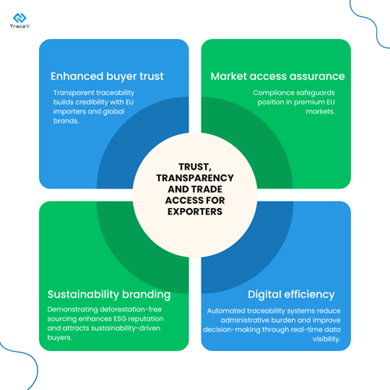
Compliance boosts transparency, strengthens buyer trust, enhances sustainability credentials, and secures continued access to high-value EU and global markets.









