Quick summary: Explore how Thailand’s gloves exporters can achieve EUDR compliance through digital traceability, geolocation mapping, and blockchain verification. Learn how platforms like TraceX simplify Due Diligence Statement (DDS) creation, ensure deforestation-free sourcing, and future-proof rubber exports to the EU market.

EUDR Compliance for Gloves Exporters in Thailand requires proving that all natural rubber used in glove manufacturing is deforestation-free, legally produced, and traceable to plantation-level origin. Given Thailand’s dependence on smallholder rubber farmers and multi-tier collection systems, exporters must implement robust geolocation mapping, supplier due diligence, and digital chain-of-custody controls. Compliance involves submitting accurate Due Diligence Statements (DDS) supported by verifiable farm data and risk assessments. Meeting EUDR requirements is essential to maintain EU market access, avoid shipment disruptions, and remain competitive in global medical and industrial glove markets.
Thailand’s rubber products export landscape covering gloves, tires, hoses, belts, seals, gaskets, O-rings, vibration dampers, and engineered rubber components (HS 4001, 4002, 4005, 4006, 4008, 4010, 4011, 4015, 4016, 4017) remains one of the world’s largest and most export-oriented. In 2024, Thailand’s rubber industry exceeded $23-25 billion, with deep-processed rubber products accounting for over $12 billion annually. Rubber gloves (HS 4015), including medical and industrial gloves, are a flagship segment: Thailand remains a top 3 global glove exporter, with exports stabilizing post-pandemic at more than $5-6 billion annually, supported by strong EU, U.S., Japan, and Middle East demand.
Production is concentrated in Southern Thailand (Songkhla, Surat Thani, Nakhon Si Thammarat, Trang) and industrial clusters in Samut Prakan, Rayong, and Chonburi, with over 85% of natural rubber sourced from smallholder plantations. Under the EUDR deadline of 30 December 2026 for large operators, Thai glove exporters face heightened compliance pressure to provide plot-level geolocation polygons, legality documentation, and verifiable chain-of-custody for EU-bound shipments. As a global rubber hub and major EU supplier, Thailand must rapidly scale digital traceability, GeoJSON farm mapping, AI-based deforestation risk monitoring, and auditable supplier systems to avoid border disruptions and protect projected $26-28 billion rubber exports by 2025, while safeguarding access to EU, U.S., Japan, and ASEAN markets.
Master the step-by-step process of submitting Due Diligence Statements under the new EUDR rules. Read the blog on filing DDS for EUDR compliance
Stay Ahead of EUDR in Healthcare Supply Chains. Germany’s medical and PPE sector is entering a new era of transparency. Read the full guide on EUDR compliance for the healthcare sector
Thai glove exporters face material operational and compliance challenges under the EU Deforestation Regulation (EUDR) because natural rubber is a regulated commodity and gloves fall under downstream rubber products sold into the EU. The key challenges are structural, data-driven, and regulatory rather than manufacturing-related.
The EUDR requires plot-level geolocation (polygons) proving that rubber is deforestation-free after 31 December 2020. Thailand sources 80-90% of natural rubber from millions of smallholders, making it difficult for glove exporters to trace latex back to individual plantations, especially when rubber is pooled through collectors and cooperatives.
Rubber typically passes through smallholders, local traders, processors, compounders, and glove factories. Each intermediary increases the risk of data gaps, batch mixing, and loss of origin integrity, making it hard to maintain an unbroken chain of custody required for EU Due Diligence Statements (DDS).
Many smallholder farms lack digitized land records, verified GPS polygons, and formal land-use or ownership documents. Without this data, exporters cannot demonstrate legal sourcing or deforestation-free status, even if practices are sustainable.
Thai exporters must prepare a Due Diligence Statement for every EU shipment, including farm-level geospatial data, risk assessment and mitigation evidence, and supplier declarations and traceability records. Manual processes are error-prone and increase the risk of shipment delays or rejection at EU borders.
As a top-3 global glove exporter, Thailand ships large volumes to the EU. Under EUDR, liability rests with exporters and EU importers, meaning a single non-compliant batch can disrupt long-term buyer relationships and contracts.
Large glove groups can invest in digital compliance systems, but SME exporters face higher per-shipment compliance costs, limited digital and ESG expertise, and supplier resistance to data sharing. This creates uneven readiness across the sector.
With the 30 December 2026 deadline for large operators, Thai glove exporters must rapidly implement digital traceability, farm mapping, and risk monitoring systems across thousands of upstream suppliers leaving little margin for delay.
The core EUDR challenges for Thai glove exporters are smallholder traceability, geolocation compliance, DDS accuracy, and supply-chain data integrity. Exporters that fail to digitize plantation data and automate risk assessments face EU market disruption, while those that adapt early can protect access, reduce regulatory risk, and strengthen buyer trust.
The EU Deforestation Regulation (EUDR) requires Thai exporters of gloves including medical, industrial, and household gloves to demonstrate that all natural rubber used in manufacturing is deforestation-free, legally produced, and fully traceable to plantation-level origin. Despite Thailand’s position as one of the world’s largest glove exporters, its heavy reliance on smallholder rubber farmers, multi-tier aggregation systems, and blended latex processing makes manual end-to-end traceability extremely difficult.
The TraceX EUDR Compliance Platform delivers a unified, digital-first solution that automates compliance workflows while strengthening Thailand’s competitiveness in EU healthcare, industrial, and consumer markets.
TraceX platform digitally connects smallholder plantations, collectors, latex processors, compounders, and glove manufacturers into a single integrated ecosystem. Each batch of raw latex, concentrated latex, or glove-grade compound is assigned a unique digital ID linked to verified plantation polygons, legality documentation, and processing histories ensuring an unbroken chain of custody from farm to EU-bound gloves.
Sourcing and procurement teams use mobile-based tools to capture plantation geolocations, land-use and ownership records, supplier declarations, and batch traceability data. TraceX automatically consolidates this information into a fully EUDR-compliant Due Diligence Statement (DDS) for every EU shipment, reducing manual errors and enabling accurate, on-time submission through the EU DDS system.
Every transaction from latex tapping in Southern Thailand (Songkhla, Surat Thani, Trang) to latex concentration and compounding in Samut Prakan and Rayong, through glove manufacturing and export, is securely recorded on TraceX’s immutable blockchain ledger. This provides EU regulators and buyers with verifiable proof of legal, traceable, and deforestation-free rubber sourcing, simplifying audits and border inspections.
With over 80% of natural rubber sourced from smallholders, TraceX platform enables scalable onboarding through mobile-first KYC, polygon mapping, and supplier profiling. Even micro-suppliers become EUDR-visible, with farmer profiles capturing land boundaries, production data, and compliance status closing the largest traceability gaps in Thailand’s rubber supply chain.
TraceX solution uses satellite imagery and AI-based land-use analytics to continuously monitor plantations for post-2020 deforestation, encroachment, and regulatory risk. Automated risk scores allow glove exporters to identify, mitigate, and document risks proactively, preventing shipment disruptions or EU enforcement action.
TraceX functions as a secure compliance workspace where manufacturers, processors, suppliers, auditors, logistics partners, and EU importers can access verified, audit-ready documentation. This accelerates compliance reviews, reduces regulatory exposure, and ensures uninterrupted glove exports into the EU.
By combining plantation-level geolocation, blockchain-secured traceability, AI-driven risk monitoring, and automated DDS workflows, TraceX enables Thai glove exporters to shift from reactive compliance to proactive market leadership. Exporters can protect EU market access, strengthen buyer confidence, and reinforce Thailand’s position as a trusted global hub for EUDR-ready medical and industrial gloves.
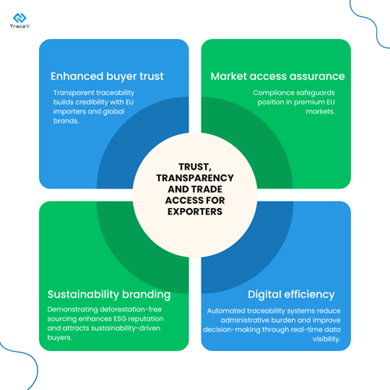
EUDR compliance is critical for Thailand’s glove exporters, as the EU remains a high-value destination for medical and industrial gloves, accounting for a meaningful share of Thailand’s $23-25 billion rubber industry and $5-6 billion annual glove exports. With enforcement deadlines set for 30 December 2026 (large operators) and 30 June 2027 (SMEs), non-compliance risks shipment rejections across HS 4015 and related rubber products (HS 4001-4017). Given that over 80% of Thailand’s natural rubber originates from smallholders, exporters must provide plantation-level geolocation polygons, legality documentation, and auditable chain-of-custody evidence to prove deforestation-free sourcing. Digitized traceability is now essential to protect EU market access, avoid disruptions across EU, U.S., Japan, and ASEAN supply chains, and sustain Thailand’s global leadership in glove manufacturing amid rising natural rubber prices.
For EUDR Compliance for Gloves Exporters in Thailand, establishing plantation-level traceability and deforestation-free verification of natural rubber is now a commercial necessity, not just a regulatory task. Exporters that implement geolocation mapping, legality validation, and auditable chain-of-custody systems can mitigate enforcement risk and ensure uninterrupted access to EU markets. Beyond compliance, EUDR readiness strengthens buyer confidence, supports long-term contracts with EU importers, and reinforces Thailand’s position as a trusted global supplier of medical and industrial gloves.
Understand the key components of EUDR compliance and how to streamline your DDS process efficiently. Read the blog on EUDR Due Diligence
Learn how AI-driven automation and intelligent workflows simplify data collection, verification, and reporting. Explore the blog on Agentic AI for EUDR
Discover how digital onboarding bridges the gap between smallholders and EUDR compliance. Read our blog: Smallholder Onboarding for EUDR Compliance
EUDR compliance requires Thai exporters to prove that all rubber products are deforestation-free, legally sourced, and traceable to their plantation of origin before entering the EU market.
The EU is a major destination for Thailand’s gloves exports. Compliance ensures continued market access, strengthens buyer trust, and positions exporters as sustainability leaders in the global value chain.
Thai exporters must map supply chains to the farm level, capture geolocation coordinates (GeoJSON), verify legal sourcing, and submit a Due Diligence Statement (DDS) via the EU portal before shipment.
Common challenges include fragmented smallholder networks, limited digital infrastructure, manual documentation, and lack of standardized traceability frameworks across the value chain.
Beyond meeting EU regulations, compliance drives supply chain transparency, builds brand credibility, enhances ESG performance, and opens access to premium global markets demanding sustainable rubber for the Thai exporters.