EUDR for Food Companies: What Happens If Your Supply Chain Isn’t Traceable?

Published
, 12 minute read

Quick summary: EUDR for food companies requires farm-level traceability and deforestation-free verification. Learn the risks of non-compliance, penalties, and how to prepare your supply chain before EU enforcement begins.
In 2026, EUDR for food companies becomes a critical compliance mandate, requiring businesses placing products on the EU market to prove that their commodities are deforestation-free and fully traceable to origin under the EU Deforestation Regulation (EUDR). 

For many food manufacturers, importers, and ingredient suppliers, EUDR for food companies is not just another sustainability initiative; it is a market access requirement that directly impacts EU revenue, retailer relationships, and long-term supply chain resilience. 

If your supply chain isn’t traceable to verified geolocation data, the consequences can include: 

  • Blocked shipments at EU borders 
  • Regulatory fines of up to 4% of EU turnover 
  • Product confiscation 
  • Retailer delisting 
  • Severe reputational damage 

TraceX Deforestation regulation solutions help food companies centralize farm-level geolocation data, automate deforestation risk analysis, and generate audit-ready due diligence statements, turning EUDR compliance into a scalable, end-to-end digital workflow. This article explains what EUDR really requires, what happens if you’re not ready, and how food companies are using technology to move from reactive compliance to automated, audit-ready traceability. 

Key Takeaways 

  • The EU Deforestation Regulation (EUDR) requires food companies selling into the EU to prove their commodities are deforestation-free and traceable to exact farm-level polygons, making it far stricter than previous sustainability frameworks that relied on supplier declarations and voluntary certifications. 
  • If your supply chain isn’t fully traceable, you risk shipment blocks, fines of up to 4% of EU turnover, retailer delisting, and reputational damage.  
  • Traditional spreadsheets and self-declarations can’t deliver the geolocation validation, satellite monitoring, and automated due diligence reporting now required.  
  • To comply, food manufacturers must map their entire value chain, collect verified geodata, assess and mitigate deforestation risk, and continuously monitor suppliers.  
  • As a result, many B2B food companies are adopting SaaS-based traceability platforms to centralize data, automate risk analysis, and generate audit-ready documentation.  
  • Solutions from TraceX help food and agri businesses transform EUDR from a regulatory burden into a scalable, digital compliance advantage that protects EU market access and strengthens retailer trust. 

What Is the EU Deforestation Regulation (EUDR) for Food Companies 

The EU Deforestation Regulation (EUDR) is a European Union law that requires food companies to prove that certain commodities placed on the EU market are deforestation-free, legally produced, and fully traceable to the farm level. 

It applies to companies importing, exporting, or selling products that contain cocoa, coffee, palm oil, soy, cattle, rubber, or wood. 

To comply, food companies must: 

  • Collect plot-level geolocation coordinates of production areas 
  • Conduct a formal deforestation risk assessment 
  • Mitigate identified risks 
  • Submit a due diligence statement before placing products on the EU market 

Without verified traceability and documentation, companies cannot legally sell covered products within the EU. 

If you’re sourcing cocoa for chocolate, palm oil for snacks, soy for animal feed, or coffee for retail distribution, EUDR applies to you.

Understand the EUDR requirements for food manufacturers before enforcement begins. 

Why EUDR Is Different From Previous Sustainability Regulations 

Many food companies already have: 

  • Supplier codes of conduct 
  • ESG reporting frameworks 
  • Voluntary certification schemes 
  • Sustainability audits 

But EUDR goes much further. 

It requires: 

  • Exact geolocation coordinates (polygons) of production plots 
  • Evidence that land was not deforested after the cutoff date 
  • Risk classification by country and region 
  • Verifiable digital documentation 

Spreadsheets and supplier declarations are no longer enough. 

The burden of proof shifts from supplier assurance to data-backed validation. 

For B2B food brands and ingredient manufacturers, this means compliance must become systematic, digital, and scalable. 

Explore our complete guide covering due diligence, geolocation mapping, risk mitigation, and enforcement timelines. 
Read the Full EUDR Compliance Guide 

Are you a consumer brand sourcing high-risk commodities? 
See how EUDR impacts private label, retail partnerships, and brand reputation. 
Read EUDR for Consumer Brands 

What Happens If Your Supply Chain Isn’t Traceable? 

Let’s break down the real business risks. 

1. Your Products Can Be Blocked at EU Borders 

Without a valid due diligence statement tied to verified geolocation data, customs authorities can: 

  • Delay shipments 
  • Increase inspection frequency 
  • Prevent goods from entering the EU 

For time-sensitive food supply chains, delays alone can destroy margins. 

A single blocked shipment can ripple across: 

  • Production schedules 
  • Retail commitments 
  • Distributor agreements 
  • Contractual SLAs 

Compliance is no longer a sustainability issue. It is a supply continuity issue. 

2. Financial Penalties Can Reach 4% of EU Turnover 

Under the EUDR framework, penalties may include: 

  • Fines proportionate to environmental damage 
  • Confiscation of products 
  • Exclusion from public procurement 
  • Temporary prohibition from placing products on the EU market 

For multinational food companies, 4% of EU turnover can represent millions in exposure. 

But the financial risk extends beyond fines. Consider: 

  • Contract penalties from retailers 
  • Lost shelf space 
  • Increased insurance premiums 
  • Investor pressure 

The true cost of non-traceability often far exceeds regulatory penalties. 

3. Retailers Are Raising the Bar 

Major European retailers are not waiting for enforcement deadlines. 

They are already demanding: 

  • Farm-level traceability 
  • Digital due diligence documentation 
  • Deforestation risk assessments 
  • Continuous monitoring evidence 

If you supply private label or ingredients to large brands, you may face compliance requirements before regulators even knock on your door. 

Failure to provide credible documentation can lead to: 

  • Delisting 
  • Reduced volumes 
  • Exclusion from future tenders 

In competitive food markets, that risk is existential. 

4. ESG and Investor Scrutiny Intensifies 

EUDR compliance intersects directly with: 

  • Corporate sustainability reporting 
  • Scope 3 emissions disclosures 
  • ESG ratings 
  • NGO monitoring 

Investors and stakeholders increasingly expect data-backed transparency. 

If your supply chain cannot demonstrate: 

  • Farm-level visibility 
  • Deforestation risk mitigation 
  • Continuous monitoring 

Your ESG credibility is weakened. 

For publicly traded food companies, this translates into: 

  • Shareholder risk 
  • Increased scrutiny in earnings calls 
  • Heightened reputational vulnerability

How a Global Food Brand Achieved Full Traceability Before EUDR Deadline 

Why Traditional Supplier Declarations Are No Longer Enough 

Many food companies still rely on: 

  • Email-based supplier questionnaires 
  • Self-declarations 
  • Manual audits 
  • Static certification documents 

These approaches fail under EUDR for several reasons: 

Lack of Plot-Level Accuracy 

EUDR requires polygon coordinates, not general farm locations or regional confirmations. 

No Continuous Monitoring 

Deforestation risk is dynamic. A farm compliant today may not be compliant next year. 

Manual audits cannot provide continuous verification. 

Tier 2 and Tier 3 Blind Spots 

Food companies often lack visibility beyond direct suppliers. 

Yet EUDR responsibility extends upstream to the production plot. 

Audit Fatigue and Data Silos 

Without centralized systems, compliance becomes: 

  • Manual 
  • Time-consuming 
  • Error-prone 
  • Expensive 

This is where digital transformation becomes not just helpful, but necessary. 

Establish End-to-end visibility across your agricultural value chain 

What EUDR-Ready Traceability Actually Requires 

To be audit-ready under EUDR, food companies need six core capabilities: 

1. Farm-Level Geolocation Collection 

  • Accurate GPS coordinates 
  • Polygon mapping of production plots 
  • Secure data storage 

2. Deforestation Risk Analysis 

  • Cross-referencing plots against satellite imagery 
  • Land-use change monitoring 
  • Country-level risk classification 

3. Risk Mitigation Workflows 

  • Flagging high-risk suppliers 
  • Escalation protocols 
  • Corrective action tracking 

4. Automated Documentation 

  • Digital due diligence statements 
  • Audit-ready reporting 
  • Version-controlled documentation 

5. Continuous Monitoring 

  • Ongoing satellite analysis 
  • Alerts for land-use changes 
  • Supplier performance tracking 

6. Scalable Architecture 

For multinational food companies, systems must support: 

  • Thousands of farms 
  • Multiple commodities 
  • Cross-border operations 
  • ERP integration 

Manual tools simply cannot scale to this level.

How Food Companies Can Become EUDR Compliant (Step-by-Step) 

Step 1: Map Your Full Agricultural Value Chain 

Start by identifying: 

  • All EUDR-covered commodities 
  • Supplier tiers 
  • Country of origin 
  • Volume exposure 

Many companies discover significant blind spots at this stage. 

Step 2: Collect and Validate Geolocation Data 

Work with suppliers to gather: 

  • Plot-level coordinates 
  • Production volumes 
  • Farm ownership information 

Validation is critical. Incorrect or imprecise data can invalidate your compliance. 

Step 3: Assess Deforestation Risk 

Overlay geolocation data with: 

  • Satellite imagery 
  • Land-use change databases 
  • High-risk country classifications 

Automated tools dramatically reduce analysis time and increase reliability. 

Step 4: Implement Monitoring and Alerts 

Compliance is not a one-time exercise. 

Continuous monitoring ensures: 

  • New deforestation events are flagged 
  • Suppliers remain compliant 
  • Risk profiles stay updated 

Step 5: Automate Due Diligence Statements 

Manual document preparation is inefficient and risky. 

Automated systems can: 

  • Generate compliant statements 
  • Link them to verified datasets 
  • Maintain audit trails 

For B2B food companies, automation reduces legal and operational exposure. 

Automate geolocation verification and due diligence reporting 

Why B2B Food Companies Are Turning to SaaS Platforms 

EUDR compliance is fundamentally a data and workflow problem. 

Spreadsheets, emails, and fragmented systems create: 

  • High compliance costs 
  • Data inconsistencies 
  • Audit vulnerability 
  • Operational bottlenecks 

Purpose-built SaaS platforms enable: 

  • Centralized supplier onboarding 
  • Secure geolocation data collection 
  • Satellite-based monitoring 
  • Risk scoring engines 
  • ERP integration 
  • Automated reporting 

For enterprise food companies, this means: 

  • Faster compliance readiness 
  • Lower internal resource burden 
  • Stronger audit defensibility 
  • Improved supplier collaboration 

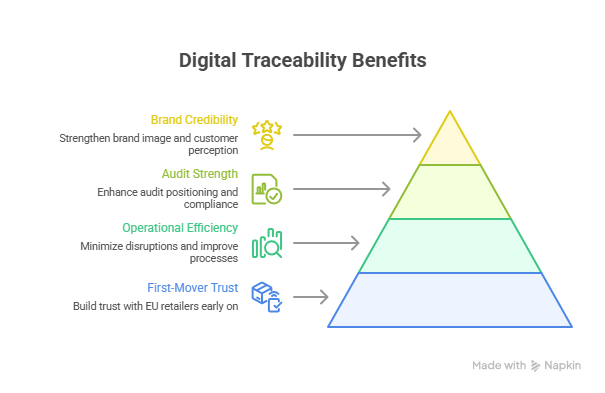
The shift is from reactive compliance to proactive risk management.
Who Is Most at Risk Under EUDR? 

Certain segments face heightened exposure: 

  • Cocoa importers supplying chocolate manufacturers 
  • Coffee brands sourcing from high-risk regions 
  • Palm oil processors serving EU retailers 
  • Soy ingredient suppliers in animal feed chains 
  • Private label manufacturers exporting to the EU 

If your company: 

  • Sources from tropical regions 
  • Has complex multi-tier supply chains 
  • Relies on intermediaries 
  • Operates in multiple jurisdictions 

Your compliance complexity multiplies. 

Explore how EUDR is reshaping agriculture & food supply chains. 

EUDR Deadlines: Why Waiting Is Risky 

Although enforcement timelines vary by company size, the direction is clear: 

  • Large companies face earlier enforcement 
  • SMEs have limited transitional relief 
  • Documentation must be ready before placement on the EU market 

Implementation takes time. 

Supplier onboarding alone can require months. 

Satellite validation and system integration add further lead time. 

Waiting until enforcement begins creates operational risk and supplier disruption. 

How TraceX Solutions Help Food & Agri Companies Achieve EUDR Compliance 

For food and agriculture companies, EUDR compliance is not just a documentation task it’s a data, traceability, and risk management challenge across complex multi-tier supply chains. 

TraceX solutions help organizations move from manual, reactive compliance to automated, end-to-end digital traceability. 

1. Farm-Level Traceability at Scale 

TraceX enables companies to collect, validate, and manage plot-level geolocation data (polygon mapping) directly from suppliers. Instead of relying on spreadsheets or self-declarations, food businesses gain structured, centralized visibility across thousands of farms and multiple sourcing regions. 

Impact: 

  • Accurate farm-to-factory traceability 
  • Reduced data inconsistencies 
  • Audit-ready geolocation records 

2. Satellite-Based Deforestation Monitoring 

TraceX integrates geospatial intelligence and satellite data to assess whether sourcing areas overlap with deforestation zones or high-risk regions. 

Impact: 

  • Automated deforestation risk analysis 
  • Continuous monitoring alerts 
  • Reduced exposure to regulatory penalties 

3. Automated Due Diligence & Reporting 

Manual due diligence preparation is time-consuming and error-prone. TraceX automates: 

  • Risk classification 
  • Mitigation workflows 
  • Digital due diligence statements 
  • Audit-ready documentation 

Impact: 

  • Faster regulatory submissions 
  • Lower compliance overhead 
  • Stronger defensibility during inspections 

4. Multi-Tier Supply Chain Visibility 

Food and agri companies often struggle with Tier 2 and Tier 3 supplier blind spots. TraceX centralizes supplier onboarding and risk data across the full agricultural value chain. 

Impact: 

  • End-to-end transparency 
  • Improved supplier accountability 
  • Stronger ESG reporting support 

5. Scalable Enterprise Architecture 

For large food manufacturers, ingredient suppliers, and exporters, TraceX integrates with ERP systems and existing procurement workflows, ensuring compliance processes don’t disrupt operations. 

Impact: 

  • Seamless system integration 
  • Cross-border regulatory alignment 
  • Reduced operational bottlenecks 

The Time to Act Is Now 

EUDR compliance is no longer a future sustainability goal; it is an immediate market access requirement. If your organization cannot demonstrate farm-level traceability, satellite-validated deforestation checks, and automated due diligence reporting, the risk extends beyond regulatory fines to lost contracts, shipment delays, and reputational damage. Forward-looking food manufacturers are investing in digital traceability systems now to protect EU revenue, strengthen retailer trust, and future-proof their supply chains. The companies that act early won’t just meet EUDR requirements, they’ll turn compliance into a competitive advantage. 

Is Your Supply Chain Audit-Ready Today? 

If regulators or major retail customers requested proof tomorrow, could you: 

  • Provide polygon-level geolocation data? 
  • Demonstrate deforestation-free status? 
  • Produce automated due diligence documentation? 
  • Show ongoing monitoring capability? 

If the answer is uncertain, your exposure is significant. 

Non-compliance can cost more than you think. 
Understand the financial, legal, and commercial consequences of failing to meet EUDR requirements. 
Read the Complete Guide to EUDR Penalties 

Not sure how to evaluate your supply chain risk? 
Discover how to conduct a structured EUDR risk assessment across multi-tier suppliers. 
Learn How to Perform an EUDR Risk Assessment 

Submitting a due diligence statement isn’t optional. 
Understand what documentation is required before placing products on the EU market. 

Read the EUDR Due Diligence Guide

Frequently Asked Questions (FAQ’s)


What is EUDR and why does it matter for food companies?

The EU Deforestation Regulation (EUDR) requires food companies to prove that certain commodities are deforestation-free and fully traceable to farm-level production plots before they can be sold in the EU. It directly impacts market access, compliance costs, and supplier relationships. 

Which food products are covered under EUDR? 

EUDR applies to products containing cocoa, coffee, palm oil, soy, cattle, rubber, and wood, including many processed food items derived from these commodities.

What happens if a food company is not EUDR compliant?

Non-compliance can result in shipment delays, blocked imports, fines of up to 4% of EU turnover, product confiscation, and exclusion from public procurement opportunities. 

What level of traceability is required under EUDR? 

Companies must collect precise plot-level geolocation coordinates (polygon mapping), conduct deforestation risk assessments, mitigate identified risks, and submit a formal due diligence statement before placing goods on the EU market. 

How can food companies prepare for EUDR compliance? 

Preparation involves mapping the full supply chain, collecting verified geolocation data, implementing satellite-based monitoring, automating risk analysis, and generating audit-ready due diligence documentation through scalable digital systems. 

Start using TraceX
Transparency, Trust, & Success for your Climate Journey.
Get the demo

Get your free trial

Request for a Demo Session

Download your EUDR for Food Companies: What Happens If Your Supply Chain Isn’t Traceable? here

Download your EUDR for Food Companies: What Happens If Your Supply Chain Isn’t Traceable? here

Download your EUDR for Food Companies: What Happens If Your Supply Chain Isn’t Traceable? here

[hubspot type=form portal=8343454 id=304874ea-d4e0-4653-9825-707360746edb]
[hubspot type=form portal=8343454 id=b8321ac0-687a-4075-8035-ce57dd47662a]
food traceability, food supply chain, blockchain traceability, agriculture traceability software

Is Your Supply Chain Audit-Ready for 2026?

Get the free TraceX Playbook — 10 traceability failures to fix before your next audit, a 10-point maturity scorecard.

Grab your Free Trial now

Ensure your supply chain is EUDR-ready with TraceX.

Don’t miss out on your chance to grab access to our early bird offer!

food traceability, food supply chain

Are you EUDR Due-Diligence Ready?

Your essential compliance guide

food traceability, food supply chain

Please leave your details with us and we will connect with you for relevant positions.

[hubspot type=form portal=8343454 id=e6eb5c02-8b9e-4194-85cc-7fe3f41fe0f4]
food traceability, food supply chain

Please fill the form for all Media Enquiries, we will contact you shortly.

[hubspot type=form portal=8343454 id=a77c8d9d-0f99-4aba-9ea6-3b5c5d2f53dd]
food traceability, food supply chain

Kindly fill the form and our Partnership team will get in touch with you!

[hubspot type=form portal=8343454 id=b8cad09c-2e22-404d-acd4-659b965205ec]