
Quick summary: Discover how furniture brands can stay ahead of EUDR compliance regulations with automated traceability, AI-powered risk management, and seamless integration, ensuring sustainability and smooth access to the EU market.

EUDR Furniture Compliance refers to the legal obligations under EU Regulation 2023/1115, which require furniture brands and importers to prove that wood, leather, rubber, or any forest-risk material in their products is deforestation-free (post December 31, 2020), legally sourced, and traceable to the exact plot of land. Non-compliance can result in fines up to 4% of EU annual turnover, product seizure, and permanent market bans. The compliance deadline for large and medium operators is December 30, 2026 (extended from 2025). SMEs face a June 30, 2027, deadline.
Furniture ranks as the world’s third-largest wood consumer after construction/paper, driving tropical hardwood demand (e.g., Indonesia/Vietnam sourcing); illegal logging accounts for 15-30% global wood trade amid 10M ha annual forest loss.
Key Takeaways: EUDR requires furniture companies placing wood-based products on the EU market to prove they are deforestation-free, legally sourced, and supported by a Due Diligence Statement (DDS). This means collecting supplier data, verifying forest-level geolocation, conducting risk assessments, and maintaining end-to-end traceability. Without structured, validated data, products cannot be legally sold in the EU making compliance a critical supply chain priority.
The EU Deforestation Regulation (Regulation EU 2023/1115) is the European Union’s most sweeping legal framework yet to curb global deforestation. Unlike voluntary ESG pledges, EUDR creates a mandatory, enforceable obligation for any business placing forest-linked goods on the EU market or exporting them from it.
For furniture brands, this hits directly. Wood is the primary material in most furniture. But EUDR goes further than wood alone: it covers leather (from cattle), rubber, paper and packaging all materials commonly found in upholstered or composite furniture.
‘Does EUDR apply to my furniture if I only use certified wood?’
Yes. EUDR is a regulatory obligation, not a certification programme. FSC or PEFC certification does not automatically satisfy EUDR. You still need plot-level geolocation, a risk assessment, and a Due Diligence Statement (DDS) submitted via EU TRACES for each product batch. Certification can support your risk assessment, but it does not replace it.
EUDR covers all products containing EUDR-listed commodities at any stage of production. For furniture, this includes:
| HS Code | Category | One-Line Description |
|---|---|---|
| 9401 | Seats | Covers chairs, sofas, and benches (excluding medical/dental) and their specific parts. |
| 9402 | Specialized Furniture | Medical, surgical, dental, or veterinary furniture (e.g., operating tables, hospital beds). |
| 9403 | Other Furniture | The ‘catch-all’ for tables, desks, beds, cabinets, and shelving units (wood, metal, or plastic). |
| 9404 | Bedding and Supports | Mattress supports, mattresses, quilts, eiderdowns, and similar stuffed furnishings. |
| 9406 | Prefabricated Buildings | Modular or ready-to-assemble structures, often primarily constructed of timber or wood panels. |
| 4421 | Other Wood Articles | Includes miscellaneous wood items often associated with furniture, such as clothes hangers and woodware. |
Furniture companies must satisfy five non-negotiable obligations before placing any in-scope product on the EU market:
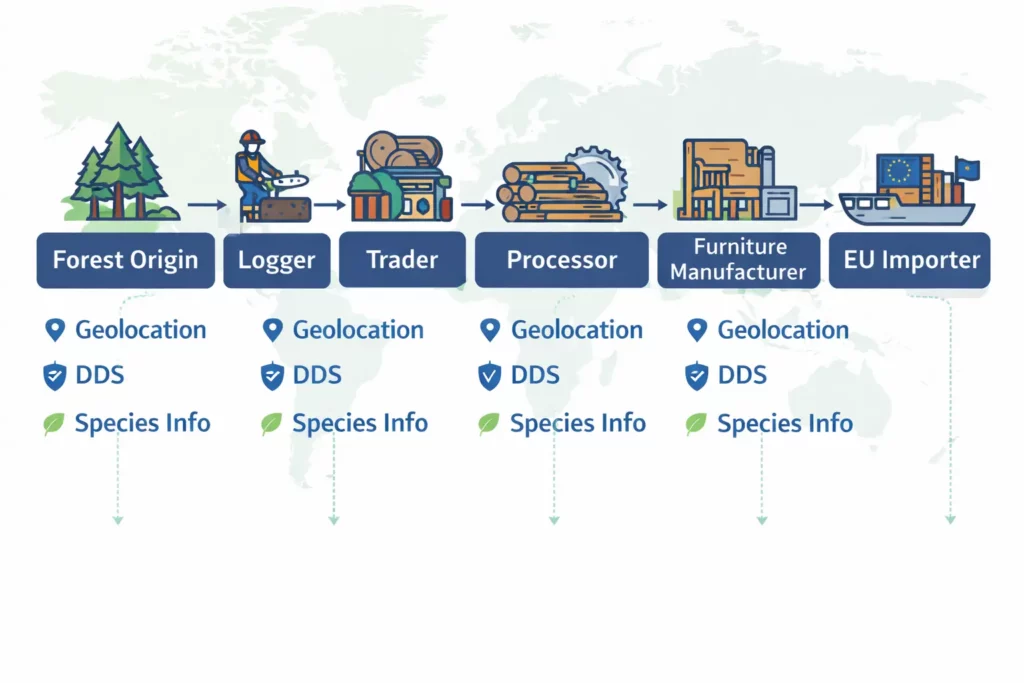
EUDR requires traceability to the exact plot of land where timber was harvested not just the country or region. This means GPS coordinates (GeoJSON format) for each forest plot in your supply chain.
Concern: ‘My suppliers are in Southeast Asia and don’t provide geolocation data.’
This is the number one compliance gap in the furniture industry. Multi-tier supply chains where wood passes through loggers, traders, processors, and exporters before reaching you make plot-level tracing difficult without digital supplier onboarding tools. Without geolocation, your DDS cannot be submitted, and your shipment cannot enter the EU market. Start onboarding suppliers with digital traceability systems now the deadline is real.
‘Deforestation-free’ has a specific legal definition under EUDR: no land used to produce the commodity was deforested after December 31, 2020. This applies regardless of whether the deforestation was legal in the country of origin.
Satellite imagery verification is increasingly the standard. Paper certificates alone are not sufficient if they cannot be cross-referenced with actual land-use data.
See how farm-level mapping enabled deforestation-free cocoa sourcing in Nigeria. Explore the full case study.
Beyond deforestation, EUDR requires that your wood was harvested in accordance with local laws of the producer country including land tenure rights, environmental laws, labour standards, and human rights protections. This adds a jurisdiction-specific compliance layer for each source country in your supply chain.
Every operator must assess supply chain risk before placing products on the market. Key risk factors include:
Where risks are identified, mitigation steps must be documented including supplier audits, additional evidence requests, or switching suppliers.
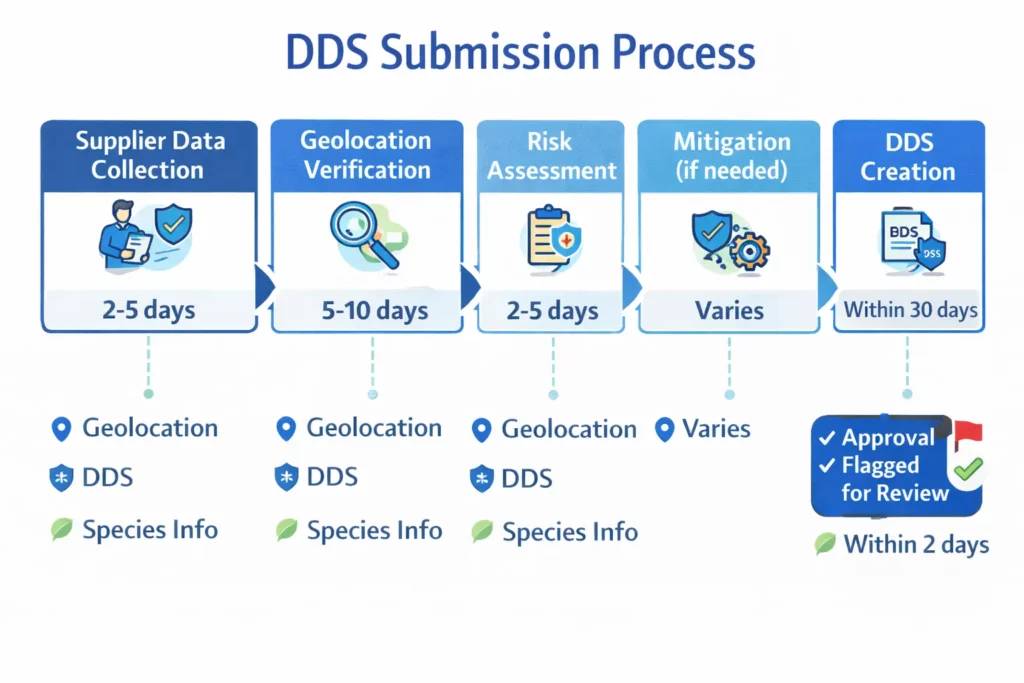
The DDS is the legal declaration confirming your product meets EUDR requirements. It must be submitted through the EU TRACES system before placing the product on the market. As of the November 2025 amendments, the DDS must now include the estimated annual quantity of regulated products.
Concern: ‘We work with dozens of wood components in each product do we need a DDS per component?’
For composite products like CKD office furniture, EUDR requires that each component meets due diligence requirements individually. However, your DDS can reference an existing DDS already submitted for a component, as long as proper due diligence had already been exercised and documented. This is where a digital traceability platform becomes critical manually tracking DDS chains across 20+ components is not sustainable.
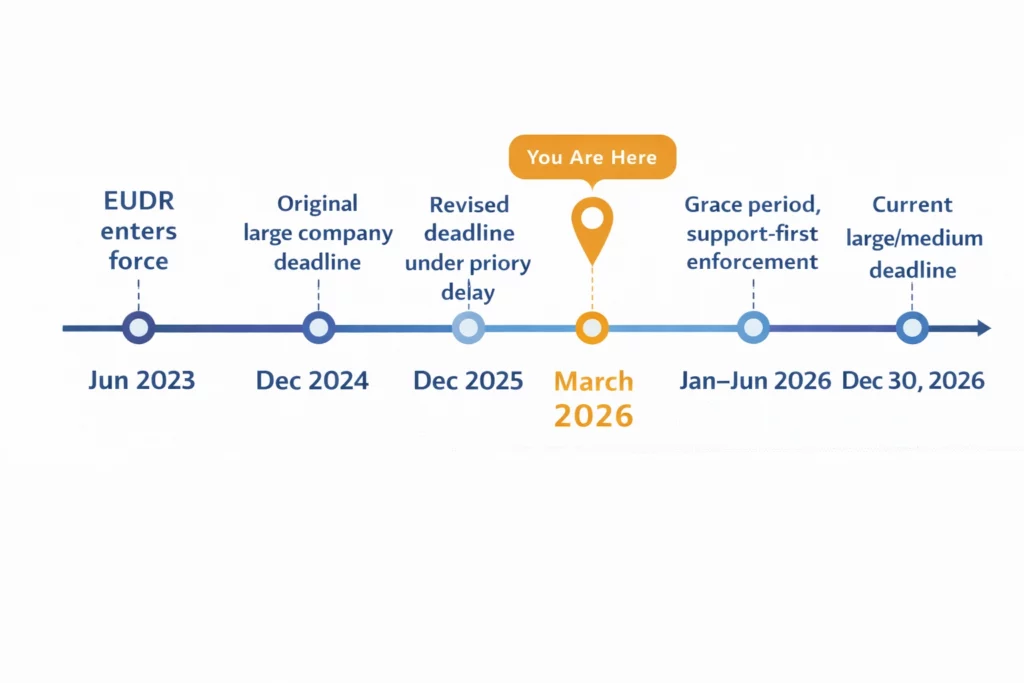
The EUDR timeline has shifted multiple times. Here is the current, legally confirmed position as of March 2026:
| Dec 30, 2026 Large & Medium Operators — Full Compliance Deadline | Jun 30, 2027 Small & Micro Operators — Extended Deadline | Active Now Grace Period (Jan–Jun 2026): Authorities prioritise support over penalties | 5 Years Record retention period required after compliance |
Key note: Regulation (EU) 2025/2650 published in the Official Journal on December 23, 2025 confirms the 12-month enforcement delay. However, the core compliance model is unchanged. Operators who pause preparation due to the delay risk false confidence: the systems, supplier onboarding, and geolocation verification take time to implement.
Concern: ‘Should we wait until closer to the deadline to invest in compliance systems?’
No. Supplier onboarding, geolocation data collection, and DDS workflow integration typically take 6-12 months to build across complex supply chains. Companies that start now use the grace period as a runway advantage over competitors. Those who wait risk rushed implementation, data quality failures, and shipment disruptions right at the deadline.
Furniture companies face a distinct set of challenges that make EUDR compliance harder than for single-commodity operators like coffee exporters. Understanding these challenges is the first step to addressing them.
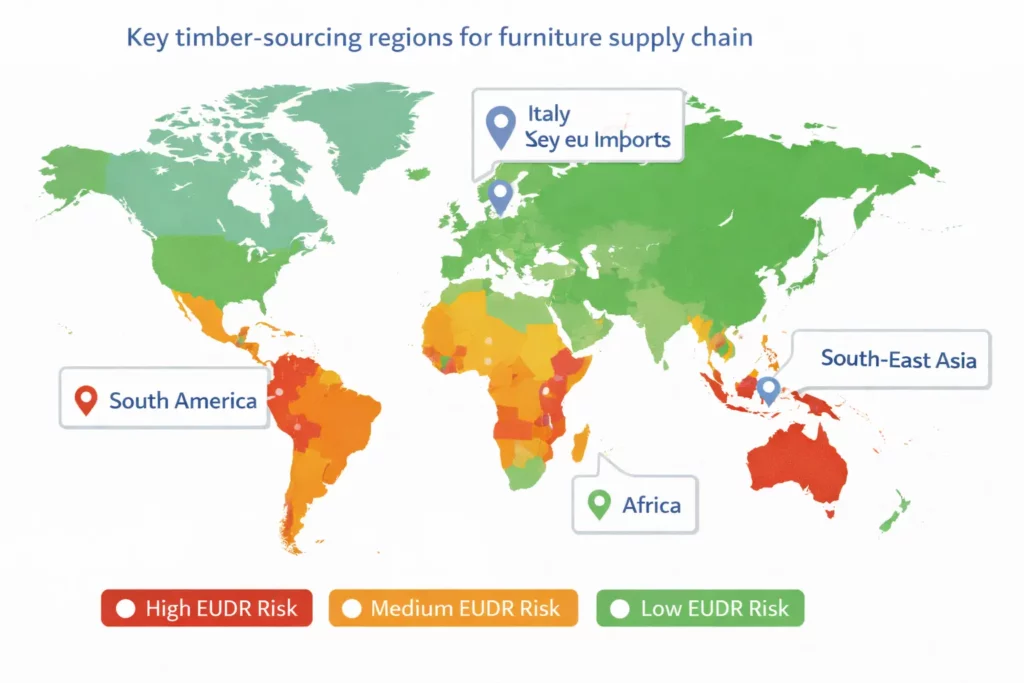
A single wooden chair may contain timber harvested in Malaysia, processed in Vietnam, assembled in China, and imported into the EU through Germany. At each stage, data about the original forest plot can be lost, modified, or simply never collected. Italian and Dutch furniture manufacturers both major EU import hubs face this challenge acutely, often dealing with 5+ intermediaries before the timber reaches their factory.
A sofa has a wooden frame, foam padding, rubber components, and potentially leather upholstery. Under EUDR, each of these components may require its own DDS or compliance verification. Most existing compliance processes are designed for single-material shipments. Composite furniture breaks these workflows entirely.
Many furniture manufacturers use mixed wood batches or recycled timber. Proving deforestation-free origin on mixed batches where wood from multiple origins has been commingled is one of the most technically demanding aspects of EUDR. Even minor commingling can result in non-compliance for the entire batch.
Upstream suppliers particularly those in South-East Asia, Latin America, and sub-Saharan Africa frequently rely on manual record-keeping and lack digital traceability systems. Many cannot consistently provide geolocation coordinates or deforestation-free evidence in the format EUDR requires. This is not a vendor problem to ignore; it is a compliance risk for the EU importer.
Without automated systems, managing compliance documentation across dozens of product SKUs, multiple source countries, and thousands of supplier batches is operationally impossible at scale. Manual errors, lost documentation, and missed deadlines create cascading compliance failures.
Identify every tier in your supply chain from the finished furniture product back to the original forest plot. Document every intermediary, their country of operation, and what data they currently capture. Flag gaps in geolocation coverage immediately.
Not every product in your range may be in scope. Work through your product catalogue against EUDR commodity and HS code lists to identify which SKUs require full due diligence. Products containing no EUDR-listed materials are out of scope.
Begin supplier onboarding with a digital platform that can collect, verify, and store geolocation data, sustainability certifications, and species information. Set a non-negotiable requirement: suppliers who cannot provide EUDR-compatible documentation by a set date will be replaced.
Use satellite imagery data and country risk benchmarks to assess each source region. Document your risk assessment methodology. Where risk is found, implement mitigation additional audits, alternative sourcing, or independent verification.
Design an end-to-end DDS creation and submission process. Pilot on a limited product line or trade lane first to test data quality and timing. Ensure your customs data and compliance data are aligned; disconnected systems create gaps that regulators will find.
EUDR compliance is not a one-time exercise. Supplier performance, deforestation events, and regulatory updates require continuous monitoring. Automated alerts that detect supplier deviations or flag compliance deadlines protect you from penalties for incidents you did not anticipate.
Concern: ‘We don’t have the internal resources to build and manage this ourselves.’
This is the right problem to have clarity on early. EUDR compliance at scale requires a dedicated digital platform, not a spreadsheet. The right solution should offer: geo-mapping and satellite verification, automated DDS creation, supplier onboarding workflows, TRACES-compatible outputs, and real-time compliance alerts. Platforms from TraceX are built specifically for this use case.
The cost of non-compliance extends far beyond a fine. Here is the full picture of what regulators can impose:
A furniture retailer that fails to properly verify its wood suppliers could find itself locked out of the EU market for a year not because of deliberate wrongdoing, but because it skipped steps in verification. Even a single missing geolocation point in a data file can escalate into a seized shipment.
Concern: ‘We’re a mid-size brand – are we really at risk?’
EUDR applies to all operators placing in-scope products on the EU market, regardless of company size. Large and medium operators face the December 2026 deadline. Small and micro operators have until June 2027. There are no size-based exemptions from due diligence obligations only extended timelines. The EUDR makes no exception for product complexity or country of origin.
EUDR is not a compliance checkbox. It is a structural transformation of how furniture brands source, document, and report on their supply chains. Brands that act now during the grace period will be ahead of competitors still untangling their supplier networks when the December 2026 deadline arrives.
TraceX provides furniture brands with end-to-end EUDR compliance infrastructure: automated traceability, AI-powered risk management, supplier onboarding, geolocation mapping, and TRACES-ready DDS creation built to scale with your supply chain.
Simplify your compliance journey – explore how to achieve end-to-end EUDR compliance.
Strengthen your sourcing strategy – learn how EUDR due diligence works in practice.
Importing wood products? Discover the best EUDR compliance tools designed for importers.
A product is deforestation-free if the land on which its raw materials were produced was not subject to deforestation or forest degradation after December 31, 2020. This cut-off date applies regardless of local laws even if the deforestation was legal in the country of origin, it still disqualifies the product from EUDR compliance.
No. Certification schemes like FSC can support your risk assessment and provide evidence of sustainable sourcing, but they do not replace the EUDR’s specific requirements: plot-level geolocation, risk assessment documentation, and DDS submission via EU TRACES.
A DDS is the formal legal declaration submitted to the EU TRACES system confirming that your product is deforestation-free, legally sourced, and fully traceable. It must be submitted before each product batch is placed on the EU market. For composite furniture products, the DDS should cover the product as a whole, while individual components can be covered by referenced existing DDS documents.
Operators the first entities to place a product on the EU market bear the primary legal responsibility. This is typically the importer. Traders who sell or distribute within the EU must maintain traceability and provide compliance documentation to their buyers. Non-EU suppliers must provide the documentation that EU buyers need to complete their own due diligence.
EUDR replaces EUTR for new products from December 30, 2025. The EUTR continues to govern timber harvested before June 29, 2023, as long as it is placed on the market between December 30, 2025 and December 30, 2028. After that, all timber and wood products will be fully subject to EUDR requirements only.
EUDR requires GPS coordinates in GeoJSON format that pinpoint the exact forest plot where raw materials were harvested. Country or region of origin is not sufficient. Where wood has been sourced from multiple plantation plots, all geolocations must be documented. This is typically the most technically demanding requirement for furniture importers with complex, multi-tier supply chains.