
Quick summary: EUDR packaging requirements explained for 2026 learn what agri-food exporters must know about scope, exemptions, compliance obligations, and how to avoid disruptions to EU market access.

EUDR packaging requirements mandates packaging for regulated commodities (coffee, cocoa, palm oil, soy, cattle, rubber, wood) must be backed by a verified Due Diligence Statement confirming the product is deforestation-free. Packaging labels alone are insufficient; each product requires GPS-validated farm-of-origin data uploaded to the EU TRACES NT system before it enters the EU market.
TraceX EUDR solutions enable packaging companies to classify materials accurately, capture supplier and geolocation data, and generate DDS-ready documentation ensuring seamless compliance for in-scope packaging products without disrupting operations.
KEY TAKEAWAYS
EUDR (EU Deforestation Regulation) requires agri-food exporters to submit Due Diligence Statements (DDS) proving deforestation-free sourcing for 7 regulated commodities. Packaging and product labelling must carry traceable origin data backed by geolocation evidence not declarations alone.
The EU Deforestation Regulation (EUDR), adopted in June 2023 and effective December 30, 2026 for large operators, represents the most significant change to agri-commodity trade compliance in a generation. It targets seven high-risk commodities linked to global deforestation and mandates that any operator placing these products on the EU market must prove their supply chain is deforestation-free traced back to the exact plot of land where the commodity was grown.
For exporters and food brands, this directly impacts how products are sourced, documented, and labelled. It is not merely a sustainability certificate you attach to a shipment. It is a data infrastructure requirement that must be embedded into your supply chain operations.
The regulation covers any product that contains, has been fed with, or has been made using the seven regulated commodities. This includes a vast range of packaged food products: coffee capsules, chocolate bars, palm-oil-based spreads, soy-based protein products, leather goods, rubber-based packaging components, and timber-derived packaging materials.
Most compliance guides focus on the DDS process but miss this critical point: EUDR traceability requirements are embedded into the product itself meaning your packaging, labelling, and product data systems must all reflect verified supply chain information. A sustainable logo is not compliance.
Understanding EUDR packaging compliance means recognising three interconnected obligations:
The regulation does not prescribe a specific label format, but it does mandate that sufficient information is available to verify the supply chain claim. In practical terms, operators must be able to link any packaged product on an EU shelf back to its DDS number and that DDS must contain the following verified data elements:
| DDS Element | What It Must Contain | Verification Method |
|---|---|---|
| Geolocation Data | GPS polygon coordinates for every plot of land | Satellite imagery cross-check (JRC/Hansen) |
| Country of Production | Country + sub-national region of origin | Supplier declaration + GPS validation |
| Commodity Description | HS code, quantity, description | Customs documentation |
| Operator Information | Legal name, address, EU-TRACES operator ID | EU TRACES NT registration |
| Certification References | Relevant sustainability certifications (FSC, RSPO etc.) | Certification body databases |
| Risk Assessment Summary | Low/standard risk classification with rationale | Internal risk scoring + satellite data |
Beyond the DDS itself, the practical implication for packaging is clear: if you are selling coffee, chocolate, or any regulated product in EU retail, your packaging QR code or batch code must be traceable through your internal systems to the DDS and that DDS must be pre-approved by your competent authority before the shipment ships.
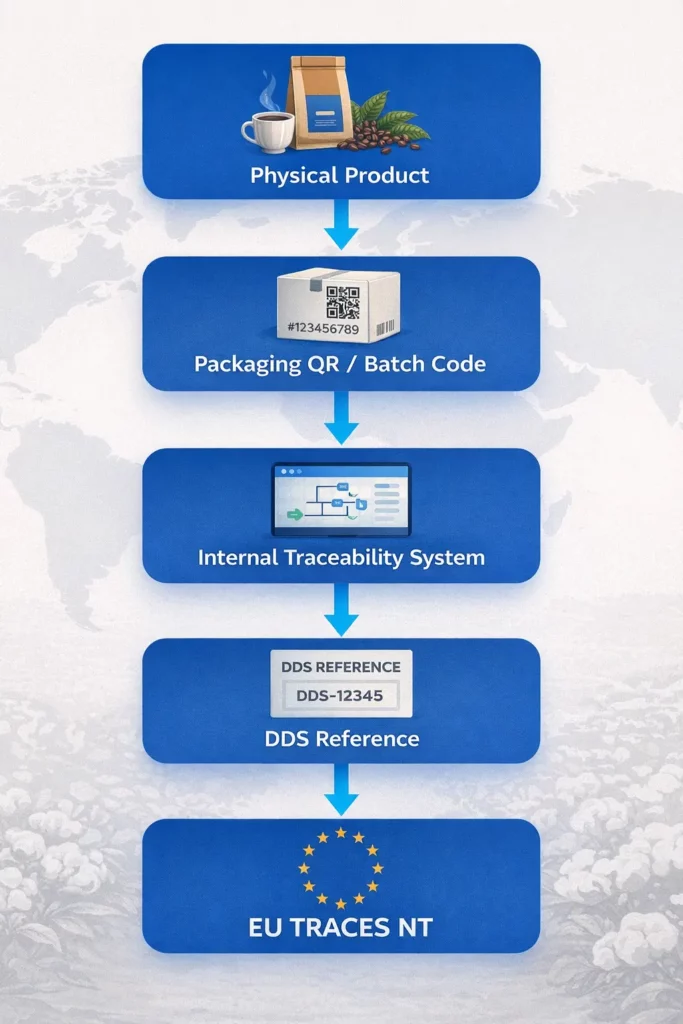
A critical nuance most compliance guides omit: EU Competent Authorities are not checking the label they are checking whether your DDS can be retrieved and validated in the EU TRACES NT system. Your packaging is evidence only insofar as it links to that digital record. A sustainable packaging claim without an auditable DDS is meaningless under EUDR.
EUDR applies to products derived from or containing the following commodities when placed or made available on the EU market, or exported from the EU:
| Commodity | Common Packaged Products Affected | Typical Exporter Markets |
|---|---|---|
| Coffee | Ground coffee, capsules, instant coffee, RTD beverages | India, Vietnam, Colombia, Ethiopia |
| Cocoa | Chocolate, cocoa powder, confectionery, beverages | Ivory Coast, Ghana, Indonesia |
| Palm Oil | Spreads, baked goods, personal care, biofuels | Indonesia, Malaysia, Nigeria |
| Soy | Animal feed, protein products, soy milk, cooking oil | Brazil, Argentina, USA |
| Cattle | Beef, leather goods, dairy (if feed chain applies) | Brazil, Argentina, Australia |
| Rubber | Latex gloves, tyres, packaging adhesives, elastic bands | Thailand, Indonesia, Malaysia |
| Wood | Furniture, paper packaging, timber products, wooden handles | Brazil, Russia, Canada |
Importantly, EUDR applies to derived products. If your packaged product contains palm oil as an ingredient, it is subject to the full regulation even if the packaging itself is not made of a regulated material. Food manufacturers and brands need to audit their full ingredient list, not just their primary commodity.
The EUDR classifies goods based on their Harmonized System (HS) code, a global standard for identifying goods. Two main HS codes relevant to packaging materials fall under the purview of the EUDR: HS Code 4819 and HS Code 4415. But the regulation’s applicability depends on how the packaging is being used.

If my invoice lists the paper box separately, does EUDR apply?
No. What matters is classification, not how it appears on your invoice. If the box is purely packaging, it follows Rule 5(b) and is exempt.
Do I need to file a DDS for pallets I use to ship my goods?
No, unless you are selling those pallets as a product in their own right.
We print branded cartons, are we exempt?
If those cartons are sold separately as a standalone product, they’re covered by EUDR. But if they only accompany your product, you’re exempt.
If your packaging is only supporting another product, Rule 5(b) shields you from separate EUDR obligations.
Focus your due diligence resources where they drive real compliance, and don’t waste time chasing data for packaging that customs already considers part of your goods.
If you’re a packaging manufacturer shipping empty corrugated boxes or specialty cartons to a distributor in Europe, those boxes are the main product.
EUDR applies: You must geolocate the source of the paper or board, verify legal harvesting, and submit a Due Diligence Statement (DDS).
Many box makers think, ‘We only make packaging, not agricultural products.’ But under EUDR, your cartons are treated exactly like other forest-based products when sold on their own.
Selling pallets as standalone goods whether to logistics providers or manufacturers places them squarely under EUDR.
EUDR applies: Every timber component must have documented origin and legality.
A single pallet may contain wood from multiple sources; without traceability, you risk penalties or blocked shipments. Some exporters are already using digital tools to attach geotagged data to each pallet batch.
Custom-printed paper sleeves or inserts, when shipped independently to EU buyers for future use, count as a product in their own right.
EUDR applies: Even though they’re ‘just packaging materials,’ the EU classifies them as forest-risk commodities when sold separately.
Many print converters are onboarding traceability platforms not only for compliance but also to prove sustainability credentials, which opens up premium markets.
Our sleeves are 70% recycled content – are we exempt?
Only the recycled portion is exempt. Any virgin fiber must be traceable with a DDS.
If your packaging is the product, EUDR applies.
Stand out from competitors by demonstrating full traceability – buyers and regulators are looking for suppliers who can prove it.
The Due Diligence Statement is the cornerstone of EUDR compliance for any operator placing packaged goods on the EU market. Here is the operational process every agri-food exporter and brand must follow:
Pain Point Addressed: ‘We cannot manually collect GPS data from 2,000 farmers every season.’ – This is the number one operational challenge for exporters targeting EU markets. TraceX’s agentic AI platform automates step 1 and 2 entirely: field agents use offline-first mobile apps to collect GPS coordinates, and the AI cross-references them against JRC/Hansen datasets in real time.
While EUDR focuses on deforestation traceability, the EU Ecodesign for Sustainable Products Regulation (ESPR) introduces another critical packaging obligation: Digital Product Passports (DPP). These are electronic records embedded in a product’s physical packaging typically via QR code or RFID that carry lifecycle sustainability data.
For food and agri-commodity packaging, the DPP requirement means your packaging must link to a data record that includes:
The convergence of EUDR and ESPR means that a single integrated traceability platform covering both commodity origin and packaging material sustainability is becoming essential for any brand selling into the EU market.
2027 Target year for ESPR Digital Product Passport requirements to begin applying to specific product categories including food contact materials – European Commission, 2024
The strategic implication most operators miss: EUDR and ESPR are converging toward a unified digital supply chain disclosure standard. Companies that implement integrated traceability now covering both commodity origin (EUDR) and packaging lifecycle data (ESPR) will have a significant competitive advantage when full ESPR compliance kicks in from 2027. Building two separate compliance systems will be far more expensive.
Based on consultations with 30+ food and agri companies, the compliance challenges are not primarily legal they are operational and data infrastructure challenges:
The average exporter of coffee or cocoa works with hundreds to thousands of smallholder farmers across fragmented geographies in India, Africa, or Southeast Asia. Collecting GPS polygon data from each farm in areas with poor connectivity, in multiple languages is not achievable through conventional field surveys.
EUDR applies through the full supply chain not just your direct supplier. For a food manufacturer sourcing through a trader who sources from a local processor who buys from thousands of farmers, the traceability obligation extends all the way back to the farm gate. Most existing supply chain systems only track tier-1 relationships.
Verifying supplier KYC documents, land tenure records, and certifications for hundreds of suppliers manually and keeping them updated is practically impossible without automation. A single delayed document can block an entire shipment.
Deforestation events do not respect annual audit cycles. A farm validated as compliant in January may show deforestation alert data by August. Compliance systems need to monitor sourcing geographies continuously, not just at onboarding.
For agri-food exporters managing supply chains across multiple sourcing geographies, the question is not whether to achieve EUDR compliance it is whether you can achieve it manually. The answer, for any company with more than 50 direct suppliers, is almost certainly no.
| Requirement | Manual/Spreadsheet Approach | TraceX Automated Approach |
|---|---|---|
| GPS polygon mapping | Manual field surveys, high error rate | Agentic AI + satellite validation (Sentinel-2) |
| DDS document generation | Days of manual compilation per shipment | Auto-generated, TRACES-ready in minutes |
| Supplier KYC and land tenure | Physical document collection per supplier | AI parses supplier emails automatically |
| Deforestation risk scoring | Manual cross-referencing of datasets | Real-time alerts via GLAD/JRC satellite data |
| Audit trail and reporting | Fragmented across systems/spreadsheets | One-click PDF/XML/CSV export, blockchain-backed |
| Multi-tier traceability | Limited to tier-1 suppliers only | Full farm-to-facility chain, smallholder-first |
| EUDR + ESPR compliance | Separate workflows for each regulation | Single platform: EUDR + ESPR + CSRD covered |
The operational math is stark: if a company has 500 direct suppliers and each requires 3 field visits per season to collect accurate GPS data, that is 1,500 field visits before any document verification or DDS preparation. At scale, manual compliance is not just slow; it creates systematic data gaps that will fail competent authority audits.
Check how we address the challenges in Food and Agri industry
TraceX EUDR Solutions is designed specifically for the operational realities of emerging market supply chains built for India, Africa, and Southeast Asia.
TraceX’s agentic AI automatically parses supplier emails, extracting KYC data, land tenure documentation, and certification references reducing manual document verification from weeks to hours. The system flags missing or expiring documents automatically.
Field agents can capture GPS polygon coordinates in remote areas without connectivity using TraceX’s offline-first mobile application. Data syncs automatically when connectivity is restored. All coordinates are cross-validated against JRC and Hansen satellite datasets in real time.
TraceX generates Due Diligence Statements automatically from verified supply chain data and submits them directly to the EU TRACES NT system via API eliminating manual DDS preparation entirely.

Continuous monitoring of sourcing geographies using GRC/Hansen satellite data triggers automatic alerts when deforestation activity is detected in any mapped farm polygon allowing compliance teams to act before a shipment, not after an audit.
TraceX supports GS1-standard Digital Product Passports, creating the compliance bridge between EUDR commodity traceability and ESPR packaging lifecycle requirements in a single platform.
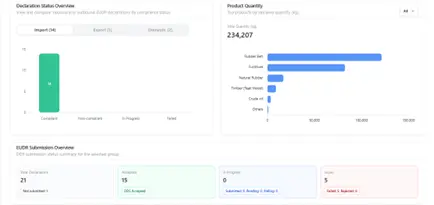
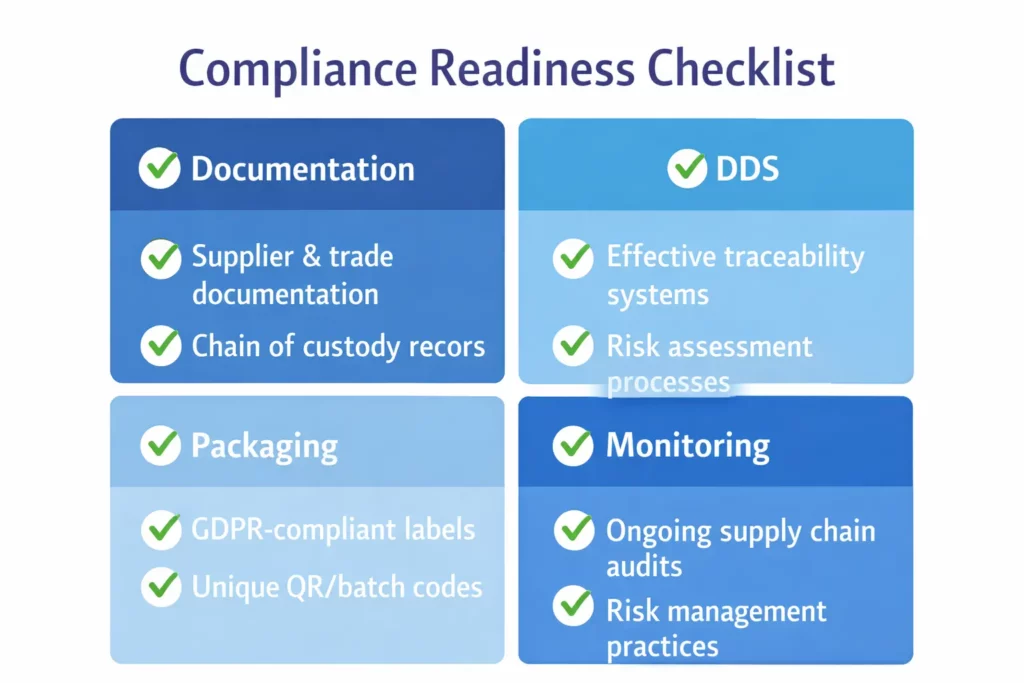
Use this checklist to audit your organisation’s EUDR readiness before the June 2027 SME deadline:
DOCUMENTATION AND DATA COLLECTION
DDS PROCESS
PACKAGING AND PRODUCT DATA
ONGOING MONITORING
EUDR packaging requirements are not met by printing a sustainability logo or attaching a certificate to a shipment. They require a verifiable, GPS-backed, real-time digital record of your supply chain from the farm gate to the EU border that can be inspected by competent authorities at any time.
For exporters managing hundreds or thousands of smallholder suppliers across emerging markets, this represents a fundamental transformation in how supply chain data is collected, verified, and reported. The companies that will continue to access EU markets are those that build or adopt the data infrastructure to make this possible not those who treat EUDR as a documentation formality.
TraceX Technologies has built the only platform designed from the ground up for the operational realities of emerging market supply chains: offline-first mobile data collection, agentic AI for document processing, real-time satellite monitoring, and automated TRACES NT DDS submission all in a single system.
Navigate wood-based supply chains.
Explore how EUDR impacts paper and pulp industries.
Strengthen your compliance strategy
Discover how to achieve EUDR compliance end-to-end.
Understand risks before they escalate
Learn how EUDR risk assessment works in practice.
EUDR applies to the product contained in the packaging, not the packaging material itself (unless that material is derived from a regulated commodity like wood-based paper). However, if your packaging contains or is made from wood, rubber, or palm oil derivatives, those materials and their sourcing must also comply. ESPR Digital Product Passports will extend lifecycle disclosure to packaging materials from 2027.
If a DDS is rejected or flagged for verification, EU competent authorities can place the shipment under temporary hold. Under EUDR enforcement (fully active from December 2025 for large operators), non-compliant shipments can be seized and destroyed at cost to the operator. Fines can reach 4% of annual EU turnover. Pre-submitting DDS well before the shipment arrives and using automated validation to catch data errors is essential.
No. EUDR contains no blanket exemption for smallholder farmers. The regulation provides some flexibility for low-risk countries (simplified DDS requirements), but geolocation data is required for all sourcing plots regardless of farm size. Operators are responsible for collecting this data from their full supply chain, including smallholders which is why mobile-first, offline-capable data collection tools are critical.
No. Sustainability certifications are supportive evidence that can reduce audit burden, but they do not replace the EUDR DDS requirement. You must still submit a DDS to EU TRACES NT with verified geolocation data for every shipment. Certifications may be referenced in your risk assessment documentation as mitigation factors.
Large operators (defined as those not meeting SME thresholds) had a mandatory DDS compliance deadline of December 30, 2025. SMEs and micro-enterprises have an extended deadline of June 30, 2026, for most commodity categories. However, if an SME supplies products to a large operator for EU market placement, the large operator’s compliance depends on the SME’s data meaning practical pressure to comply applies regardless of formal deadlines.