Quick summary: Learn how to achieve EUDR Palm oil compliance with traceability, DDS filings, and digital solutions for exporters, mills, and smallholders.

If you’re a palm oil exporter, mill operator, or compliance lead, here’s the situation you’re likely facing right now: Your shipment is ready. Your sustainability certifications are in order. But EU customs wants polygon-level geolocation tied to every farm plot in your supply chain, including the 200 smallholders your FFB agents aggregate from. And right now, those records don’t exist in a format that TRACES will accept. EUDR palm oil compliance requires full supply chain traceability down to the plantation plot.
That’s the EUDR gap. And it’s blocking real shipments from real companies today.
Exporters, mills, and smallholders must provide polygon geolocation, prove no deforestation after 31 December 2020, and submit a Due Diligence Statement (DDS) in the EU TRACES system. Certifications like RSPO or ISCC may support risk mitigation, but do not replace DDS filings. Digital platforms such as TraceX streamline geolocation, risk assessment, supplier onboarding, and TRACES submissions for audit-ready EUDR palm oil compliance.
Palm oil exporters are losing EU market access not because they’re non-compliant in spirit, but because their geolocation data is incomplete, their FFB agent records are informal, and their DDS filings lack verifiable evidence. This guide covers exactly what EUDR palm oil compliance requires, where supply chains break, and how digital solutions from TraceX help exporters, mills, and smallholders file audit-ready DDS submissions without the guesswork.
The EU is one of the largest global importers of palm oil, using it in food, cosmetics, biofuels, and industrial applications.
Top Palm Oil Exporting Countries Affected by EUDR: Indonesia (54% global production, 49% exports) and Malaysia (28% production, 30% exports) together account for approximately 80% of global palm oil and face major impacts.
Because palm oil cultivation has historically been linked to large-scale deforestation in Southeast Asia and increasingly in Africa, it is directly targeted under the EU Deforestation Regulation (EUDR). For palm oil exporters, this means strict new compliance rules: every shipment must be backed by geolocation data down to the plantation plot, legality verification, and a Due Diligence Statement (DDS) filed in TRACES.
The risk of non-compliance is severe: rejected consignments, financial penalties, and loss of EU market access. For companies dependent on Europe as a buyer, EUDR palm oil compliance is now business-critical.
Preparing your supply chain for EU deforestation rules? Explore our complete guide to EUDR Compliance and understand what companies must do before placing products on the EU market.
Not sure what the regulation actually requires? Read our breakdown of EUDR Requirements and learn the data, traceability, and due diligence obligations for operators.
Unlike past sustainability initiatives, the EUDR is not about broad pledges or certification logos it’s about evidence.
The regulation requires polygon-level boundaries for every oil palm plot, not just a point on a map or the address of a warehouse. This shift matters: polygons can show exactly where palm grows and whether it overlaps with deforested land. It’s not enough to know ‘where’, the EU wants to know how much and on what land.
TraceX in action: A palm oil exporter in Sumatra working with hundreds of independent smallholders used TraceX’s mobile farm mapping tool to capture GeoJSON polygons at the farm gate, offline and in local languages, and sync them automatically to their compliance dashboard. Result: plantation-level geolocation across their entire supply base in under six weeks, without a single field team duplicating effort.
This isn’t retrospective sustainability branding, it’s a legal cut-off. Every plot submitted in a DDS must be cross-referenced against satellite deforestation data to confirm forest cover as of December 31, 2020. Plots that can’t be verified against this baseline are non-compliant, regardless of current certification status.
TraceX in action: TraceX integrates satellite-based deforestation risk scoring into every polygon submitted. Compliance leads get a plot-by-plot risk flag before the DDS is filed, not after customs rejects it.

A DDS is not just a declaration; it’s a structured data submission to the EU TRACES system that must include geolocation coordinates, legality documentation, and a risk assessment. Errors in format, missing fields, or unresolvable polygon coordinates will result in rejection.
TraceX in action: TraceX generates TRACES-compatible DDS files directly from verified supply chain data, reducing manual re-entry errors and cutting filing time from days to hours for compliance teams managing multiple export lots.
Most palm oil mills cannot meet their processing capacity with their own plantations alone. They depend heavily on third-party suppliers of Fresh Fruit Bunches (FFBs). In Indonesia, for example, mills often work with one or two large traders who, in turn, rely on a network of sub-agents.
For independent smallholders, this means the only contact point in the supply chain is the sub-agent, not the mill. Transactions are typically informal: a smallholder delivers FFBs, receives a paper receipt for weight and payment, and the fruit is passed along.
This is where EUDR traceability breaks completely.
Who this affects most: Mill compliance officers managing 50-500 FFB agents across a region, with no existing digital infrastructure to collect or validate farm data upstream.
TraceX in action: TraceX’s FFB agent onboarding module gives agents a simple mobile interface to register each delivery with farmer ID, farm polygon, and lot weight, linking every delivery back to a specific plot. Mills get a live dashboard showing traceability coverage by agent, by region, and by risk tier. No more broken chain of custody.
Smallholders produce approximately 35-40% of global palm oil. Their inclusion in EUDR-compliant supply chains is not optional; it’s mathematically required for most mills to export to the EU at all.
But the compliance burden is asymmetric. Smallholders are being asked to provide polygon-level geolocation, legality documentation, and deforestation-free proof without the technical literacy, devices, or institutional support to do it.
Who is struggling most: Independent smallholders in Indonesia and Malaysia operating plots under 5 hectares, often without smartphone access, working with agents who don’t collect digital records.
TraceX in action: TraceX’s farmer-first onboarding is built for this reality. Field officers can map smallholder plots on behalf of farmers using the TraceX mobile app, generate a farmer’s digital ID linked to their plot polygon, and connect every future FFB delivery to that ID. Smallholders don’t need a smartphone. The data is captured once and flows automatically into the exporter’s DDS workflow.
A common question from compliance teams: ‘We’re RSPO-certified. Does that cover our EUDR obligation?’
The answer is no, but it helps.
Certifications like RSPO and ISCC demonstrate commitment to sustainable sourcing and may reduce the due diligence burden in some risk assessment steps. But they do not replace the legal requirement to:
The EU has been explicit: DDS filing is mandatory regardless of certification status. Certifications can be used as supporting evidence in risk assessment, but they do not substitute for it.
For an exporter managing a palm oil supply chain across multiple origins, EUDR compliance is not a one-time filing, it’s an ongoing operational process. Here’s what end-to-end compliance looks like when it’s working:
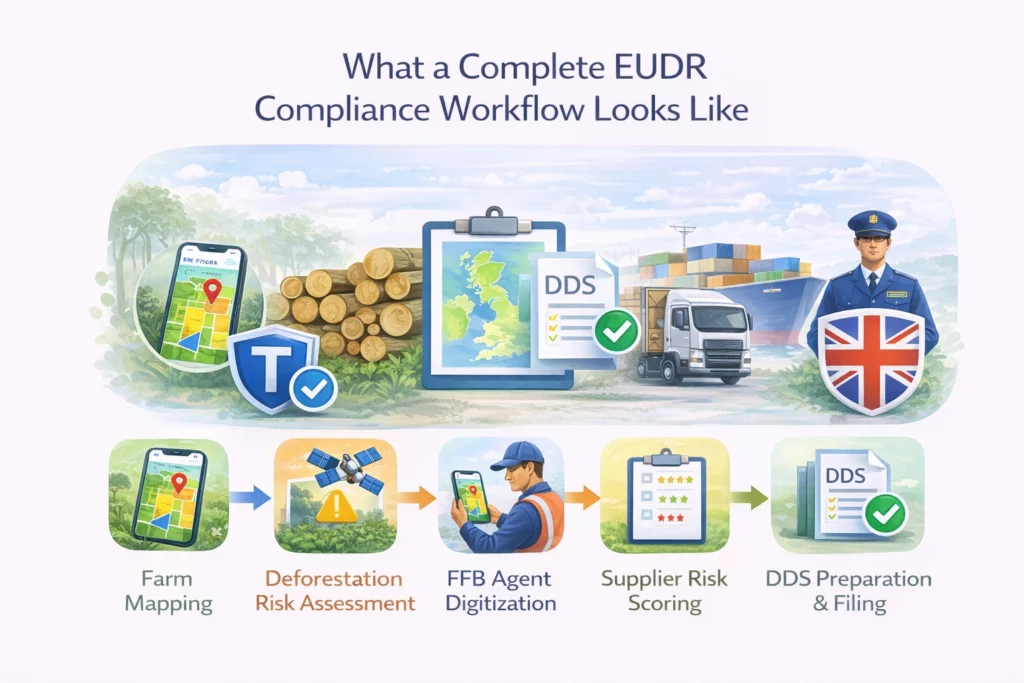
These are the real questions palm oil compliance leads are searching for right now. Here are direct answers:
If a plot cannot be geolocated to polygon level, it cannot be included in a compliant DDS. The options are: (1) map the plot using a field officer on the smallholder’s behalf, (2) exclude that supplier until mapping is completed, or (3) use a platform like TraceX that enables proxy mapping at scale.
Technically yes, TRACES accepts manual submissions. But for any supply chain with more than 20-30 suppliers, manual filing creates unacceptable error risk and audit exposure. Most compliance teams managing real export volumes use a platform.
Every shipment that places or makes available palm oil on the EU market requires its own DDS. There is no blanket approval.
Under EUDR, mixed-origin lots where non-compliant fruit cannot be separated and identified are non-compliant by default. The only solution is digitizing agent collection so each delivery is logged separately by farm source.
The EU Commission classifies countries into low, standard, and high-risk tiers based on deforestation rates. Both Indonesia and Malaysia are currently classified as standard risk, meaning full due diligence is still required but simplified procedures may apply for some operators. Check the most current classification before filing.
TraceX has a purpose-built supply chain traceability and compliance solution for agricultural commodities under EUDR and similar regulations. For palm oil specifically, TraceX provides:
Polygon-level farm mapping
Mobile-first, offline-capable, supports proxy mapping for smallholders.
Automated deforestation risk scoring
Cross-referenced against satellite data at plot level.
FFB agent digitization
Delivery-by-delivery traceability from farm gate to mill.
TRACES-compatible DDS generation
Compiled from verified supply chain data, ready to submit.
Supplier risk dashboards
Real-time coverage and risk monitoring across your entire supply base.
Audit trail storage
5-year documentation retention as required by EUDR.
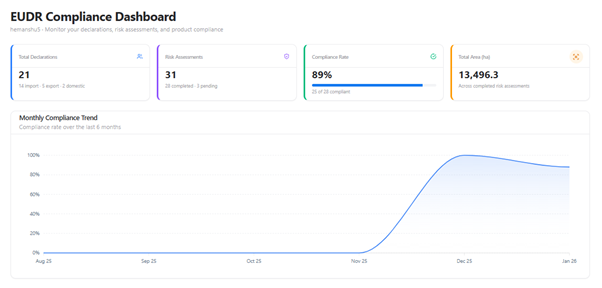
The EU Deforestation Regulation marks a major shift for palm oil exporters, mills, and smallholders supplying the European market. Compliance now requires farm-level geolocation data, verified legality documentation, deforestation risk assessments, and fully traceable supply chains before products can enter the EU. For companies operating in complex smallholder-driven supply networks, this means moving beyond manual records toward digitized traceability, structured supplier data management, and satellite-based deforestation monitoring. Organizations that begin mapping plantations, onboarding suppliers with standardized data requirements, and implementing robust compliance systems today will be best positioned to maintain uninterrupted EU market access. In the EUDR era, proactive, data-driven compliance is not just a regulatory obligation, it is a competitive advantage for responsible palm oil supply chains.
Geolocation data is the foundation of EUDR compliance. Read our guide to EUDR Geolocation Requirements and learn how to collect GPS points and polygon maps for palm oil plantations.
Smallholders play a critical role in palm oil supply chains. Discover how EUDR affects smallholders and what support systems are needed for compliance.
EUDR requires geolocation polygons of plantations, proof of no deforestation after Dec 31, 2020, and a Due Diligence Statement (DDS) filed in TRACES.
No. Certifications may support risk assessment but do not replace the legal obligation to file a DDS with verified geolocation and deforestation-free proof for each shipment.
The DDS obligation falls on the operator placing the product on the EU market (typically the exporter or importer). But compliance is only possible if mills and smallholders upstream provide verifiable traceability data. Everyone in the chain has a role.
FFB agents aggregate palm fruit from multiple smallholders and sell to mills. Because they sit between smallholders and mills, they are the most common point where traceability breaks. Under EUDR, their records must be digitized and linked to individual farm plots.
No. Without digitizing FFB agent records and linking them to farm-level geolocation, the chain of custody breaks and the DDS cannot be fully substantiated for EU customs.
Digital platforms like TraceX enable field officers to map smallholder plots on their behalf, generate farmer digital IDs, and link every FFB delivery to a verified farm source without requiring smallholders to own or operate a smartphone.
Smallholders produce 35-40% of global palm oil. Without their inclusion in verified supply chains, most mills cannot source enough compliant volume to maintain EU export operations.