
Quick summary: EUDR risk assessment and mitigation: learn how to move beyond data collection to automated decision-making, supplier risk scoring, and audit-ready compliance workflows.
Most organizations approaching the EU Deforestation Regulation (EUDR) treat it as a data collection exercise: gather geolocation coordinates, obtain supplier declarations, and upload documents. That framing is incomplete and dangerous.
The EUDR requires companies to demonstrate that products placed on the EU market are deforestation-free and produced in compliance with the legislation of the country of origin. EUDR risk mitigation, therefore, becomes central to compliance, as meeting this bar requires active decision-making at scale: classifying supplier risk, triggering investigations, escalating non-conformance cases, and documenting every step with audit-ready evidence.
Buyers evaluating EUDR compliance solutions today are asking a fundamentally different set of questions than they were two years ago. They are not just asking, ‘Can you collect my supplier data?’ They are asking: ‘Can your system tell me which suppliers I should be worried about and what I should do about it?’
This guide unpacks how integrated risk scoring and automated mitigation workflows are becoming the new baseline for EUDR compliance and what risk engines combining supplier data, satellite imagery, and legal checks look like in practice.
The Scale of the Challenge
| 28+ EU member states bound by EUDR | 28+ EU member states are bound by EUDR | 7 Commodities covered (incl. derivatives) | €150B+ Trade value is impacted annually |
Effective EUDR risk assessment operates across three distinct dimensions simultaneously. Collapsing them into a single ‘risk score’ without understanding each dimension leads to miscategorization and enforcement exposure.
The foundational layer of EUDR compliance is confirming that the plots where commodities originate have not been subject to deforestation or forest degradation after December 31, 2020. This requires:
According to Global Forest Watch, the world lost 4.1 million hectares of primary tropical forest in 2023 alone, an area roughly the size of the Netherlands. EUDR compliance systems must be capable of detecting and responding to deforestation events in near real-time.
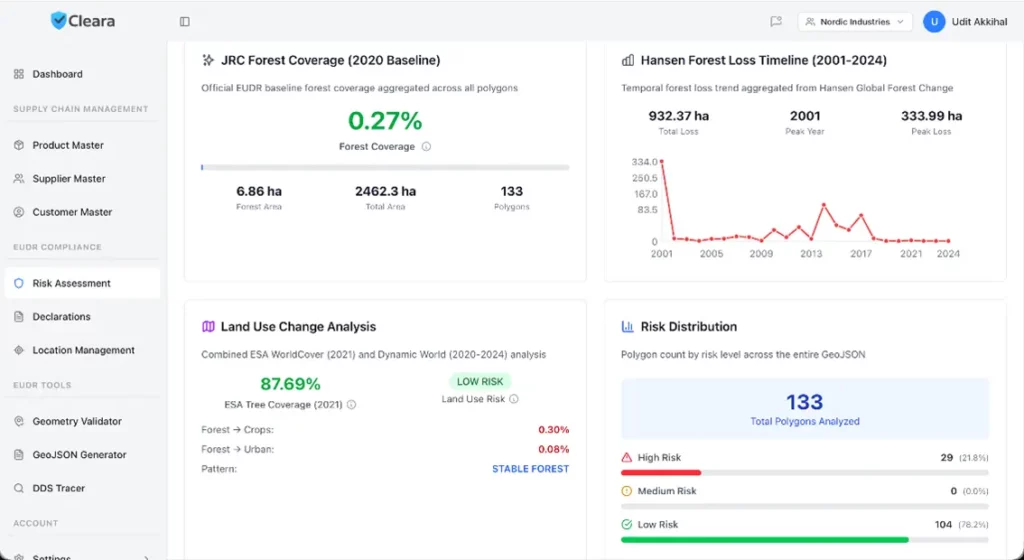
The European Commission is required to publish a country benchmarking system classifying countries as low, standard, or high risk based on their deforestation rates and governance quality. This classification will directly impact the due diligence obligations of operators.
| Risk Category | Due Diligence Obligation | Monitoring Frequency |
|---|---|---|
| Low Risk | Simplified due diligence – no full risk assessment required if negligible risk demonstrated | Annual or event-triggered |
| Standard Risk | Full due diligence required – risk assessment, mitigation, and documentation | Continuous monitoring with quarterly reviews |
| High Risk | Enhanced due diligence – in-depth verification, third-party audits, product holds until cleared | Real-time monitoring; mandatory pre-import clearance |
Beyond the land itself, compliance teams must assess the behavioural and structural risk presented by each supplier in the value chain. This dimension incorporates:
The compliance industry has operated on checklists for decades. EUDR changes that paradigm. A checklist can tell you whether a supplier submitted documents. It cannot tell you whether a supplier’s declared plot is consistent with satellite-observed forest cover, whether their yield volumes are plausible for the declared area, or whether a newly flagged deforestation event inside their sourcing polygon should trigger a shipment hold.
That is the role of an integrated risk scoring engine.
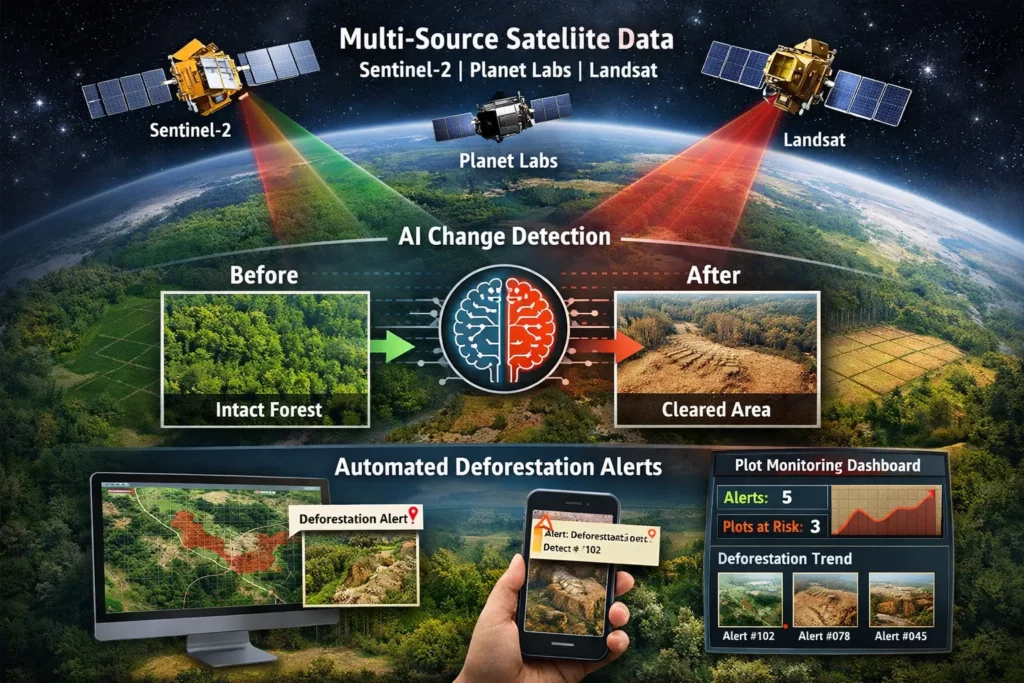
A modern EUDR risk engine synthesizes multiple data streams into a composite risk score then updates that score automatically as new information arrives. The architecture typically includes the following input data layers:
Risk engines combine these data inputs using weighted scoring models that reflect the actual regulatory criteria in EUDR Article 10 (risk assessment) and Article 11 (risk mitigation). Typical weighting factors include:
| Risk Factor | Typical Weight | Data Source |
|---|---|---|
| Legal compliance status in the origin country | High (35-40%) | Satellite + GFW alerts |
| Country risk classification (EU benchmark) | High (25-30%) | EU Commission database |
| Legal compliance status in origin country | Medium (15-20%) | Legal databases, gov registries |
| Supplier data quality and completeness score | Medium (10-15%) | Platform intake + verification |
| Yield plausibility vs declared area | Medium (10-15%) | Trade data + agronomic models |
| Historical non-conformance record | Low-Medium (5-10%) | Internal audit history |
The output of the scoring engine maps directly to the three-tier risk classification required under EUDR. This is not just an internal tool, it is the documented evidence that authorities will request during inspections.
EUDR Article 10 explicitly requires operators to conduct risk assessments considering country-level risk, product characteristics, sourcing geography, and supply chain complexity. An automated risk scoring model provides the structured, reproducible methodology required to satisfy this obligation at scale.
Key design principles for compliant risk classification outputs:
Risk scoring without a mitigation workflow is an alert system. It tells you what is wrong but does not help you fix it, document your response, or demonstrate to a competent authority that you acted appropriately. The gap between alert systems and true compliance platforms is the presence or absence of built-in mitigation workflows.
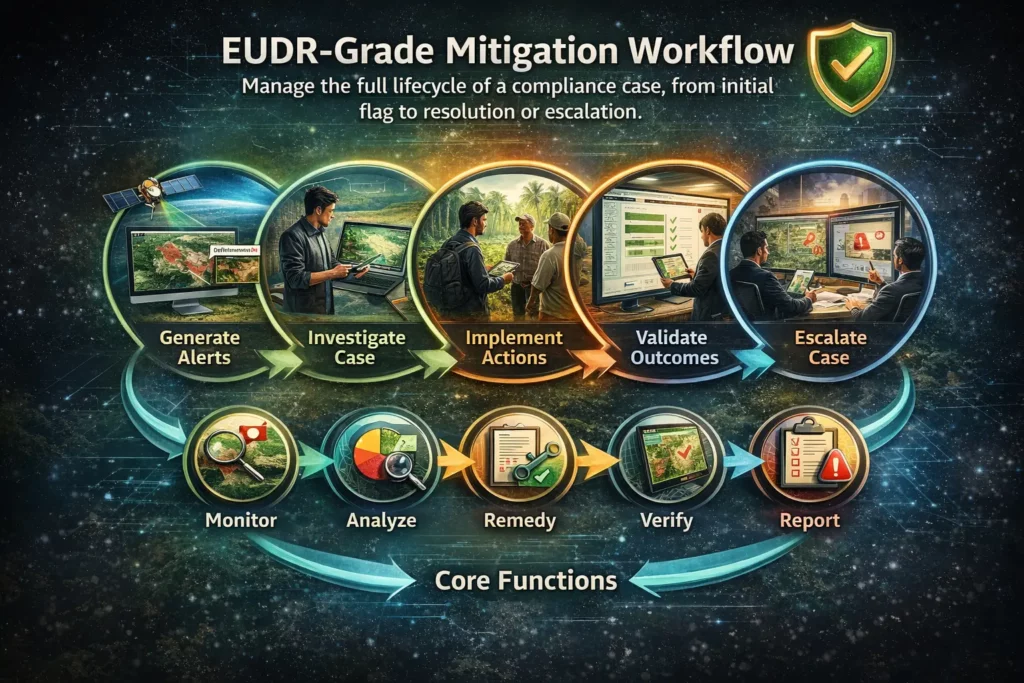
An EUDR-grade mitigation workflow needs to manage the full lifecycle of a compliance case, from initial flag to resolution or escalation. This includes five core functions:
When a supplier’s risk score crosses a threshold or when a satellite deforestation alert fires inside a declared plot the system should automatically generate a compliance case, assign it to the responsible team member, and notify relevant stakeholders. Manual case creation at the volume EUDR required is not operationally viable for large operators.
The case management system should guide investigators through a defined workflow: request additional documentation from the supplier, upload and tag satellite evidence, log field verification outcomes, and record corrective action commitments. This structured approach ensures that the due diligence obligation is met and documented consistently across all cases.
Research by the Sustainable Supply Chains Initiative found that supply chain compliance investigations in the agricultural sector average 6-12 weeks when managed manually. Digitized workflows with automated evidence collection can reduce this by 40-60%, according to early adopter benchmarks.
Not all risk scenarios are equal. A mitigation workflow should support configurable escalation rules: cases involving high-risk countries or confirmed deforestation events should require senior sign-off before proceeding to import. Cases involving minor data completeness issues can follow a lighter-touch resolution path. Appropriate escalation matrices protect organizations from regulatory exposure and poor individual decisions.
For suppliers who fail initial screening, the compliance system should be able to track corrective action plans (CAPs): what commitment the supplier has made, what evidence is expected, what the deadline is, and whether the CAP has been fulfilled. This transforms reactive screening into a proactive supplier development capability.
Every resolved case must generate a documented closure record: what risk was identified, what mitigation steps were taken, what evidence was collected, and the final compliance determination. Under EUDR, operators are required to maintain these records for at least five years and make them available to competent authorities on request.
The most advanced EUDR compliance platforms are converging on a risk engine architecture that pulls together three distinct data streams. Understanding each layer and how they interact is essential for both buyers evaluating solutions and compliance practitioners building their programs.
The foundation of EUDR due diligence is supplier-submitted data: geolocation polygons, operator declarations, certification documents, and supply chain maps. The challenge is that this data arrives in inconsistent formats, at inconsistent times, and with inconsistent levels of accuracy.
A modern risk engine handles supplier data through:
Supplier self-reporting is necessary but not sufficient. The defining feature of EUDR-grade compliance versus earlier voluntary standards is the requirement for independent verification of deforestation status. This is where satellite data becomes non-negotiable.
The EU EUDR Information System (EUDR IS) integrates satellite monitoring capabilities to support competent authority oversight. Platforms that connect to comparable data sources (Sentinel Hub, Global Forest Watch, Planet Labs) allow operators to perform equivalent independent verification as part of their due diligence process.
Effective satellite integration provides:
The third data stream addresses what satellite imagery cannot reveal: whether the legal framework governing land use in the country of origin has been respected. EUDR Article 3 requires that products are not only deforestation-free but also produced in compliance with the relevant legislation of the country of production.
Legal data checks in a modern risk engine include:
The power of an integrated risk engine is not in any individual data stream it is in the synthesis. Consider a soy shipment from Brazil:
Without an integrated risk engine, this scenario would require a compliance analyst to manually cross-reference satellite feeds, legal databases, and supplier documents. With it, the detection, case creation, and escalation happen automatically within hours of new data arriving.
For supply chain and compliance leaders designing or evaluating their EUDR programs, the following roadmap reflects current best practices.
Enforcement Timeline Reminder: Large operators and traders faced the original December 30, 2024, deadline, now deferred to December 30, 2026, following the amended timeline. SMEs have until June 30, 2027. Competent authorities are required to conduct risk-based checks on a minimum of 3% of operators placing products on the market annually.
EUDR compliance is not a regulatory burden that ends at the point of document submission. It is an ongoing operational capability that requires automated risk scoring, structured mitigation workflows, and continuously refreshed data from satellite, supplier, and legal sources.
Organizations that build this capability now rather than waiting for enforcement to force their hand gain more than regulatory protection. They gain supply chain transparency that informs sourcing decisions, risk intelligence that reduces costly supply disruptions, and credible sustainability credentials that increasingly influence purchasing decisions among EU buyers.
The question is not whether your organization needs an integrated EUDR risk engine. The question is how quickly you can deploy one.
Understand sourcing risks by region – explore our guide to EUDR country benchmarking.
Make informed sourcing decisions – learn how country risk impacts EUDR compliance.
From benchmarking to action – discover how to align your supply chain with EUDR requirements.
No. Data collection is only the first step. EUDR requires risk assessment, mitigation actions, and documented decision-making to validate compliance.
Manual risk assessment is not scalable. With multi-tier supply chains, automated risk scoring and workflows are essential to ensure consistency and speed.
Without risk mitigation, high-risk suppliers can invalidate your DDS, leading to blocked market access, penalties, and audit failures.
While not legally mandated, a digital system is critical to manage data, trigger actions, maintain audit trails, and ensure compliance at scale.
It enables real-time risk classification, faster mitigation actions, and consistent documentation ensuring your compliance process is proactive and audit-ready.









