
Quick summary: EUDR rubber compliance tool for importers: GPS mapping, DDS automation & satellite risk scoring. Check your readiness before June 2026 — avoid shipment bans.
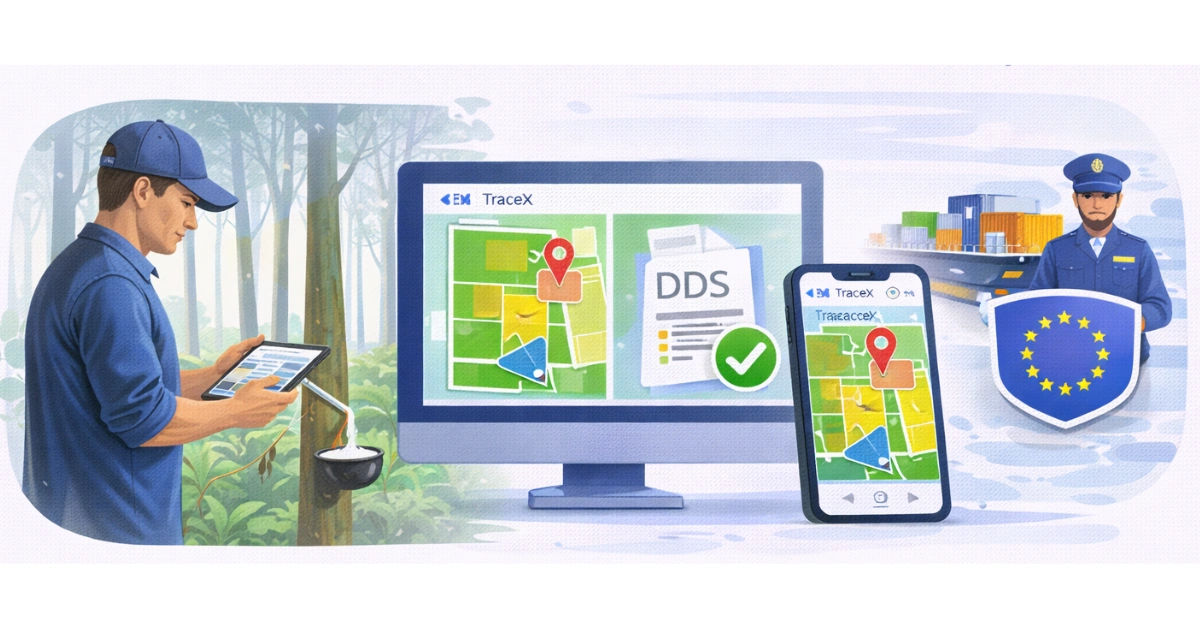
Rubber is on EUDR’s watch list, and most importers aren’t ready. An EUDR rubber compliance tool for importers is software that automates the three core obligations of the EU Deforestation Regulation: GPS-based farm polygon mapping, satellite deforestation risk scoring, and Due Diligence Statement (DDS) auto-generation with direct submission to the EU TRACES NT system.
The EU Deforestation Regulation (EUDR) entered force in June 2023, and the compliance clock is now critical: large operators faced a December 30, 2025 deadline, while SMEs have until June 30, 2026. Every rubber shipment entering the EU after these dates must arrive with a verified Due Diligence Statement proving the product did not contribute to deforestation. Importers who can’t produce one face shipment bans, market withdrawal, and fines of up to 4% of annual EU turnover.
The challenge for rubber is structural: supply chains stretch across fragmented smallholder farms in Indonesia, Thailand, Malaysia, and Vietnam farms where paper records are the norm and GPS coordinates don’t exist yet. Generic compliance approaches built for coffee or palm oil don’t solve rubber’s unique last-mile problem.
This guide gives you the complete readiness framework: what EUDR demands of rubber importers, what to look for in a compliance tool like TraceX EUDR Solutions and a step-by-step checklist to assess where your operation stands today.
EUDR isn’t a certification scheme; it’s a market access gate. Natural rubber (HS code 4001) is one of seven regulated commodities under Regulation (EU) 2023/1115. Any importer placing rubber or rubber-derived products on the EU market must file a geo-referenced Due Diligence Statement confirming the source land was not deforested after December 31, 2020. According to the European Commission’s own data, natural rubber accounts for roughly €2.3 billion in annual EU imports making it the third most exposed commodity after palm oil and soy.
EUDR covers natural rubber and a broad set of derived products. This is where many importers misjudge their exposure.
| HS Code | Product Description | EUDR Covered? |
|---|---|---|
| 4001 | Natural rubber, balata, gutta-percha, chicle | Yes – Regulated |
| 4005 | Compounded rubber, unvulcanised | Yes – Regulated |
| 4006 | Other forms of unvulcanised rubber | Yes – Regulated |
| 4007-4017 | Vulcanised rubber products (tyres, tubes, belts, gaskets) | Yes – if rubber-derived |
| 4002 | Synthetic rubber and factice | No – Exempt from EUDR |
Most competing articles fail to clarify that synthetic rubber (HS 4002) is explicitly EXEMPT from EUDR a critical distinction for importers sourcing blended products. If your product contains a mix of natural and synthetic rubber, only the natural rubber-derived components trigger EUDR obligations. Importers of industrial components, automotive parts, or mixed-compound goods must review each product’s bill of materials before assuming full compliance liability.
Under Article 9 of EUDR, rubber importers must collect and hold the following evidence for every shipment:
This is not a one-time audit. Every single shipment requires a fresh DDS. Compliance infrastructure must be operational and scalable – not a spreadsheet exercise performed once a year.
Exporting rubber to the EU?
Read our guide to EUDR Rubber Regulations and understand the compliance requirements for natural rubber supply chains.
Unsure how to submit your Due Diligence Statement?
Learn how to file an EUDR DDS step by step and avoid common submission mistakes.
Coffee and cocoa supply chains, while complex, often flow through established cooperative structures with existing certification systems (Rainforest Alliance, Fairtrade). Rubber doesn’t. Over 85% of the world’s natural rubber is produced by smallholder farmers on plots of 2-5 hectares, predominantly in Southeast Asia, where land registries are incomplete and digital infrastructure is sparse. This structural reality makes rubber EUDR compliance one of the most technically demanding use cases in the regulation.
A typical rubber importer in Europe may source from one or two aggregators, but each aggregator works with hundreds of independent collectors, who purchase from thousands of farm households. By the time rubber reaches a processing facility, it may represent production from 2,000-5,000 individual plots. Each of those plots needs a GPS polygon. That’s not a spreadsheet task; it’s a field data capture operation.
Most EUDR readiness articles treat ‘geo-referenced coordinates’ as a checkbox item. The real challenge is the DATA COLLECTION WORKFLOW, how you train field agents, capture GPS polygons on sub-standard mobile networks, and maintain data quality across seasonal farm visits. Tools that don’t address offline functionality and multilingual agent support are not fit for rubber supply chains. This workflow gap is the #1 reason rubber importers fall behind on compliance timelines, yet it appears in almost no competitor content on this topic.
Standard EUDR guidance references GPS coordinates or GeoJSON polygon data. But in Sumatra, Borneo, or the Mekong Delta, many rubber farms have never been formally surveyed. Field agents must physically visit and map plots using mobile apps that work offline because 3G/4G connectivity can’t be assumed in these geographies.
This is the operational gap where most compliance attempts break down. Companies investing in EUDR compliance for rubber need tools built for last-mile field data collection, not enterprise dashboards designed for desk-based analysts.
enterprise dashboards designed for desk-based analysts.
| €2.3B Annual EU rubber imports subject to EUDR European Commission, 2023 | 85% Natural rubber from smallholder farmers IRSG, 2024 | 4% Max fine as % of EU annual turnover EUDR Article 25, 2023 |
| Jun 2026 SME compliance deadline European Commission, 2024 | 5,000+ Farm plots a mid-size aggregator must map Proforest / Industry Est., 2024 | 23% Rubber supply chains with verified GPS data Forest500 / Proforest, 2024 |
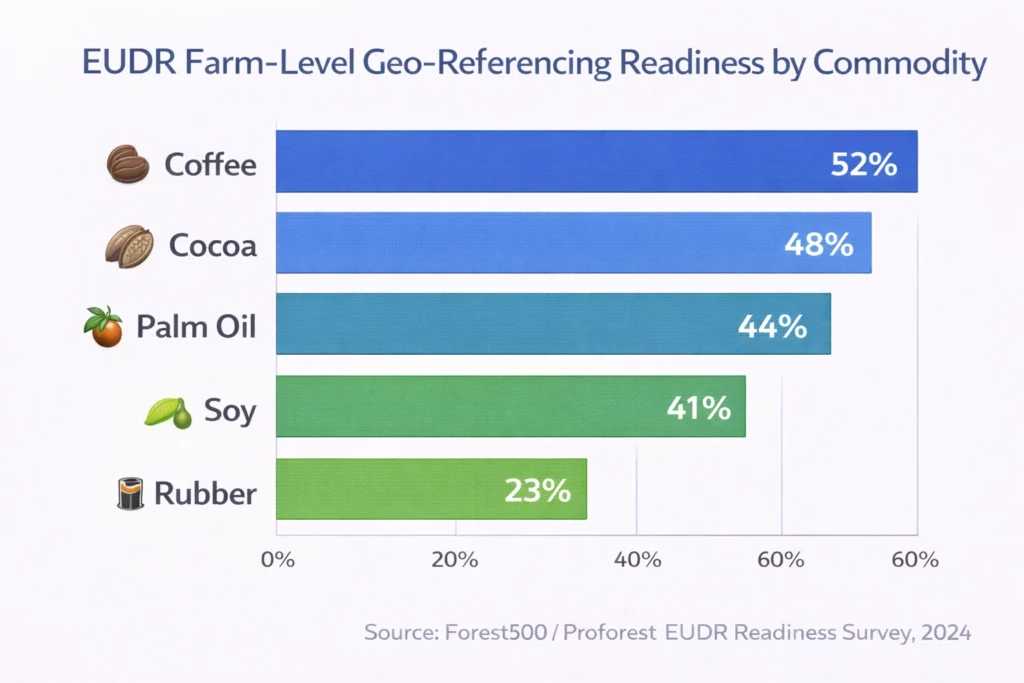
The data above reveals that rubber supply chains have the lowest verified GPS readiness among all EUDR-regulated commodities less than half the rate of coffee. This gap reflects the structural smallholder fragmentation challenge unique to rubber, not lack of importer intent.
Not every supply chain compliance platform is built for EUDR’s rubber-specific demands. A fit-for-purpose EUDR rubber compliance tool must handle three non-negotiable capabilities: farm-level GPS data capture in low-connectivity environments, automated cross-referencing against satellite deforestation datasets, and direct DDS generation and submission to EU TRACES. Tools missing any of these three pillars will leave importers exposed.
GPS polygon mapping means capturing the full boundary of a farm plot a polygon cross-referenced against forest cover datasets. For EUDR, the two primary reference datasets are:
A compliant tool must automatically cross-reference all farm polygons against both datasets and flag plots showing deforestation risk. Manual cross-checking at scale is not viable tools requiring individual polygon checks per farm cannot handle the volume a rubber importer needs.
The DDS is a structured legal document submitted via EU TRACES NT. Each DDS references specific shipment data, supplier information, geo-coordinates, and the importer’s risk assessment conclusion. Manually drafting DDS documents from fragmented supplier data is the compliance bottleneck that causes most deadline failures.
The right tool uses AI to pull data from supplier records, GPS databases, and satellite risk scores and outputs a TRACES-ready DDS with one click. Verify that any tool you evaluate supports direct API submission to TRACES, not just document export.
EUDR enforcement relies on EU TRACES NT for DDS registration. Operators must assign a unique DDS reference number to each shipment customs authorities verify this at the border. Tools that produce compliant DDS documents but require manual copy-paste into TRACES create error risk and compliance gaps.
Additionally, EU authorities may conduct audits of your full due diligence system. Your tool must generate exportable audit trails in PDF, XML, and CSV formats showing the full data lineage from farm GPS capture to DDS submission reference.
Use this feature matrix to evaluate any EUDR rubber compliance tool against your operational needs. All features listed are either required by the regulation or operationally essential for rubber supply chains:
| Feature | Why It Matters for Rubber | Must-Have? |
|---|---|---|
| GPS polygon capture – mobile, offline-first | 80%+ of rubber farms are in low-connectivity zones | Critical |
| JRC + Hansen satellite cross-referencing | Required for EUDR deforestation verification standard | Critical |
| Automated DDS generation | Manual DDS at scale is error-prone and slow | Critical |
| Direct TRACES API submission | Manual TRACES upload creates compliance gaps | Critical |
| Supplier KYC and AI document parsing | Aggregates land tenure docs from diverse supplier formats | Critical |
| Risk scoring and real-time deforestation alerts | Flags new land conversion near active supplier plots | Critical |
| Multilingual field agent app | Essential for agents in SE Asia / Africa | High Value |
| ERP / procurement system integration | Avoids duplicate data entry across systems | High Value |
| Audit-ready export (PDF / XML / CSV) | Required if authorities request full compliance audit | Critical |
| Carbon / Scope 3 MRV (bonus feature) | Satisfies CSRD alongside EUDR in one platform | Added Value |
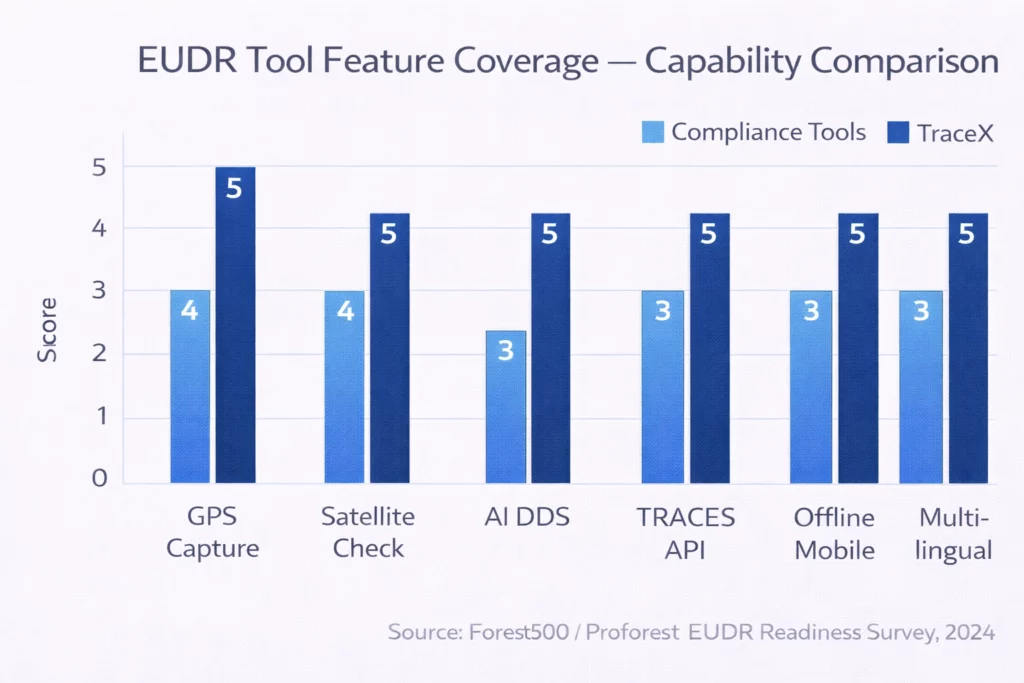
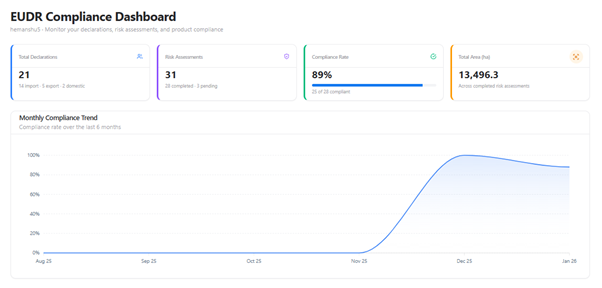
TraceX’s EUDR Compliance Platform is purpose-built for the operational realities of emerging market supply chains, the fragmented smallholder farms in Southeast Asia and Africa, where most natural rubber originates. Unlike generic compliance tools, TraceX was designed around agentic AI, offline-first mobile infrastructure, and direct TRACES integration, the three pillars that rubber importers actually need.
TraceX field agents use an offline-first mobile app to visit rubber farms and capture full GPS polygon boundaries even in areas without 3G/4G coverage. Data syncs automatically when connectivity is restored. The app supports multilingual interfaces, allowing local agents to operate in Bahasa, Tamil, Thai, or other regional languages without translation delays.
Each farmer receives a digital profile including KYC documents, land tenure records, and crop history. This farm-level data becomes the foundation of every DDS submission.
Want to see how global manufacturers are preparing their rubber supply chains for EUDR? Read the case study: ‘How a Leading Tire Company Achieved EUDR Compliance Through Large-Scale Polygon Mapping’ to learn how farm-level geolocation mapping and satellite verification enabled scalable, deforestation-free sourcing.
Once GPS polygons are captured, TraceX automatically cross-references each farm boundary against the JRC Global Forest Cover dataset and the Hansen GLAD tree cover loss data (updated to the current season). Farms receive a risk score of low, standard, or high based on proximity to deforested areas and historical land use patterns.

Real-time deforestation alerts notify compliance managers when new satellite data shows land conversion activity near active supplier plots, enabling proactive risk management rather than reactive audit failures.
TraceX’s agentic AI parses supplier documentation emails, scanned land records, certification PDFs and auto-populates DDS fields without manual data entry. For a rubber importer sourcing from 50+ suppliers, this step alone can reduce DDS preparation time from weeks to hours. The AI extracts KYC data, land tenure information, and supply chain linkage automatically, with human review flagging any exceptions.
Completed DDS documents submit directly to EU TRACES NT via API no copy-paste, no manual upload workflow. Each submission generates a unique DDS reference number automatically matched to the corresponding shipment record in TraceX.
Audit-ready exports are available one-click in PDF, XML, and CSV formats, covering the full compliance trail from farm GPS capture to DDS reference number. If an EU authority requests a compliance audit, everything is in one exportable package.
Use this checklist to assess where your rubber supply chain stands against EUDR requirements. Each item corresponds to a specific regulatory obligation or operational requirement:
| Readiness Requirement | Status | TraceX Handles This? |
|---|---|---|
| All source countries for the rubber supply chain identified | Done / In Progress / Not Started | Supplier mapping |
| GPS polygon data captured for all rubber farm plots | Done / In Progress / Not Started | Offline GPS app |
| Farm plots cross-referenced against JRC deforestation data | Done / In Progress / Not Started | Auto satellite check |
| Risk assessments completed for all suppliers | Done / In Progress / Not Started | Risk scoring engine |
| System to generate EUDR-compliant DDS per shipment | Done / In Progress / Not Started | AI DDS generation |
| DDS submitted directly to EU TRACES NT per shipment | Done / In Progress / Not Started | TRACES API |
| Audit-ready documentation for full due diligence system | Done / In Progress / Not Started | One-click export |
| EU buyer contracts confirm EUDR requirements in writing | Done / In Progress / Not Started | Documentation support |
| Compliance system covers both 2025 and 2026 deadlines | Done / In Progress / Not Started | Full coverage |
| Ongoing monitoring for new deforestation near supplier farms | Done / In Progress / Not Started | Real-time alerts |
Scoring Your Readiness
0-3 complete – HIGH RISK: Shipments may be blocked at EU customs. Immediate action is required.
4-6 complete – MODERATE RISK: Foundations in place but critical gaps. Begin tool selection now.
7-10 complete – LOW RISK: On track. Focus on operationalizing remaining gaps and field training.
EUDR rubber compliance isn’t a documentation exercise it’s a supply chain data transformation program. The regulation requires farm-level GPS data at a scale most rubber importers have never had to collect before. Manual approaches will fail under the volume and deadline pressure.
The importers who maintain EU market access in 2026 are the ones who select the right compliance tool now, begin farmer onboarding immediately, and build the data infrastructure every future shipment depends on. The checklist above shows you where you stand. The question is whether you act on it.
Geolocation data is the foundation of EUDR compliance.
Read our guide to EUDR Geolocation Requirements and learn how to collect GPS points and polygon maps for production plots.
Not sure how to determine deforestation exposure in your sourcing regions?
Explore our EUDR Risk Assessment guide and understand how companies classify and mitigate supply chain risks.
Preparing your supply chain for EU deforestation rules?
Discover our complete guide to EUDR Compliance and learn the data and documentation required before placing products on the EU market.
EUDR compliance for rubber importers means proving, before each EU shipment, that the natural rubber in the product was not produced on land deforested after December 31, 2020. This requires GPS-verified farm coordinates, satellite deforestation cross-checks, and a Due Diligence Statement filed with EU TRACES NT. Non-compliant shipments face market withdrawal and fines up to 4% of EU annual turnover.
Rubber importers need: (1) GPS polygon coordinates for every source farm plot, (2) satellite deforestation cross-check evidence, (3) a completed DDS referencing all source farms and shipment data, (4) a supplier risk assessment classifying each as low/standard/high risk, and (5) KYC and land tenure documentation from each supplier. All documents must be retained for five years and made available to EU authorities on request.
EUDR applies only to natural rubber (HS 4001) and products derived from it. Synthetic rubber (HS 4002) is explicitly exempt. However, products containing a blend of natural and synthetic rubber such as certain industrial belts, gaskets, or footwear may still trigger EUDR obligations for the natural rubber content. Importers of blended products should review each product’s bill of materials carefully to determine EUDR scope.
If EU customs determines a shipment lacks a valid, compliant DDS, the shipment can be detained, refused entry, or required to be withdrawn from the EU market. Fines reach up to 4% of the operator’s total annual EU turnover, and repeat violations can result in exclusion from public procurement. Reputational damage with EU buyers is also significant, as many now contractually require EUDR compliance.
SME rubber importers have an extended deadline of June 30, 2026, following the European Commission’s phased implementation announcement in 2024. Large operators faced December 30, 2025. Starting compliance preparation now is essential GPS data collection from thousands of farms typically takes 6-12 months to operationalize.