
Quick summary: EUDR compliance doesn't end at the log yard. Learn how timber processors maintain chain of custody, DDS continuity, and audit readiness after transformation.
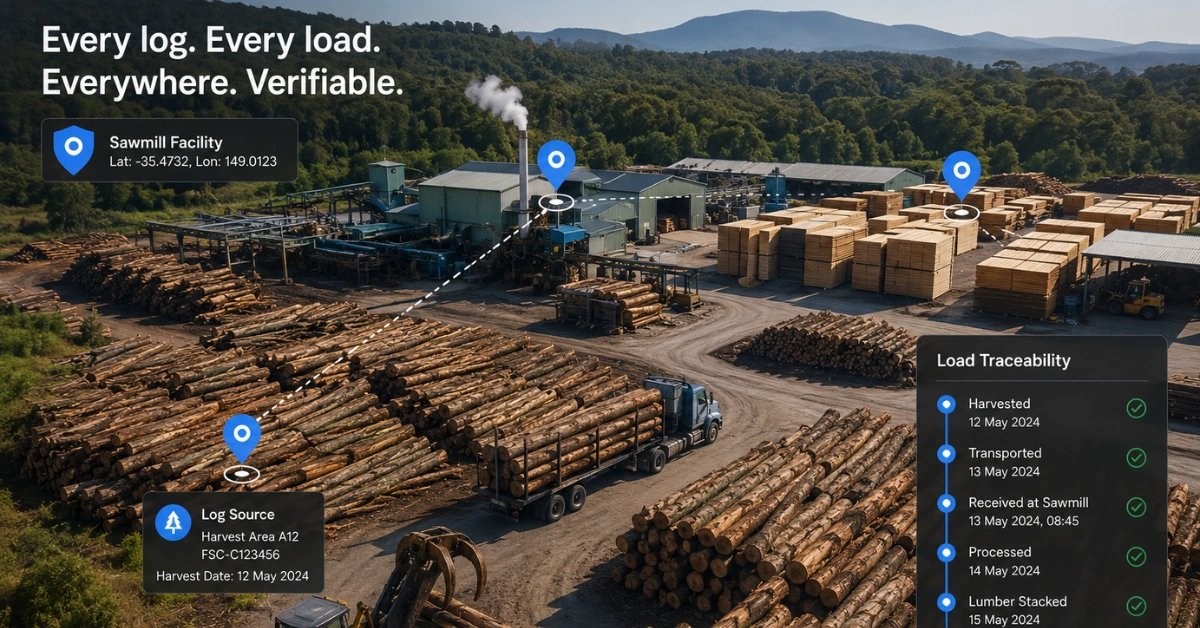
Timber companies maintain EUDR sawmill compliance through transformation by linking every finished lumber batch back to the specific forest plots, log batches, and supplier DDS references that contributed to it using geolocation polygons, batch-level chain of custody, and volume reconciliation across input, yield, and shipment. Receiving a supplier DDS is not enough on its own. Once a log is cut, the operator becomes responsible for proving the linkage held.
Most timber compliance conversations stop at the forest gate. Collect a geolocation polygon, get a Due Diligence Statement reference from the supplier, file it. Done.
It is not done. It is barely started.
Under the EU Deforestation Regulation, operators placing timber products on the EU market are responsible for proving at the shipment level that every cubic metre of wood inside that shipment traces back to a deforestation-free, legally harvested forest plot. That obligation does not pause when a log gets pushed through a debarker.
And here is what makes it brutal: by the time finished lumber reaches a customer, dozens of logs from several suppliers, harvested across multiple weeks, may have been pooled into a single production batch. If you cannot recreate that pooling on demand, six months later, in front of an auditor you do not have traceability. You have a story.
| Key takeaways EUDR compliance for sawmills is not really a sourcing problem it’s a transformation problem. The hard work begins the moment a log enters the mill and becomes lumber, chips, and waste. Operators who can connect forest plot → log batch → production batch → finished lumber → shipment, with reconciled volumes and continuous DDS references, will be the ones who pass audits and keep EU market access. Everyone else is exposed. |
Across the timber processors we have onboarded for EUDR readiness, the failure point is almost never supplier data collection. It is the moment of physical transformation. The supplier hands you a clean DDS reference. Then you cut the log. And the link between that DDS and the lumber stack on the loading dock evaporates inside the production log.
Discover how timber traceability works, why traditional documentation systems fall short, and what leading organizations are doing to build audit-ready, transparent supply chains.
Read the full blog on Timber Traceability →
Before the transformation problem makes sense, the supply chain needs to be drawn out properly stage by stage. Most diagrams stop at ‘sawmill’. The reality has at least seven hand-offs, and each one is a place where data can drop.
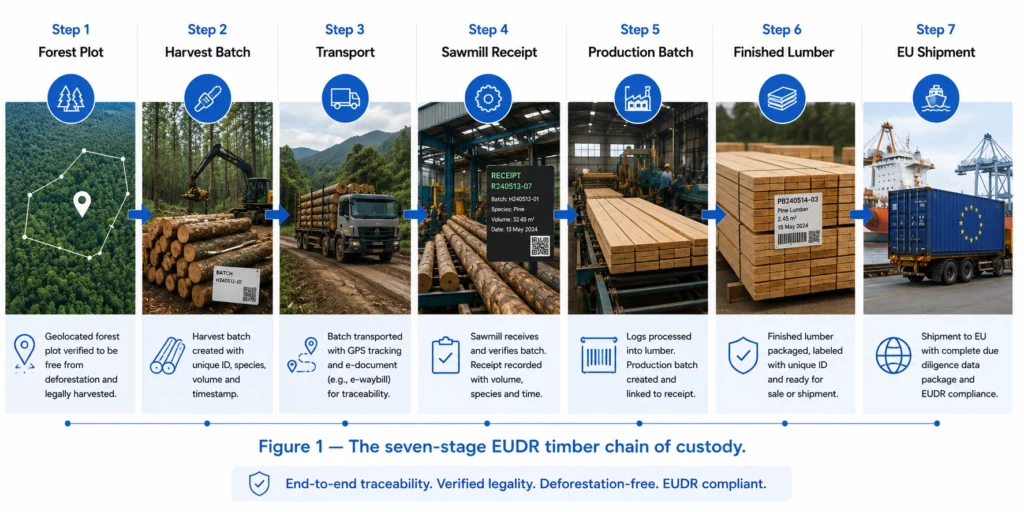
This is where the regulation begins. You need GPS polygons (not points), country and region of harvest, harvest dates, species declarations, and legality documentation. Polygon accuracy is what gets validated against JRC and Hansen satellite datasets.
Harvested trees become traceable log batches each tagged with harvest permits, species declarations, supplier ID, and a batch identifier that will travel with the wood downstream.
Logs arrive at the mill. This is where supplier verification, DDS references, and inventory registration converge. Skip it and you have already broken the chain before the first cut.
A typical run might look like this:
| 55–65% | 3–5 | 6 months |
|---|---|---|
| typical lumber yield from softwood logs | different suppliers commonly pooled per production batch at mid-size mills | typical look-back window an auditor may request |
In customer mills, the single most common gap we find is a missing link between the production-batch number in the ERP and the upstream log-batch IDs. The ERP knows what was produced. The procurement system knows what was received. Nothing in between connects them. That is the broken link an EUDR audit will surface immediately.
Each of those four output streams may end up on a different shipment, sold to a different customer, on a different date. Every one of them needs to point back to the same set of forest polygons and the same DDS references. Try doing that in a spreadsheet six months later. It does not work.
| Working through your own transformation event right now? If you are mapping your sawmill’s chain of custody and you are not sure your current setup can reconnect production batches to forest plots six months later you are not alone. Most processors are in the same place. See how TraceX rebuilds that link automatically through batch-level traceability. |
Learn how chain-of-custody systems help maintain traceability through harvesting, processing, manufacturing, and distribution while supporting audit readiness, legality verification, and regulatory compliance.
Read the full blog on Timber Chain of Custody →
Mixed-origin lots are the default reality at any working mill above a certain scale. The compliance question is not whether you pool logs from different suppliers you almost certainly do. The question is whether you can recreate the pooling on demand.
Under EUDR, you need to be able to answer three things for any production batch you ship:
Table 1 — Mixed-origin handling: what works and what fails an audit
| Practice | What it looks like | Audit outcome |
|---|---|---|
| Mass balance with no batch link | Total volumes match annually, but no link from any one shipment to any one forest plot | Fails — cannot prove plot-level deforestation-free claim |
| Segregated lots only | Each supplier’s logs kept fully separate; no pooling | Passes, but operationally painful and rarely viable at scale |
| Batch-level chain of custody | Every production batch carries the upstream log-batch IDs and proportional volumes | Passes and supports volume reconciliation |
| Spreadsheet-based pooling logs | Manual entries reconciled at month-end | High risk version control, transposition errors, audit lag |
| Digital traceability platform with polygon binding | Real-time link from production batch to all contributing plots and DDS refs | Passes and supports the 6-month look-back automatically |
There is no compliance credit for ‘on average’. EUDR is shipment-level. Every consignment that crosses an EU border needs its own defensible answer.
Volume reconciliation is the regulator’s favourite question. It is simple, mathematical, and unforgiving.
The expectation: for any time window, you should be able to demonstrate four numbers and explain the relationship between them.
| Step 1 | Step 2 | Step 3 | Step 4 |
|---|---|---|---|
| 1,000 CBM Logs In | 650 CBM Lumber | 350 CBM By-products | Reconciled & Shipped |
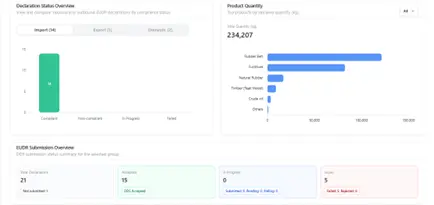
Among timber processors that approached TraceX in the run-up to the EUDR deadline, roughly — at least one of the four red flags above in their last twelve months of records — almost always because production and procurement systems were not talking to each other. The fix is not more spreadsheets. It is a single chain-of-custody layer sitting between them.
Learn how interoperable systems help organizations connect suppliers, traceability data, geospatial information, and compliance workflows to create a seamless, audit-ready EUDR ecosystem.
Read the full blog on Interoperability in EUDR →
If you are receiving logs, doing minimal processing, and the product placed on the EU market is essentially the same regulated product covered by the supplier’s DDS and you are not the one placing it on the market you may rely on the upstream DDS reference. The keyword is ‘may’. Risk is yours to assess.
In practice, most sawmills exporting to the EU end up needing to generate their own DDS workflow not because they doubt their suppliers, but because the transformation event itself creates a new product and a new operator obligation.
Learn the step-by-step process for preparing and filing a DDS, the data required, common mistakes to avoid, and how organizations can streamline submissions through digital compliance workflows.
Read the full blog on How to File a DDS Under EUDR →
Manual systems fail at timber scale. A mid-size processor working with 50 suppliers, 800 forest plots, and 200 production batches a year is generating somewhere north of 40,000 traceability data points annually. That is a spreadsheet problem until the day it isn’t — usually the day an auditor asks for a specific batch from eight months ago.
A purpose-built EUDR platform — and this is exactly the work the TraceX EUDR Compliance Platform was built for — closes the gap across six functions:
Compliance data that does not flow into the production system is compliance theatre. TraceX integrates with SAP, Microsoft Dynamics, Oracle, and COMARCH — the four platforms most commonly seen in mid-to-large timber processors — so the production batch in your ERP carries the upstream chain-of-custody identifiers automatically, and shipment-level DDS generation happens without manual re-keying.
A timber company is EUDR-ready when, for any cubic metre on any shipping manifest, it can produce in under five minutes:
EUDR Compliance Doesn’t End at the Forest — It Must Survive the Mill
For sawmills and timber processors, the true test of EUDR compliance begins once logs enter production. Collecting geolocation data and supplier DDS references is only the starting point. The real challenge lies in maintaining traceability as timber is transformed into lumber, batches are combined, volumes are reconciled, and products move toward domestic and international markets.
Organizations that can successfully connect forest plots, harvesting records, log inventories, production batches, and finished lumber shipments will be best positioned to demonstrate compliance, withstand audits, and protect market access. As regulatory scrutiny increases, traceability can no longer be treated as a documentation exercise—it must become an operational capability embedded across sourcing, production, and supply chain workflows.
In the EUDR era, competitive advantage will belong to timber companies that can prove the journey of every piece of lumber from forest origin to final customer with confidence, accuracy, and audit-ready evidence.
EUDR applies to relevant commodities and products placed on the EU market or exported from it after the relevant compliance date 30 December 2026 for large operators and traders, 30 June 2027 for SMEs. Wood harvested before EUDR entered into force has limited transitional treatment, but processed products entering the market after the deadline are in scope regardless of when the underlying log was felled.
Not when the sawmill transforms the wood into a new product or is the operator placing the finished product on the EU market. In those cases the sawmill must conduct its own due diligence and lodge its own DDS, even where it cites upstream DDS references. Pure traders moving the same product unchanged can rely on prior DDS, with risk assessment obligations.
For plots above 4 hectares, EUDR requires polygon coordinates that accurately describe the perimeter of the harvest area. Point coordinates are only acceptable for plots up to 4 hectares. Polygons are validated against the Joint Research Centre and Hansen deforestation datasets, so loose or inaccurate boundaries can trigger automated risk flags.
Volume reconciliation is the demonstrable balance between logs received, yields produced, transformation losses, and finished products shipped across a defined time window. Auditors use it to detect impossible yields, duplicate DDS declarations, or volumes that exceed what the named forest plots can physically supply. It is one of the fastest ways non-compliance gets surfaced.
Operators and traders must keep all due diligence documentation supplier data, geolocation, DDS references, risk assessments, mitigation measures for at least five years from the date the product was placed on or exported from the EU market. Records must be available to competent authorities on request, in a format that supports verification.