Quick summary: Supplier Data Collection in EUDR for the Coffee Supply Chain in Norway: understand data responsibilities, mandatory supplier information, common data gaps, and how Norwegian coffee roasters, traders, and exporters can support EUDR compliance for EU market access without disrupting exports.
Supplier Data Collection in EUDR for Coffee in Norway has rapidly become a critical compliance challenge for Norwegian coffee companies even though Norway is not an EU member state. As a close trading partner of the EU and part of the European Economic Area (EEA), Norway’s coffee supply chains are tightly linked to EU markets, placing Norwegian exporters, roasters, and traders directly within the operational reach of the EU Deforestation Regulation (EUDR).
Norway is not just a coffee-consuming country. It is an important import, roasting, and distribution base, with Norwegian companies sourcing green coffee globally and selling finished coffee into EU markets either directly or through EU-based partners. When Norwegian businesses place coffee on the EU market or act as upstream suppliers to EU operators, EUDR compliance becomes unavoidable, with supplier data quality determining whether coffee can legally be sold.
If your business sources, trades, or sells coffee from Norway into the EU, mastering Supplier Data Collection in EUDR for Coffee in Norway is no longer optional it is the foundation for protecting EU market access and commercial continuity.
Read the complete EUDR guide to clearly understand your obligations, required supplier data, and the due-diligence steps needed to stay compliant.
EUDR is an EU regulation that requires coffee placed on the EU market to be proven deforestation-free and legally produced. While Norway is not an EU member state, the regulation is highly relevant to Norwegian coffee companies because EUDR applies at the point where coffee enters or circulates within the EU market and Norwegian businesses are often directly involved in that process.
Norway is not only a coffee-consuming country. It is a significant roasting, branding, and export base, with Norwegian companies importing green coffee, adding value domestically, and selling finished coffee into EU markets. When Norwegian roasters, traders, or brand owners sell coffee directly to EU buyers or act as upstream suppliers to EU operators EUDR compliance becomes unavoidable.
Under EUDR, EU operators must prove using supplier- and farm-level data that coffee is not linked to deforestation. If Norwegian suppliers cannot provide this data, EU buyers may be unable to submit a valid Due Diligence Statement (DDS), leading to blocked sales, rejected shipments, or contractual termination.
Norway’s coffee supply chain imports green coffee primarily from Brazil, Colombia, Guatemala, Peru, and Kenya, with the green coffee market valued at $127M in 2024 (down 7.6% YoY after peaking at $163M). Total coffee/tea/spices imports reached $294M in 2024, reflecting Norway’s high per capita consumption (approximately 10kg/person annually).
EUDR applies to coffee in both green and roasted forms. To legally place coffee on the EU market, companies must:
For coffee, compliance depends entirely on supplier-level data, including:
No data = no EU market access.
Norway plays a distinct but highly exposed role in Europe’s coffee supply chain:
Because many Norwegian companies sell directly into the EU, they are either the first economic actor placing coffee on the EU market, or a critical upstream supplier without whom EU operators cannot comply.
In both cases, Norwegian companies become central to EUDR compliance even if customs clearance happens inside the EU.
In practice, this gives Norway high indirect EUDR exposure. While the country may not function as a major import gateway like the Netherlands, Norwegian coffee companies often control sourcing decisions, supplier relationships, and data quality which are the determining factors for EUDR approval.
For Norwegian coffee companies, supplier data collection is not a back-office task. It is the core dependency that determines whether coffee can legally be sold into EU markets under EUDR.
If supplier data is incomplete, inconsistent, or cannot be verified, the consequences under EUDR are immediate and commercially material for Norwegian coffee companies supplying the EU.
Key impacts include:
In practice, a single missing farm geolocation, unclear plot boundary, or inconsistent supplier record can block an entire shipment even when the coffee is roasted in Norway and destined for an EU retailer.
Because Norwegian companies often sit upstream of EU operators, supplier data gaps in Norway quickly become market-access failures in the EU.
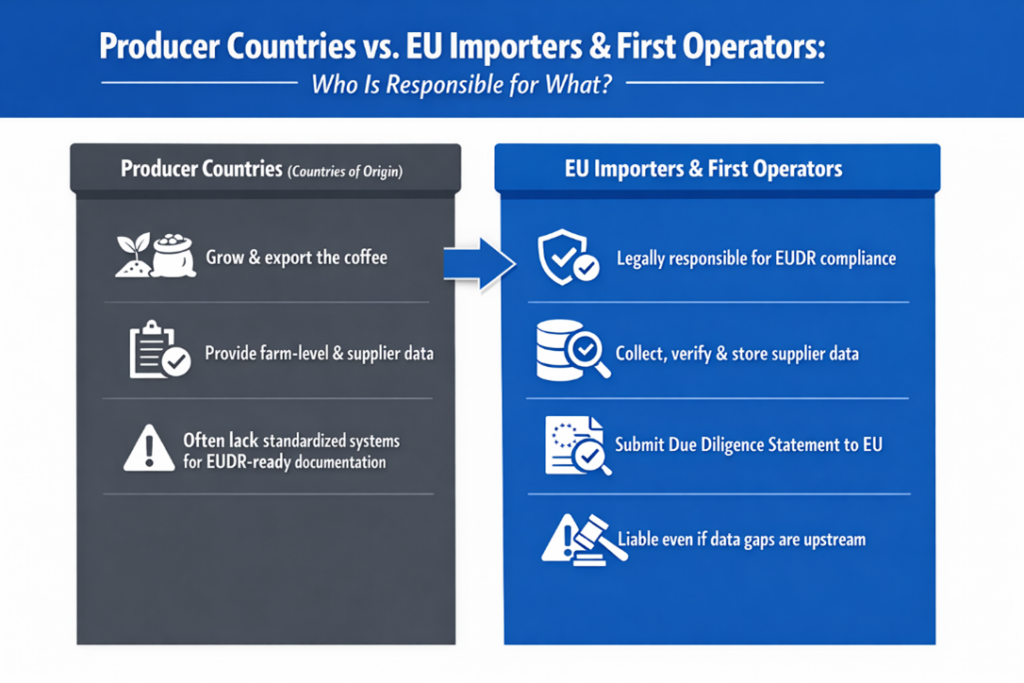
Under EUDR, any Norwegian company that sells coffee into the EU or supplies EU operators depends on complete, verifiable supplier data, even if the legal obligation to submit the DDS rests with an EU-based buyer.
Below is a role-by-role breakdown for the Norwegian coffee supply chain.
Norwegian roasters face high EUDR exposure when they export roasted coffee into EU markets.
If you import green coffee into Norway, roast or process coffee domestically, and sell roasted coffee to EU buyers, you must ensure:
Roasting does not reduce EUDR responsibility. In many cases, it increases scrutiny because Norwegian brands are visible and contractually accountable to EU buyers.
Norwegian traders and exporters supplying coffee into the EU act as critical upstream data providers.
Even when the EU buyer submits the DDS, Norwegian exporters must:
If data is missing or unverifiable, EU operators may legally refuse the shipment, regardless of commercial agreements.
In cases where Norwegian companies import coffee into the EU through EU-based subsidiaries or logistics partners, they may become first operators under EUDR.
In these cases, they must:
Legal responsibility cannot be outsourced even if data is collected upstream.
Norwegian companies buying or reselling coffee that has already been placed on the EU market are considered downstream operators.
They do not submit a new DDS if:
However, they must still:
If the DDS is missing, invalid, or unverifiable, liability and operational risk can shift downstream rapidly.
This distinction is often misunderstood by non-EU companies.
Legal Responsibility
Lies with the EU operator placing coffee on the EU market. Includes liability for false, missing, or misleading data.
Data Dependency
Applies to every actor in the supply chain. Norwegian roasters and traders often control sourcing and data quality. A single upstream data gap in Norway can block EU sales entirely.
In practice: You may not submit the DDS but you determine whether it can be submitted at all.
For coffee supplied from Norway into the EU, the following data is non-negotiable.
Missing even one element can invalidate a DDS, delay or block EU sales, and trigger audits and commercial disputes.
No data = no EU market access.
| Compliance Pillar | Key Data Points Required | Critical ‘Why’ for Audits |
|---|---|---|
| 1. Supplier Identity and KYC | Full Legal Name and Reg. Number; Physical Address; Country of Production (Origin); Role: Farmer vs. Coop vs. Exporter | Links coffee to a responsible economic actor. Shipments without a verified actor are non-compliant by default. |
| 2. Geolocation and Plot Data | GeoJSON Polygons (Mandatory for plots over 4ha); GPS Center Points (Allowed for plots under 4ha); Defined plot boundaries | Polygons are the only way to cross-reference satellite imagery to prove no deforestation occurred after 31 Dec 2020. |
| 3. Harvest and Production | Harvest Year/Production Period; Exact Volume per Plot/Coop; Traceability to Batch/Lot Number | Prevents ‘laundering’ by ensuring volumes are realistic relative to farm size and regional crop calendars. |
| 4. Legality and Compliance | Land-use legality proof; Local permits/registrations; Producer Declarations (Self-Attest) | Proves coffee wasn’t just deforestation-free but also produced in line with local environmental and labour laws. |
Even highly advanced coffee roasters, traders, and brand owners in Norway are facing EUDR challenges not because of weak intent, but because coffee supply chains were never built for plot-level legal verification. In practice, most EUDR-related disruptions affecting Norwegian companies supplying the EU can be traced to the same recurring supplier data gaps.
Coffee sourced by Norwegian companies typically comes from hundreds or thousands of smallholder farmers, cooperatives with frequently changing membership, and exporters aggregating coffee from multiple informal producer networks.
The challenge is that farms are small, geographically dispersed, and evolve over time. Cooperative membership lists are often incomplete or outdated. A single roasted coffee SKU sold into the EU may represent coffee from dozens of farms.
For Norwegian roasters and traders supplying multiple EU buyers, this fragmentation makes consistent farm-level data collection extremely difficult, especially when sourcing decisions are made months before EU sales.
Despite Norway’s advanced downstream operations, much upstream supplier data still exists as handwritten farm records, paper delivery notes and cooperative logs, and local spreadsheets with no standardized structure.
Paper records cannot be reliably validated or audited. Data is often outdated, incomplete, or inconsistent. Manual digitization introduces delays and transcription errors.
EUDR requires digital, structured, and verifiable data. Paper-based systems break quickly when Norwegian companies must support EU buyers filing Due Diligence Statements (DDS).
Geolocation data provided to Norwegian roasters and traders often includes single GPS points instead of farm or plot polygons, mixed coordinate formats (decimal vs degrees/minutes/seconds), and low-accuracy or unverified coordinates.
EU authorities cannot reliably assess deforestation risk. Satellite checks return false positives or inconclusive results. DDS submissions are delayed or rejected by EU operators.
Inconsistent or low-quality geolocation data is one of the fastest paths to EU buyer rejection for Norwegian-supplied coffee.
Supplier documentation frequently arrives in local languages without certified translation, using land-tenure terms unfamiliar to EU authorities, and with inconsistent naming across farms, cooperatives, and exporters.
This results in unclear land-use or ownership status, weak linkage between farms, cooperatives, and shipments, and increased friction during audits and buyer due diligence.
Under EUDR, ambiguity itself is a compliance risk, even when coffee is responsibly sourced.
Aggregation is common in Norwegian sourcing models but risky under EUDR. Typical issues include coffee from multiple farms mixed without volume attribution, cooperative-level declarations replacing farm-level evidence, and batches not traceable back to specific plots.
Once the link between farm, plot, volume, and shipment is broken, EUDR compliance cannot be demonstrated, regardless of sustainability claims or commercial contracts.
For coffee companies in Norway, EUDR compliance is not about collecting more data it’s about collecting the right data, in the right sequence, from the right actors. Below is a practical, job-to-be-done framework used by Norwegian roasters, traders, and brand owners supplying the EU.
Start by identifying EUDR-relevant suppliers, not your entire supplier base.
Actions:
Segment suppliers by risk and volume:
Outcome: Compliance efforts are focused where EU market-access risk is highest, not diluted across low-risk suppliers.
Unstructured supplier data is the biggest bottleneck for Norwegian companies supporting EU DDS filings.
Best practice includes:
Critical point: If your data framework does not map exactly to DDS requirements, delays and rework are inevitable.
Data collection without validation does not equal compliance.
Key validation steps:
High-risk suppliers should be flagged before commercial contracts are finalized, given remediation timelines, and replaced if risk cannot be reduced.
Outcome: DDS failures are prevented upstream, not discovered by EU buyers or authorities.
TraceX EUDR Compliance Solutions help Norwegian coffee companies move from fragmented, high-risk supplier data to EU-ready, DDS-compliant workflows.
Through digital supplier onboarding, TraceX captures KYC information and required documents directly from farmers, cooperatives, and exporters reducing back-and-forth and data loss. Farms and plots are mapped using GPS-verified polygon capture, while AI-driven geolocation validation flags inaccuracies and deforestation-risk overlaps early. Automated, EUDR-aligned risk scoring enables Norwegian teams to prioritize remediation before coffee is sold into EU markets. All data is structured to be DDS- and TRACES-ready and integrates with the ERP systems commonly used by Norwegian roasters and exporters.
For Norwegian coffee companies, TraceX transforms supplier data collection from a compliance bottleneck into a scalable, audit-ready operating model.
Supplier Data Collection in EUDR for the Coffee Supply Chain in Norway is no longer a back-office task it is the gatekeeper to EU market access. While Norway is not an EU entry port, Norwegian roasters, traders, and brand owners often control the data EU operators depend on to file valid DDS submissions.
Companies that succeed will treat supplier data as a structured, verifiable asset: mapping and prioritizing suppliers, standardizing collection, validating geolocation and legality, and resolving risk before coffee is sold into the EU. Those that don’t will face buyer refusals, DDS failures, and commercial disruption.
In short, mastering supplier data collection is how Norwegian coffee companies protect continuity, credibility, and long-term access to EU markets under EUDR.
Read our blog on EUDR Compliance for Coffee Supply Chains to see how importer, roaster, and trader responsibilities connect and where most compliance failures happen.
Explore our guide on EUDR for Operators and Traders to understand legal responsibility, DDS handover, and what checks you must perform before buying or selling coffee in the EU.
Dive into our practical breakdown of EUDR Due Diligence, including required data, risk assessment steps, and how to avoid delays at customs.
Norwegian companies supplying coffee into the EU must collect and provide supplier identification (KYC), farm- or plot-level geolocation (preferably polygons), harvest year, supplied volumes, traceability to batches or lots, and proof of legal production. Without this data, EU operators cannot submit a valid Due Diligence Statement (DDS), and the coffee cannot be legally placed on the EU market.
Yes, if the roaster sells coffee into the EU and acts as an upstream operator or data provider. Norwegian roasters importing green coffee directly must hold verified farm- or plot-level geolocation data. If coffee has already been placed on the EU market, roasters must retain a valid DDS reference and maintain traceability records.
Yes, and digital submission is strongly recommended. Farmers, cooperatives, and exporters can provide EUDR data through digital questionnaires, GPS-based farm-mapping tools, or traceability platforms. Digital data is faster to validate and significantly reduces DDS rejection risk for EU buyers relying on Norwegian suppliers.
While legal retention obligations apply to EU operators, Norwegian companies are typically required by contractual and audit expectations to retain EUDR-related supplier and traceability data for at least five years, so it can be provided to EU buyers or competent authorities upon request.
If supplier data changes such as new plots, updated geolocation, ownership changes, or volume adjustments the risk assessment must be updated. Material changes may require EU operators to submit a new or revised DDS before coffee linked to the updated data can be placed on or traded within the EU market.