
Quick summary: Supplier Data Collection in EUDR for the Packaging Industry in Germany: understand legal responsibilities, mandatory supplier data, common compliance risks, and how German packaging manufacturers, converters, and importers can meet EUDR requirements without disrupting production or EU market access.

Supplier Data Collection in EUDR for the Packaging Industry in Germany has become a critical compliance priority for packaging manufacturers, converters, FMCG suppliers, and industrial packaging producers. While Germany is not primarily an import gateway like the Netherlands, it is Europe’s largest manufacturing economy and a major consumer and producer of packaging materials derived from paper, pulp, and wood.
Germany plays a central role in transforming imported and domestically sourced raw materials into flexible and rigid packaging materials, cardboard and corrugated packaging, food and FMCG packaging solutions, labeling and printed packaging components, and industrial and protective packaging.
Because of this strong downstream manufacturing ecosystem, German packaging companies are often operators placing packaging products on the EU market, making EUDR compliance legally binding at the point of production and commercialization.
For Germany’s packaging sector, EUDR compliance is not about port-level checks it is about end-to-end supply chain transparency from forest to packaged product.
The EU Deforestation Regulation (EUDR) requires that all wood-based packaging materials placed on the EU market must be deforestation-free, legally produced, and supported by a Due Diligence Statement (DDS).
In Germany, EUDR obligations apply to packaging manufacturers, FMCG packaging suppliers, labeling and printing companies, distributors placing packaging products on the EU market, and industrial users of paper and pulp-based packaging.
Germany’s packaging supply chain is both domestic and import-dependent, sourcing raw materials from EU forests as well as global suppliers in regions such as Brazil, Indonesia, Canada, and Northern Europe.
Even when raw materials enter the EU through other countries, German packaging companies placing finished goods on the market may still qualify as operators under EUDR.
Compliance responsibility cannot be outsourced even when sourcing is managed by intermediaries or mills.
German packaging companies placing wood-based packaging products on the EU market must prove materials are not linked to deforestation after 31 December 2020, demonstrate compliance with local forestry laws in origin countries, and submit a Due Diligence Statement (DDS) before commercialization.
Failure to comply can result in blocked packaging product sales, financial penalties (up to at least 4% of EU turnover), product confiscation, public enforcement notices, and reputational damage across retail and FMCG ecosystems.
For Germany’s packaging industry deeply embedded in consumer supply chains non-compliance impacts not just operations, but brand trust and retailer relationships.
Germany’s packaging sector faces a core challenge: upstream forest visibility.
Packaging companies must collect supplier-level data across complex forestry supply chains spanning Brazil, Indonesia, Finland, Sweden, Canada, and Baltic countries.
Required data includes polygon-level geolocation of forest plots, country and region of harvest, tree species and harvesting timelines, volume traceability linking raw materials to packaging outputs, risk assessment documentation, and risk mitigation evidence.
Because packaging production often involves fiber aggregation and multi-source inputs, traceability becomes significantly more complex.
No verified geolocation data = no compliant packaging product.
Germany’s risk profile is different from logistics hubs. Its exposure comes from being Europe’s largest packaging and FMCG supply base, high demand for sustainable packaging, strong manufacturing ecosystem, strict regulatory enforcement, and high ESG expectations from retailers and consumers.
Unlike import hubs, Germany’s EUDR risk is embedded in manufacturing and product placement. Compliance is enforced at the packaging product level not just raw materials.
For packaging manufacturers and suppliers, supplier data collection under EUDR is no longer a compliance checkbox it is a core operational capability.
Key priorities include digitizing supplier onboarding, mapping forest plots at polygon level, implementing risk-based sourcing frameworks, ensuring batch-level traceability, and maintaining audit-ready documentation.
Given the packaging sector’s integration with retail, FMCG, and exports, compliance failures can cascade across entire value chains.
For German packaging companies, EUDR compliance requires upstream data transparency, structured risk assessment workflows, cross-border supplier coordination, and integration across procurement, sustainability, and compliance teams.
Supplier data collection is no longer administrative. It is strategic risk management that determines market access.
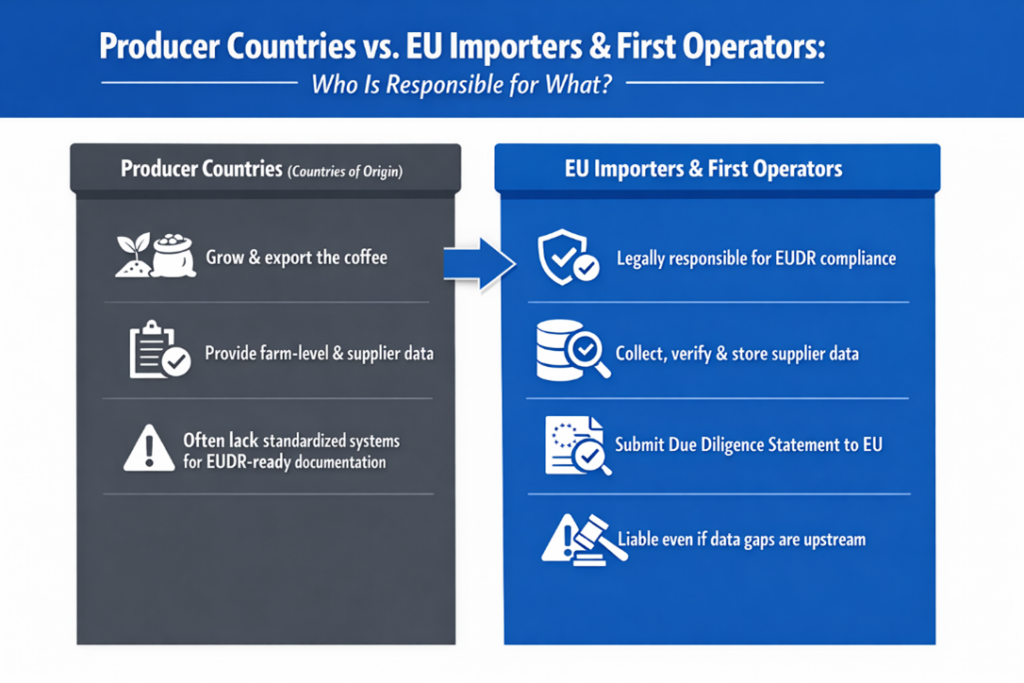
If supplier data for packaging materials is incomplete, inconsistent, or unverifiable, the consequences under EUDR are immediate and commercially significant for German packaging operators.
In Germany’s packaging ecosystem where materials flow directly into food, retail, and consumer goods supply chains a single missing forest polygon, unverifiable geolocation, or incomplete supplier dataset can halt commercialization of finished packaging products.
Unlike port-based disruption, Germany’s exposure lies in manufacturing and product placement. If packaging inputs are non-compliant, the final packaging cannot legally enter the EU market.
For Germany’s FMCG and retail packaging ecosystem, compliance failures cascade across converters, brands, retailers, and export commitments.
Under EUDR, any company in Germany that places wood-based packaging products on the EU market must ensure supplier data is complete, verifiable, and linked to a valid DDS even if the data originates upstream.
German packaging manufacturers producing cartons, corrugated packaging, labels, or paper-based packaging may qualify as operators under EUDR.
Responsibilities include ensuring forest-level polygon geolocation exists, verifying deforestation-free status post-31 December 2020, conducting documented risk assessments, submitting a Due Diligence Statement (DDS), and maintaining traceability from raw fiber to finished packaging.
Because packaging production involves processing and transformation, traceability must be preserved throughout manufacturing.
Companies producing FMCG packaging, food-grade packaging, industrial and protective packaging, and labels and printed packaging may become operators if they import directly or place products on the EU market for the first time.
They must ensure fiber inputs are traceable to forest polygons, risk assessments are documented, and DDS submissions are completed before commercialization.
Failure to validate upstream supplier data can prevent packaging products from being legally marketed.
If a German company imports packaging materials, pulp, or timber directly, it becomes a first operator under EUDR.
Responsibilities include collecting supplier and forest data, validating geolocation and deforestation status, conducting structured risk assessment, and submitting DDS before market placement.
Legal liability remains with the importer even if suppliers provide data.
If you import packaging materials, you are a first operator. If you trade packaging already placed on the EU market, you are a downstream operator.
Responsibilities include verifying DDS references, maintaining traceability to compliant batches, retaining transaction and supplier records, and passing DDS references to buyers.
Trading packaging without valid DDS references exposes companies to audit and commercial risk.
Companies using packaging materials may qualify as downstream operators. They must verify DDS references, maintain audit documentation, and ensure traceability is preserved.
If DDS is missing or invalid, shipments may be rejected, contracts may be disrupted, and regulatory exposure increases.
Legal Responsibility
Lies with the first operator placing packaging products on the EU market. Includes liability for incorrect supplier data.
Operational Exposure
Affects packaging manufacturers, FMCG brands, retailers, and distributors. Even without filing DDS, they depend on upstream data integrity. Missing data can halt packaging supply and product launches.
In Germany’s packaging sector: even if you are not the importer, if you place packaging on the market, compliance exposure sits with you.
For packaging products placed on the EU market, the following supplier data is mandatory: polygon-level geolocation of forest plots, country and region of harvest, tree species and production details, harvest timelines, volume traceability linking raw materials to packaging outputs, risk assessment documentation, and risk mitigation evidence.
If even one of these elements is missing or unverifiable, the DDS may be invalid preventing legal commercialization of packaging products in the EU.
In Germany’s packaging industry, supplier data is not just compliance it directly determines whether your packaging can reach the market or not.
| Compliance Pillar | Key Data Points Required | Critical “Why” for Audits |
|---|---|---|
| 1. Product Scope and HS Classification | HS Codes (e.g., 4819, 4415, 4823); Functional Use Declaration; Virgin vs. Recycled Fiber Ratio; Commodity Link (Wood/Rubber) | Auditors first check “Essential Character.” If the packaging is sold separately (e.g., gift boxes, empty pallets), it is a “relevant product.” If it’s just a transport shell for electronics, it may be exempt. |
| 2. Geolocation and First-Mile Traceability | GeoJSON Polygons (over 4ha); GPS Center Points (under 4ha); Date of Production/Harvest; Satellite Proof (No clearing post-2020) | Packaging often uses “Short-Rotation” wood or bamboo. Auditors use Geolocation to ensure that fast-growing plantations haven’t replaced natural forests after the December 31, 2020 cutoff. |
| 3. Composite and Material Mixing | Pulp Source Origin; Adhesives/Liners Origin (if rubber-based); Batch ID for Master Rolls; Segregation Certificates | Corrugated board is a Composite. If a box uses a virgin liner and a recycled medium, the virgin portion must be traced back to the specific plot. Auditors look for “Anti-Contamination” protocols in the mill. |
| 4. Legality and Supplier KYC | Harvesting Permits; Environmental Impact Assessments; Supplier EORI and VAT Numbers; Labor Standards Declaration | Packaging supply chains are notoriously fragmented. Auditors focus on Dealer KYC to ensure that fiber aggregators aren’t sourcing from illegal land-clearance sites and “blending” them into the mill supply. |
Even the most advanced packaging manufacturers, converters, and FMCG packaging suppliers in Germany are facing EUDR compliance challenges because global forestry supply chains were never built for plot-level traceability and regulatory verification.
In practice, most DDS failures affecting packaging materials can be traced back to recurring supplier data weaknesses.
Packaging materials used in Germany often originate from small and medium-sized forest holdings, state-managed and private forests, multiple harvesting contractors, multi-tier supplier networks, and mixed fiber aggregation across mills.
Common issues include inconsistent forest plot identifiers, limited visibility into subcontracted harvesting, fiber mixing across regions and suppliers, and difficulty linking raw materials to specific forest plots.
For German packaging companies, this fragmentation creates upstream data instability, making it difficult to validate compliance for finished packaging products. A single packaging batch may trace back to multiple forest plots each requiring verified geolocation and legality documentation.
While Germany’s packaging industry is highly digitized, upstream forestry data often remains paper-based harvesting permits, manual logging records, non-standardized supplier documentation, and local spreadsheets managed by forest operators or mills.
EUDR requires digitally structured, geospatially validated data. Legacy systems do not integrate with packaging companies’ ERP, procurement, or compliance systems creating a disconnect between origin data and regulatory requirements.
Common issues include point coordinates instead of polygon boundaries, incomplete or partially mapped forest plots, overlapping or duplicated geolocation data, coordinates outside valid forestry zones, and missing harvest timestamps.
Consequences include satellite verification failing or flagging high risk, risk assessments becoming unreliable, and DDS submissions being delayed or rejected.
For packaging companies, poor geolocation data can block finished packaging products from entering the EU market. Polygon-level mapping is no longer optional it is foundational.
Supplier documentation often arrives in local languages without certified translation, with inconsistent naming conventions, without standardized legal declarations, and using classifications unfamiliar to EU regulators.
Under EUDR, unclear legality equals compliance risk. For Germany’s packaging sector closely tied to FMCG and retail this increases exposure during audits and regulatory inspections.
Aggregation is inherent to packaging production but introduces structural risk.
If the link between forest plot, polygon, harvested volume, pulp, and packaging product is broken, compliance cannot be demonstrated.
forest plot – polygon – harvested volume – pulp – packaging product
For packaging manufacturers processing high volumes of mixed fiber inputs, reconstructing traceability becomes extremely complex. Traceability must survive conversion, processing, and packaging production.
EUDR compliance is not about collecting more data it’s about collecting validated, production-linked, DDS-ready data.
Actions:
Segment suppliers by volume contribution, country-level deforestation risk, data maturity, and aggregation complexity.
Prioritization: high volume + high risk requires immediate verification; high volume + moderate risk requires structured validation; low volume + high risk requires remediation or replacement.
Compliance must begin before materials enter packaging production.
Best practices:
Key principle: If supplier data does not map directly to DDS requirements, commercialization will be delayed.
Germany’s packaging industry requires precision-driven compliance systems.
Validation must include:
Geolocation Verification: polygon completeness and accuracy, alignment with forestry zones, satellite validation.
Deforestation Risk Checks: post-2020 compliance, land-use history, proximity to high-risk areas.
Supplier Risk Scoring: data completeness, geographic exposure, aggregation complexity, traceability strength.
High-risk suppliers should be flagged before procurement, assigned remediation timelines, and replaced if mitigation fails.
DDS failures must be prevented before packaging products are placed on the market.
TraceX EUDR Solution enables packaging companies to move from fragmented supplier data to structured, production-ready compliance:
For Germany’s packaging sector, TraceX transforms compliance into a scalable, integrated system ensuring uninterrupted production and EU market access.
Supplier data collection is no longer an upstream task it determines whether packaging products can be legally sold in the EU.
Germany’s exposure lies at the product and manufacturing level, not just imports.
Companies that digitize supplier onboarding, implement polygon-level validation, and embed risk assessment into procurement will maintain uninterrupted market access.
Those relying on fragmented data will face DDS rejections, production delays, retail and FMCG disruptions, and regulatory scrutiny.