
Quick summary: EUDR wood compliance is now mandatory for EU importers. Discover the tools, steps, and data requirements to submit a valid DDS and protect your market access.
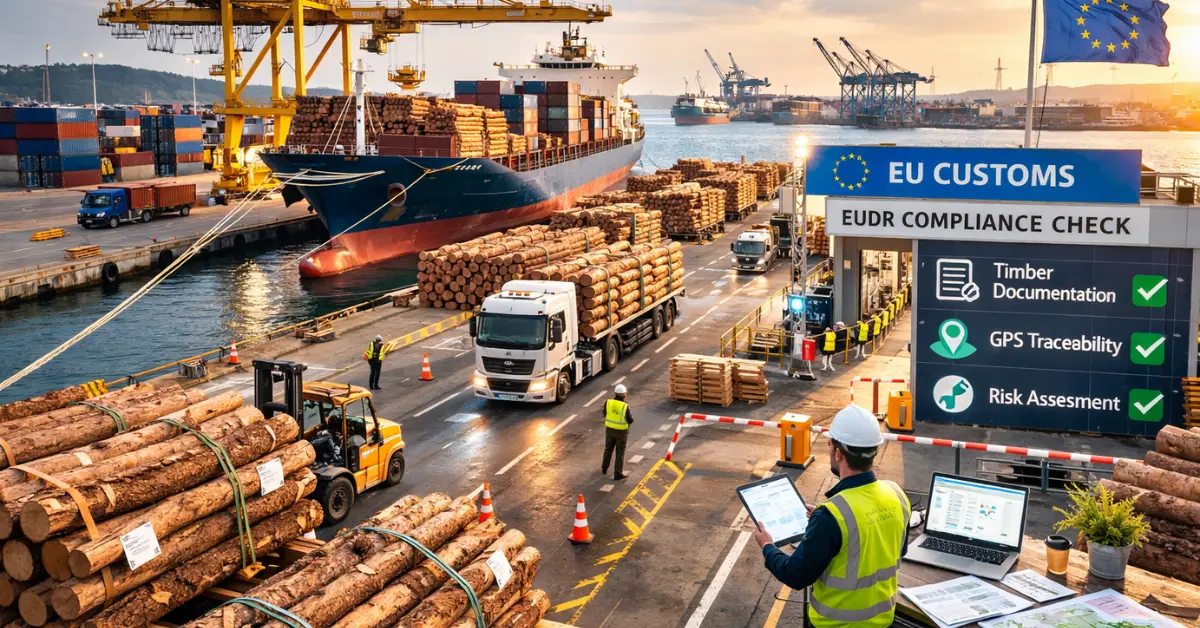
An EUDR wood compliance tool for importers gives them the ability to collect geolocation data from forest plots, conduct automated risk assessments, generate Due Diligence Statements, and submit them directly to the EU TRACES system all from a single platform. Without this infrastructure, importers face the near-impossible task of manually sourcing GPS coordinates and legal documentation from thousands of forest parcels across multiple countries, then compiling them into a legally defensible DDS before each shipment crosses an EU border.
Your timber shipment is at the port. The customs officer asks for your Due Diligence Statement. You open your laptop and stare at a spreadsheet with 847 rows, partial GPS coordinates, and a column labeled ‘check with supplier.’
That scenario isn’t hypothetical. For thousands of wood importers across India, Southeast Asia, and Africa, it’s a compliance crisis waiting to happen. The EU Deforestation Regulation (EUDR) doesn’t accept good intentions. It requires data specific, verifiable, geolocated data before your product can legally enter the EU market.
This guide walks you through exactly what EUDR requires for wood and timber importers, what a purpose-built compliance tool must do, and how to build a readiness posture that survives a customs inspection.
TL;DR: Wood and timber importers placing products on the EU market must comply with EUDR by submitting a Due Diligence Statement (DDS) proving deforestation-free sourcing. Non-compliance risks fines of up to 4% of annual EU turnover. The right EUDR compliance tool automates GPS plot mapping, DDS generation, risk scoring, and TRACES submission eliminating the manual data nightmare for complex timber supply chains.
Don’t leave compliance to chance.
Miss one data point and your DDS gets rejected. Download the EUDR Checklist Now.
The EU Deforestation Regulation (Regulation EU 2023/1115) came into force on June 29, 2023, with the original enforcement deadline set for December 30, 2024 for large operators and June 30, 2025 for SMEs. Following industry feedback, the European Commission extended the deadline to December 30, 2025 for large operators and June 30, 2026 for SMEs giving importers a final window to build compliant infrastructure.
EUDR targets seven commodity categories whose production is historically linked to global deforestation: cattle, cocoa, coffee, palm oil, soya, wood, and rubber. For wood importers specifically, the regulation covers not just raw timber but any product that contains, has been fed, or has been made using wood harvested from deforested land after December 31, 2020.
The core logic is simple: if you can’t prove your wood didn’t contribute to deforestation, you can’t sell it in the EU. What’s complex is the evidence chain required to prove it and that’s where most importers are underprepared.
Unlike FSC or PEFC certification (which assess forest management practices), EUDR requires plot-level geolocation data for every forest parcel contributing to a shipment. Certification alone is not sufficient for EUDR compliance a critical gap that most competing articles fail to clarify.
EUDR’s scope for wood products is deliberately broad. It covers timber at every stage of the value chain from raw logs to finished furniture as long as that product contains wood. The relevant HS codes include lumber, plywood, particleboard, wood pulp, paper, paperboard, printed products, and wood-derived packaging materials.
A key implication: importers of downstream product furniture manufacturers, paper distributors, packaging companies are also in scope. This is not just a problem for raw timber traders. Any business whose product bill of materials includes wood from a deforestation-risk country must comply.
Paper and printing companies are among the least-prepared sectors for EUDR. Most compliance tooling has been built for coffee/cocoa supply chains. A dedicated EUDR wood compliance tool must be configured to handle multi-tier, processed wood product traceability not just farm-level geolocation.
EUDR is not just regulation it’s a system you must navigate flawlessly. Download the Complete EUDR Compliance Guide.
EUDR compliance is built around three interlocking obligations: collect the right data, conduct a risk assessment, and submit a Due Diligence Statement (DDS) before placing the product on the EU market. The process sounds linear; in practice, it’s data-intensive.
Every shipment of EUDR-regulated wood products placed on the EU market requires a DDS submitted through the EU TRACES NT system. The DDS must include the product’s HS code and trade name, the quantity and unit of measure, the country of production, the geolocation coordinates of every forest plot from which the wood originates, and a statement that the operator has conducted due diligence showing zero deforestation risk.
This is the single most operationally challenging element of EUDR compliance. For timber supply chains operating across fragmented smallholder forests in Indonesia, Malaysia, Brazil, or the Congo Basin, collecting plot-level GPS polygon data at scale is not a paperwork exercise it’s a field data collection programme.
Importers working with 50 suppliers each managing 20 forest plots are looking at 1,000+ individual geolocation data points that need capturing, validating against satellite deforestation datasets, and refreshing each season. The only scalable way to do this is with a mobile-first, offline-capable data collection tool not a spreadsheet.
Articles on EUDR typically reference geolocation as a ‘requirement’ without explaining what polygon-level precision means in practice. For EUDR, a single GPS point is insufficient the regulation requires plot boundary coordinates forming a closed polygon. This distinction eliminates most generic data collection tools from consideration.
Explore TraceX solutions built for the furniture industry
The EU has been explicit: EUDR is not a guidelines framework. It’s a binding regulation with enforcement teeth. Member states are required to designate competent authorities, conduct regular checks, and impose penalties that are ‘effective, proportionate and dissuasive.’
Up to 4% of annual EU turnover – Maximum fine for EUDR non-compliance (European Commission, 2023)
Beyond financial penalties, non-compliant operators face confiscation of the products and revenues derived from the transaction, temporary exclusion from public procurement contracts, and in cases of serious or repeated violation criminal liability under national law.
The practical consequence most importers fear most isn’t the fine. It’s the shipment blockage. A container of timber held at Rotterdam or Hamburg while an authority investigates your DDS submission can cost more in demurrage, customer penalties, and relationship damage than any regulatory fine.
| Violation | Penalty | Who It Applies To |
|---|---|---|
| Non-submission of DDS | Up to 4% of annual EU turnover | All operators placing products on EU market |
| False/incomplete geolocation data | Criminal liability in severe cases | Large operators and EU importers |
| Failure to conduct risk assessment | Product confiscation + fines | Operators across all commodity types |
| Repeated non-compliance | Exclusion from EU public procurement | Any EUDR-regulated operator |
Is Your Wood Import Business EUDR-Ready? Download the TraceX EUDR Readiness Assessment to audit your compliance gaps before enforcement hits.
Not all compliance software is built for the operational reality of timber supply chains. Most EUDR tools were designed around coffee and cocoa commodities with relatively straightforward farm-level traceability. Wood is structurally different: multi-species, multi-country, multi-tier, and often processed through intermediaries who may not have invested in digital documentation.
Here’s what an effective EUDR wood compliance tool must do and where most generic solutions fall short.
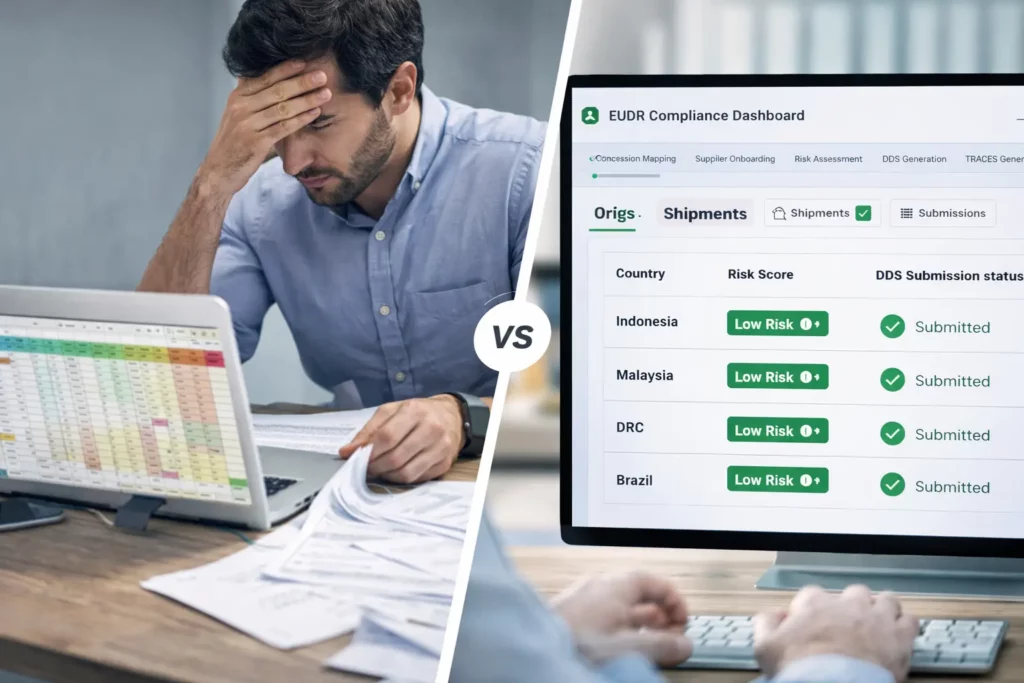
Explore our Wood Compliance Solutions
| Requirement | Manual Process | TraceX EUDR Tool | Risk Without Tool |
|---|---|---|---|
| GPS Plot Mapping | Spreadsheets / paper surveys | Automated polygon capture via mobile app | Geolocation gaps – DDS rejection |
| DDS Generation | Manual data entry, prone to errors | AI auto-generates and submits to TRACES | Non-compliant submissions |
| Deforestation Check | Third-party audits (slow, costly) | Real-time satellite alerts (Sentinel-2) | Shipment blocking at EU border |
| Supplier Document Parsing | Email attachments reviewed manually | Agentic AI extracts KYC + certifications | Incomplete audit trail |
| Risk Scoring | Subjective, inconsistent | Automated risk scoring per supplier/plot | Blind spots in supply chain |
| Audit Readiness | Weeks to compile | One-click PDF/XML/CSV export | Failed compliance audits |
| ERP Integration | Manual re-entry into systems | API-first, plugs into procurement/ERP | Data silos, duplication errors |
TraceX Technologies builds its EUDR Compliance Solutions specifically for the supply chain realities facing exporters in India, Southeast Asia, and Africa the primary sourcing regions for EU-bound timber. The platform addresses the five hardest operational problems in wood EUDR compliance.
TraceX’s offline-first mobile app allows forest agents to capture GPS polygon boundaries, record plot ownership documentation, and log harvest data in areas with zero connectivity. Data syncs automatically when internet is restored.
TraceX’s agentic AI reads supplier documents concession permits, land certificates, KYC files directly from email attachments and procurement systems, auto-populates the DDS data fields, and submits to the EU TRACES system via direct API integration. Manual DDS creation is eliminated.
Every forest plot in the TraceX system is automatically cross-referenced against Sentinel-2 satellite imagery and the Hansen Global Forest Watch dataset. Importers receive real-time deforestation alerts if a sourcing plot shows forest loss before a shipment is dispatched.

Every data transaction from plot registration to DDS submission is recorded on an immutable blockchain layer. This gives customs authorities and EU buyers a tamper-proof audit trail, materially reducing the risk of a shipment investigation.
TraceX is API-first. It connects directly to existing procurement and ERP systems, meaning importers don’t create a compliance silo EUDR data lives inside their existing operational infrastructure.
Most EUDR compliance tools were designed for Western enterprise buyers who push compliance requirements upstream to producers. TraceX is built in the opposite direction starting from the smallholder and producer level in emerging markets, then aggregating data upward to importers. This producer-first architecture is structurally more reliable for complex, fragmented timber supply chains.
Use this checklist to assess your current compliance posture before the enforcement deadline. Each pillar maps to a specific tool capability and a specific risk if it’s missing.
| Readiness Pillar | What’s Required | TraceX Feature |
|---|---|---|
| Plot Geolocation | GPS polygon data for every forest plot | Mobile GPS capture – offline-first |
| Supply Chain Mapping | Full chain of custody from forest to gate | Blockchain-backed traceability layer |
| DDS Submission | TRACES-compatible due diligence statements | AI DDS generator + TRACES API integration |
| Risk Assessment | Documented country/operator risk score | Automated risk scoring + satellite alerts |
| Audit Documentation | Exportable records for customs authorities | One-click PDF/XML/CSV audit export |
Most readiness checklists stop at ‘do you have supplier data?’ TraceX-level readiness requires checking whether that data is geolocated, satellite-verified, parsed from legal documents, and connected to a TRACES-submittable DDS. The gap between ‘we have supplier records’ and ‘we’re EUDR compliant’ is where most wood importers currently live.
As EUDR enforcement approaches, wood importers can no longer rely on fragmented documentation or reactive compliance processes. A robust EUDR wood compliance tool is not just a support system it is becoming a strategic necessity for ensuring uninterrupted market access. By combining geolocation traceability, satellite-based deforestation verification, supplier risk scoring, and automated due diligence workflows, importers can transition from manual compliance to scalable, data-driven decision-making.
Early adoption of digital compliance tools enables companies to identify risks before they escalate, strengthen supplier accountability, and confidently submit Due Diligence Statements backed by verifiable evidence. In an increasingly regulated and sustainability-focused market, those who invest in proactive EUDR readiness today will be best positioned to maintain trust, avoid disruptions, and secure long-term access to EU timber markets.
What does wood compliance under EUDR involve? Read here
How do you assess deforestation risk? Find out here
What are the biggest risks in wood sourcing? Read more
Large operators (annual EU turnover above €150M) were required to comply by December 30, 2025 following the Commission’s one-year extension. SMEs (below €150M) have until June 30, 2026. Both deadlines are firm no further extensions have been announced as of March 2026. Importers who haven’t begun building compliance infrastructure should treat both dates as immediate priorities, not future milestones.
EUDR covers all wood products listed in Annex I of the regulation, including raw timber, sawn wood, plywood, wood pulp, paper, paperboard, printed products, furniture containing wood, and wood-derived packaging materials. If a product’s bill of materials includes wood that originates from a post-December 31, 2020 harvest in a deforestation-risk country, EUDR applies. Downstream processors and distributors are equally in scope, not just primary importers.
A valid DDS requires: the product HS code and trade name; quantity; country and region of production; GPS polygon coordinates for every forest plot contributing to the shipment; harvest date confirmation (post-December 31, 2020); documentation proving compliance with production country laws (land tenure, environmental permits); and a risk assessment conclusion. All data is submitted through the EU TRACES NT system before the product is placed on the EU market.
EUDR penalties are set by EU member states and must be ‘effective, proportionate and dissuasive.’ The regulation specifies a maximum fine of at least 4% of the operator’s total annual EU turnover. Additional sanctions include product confiscation, temporary exclusion from public procurement, and criminal liability for serious or repeated violations. Shipment blocking at the EU border causing demurrage, customer penalties and lost contracts is the most immediate operational risk most importers will face.
Automating EUDR compliance requires three connected capabilities: field data collection (GPS polygon capture via offline-capable mobile tools), deforestation risk verification (automated satellite cross-check against JRC/Hansen datasets), and DDS generation with direct TRACES API submission. Platforms like TraceX combine all three with an AI-powered document parsing layer that extracts KYC and legal documentation from supplier emails eliminating manual data assembly and reducing DDS preparation from weeks to hours.









