Quick summary: Learn how Farm Management for Compliance helps agribusinesses digitize farms, meet regulatory requirements like EUDR, reduce audit risk, and secure export market access.

Now here’s the hard truth: If your farm data cannot be produced digitally, shipment-linked, and audit-ready within 24 hours, your market access is at risk. Rising regulatory pressure from EUDR to ESG due diligence and deforestation-free sourcing laws is transforming compliance from a back-office function into a core business capability. Farm Management for Compliance addresses this gap. It replaces fragmented documentation with centralized, digitized farm intelligence that connects plots to batches, risk assessments to shipments, and sustainability claims to verifiable data.
Buyers are no longer accepting supplier declarations and self-certified PDFs. Audit frequency is increasing. Retailers and importers now expect structured, traceable, and verifiable farm-level evidence. And this is where many agribusinesses feel the strain. When an inquiry arrives, teams scramble. In today’s regulatory landscape, compliance is no longer about paperwork it is about infrastructure.
This guide will help agribusinesses understand how to build that infrastructure correctly: from farm-level digitization and traceability to procurement integration and export readiness without disrupting operations or overwhelming field teams.
Key Takeaways
Farm Management for Compliance is the structured digitization, validation, and continuous management of farm-level data to meet regulatory, certification, and buyer requirements across the supply chain.
It goes beyond basic record-keeping. It connects farm data such as geolocation, crop cycles, input usage, harvest volumes, and risk indicators to traceability, export documentation, ESG reporting, and procurement systems in a verifiable, audit-ready format. TraceX digital farm management solutions enable this end-to-end connectivity through mobile-first data capture, polygon-level mapping, automated risk scoring, and seamless ERP integration, turning farm-level data into compliance-ready intelligence.
In short, it transforms farm data from passive records into an active compliance infrastructure.
Understanding Farm Management for Compliance becomes easier when you compare it to traditional approaches.
Farm records are typically:
They may exist but they are not structured, linked, or validated.
A compliance-ready system, by contrast:
The difference is not just format it is system-level integration.
Traditional compliance often revolves around periodic audits.
Data is gathered before inspection.
Documents are compiled reactively.
Teams scramble when requests arrive.
Farm Management for Compliance shifts to continuous workflows, where:
Instead of preparing for audits, the system is always prepared.
Collecting documents does not equal compliance.
Supplier declarations, certificates, and PDFs can be incomplete, outdated, or unverifiable.
A compliance-focused farm management system includes:
The emphasis shifts from storing documents to validating data integrity.
Certification reporting often focuses on meeting scheme requirements at specific intervals.
Farm Management for Compliance goes further by enabling:
It integrates compliance into daily operations not just annual reporting.
Explore our complete guide to digital farm management and learn how to build scalable, compliance-ready farm infrastructure from the ground up.
Read: The Complete Guide to Digital Farm Management
Discover how farm management systems power end-to-end traceability from geolocation mapping to shipment-level linkage.
Read: Farm Management for Traceability Explained
For years, agricultural compliance was managed at the export desk through paperwork, certifications, and supplier declarations. That model no longer works.
Today, compliance starts at the farm because regulators and buyers are demanding verifiable, plot-level evidence, not downstream documentation. The shift is structural, and it is driven by regulation, market expectations, and rising risk exposure.
Under the EU Deforestation Regulation (EUDR), companies must provide precise geolocation data for the land where commodities were produced. This means:
Compliance can no longer rely on country-of-origin declarations. It requires spatial evidence tied to production.
Exporters must submit structured Due Diligence Statements confirming that products are deforestation-free and legally produced.
To do this credibly, companies need:
Without digitized farm data, DDS submissions become risky and error-prone.
Regulations now reference specific cut-off dates (e.g., no deforestation after a defined year). Proving compliance requires:
This level of verification cannot be recreated retroactively if farms were never digitized.
Enforcement mechanisms are becoming more structured and data-driven. Authorities can:
The ability to produce verified farm data quickly is becoming a competitive necessity.
Regulation is only part of the equation. Market pressure is accelerating the shift.
Retailers and international buyers increasingly require:
Supplier declarations alone are no longer considered sufficient proof.
Large buyers now embed ESG criteria directly into procurement decisions. This includes:
Farm-level data feeds directly into these procurement scoring models.
Export access to certain markets increasingly depends on sustainability compliance. Farm digitization ensures:
In this environment, compliance is not a defensive strategy it is a market access strategy.
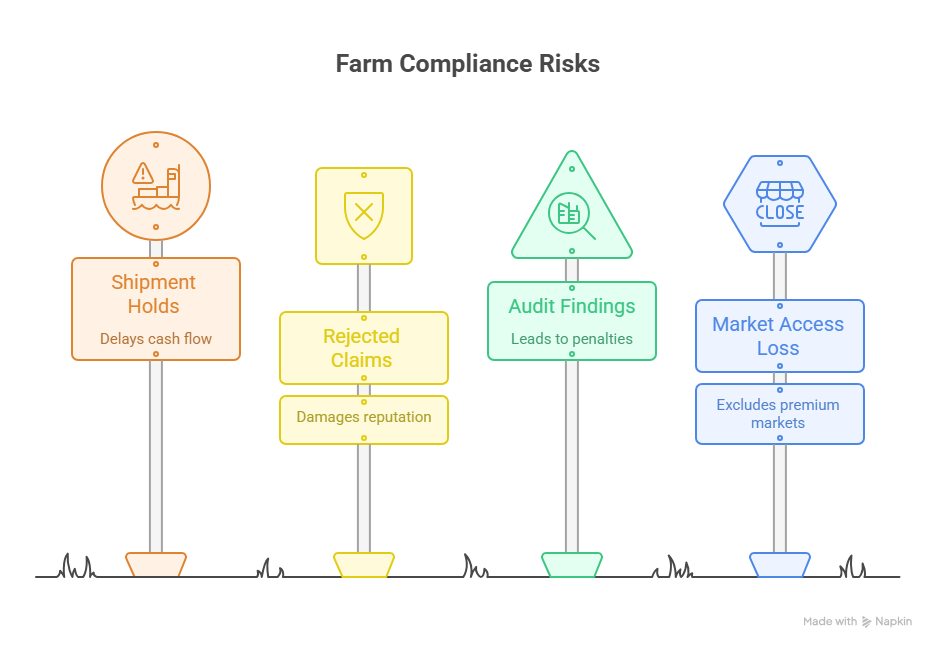
Effective Farm Management for Compliance is not a single feature; it is a structured system made up of interlinked components. Each layer ensures that farm-level data is not only collected but validated, traceable, and usable for regulatory, buyer, and export requirements.
Below are the essential building blocks.
Compliance begins with knowing exactly who is in your supply base.
An enterprise-grade system should establish:
This moves the organization from static supplier lists to structured supplier intelligence. When enforcement intensifies, the ability to demonstrate documented farmer-level history becomes a major advantage.
Plot-level visibility is now foundational.
This includes:
Polygon-based mapping enables spatial validation, ensuring farms are not located in restricted or deforested areas. Without this, compliance remains unverifiable.
Plot-level digitization transforms compliance from self-declared to independently validated.
Want to see how farm mapping enables real traceability in action?
Discover how coffee was tracked from bean to cup using plot-level digitization and shipment-linked traceability.
Read the Case Study: Tracking the Journey of Coffee from Bean to Cup
Compliance increasingly requires visibility into how crops are produced.
A robust system should capture:
This allows agribusinesses to:
Instead of collecting input records retroactively, compliance becomes embedded into daily farm operations.
Traceability must extend beyond production into movement.
This requires:
The goal is to connect farm production directly to procurement and export shipments.
If authorities or buyers request documentation, companies must be able to trace a shipment back to specific farms not just regions.
This is where many supply chains break down without structured systems.
Collecting data is not enough. It must be validated and analyzed.
A compliance-focused farm management system includes:
This shifts compliance from reactive reporting to proactive risk management.
Instead of discovering gaps during audits, companies can identify and resolve issues before shipments leave the country.
Farm Management for Compliance is not just an operational upgrade for field teams. It is a strategic infrastructure serving multiple decision-makers across the agribusiness value chain. Each stakeholder group faces different pressures, but they converge at the same need: structured, verifiable farm-level data.
Procurement is no longer only about price and volume; it is about defensibility.
With Farm Management for Compliance, procurement teams gain:
Instead of relying on supplier assurances, procurement teams can demonstrate that sourcing decisions were based on validated risk assessments a critical safeguard in today’s regulatory environment.
Sustainability teams face increasing scrutiny from buyers, regulators, and investors.
Farm Management for Compliance enables:
This shifts sustainability from storytelling to structured proof reducing greenwashing risk and strengthening credibility with stakeholders.
Compliance teams carry the operational burden when documentation is incomplete.
With digitized systems, they gain:
Instead of scrambling weeks before submission deadlines, compliance becomes a continuous workflow lowering stress and reducing error risk.
For exporters and traders, compliance failures directly impact revenue.
Farm Management for Compliance delivers:
When shipment traceability links directly to farm-level evidence, exporters reduce friction at borders and strengthen buyer trust.
Many agribusinesses still rely on legacy systems that were never designed for today’s regulatory complexity.
Field officers often collect data manually, resulting in:
Paper-based systems cannot support real-time verification or digital audit trails.
Compliance data is frequently fragmented across:
These silos create inconsistencies and duplication, making audit preparation time-consuming and error-prone.
In many supply chains, data is aggregated at cooperative or regional levels without:
Without individual plot evidence, compliance claims remain vulnerable under stricter regulations.
Traditional systems lack:
This means issues are often discovered only during audits when correction is costly and urgent.
A common pattern emerges:
This reactive cycle creates ongoing audit anxiety and operational disruption.
TraceX’s Farm Management Solutions for Compliance provide an end-to-end digital framework that transforms fragmented farm records into structured, validated, and shipment-linked data streams.
TraceX captures full polygon farm boundaries not just single GPS coordinates so that each plot can be independently verified against deforestation, land-use, and risk criteria.
Polygons provide the true footprint of production areas, enabling credible traceability rather than vague location tags.
TraceX’s mobile interfaces empower field officers and farmers to capture data directly from the ground, even without internet connectivity.
Once connectivity is restored, data syncs automatically.
TraceX integrates seamlessly with enterprise systems like SAP, Oracle, or other procurement and inventory management platforms.
Compliance isn’t isolated it must flow into procurement and ERP workflows to ensure traceability follows the product from farm to factory.
TraceX applies rule-based and configurable logic to assess compliance and sustainability risk at the farm and plot level.
Each farm and shipment is scored and flagged automatically. Rather than manually scanning records when an audit hits, you get early warnings so you can mitigate before it becomes a compliance incident.
TraceX is built for complex, multi-country supply chains .This supports global agribusinesses exporting into regulated markets like the EU, UK, or North America. You need one platform that works everywhere not fragmented systems per geography.
With TraceX, documentation from plot geolocation and risk assessments to harvest records can be exported in structured, machine-readable formats that satisfy regulatory authorities and buyers alike. No more scrambling weeks before inspections; you can respond instantly with verified compliance evidence.
Compliance is no longer a sustainability add-on handled at reporting time it has become core supply-chain infrastructure. Farm management now sits at the center of procurement, risk mitigation, and export continuity. Companies that lead in this shift validate data at the point of origin, preserve traceability even through aggregation and processing, and treat farm-level information as a strategic asset rather than a documentation burden. The difference is clear: reactive organizations scramble before audits, while structured organizations operate with continuous control. In today’s regulatory environment, that control is what protects market access, buyer trust, and long-term competitiveness.
Learn how digital farm management simplifies audit preparation, tracks input usage, and supports sustainability certifications at scale.
Read: Farm Management for Sustainability Certifications
Discover how farm-level intelligence powers smarter, risk-aware procurement decisions.
Read: How Digital Procurement Solutions Transform Agri Sourcing
See how digitized farm data protects shipments, accelerates customs clearance, and secures EU market access.
Read: Farm Management for Export-Ready Supply Chains
Farm Management for Compliance is the structured digitization, validation, and continuous management of farm-level data including geolocation, crop, input, and harvest records — to meet regulatory, certification, and buyer requirements in an audit-ready format.
It enables plot-level geolocation capture, links farm data to export batches, automates risk assessments, and generates structured documentation required for Due Diligence Statements (DDS) under the EU Deforestation Regulation.
Plot-level polygon mapping allows authorities and buyers to verify that production did not occur on deforested land after regulatory cut-off dates. GPS points alone are insufficient for satellite validation and spatial risk analysis.
It replaces reactive document collection with continuous data validation, automated risk scoring, shipment-linked traceability, and instant documentation exports reducing last-minute reconstruction and compliance gaps.
Yes with mobile-first data capture, structured onboarding, and centralized validation workflows, even large smallholder networks can achieve scalable, plot-level traceability and regulatory readiness.