
Quick summary: Discover how Farm Management for Sustainability Standards and Certifications helps agribusinesses meet EUDR, Global G.A.P., Rainforest Alliance, Organic, and other certification requirements through plot-level traceability, input tracking, and continuous compliance systems.

Sustainability certifications used to be about paperwork. Today, they’re about proof. Across global supply chains, buyers, regulators, and consumers are asking tougher questions: Where was this grown? On which plot? Under what practices? Can you prove it? This is why Farm Management for Sustainability Standards and Certifications has moved from a back-office function to a strategic priority.
Certifications such as EUDR, Global G.A.P., Rainforest Alliance, and organic standards no longer accept high-level declarations or cooperative summaries. They demand structured, plot-level, verifiable data that connects farmers, land, inputs, harvest volumes, and transactions in a continuous digital record.
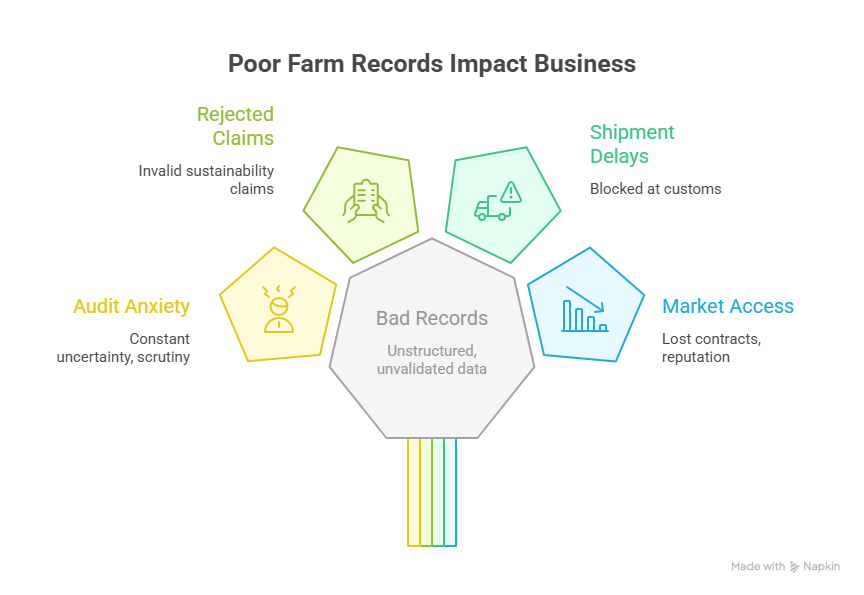
For many agribusinesses, this shift exposes a painful gap. Farm data still lives in paper registers, PDFs, and disconnected spreadsheets. Audit preparation becomes a scramble. Compliance depends on manual reconciliation. And when data is missing or unverifiable, shipments stall, certifications are questioned, and reputational risk rises.
The reality is clear: document-based compliance cannot support modern sustainability requirements. System-based farm management must replace it.
This guide explains what agribusinesses must get right to build certification-ready farm management systems how to move from reactive audit preparation to continuous compliance, and how to turn sustainability from a reporting burden into operational control.
Key takeaways
Farm Management for Sustainability Standards refers to the structured, digital management of farm-level data, activities, and transactions to meet certification, regulatory, and buyer requirements.
In a certification context, it goes beyond simply listing farmers. It creates a continuously updated system that links farmers, plots, crops, inputs, harvest volumes, and transactions into verifiable, audit-ready records.
At its core, it ensures that sustainability claims are supported by operational data not declarations.
Registration tells you who exists.
Farm management tells you what is happening, where, and when.
Modern sustainability frameworks increasingly expect ongoing visibility, not just periodic review.
Reporting communicates outcomes.
Operational sustainability controls them.
Certification bodies and regulators are raising the bar because risk exists at the farm and plot level not at the cooperative name.
Today’s standards increasingly require:
Risk (deforestation, land-use change, encroachment) happens at the plot level. Certifications now expect boundary-based mapping rather than general origin descriptions.
Fertilizers, pesticides, and other inputs must be monitored to ensure compliance with environmental and safety standards. Input usage must be linked to specific crops and plots.
Harvest volumes must connect back to farms and forward to buyers. Without this linkage, traceability breaks once aggregation begins.
Navigating sustainability certifications? Discover how leading agribusinesses meet global standards without operational chaos.
Ready to digitize your farm supply chain?
Download the Digital Farm Management Guide to learn how to build traceable, compliant, and export-ready operations from the ground up.
Global agribusinesses now operate under a complex web of sustainability standards that affect sourcing decisions, farm management practices, and export readiness. These standards vary by commodity and region but they increasingly share one common requirement: structured, verifiable farm-level data.
Below are the key frameworks shaping compliance across the EU, Southeast Asia, Latin America, and Africa.
EU The Deforestation Regulation (EUDR) is redefining compliance for commodities such as cocoa, coffee, palm oil, rubber, soy, and timber entering the EU.
Key Requirements:
Impact Regions:
EUDR shifts accountability directly to the farm and plot level, making digital farm management critical.
Global G.A.P. is widely adopted across fresh produce supply chains in Europe, Latin America, Africa, and Southeast Asia.
Focus Areas:
Exporters supplying European supermarkets must maintain structured field-level records to retain certification.
Rainforest Alliance certification is prevalent in coffee, cocoa, tea, and tropical commodities across Latin America, Africa, and Asia.
Core Criteria:
Certified supply chains must demonstrate that volumes can be traced back to verified farms while maintaining sustainability performance.
Organic standards apply across global agricultural exports, including coffee (Latin America), rice (Southeast Asia), spices (India), and fruits & vegetables (Africa and EU suppliers).
Requirements Include:
Traceability and input management are central to maintaining organic integrity.
The Forest Stewardship Council (FSC) and Programme for the Endorsement of Forest Certification (PEFC) are critical for:
They require:
These standards are especially relevant in Southeast Asia, Latin America, and parts of Africa.
UEBT certification applies to companies sourcing biodiversity-based ingredients particularly in cosmetics, food, and natural extracts.
Focus Areas:
Relevant in Latin America, Africa, and Southeast Asia, especially for botanicals and specialty crops.
The Sustainable Rice Platform (SRP) is increasingly adopted across Southeast Asia (Vietnam, Thailand, India), Africa, and export-focused rice supply chains.
Requirements Include:
SRP certification demands field-level documentation and performance data, not just policy declarations.
The Sustainable Tobacco Program (STP) governs tobacco sourcing in India, Brazil, Africa, and Southeast Asia, particularly for exports to EU and global manufacturers.
Core Elements:
For tobacco companies supplying multinational buyers, STP compliance requires consistent farm profiling, crop tracking, and transaction linkage.
See how VST Industries scaled sustainable tobacco sourcing with full farm-to-factory traceability. Read the case study.
While these frameworks vary by commodity and geography, they increasingly require:
From the EU’s EUDR to Southeast Asia’s SRP adoption, from Latin America’s Rainforest Alliance programs to Africa’s cocoa traceability initiatives, the message is consistent:
Sustainability certification now depends on structured farm management systems not document collection.
Agribusinesses that embed farm-level digitization into daily operations are better positioned to maintain certifications, protect export access, and compete in regulated global markets.

For years, farm records were built to support internal tracking and occasional audits not continuous, data-driven compliance. But modern sustainability standards now demand structured, traceable, and verifiable farm-level data. Traditional systems simply weren’t designed for that level of scrutiny.
Paper registers, handwritten field logs, and physical declarations are still common across smallholder networks. While familiar, they introduce major risks:
Under standards like EUDR, Global G.A.P., or Rainforest Alliance, paper documentation is not enough. Regulators and buyers expect digital, structured evidence not scanned copies.
Spreadsheets often replace paper but they introduce a new set of challenges:
When data is fragmented across departments, no single source of truth exists. During audits, teams scramble to align inconsistent files wasting time and increasing risk.
Many supply chains rely on cooperative-level or trader-level declarations rather than farm-level proof. While efficient at scale, this model fails under modern scrutiny:
Sustainability risks, especially deforestation and land-use change, occur at the plot level. Aggregated declarations cannot substitute for plot-based evidence.
One of the biggest structural gaps is the lack of boundary-based mapping.
Without plot-level visibility, compliance teams cannot demonstrate deforestation-free sourcing, legality, or field-level sustainability practices.
In traditional systems, audits trigger reconstruction:
This reactive approach turns certification into a stressful, high-risk event instead of a routine verification exercise.
Sustainability certification today requires more than isolated records. It demands a connected system that links farmers, land, inputs, harvests, and transactions into a verifiable, continuously updated data structure. Below are the foundational components that make farm management certification-ready.
Every compliance-ready system begins with a clear, persistent farmer identity.
Unique Farmer IDs
Each farmer must have a single digital identity that avoids duplication across programs, seasons, or buyers. This ensures consistency in reporting and traceability.
Longitudinal Data
Farmer records should evolve over time capturing crop changes, new plots, updated certifications, and transaction history. One-time surveys are insufficient for ongoing compliance.
KYC and Documentation Storage
Know-Your-Customer (KYC) data, land tenure records, certifications, and identification documents must be securely stored and easily retrievable during audits.
See how integrated KYC validation transforms farmer onboarding from paperwork to proof. Read the case study.
Without structured farmer identity management, traceability and compliance quickly fragment.
Modern standards require visibility at the plot not just farm or village level.
GPS Polygon Mapping
Plot boundaries should be captured using polygon mapping rather than single-point coordinates. This allows accurate land-use verification and risk assessment.
Linking Plots to Crops and Seasons
Each mapped plot must connect to crop type, planting cycle, and harvest season. This preserves the relationship between land and production.
Satellite Validation
Overlaying plot data with satellite imagery enables deforestation checks, land-use monitoring, and environmental risk assessment essential under regulations like EUDR.
Plot-level digitization ensures sustainability claims are geographically defensible.
Certifications increasingly focus on how crops are grown not just where.
Fertilizer and Pesticide Tracking
Approved inputs must be monitored and recorded, with clear linkage to specific plots and crops.
Usage Logs
Application dates, quantities, and methods should be logged digitally to demonstrate compliance with environmental and safety standards.
Approved Input Monitoring
Systems should flag prohibited substances or deviations from certification criteria before they create audit failures.
Input transparency transforms sustainability from a declaration into operational discipline.
Traceability often breaks at harvest and aggregation. Strong farm management systems prevent that.
Volume Capture
Harvest volumes must be digitally recorded at the farm or collection level.
Batch Traceability
Each batch should maintain a digital identity that links back to farmer and plot data—even after aggregation.
Scan-and-Transfer Workflows
Mobile-enabled workflows at buying centers help preserve traceability by digitally recording ownership transfers, volumes, and timestamps.
This ensures the chain of custody remains intact from field to processing and export.
Farmer ledgers serve as the operational memory of the supply chain.
Transaction History
Complete records of deliveries, payments, and sourcing volumes create transparency and accountability.
Delivery Records
Linking deliveries to plots and harvest cycles strengthens compliance under traceability frameworks.
Compliance History
Certification status, audit results, and corrective actions should be attached to farmer profiles to inform procurement decisions.
Farmer ledgers turn sustainability compliance into a structured, searchable dataset rather than scattered documentation.
This is what enables sustainability certifications to move from paperwork-based verification to system-based compliance protecting market access, buyer trust, and long-term competitiveness.
Sustainability audits are no longer periodic paperwork exercises they are data verification events. TraceX’s Supply Chain Sustainability Solution’s Audit Module transforms farm management from reactive document preparation into continuous, audit-ready compliance.
Here’s how:
TraceX centralizes farmer profiles, plot polygons, crop cycles, input usage logs, certifications, and transaction history into a standardized digital framework.
Instead of chasing PDFs, field notebooks, and spreadsheets before an audit, auditors access:
Documentation is structured, searchable, and aligned to sustainability standards such as EUDR, Global G.A.P., Rainforest Alliance, Organic, STP, and SRP.
Audit failures often happen because data gaps are discovered too late.
TraceX validates data at the point of entry by:
This means non-compliance risks are surfaced upstream not during the audit.
Field data collection is embedded into the system through configurable digital surveys aligned to certification requirements.
TraceX enables:
Surveys can be customized to match specific standards (EUDR, Rainforest Alliance, Global G.A.P., STP, etc.), ensuring that required data is captured in a consistent, auditable format. Built-in validation rules prevent incomplete or contradictory submissions, improving data integrity from the start.
Certification renewals demand:
Because TraceX maintains longitudinal farmer and farm data across seasons, renewal preparation becomes a validation step not a rebuilding exercise.
This reduces renewal timelines and improves confidence during surveillance audits.
The Sustainability Audit Module ensures:
This strengthens chain-of-custody proof and enhances credibility with certification bodies, buyers, and regulators.
Choosing a farm management system for sustainability certifications is not about features it’s about whether the system can stand up to audits, scale across regions, and support procurement and compliance simultaneously. Here are the non-negotiables to evaluate.
Certifications such as EUDR, Rainforest Alliance, and FSC require precise land verification. A simple GPS point is not sufficient.
Look for a system that provides:
Certification-ready data must be captured at the source, in the field.
Ensure the system offers:
Farm data should not live in isolation. It must connect to sourcing, transactions, and enterprise workflows.
Look for:
Certification readiness requires early detection of issues—not reactive fixes.
The right system should provide:
Pilots are easy. Scale is hard.
A certification-ready farm management system must:
Farm Management for Sustainability Standards and Certifications is no longer a back-office documentation exercise it is a strategic capability that determines market access, buyer trust, and long-term resilience. As regulations tighten and certification bodies demand plot-level, verifiable data, agribusinesses must shift from reactive audits to system-based, continuous farm management. Those who invest in structured farmer profiling, plot digitization, input tracking, harvest traceability, and risk monitoring will not only meet certification requirements, but they will operate with greater control, credibility, and confidence. In a world where proof matters more than declarations, farm management becomes the infrastructure that turns sustainability commitments into a defensible, scalable reality.
Explore how Organic Certifications are transforming farm-level compliance and market access. Read the full guide.
Understand UEBT requirements and what ethical sourcing means in practice—dive into our detailed breakdown.
Discover how the Sustainable Rice Platform (SRP) sets new benchmarks for responsible rice production. Learn more here.
It is a structured, digital approach to capturing and managing farm-level data farmer identity, plot mapping, crop records, inputs, harvests, and transactions to meet certification and regulatory requirements with verifiable evidence.
Modern standards such as EUDR and Rainforest Alliance require precise geolocation and land-use verification to demonstrate deforestation-free production and legal compliance. Village-level or cooperative-level data is no longer sufficient.
By maintaining continuously updated, structured digital records, farm management systems reduce last-minute audit preparation, minimize documentation gaps, and provide clear traceability from farm to shipment.
Essential components include farmer profiling, polygon-based plot mapping, input usage tracking, harvest and transaction traceability, farmer ledgers, and automated risk monitoring.
It reduces supplier risk, supports defensible sourcing decisions, speeds up certification renewals, minimizes audit friction, and protects access to premium and regulated markets.