
Quick summary: Discover the role of Farmer Agreements in Grower Management Systems and how they enable structured sourcing, supply predictability, quality control, and digital traceability across modern agricultural value chains.

A single broken promise can disrupt an entire agricultural supply chain. When crop volumes miss forecasts, quality standards slip, or procurement plans collapse, the root cause is often the same informal, unclear farmer–buyer relationships. This is where Farmer Agreements become critical. They turn fragmented farming operations into structured, predictable, and professionally managed grower networks that agribusinesses can rely on.
Without clear agreements, grower management systems face serious operational challenges:
Modern agri-enterprises are solving these gaps by embedding Farmer Agreements into digital grower ecosystems and platforms like TraceX Farm Management Solutions help operationalize this through structured onboarding, compliance tracking, and end-to-end grower coordination.
Modern agribusinesses rely on organized grower networks to ensure consistent supply, quality control, and traceability. As food supply chains become more global, regulated, and quality-sensitive, companies can no longer depend on fragmented, informal sourcing from scattered farmers. Instead, they use Grower Management Systems (GMS) structured frameworks that help businesses systematically manage relationships with farmers, plan production, monitor crops, and streamline procurement.
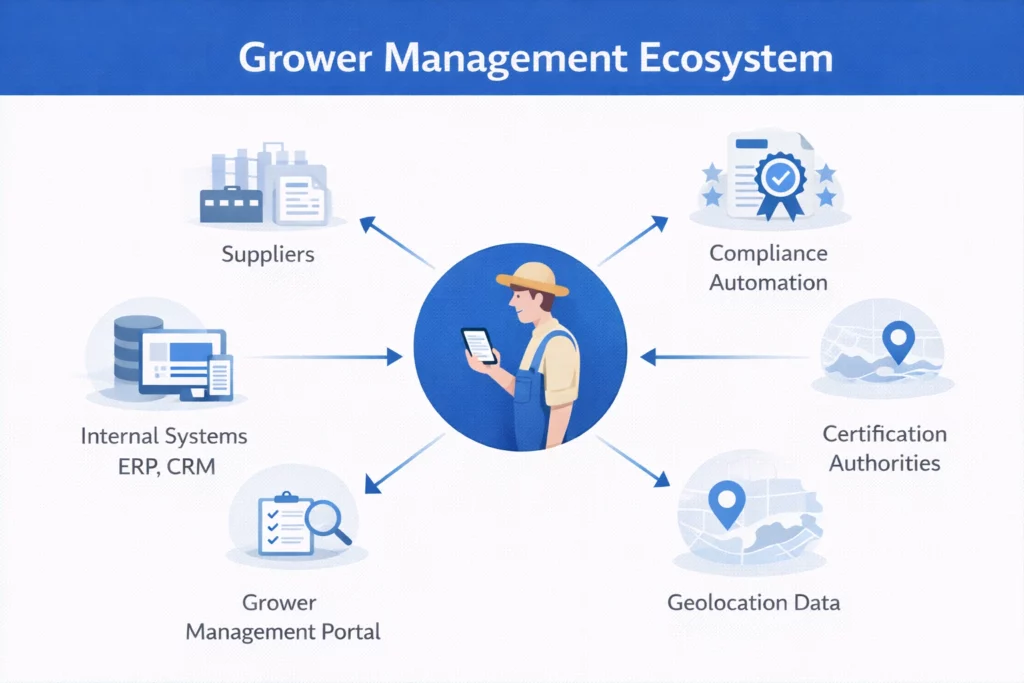
A Grower Management System is a coordinated approach that connects farmers, field operations, and buyers through standardized processes and often digital tools. It transforms independent growers into an integrated production network aligned with market demand. Rather than buying whatever arrives at local markets, agribusinesses can forecast supply, maintain quality standards, and trace produce back to its origin.
GMS platforms are widely used by:
At their core, grower management systems handle four critical operational functions. First, farmer onboarding ensures growers are registered, verified, and mapped to specific crops or regions. Second, crop planning aligns acreage and production schedules with demand forecasts. Third, field monitoring tracks crop progress, input usage, and quality compliance. Finally, procurement management organizes harvest collection, logistics, grading, and payments.
This marks a major shift from informal sourcing, where relationships are verbal and volumes unpredictable to structured grower ecosystems built on planning, accountability, and long-term collaboration.
Want to see how collective farmer networks transform rural economies?
Read our deep dive on the Importance of Farmer-Producer Organizations (FPOs) and how they strengthen bargaining power, market access, and income stability for growers.
Explore our guide to Digital Platforms for Contract Farming to learn how e-contracts, traceability tools, and farm management software are modernizing agri supply chains.
A strong grower network runs on three foundational pillars:
Together, these components turn scattered farmers into a coordinated, efficient, and market-aligned production ecosystem.
Globally, ~20-30% of agribusiness sourcing occurs via organized grower networks (contracts/cooperatives/FPOs), while 70-80% relies on open markets (spot/mandis), per studies in India/US where intermediaries dominate smallholder sales.
Farmer agreements act as the legal and operational backbone of structured grower networks. While grower management systems organize farmers, workflows, and data, Farmer Agreements provide the formal framework that governs how every participant works together. They convert informal relationships into accountable partnerships, ensuring that both growers and buyers clearly understand their roles, responsibilities, and expectations.
At the most fundamental level, agreements formalize the relationship between farmers and agribusinesses. Instead of relying on verbal commitments or spot-market transactions, both parties enter documented contracts that establish mutual obligations. This clarity builds trust and creates a stable foundation for long-term collaboration.
Farmer agreements also define production standards that growers must follow. These include crop varieties, input usage, quality benchmarks, grading norms, and sustainability requirements. By setting these parameters in advance, companies can ensure uniform output that meets processing, retail, or export standards.
Equally important, agreements specify pricing structures and delivery timelines. Whether prices are fixed, formula-based, or market-linked, growers gain income visibility while companies secure predictable procurement costs. Pre-agreed harvest windows and delivery schedules further help synchronize farm output with factory demand, logistics planning, and market commitments.
This alignment between farm production and company demand forecasts significantly reduces supply uncertainty. Agribusinesses can estimate volumes more accurately, avoid last-minute shortages, and minimize over-procurement. Farmers benefit from assured market access and reduced price risk.
Farmer agreements support grower management systems across three critical operational stages:
By structuring planning, production, and procurement, farmer agreements transform grower networks into coordinated, reliable, and scalable supply systems.
Agreements transform fragmented farming into coordinated production systems. In traditional agriculture, growers make independent decisions about crops, inputs, and harvest timing, which often leads to supply mismatches, quality variation, and procurement inefficiencies. Farmer Agreements bring structure and synchronization to this process by aligning on-farm activities with organized grower management objectives.
One of the most important operational roles agreements play is in crop planning and acreage allocation. Before a season begins, buyers and growers mutually decide what crops will be cultivated, how much land will be allocated, and what yield targets are expected. This ensures production is market-driven rather than speculative, preventing oversupply of low-demand crops and shortages of high-demand ones. For agribusinesses, this enables accurate forecasting and resource planning across processing, storage, and logistics.
Agreements also enable quality protocol enforcement. They clearly define cultivation standards, input specifications, grading norms, residue limits, and post-harvest handling requirements. Because these expectations are contractually documented, growers are more likely to follow standardized practices, resulting in uniform produce that meets processor, retailer, or export requirements.
Another critical function is input distribution and technical advisory. Agreements often include provisions where buyers supply certified seeds, fertilizers, crop protection products, and agronomic guidance. This not only improves yield and quality but also ensures production consistency across geographically dispersed farms.
Farmer agreements further support harvest scheduling and logistics coordination. Pre-agreed harvest windows, aggregation points, and delivery protocols help companies streamline procurement operations, reduce wastage, and avoid last-minute supply chain disruptions.
Managed contracts yield 20-50% yield improvements and 30-70% rejection-rate reductions for smallholders, per studies on contract farming in India/Africa (e.g., rice/wheat +25-40% output, produce rejection drops from 20-30% to <10%).
Modern grower ecosystems increasingly digitize these processes:
Through operational alignment and digital integration, farmer agreements enable scalable, transparent, and efficiently managed grower networks.
The Farmer Agreement Feature from TraceX is a game-changer for onboarding new farmers and establishing clear agreements. Here’s how it simplifies the process:
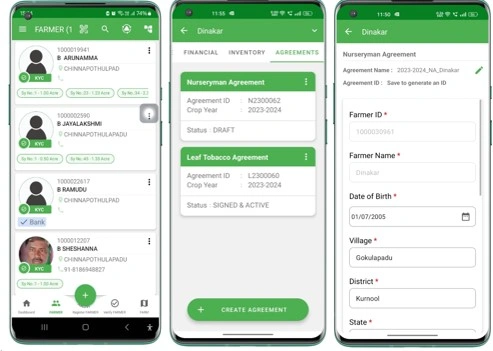
Imagine ditching the paper forms! Field technicians can efficiently input new farmer data directly into the system. This includes essential details like:
Gone are the days of generic contracts! Field technicians can work collaboratively with farmers to create a customized ‘Crop Agreement’ for the current crop year. This agreement typically outlines important details like:
Say goodbye to manual paperwork! Once the agreement is finalized, the system automatically generates a downloadable PDF document. This PDF typically includes:
Security is paramount! The system restricts agreement creation to only those farmers who have undergone a KYC (Know Your Customer) verification process. This typically involves verifying the farmer’s identity using government-issued IDs like Aadhaar (India) or other relevant documents. This ensures data security, minimizes the risk of fraud, and fosters trust in the system.
Following a successful agreement creation, the system automatically updates the farmer’s ledger for the specific crop year. This ledger typically tracks information like:
This automated ledger update not only saves time but also provides a clear and transparent overview of transactions for both the farmer and the organization.
A leading tobacco company strengthened the sustainability and transparency of its leaf procurement operations by digitizing its contracting process with the TraceX Farmer Agreement feature. Previously dependent on paper records and manual data collection, the company faced inefficiencies and traceability gaps across its grower network. With TraceX, field representatives could digitally capture comprehensive farmer and crop data, including agreement type, crop year, acreage, yield estimates, crop history, and socio-economic details while generating secure, customized agreements covering pricing terms, delivery schedules, quality standards, and optional sustainability clauses. This shift replaced paperwork with automated workflows, saving time and enabling field teams to focus more on farmer engagement and on-ground support. The centralized data system also created end-to-end traceability of tobacco leaf origins, helping address ethical sourcing and labor compliance concerns. As a result, the company improved operational efficiency, strengthened farmer relationships, enhanced supply chain transparency, and built a more sustainable and accountable procurement ecosystem.
Structured agreements reduce inefficiencies caused by middleman layers and price volatility. In conventional agricultural markets, produce typically moves through multiple intermediaries before reaching processors or retailers. Each layer adds cost, time delays, and uncertainty around quality and volume. Farmer Agreements streamline this fragmented system by creating direct, organized linkages between growers and buyers, making supply chains faster, leaner, and more predictable.
Agreements enable tight operational alignment across the supply chain:
By connecting production planning with procurement execution, farmer agreements transform agricultural supply chains into coordinated, cost-efficient, and demand-driven systems.
In the years ahead, digital agriculture platforms will transform farmer agreements from static documents into intelligent coordination systems that power connected grower ecosystems. As contracting becomes fully digital through e-contracting workflows and secure digital signatures, agreements will be created, executed, and stored seamlessly within farm management platforms, eliminating paperwork and administrative delays. Satellite-based crop monitoring will further strengthen these agreements by enabling real-time visibility into crop progress, acreage compliance, and yield forecasts, ensuring that both growers and buyers stay aligned throughout the season. Mobile advisory integration will connect agreement terms directly to field-level actions, delivering timely guidance on inputs, crop care, and quality protocols through farmer apps and field officer tools. Emerging technologies like blockchain will add tamper-proof traceability, recording every transaction and crop movement in secure digital ledgers that strengthen trust across supply chains.
Digital farmer agreements will also become essential instruments for sustainability governance. Integrated compliance tracking will help companies monitor adherence to environmental standards, safe input usage, labor norms, and certification requirements. At the same time, responsible sourcing verification will allow brands to demonstrate that their raw materials come from ethically managed farms, strengthening ESG reporting and consumer confidence.
Together, these advancements will position farmer agreements as the digital backbone of transparent, resilient, and sustainability-driven agricultural supply networks.
Want deeper visibility into your grower network?
Read our guide on Digital Farmer Profiling to see how structured farmer data improves traceability, planning, and sourcing decisions.
Looking to digitize field operations end-to-end?
Explore our blog on Digital Farm Management Platforms and learn how technology connects farmers, field teams, and buyers in one seamless ecosystem.
Need stronger compliance across your farm network?
Discover how Farm Management for Compliance helps you meet quality standards, sustainability norms, and audit requirements with confidence.