Quick summary: Learn how to successfully onboard farmers into digital farm management systems with practical strategies that improve adoption, training, and long-term engagement.
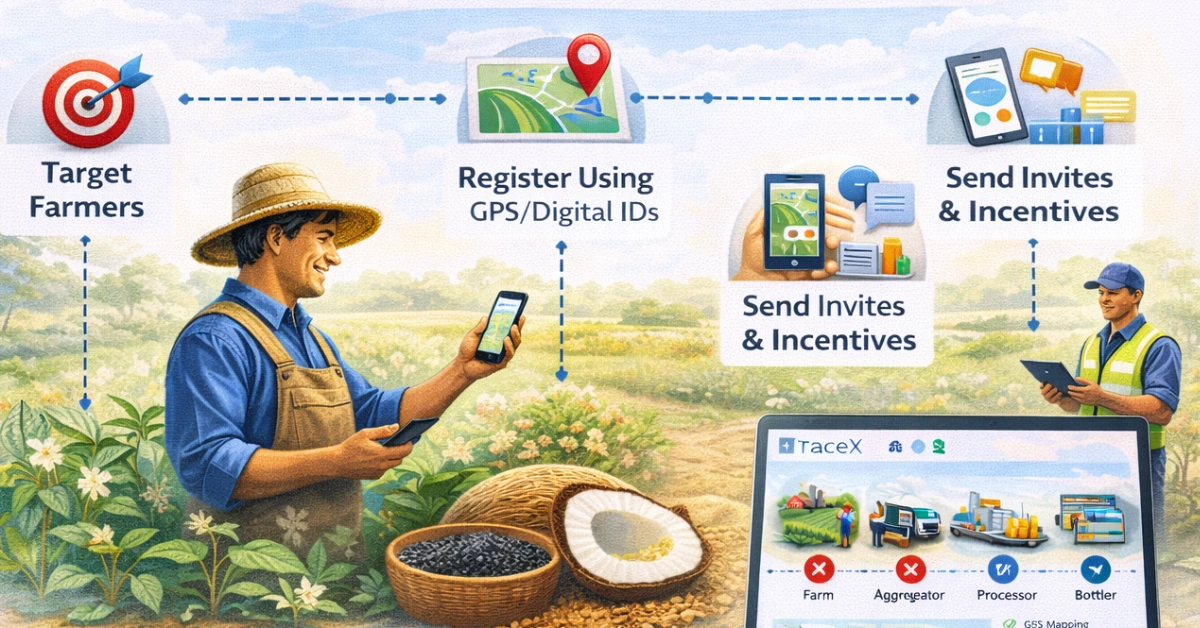
Most agribusinesses budget for the platform. Almost no budget for the onboarding. The result is predictable: pilots succeed, rollouts fail. Farmer onboarding is not a software problem; it is an operations problem. And it requires the same structured planning as any field operation.
Many agribusinesses struggle to onboard farmers into digital farm management systems because farmers may face limited digital literacy, connectivity challenges, and resistance to replacing traditional record-keeping methods.
TraceX Farm Management Solutions simplifies farmer onboarding with intuitive mobile tools, offline data capture, and seamless traceability that make digital adoption easy for farmers and scalable for agribusinesses.
This guide gives your operations team a practical playbook: how to design the onboarding workflow, what the platform must support at each stage, where adoption collapses and why, and the metrics that tell you whether your farmer network is genuinely digitized or merely registered.
| <20% Digital tool adoption rate among smallholder farmers in Africa & Southeast Asia (McKinsey, 2024) | 33M Smallholder farmers reached by digital agri apps in Africa — vs. a 200M target by 2030 (CTA, 2024) | 40–60% Hours field agents operate offline in South Asia — making offline-first onboarding mandatory |
| 70%+ Farmers using precision agriculture reporting yield gains within 2 years of adoption | 25% Operational productivity increase when farms are digitized with data-driven tools | 35–40% Commercial farm adoption of AI-driven systems globally in 2024 — vs. near-zero smallholder parity |
The gap is not access. Most target farmers have a mobile phone. The gap is structured in the onboarding process of converting a farmer from a name on a supplier list into an active, data-contributing participant in your digital system.
Struggling to capture accurate farmer data at scale?
Learn how structured farmer profiling improves traceability, compliance, and supply chain transparency.
Read the Farmer Profiling Guide
Want to digitize farm operations and improve field-level visibility?
Explore our complete guide to implementing effective digital farm management systems.
Read the Digital Farm Management Guide
Before designing your onboarding program, understand why previous attempts failed. In almost every case, failure traces to one or more of four structural causes.
Onboarding starts before the farmer ever touches a mobile app. It requires knowing who you are, onboarding name, plot location, crop type, existing certification status, cooperative affiliation, and contract history. Organizations that skip this step arrive at field onboarding sessions with no records, forcing manual data collection under pressure.
Operational Risk: If your onboarding process begins at the farmer’s farm rather than in your own data systems, you have already lost two to three weeks of productive digitization time and introduced avoidable data quality risks.
Platforms designed for agronomists in offices fail in the hands of field agents and smallholder farmers operating in low-literacy, low-connectivity, multilingual environments. A form requiring 14 fields to be completed before a harvest can be recorded will be abandoned or faked.
Highest Barrier: Literacy and digital skills are cited as the highest barriers to mobile device adoption among smallholder farmers in low- and middle-income countries (GSMA Gender Report, 2024)
One field agent cannot sustainably onboard, train, and support more than 80-120 farmers simultaneously while maintaining data quality. Organizations that assign one agent to 300 farmers produce registration numbers, not digitized farmers.
Best Practice: Plan field agent capacity at a ratio of 1:80 to 1:100 farmers during active onboarding sprints. Increase to 1:150 only for maintenance-phase follow-up after initial activation is confirmed.
A registered farmer has a profile in the system. An active farmer has submitted at least one season’s worth of data through the platform plot map, input records, and harvest declaration. Many programs count registration as success and never reach activation. This produces headcount metrics that look impressive and supply chain visibility that does not exist.
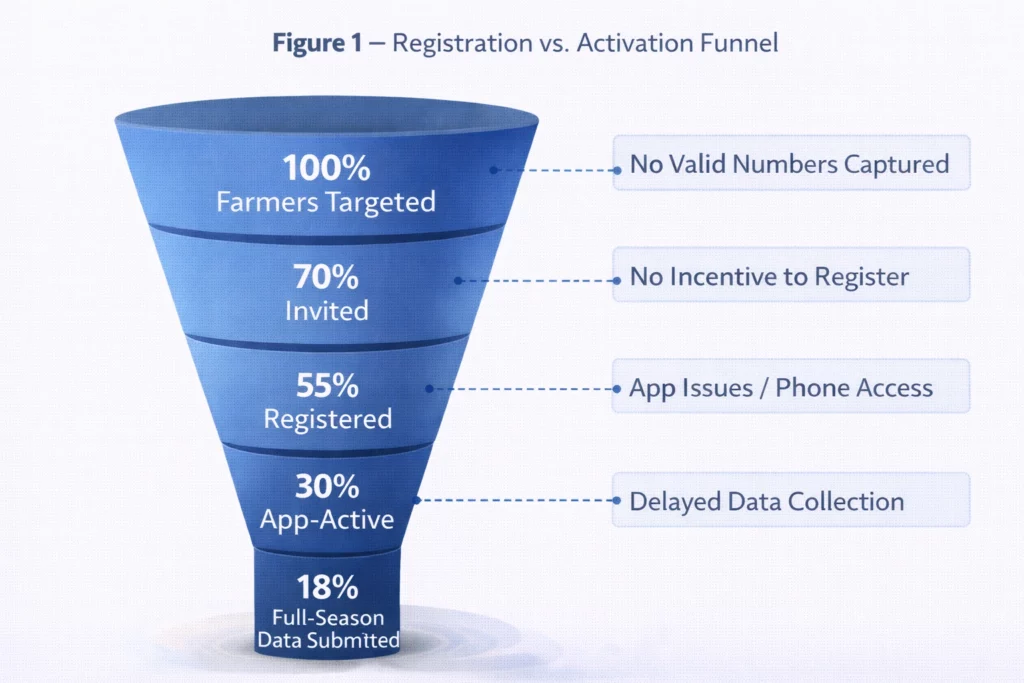
A structured onboarding program moves every farmer through five phases. Each phase has a defined entry condition, a set of platform-supported activities, and an exit condition that must be met before the farmer is counted as digitized.
| Phase | Key Activities | Platform Features Used | Success Metric |
|---|---|---|---|
| Phase 1 Pre-Enrollment | Supplier mapping, cooperative roster import, KYC document collection | Bulk farmer import, document upload, duplicate detection | 100% of target farmers have a system profile before field visits begin |
| Phase 2 Digital Registration | Identity verification, consent collection, SIM/device check | Mobile OTP verification, consent form digital signature, device compatibility check | Every registered farmer has a verified unique ID in the platform |
| Phase 3 Plot Mapping | GPS boundary capture, plot area calculation, land tenure recording | Mobile GPS mapping tool, satellite verification layer, deforestation risk check | Every plot has a geo-tagged polygon with EUDR-compliant coordinates |
| Phase 4 Training and Activation | App walkthrough, first data entry guided session, harvest recording demo | Offline-capable app, guided onboarding flow, local-language UI | Farmer completes at least one end-to-end data entry workflow without agent assistance |
| Phase 5 Data Collection | Seasonal input logging, harvest declaration, advisory receipt | Push notifications, SMS reminders, agent dashboard for engagement monitoring | Farmer submits complete crop cycle data for at least one full season |
The most expensive mistake in farmer onboarding is beginning field operations without a clean, structured farmer registry. Pre-enrollment turns your existing supplier lists, cooperative rosters, and contract databases into a structured digital foundation before any field agent is deployed.
See how TraceX transformed farm data digitization and compliance for an agribusiness leader.
Read the full case study
390+ Digital agriculture service providers operating in Africa alone yet fewer than 17% of smallholder farmers in Sub-Saharan Africa are consistently using digital tools. The gap is not platform availability it is structured enrollment.
Best Practice: Run a data quality audit on your existing farmer lists before import. Typical issues: duplicate entries (12-18% of lists), missing phone numbers (20-35%), and outdated plot areas. Clean this upstream every error that reaches the platform costs 3-5x more to fix after registration.
Registration is the moment a farmer moves from a spreadsheet row to a verified digital identity. This phase must be fast (under 8 minutes per farmer), reliable in low-connectivity conditions, and designed to collect only the minimum data required at this stage additional data comes in subsequent phases.
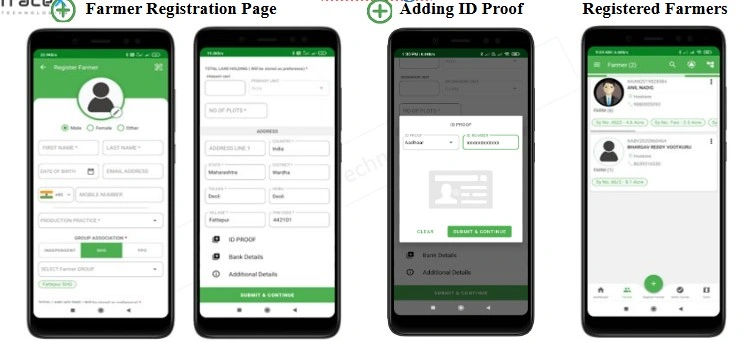
Operational Risk: Do not make registration conditional on plot mapping completion. These are separate phases. Bundling them forces agents to spend 35-50 minutes per farmer at registration, destroying the field throughput needed to onboard large networks.
Plot mapping is the most operationally intensive phase of onboarding and the most strategically critical. A geo-tagged plot polygon is the anchor for yield forecasting, deforestation risk assessment, input logistics, and EUDR compliance. Every compliance report you ever produce for a covered commodity traces back to the accuracy of this data.
EUDR Alert: The EU Deforestation Regulation requires plot-level polygon coordinates for all covered commodities (cocoa, coffee, palm oil, soy, cattle, wood, rubber). Center-point approximations are non-compliant. Platforms must support full polygon capture.
Training is not a one-time event. It is a series of structured interactions designed to move the farmer from passive registrant to active data contributor. The most effective training programs are tied to real farm activities not classroom demonstrations.
Digital literacy and language are the highest-cited barriers to mobile tool adoption in low- and middle-income farming contexts. Your platform must have operational responses, not just feature-list claims to these barriers.
Every farmer onboarding program encounters the same recurring barriers. The table below maps each barrier to its root cause and the platform feature or operational response that resolves it.
| Onboarding Barrier | Root Cause | Platform Solution |
|---|---|---|
| Low smartphone penetration | Cost of data-capable devices; infrastructure gaps | Feature-phone SMS workflows + agent-assisted data entry on shared tablets |
| Poor rural connectivity | No 3G/4G coverage; seasonal dead zones | Offline-first app with full data capture; auto-sync when connectivity resumes |
| Digital literacy gaps | Low exposure to mobile apps; language barriers | Icon-based UI; voice input; local-language content; peer champion network |
| Farmer resistance / low trust | No perceived benefit; data privacy concerns; previous program failures | Visible quick wins (advisory message, payment confirmation); clear data ownership communication |
| Field agent fatigue | Too many farmers per agent; repetitive re-entry; poor tools | Pre-loaded profiles; GPS auto-capture; agent performance dashboard; rational territory design |
| Duplicate / inaccurate records | Rushed registration; no deduplication logic | Platform-level duplicate detection at registration; mandatory field validation; quality scoring per agent |
| GPS accuracy issues | Duplicate/inaccurate records | Accuracy threshold warning; satellite cross-check flag; mandatory accuracy confirmation before saving |
| No onboarding follow-through | Registration seen as completion; no activation target | Low-end devices, canopy interference; agent shortcuts |
Explore our Farm Management Solutions
Onboarding programs without defined metrics default to measuring registration counts and calling it success. Define these KPIs before the program begins, and build your field agent management systems around them.
| ≤8 min Target time per farmer registration (excluding plot mapping) | ≥85% Registration completion rate from enrolled farmer list | ≤72 hrs Max time from registration to plot mapping completion |
| ≥60% Activation rate (app-active) within 30 days of registration — industry benchmark | ≥40% First full-season data submission rate — the real digitization metric | 1:100 Field agent to farmer ratio during active onboarding sprints |
Rather than a binary registered/not-registered classification, implement a three-tier status model that gives your operations team actionable visibility into where each farmer sits in the onboarding journey.
Best Practice: Report your farmer network size using Tier 3 (Data-Active) as your headline number. Reporting Tier 1 (Registered) to procurement and sustainability teams creates false confidence in supply chain visibility that does not yet exist.
Not all farm management platforms are designed for large-scale rural onboarding. Before selecting a platform or evaluating your existing one against these requirements, confirm the following capabilities are present not roadmapped.
Digital farm management delivers supply chain visibility, compliance data, and procurement intelligence only when the farmer network is genuinely active, not merely registered. The organizations that achieve this are not those with the best platforms. They are the ones that treat farmer onboarding as a structured field operation with defined phases, measurable activation targets, and dedicated agent capacity.
The five-phase framework in this guide, Pre-Enrollment, Digital Registration, Plot Mapping, Training and Activation, and Ongoing Data Collection, gives your operations team a repeatable process that scales from 500 to 50,000 farmers without losing data quality. The goal is not a registered farmer count. The goal is a Data-Active farmer network that is the foundation of a defensible, compliant, and procurement-ready supply chain.
Discover how digital farm management enables end-to-end traceability from farm to market.
Read the Farm Management for Traceability Guide
Learn how digital farm management systems simplify audits, reporting, and regulatory compliance.
Read the Farm Management for Compliance Guide
Explore how digital farm management helps track sustainability metrics and drive responsible agriculture.
Read the Farm Management for Sustainability Guide
No. Most platforms are designed with simple mobile interfaces and local language support so farmers can easily record and manage farm activities.
Many digital farm systems support offline data entry and sync automatically when the device reconnects to the internet.
Not necessarily. Many solutions offer scalable pricing, cooperative-based access, or support from agribusiness programs and sustainability initiatives.
Reputable platforms follow strict data protection practices, ensuring that farm data is stored securely and used only for agreed purposes.
Actually, it often reduces manual paperwork and simplifies record-keeping, saving time while improving compliance and traceability.