
Quick summary: Your FSC certificate signals that timber came from a responsibly managed forest. That’s valuable, but it’s not what the Australian Illegal Logging Prohibition Act (ILPA) demands from you as an importer. These are two different legal requirements, and confusing them is one of the most common and costly compliance mistakes in the timber trade. Relying […]
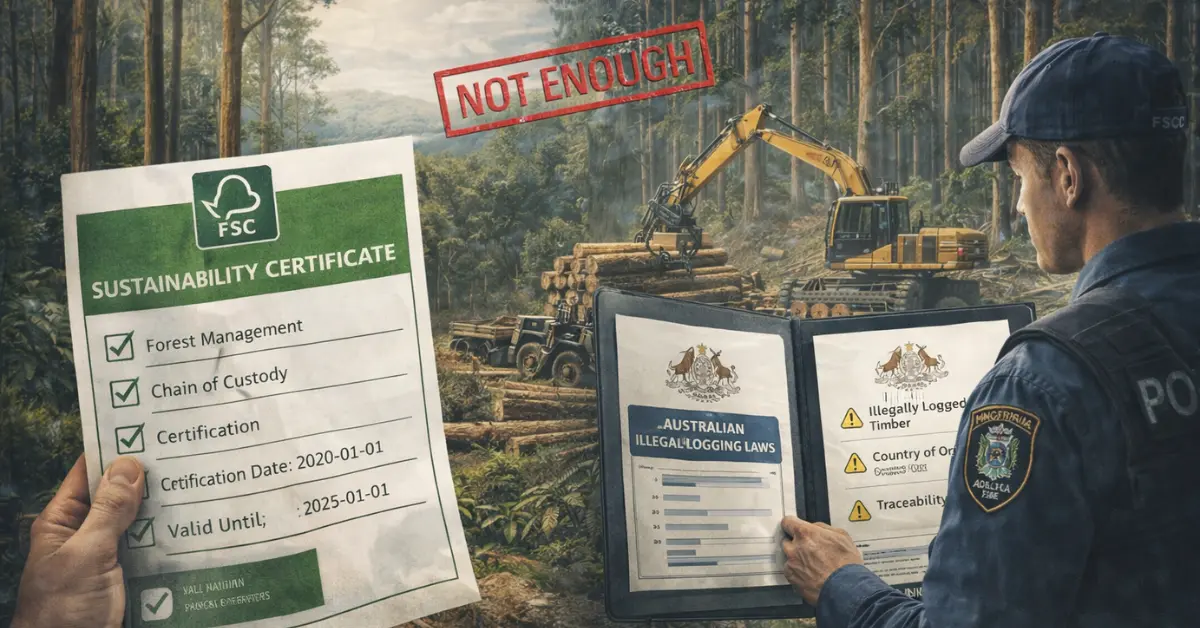
Your FSC certificate signals that timber came from a responsibly managed forest. That’s valuable, but it’s not what the Australian Illegal Logging Prohibition Act (ILPA) demands from you as an importer. These are two different legal requirements, and confusing them is one of the most common and costly compliance mistakes in the timber trade. Relying on FSC for AILPA compliance alone is not sufficient; importers must still conduct formal due diligence, verify legal origin, and maintain auditable documentation to meet regulatory requirements.
The ILPA requires importers and processors of regulated timber products to conduct independent due diligence at the transaction level. FSC certification, applied at the forest management or chain-of-custody level, doesn’t automatically satisfy that obligation. This article explains exactly where the gap lies, what enforcement looks like in practice, and how technology-enabled traceability systems are closing it.
| AU$222K Max civil penalty per contravention (ILPA 2012) | AU$1.1M+ Max corporate criminal fine for systemic non-compliance | ~15% Of global timber trade estimated to involve illegally harvested wood (WWF/TRAFFIC) | 100+ Regulated product categories under Australian ILPA |
The Illegal Logging Prohibition Act 2012 (ILPA) and its accompanying Illegal Logging Prohibition Regulation 2012 impose legally binding due diligence obligations on anyone who imports regulated timber products into Australia, or who processes raw logs sourced domestically. This is not a voluntary framework it carries real penalties.
Under the Act, importers must carry out a due diligence system (DDS) for each regulated timber product before it enters the Australian market. This means actively gathering and evaluating information, identifying risk, and mitigating that risk when it exists. The obligation is yours it cannot be transferred to or satisfied by your supplier’s certifications.
The Regulation does not create a blanket exemption for FSC-certified timber.
Even timber bearing an FSC full certification chain-of-custody mark must still pass through the importer’s own due diligence system. The Department of Agriculture’s guidance explicitly states that third-party certification ‘may be considered’ as one input into risk assessment it is not a substitute for the DDS itself.
This is the gap. Importers who rely solely on FSC documentation without building a systematic due diligence process are exposed regardless of the quality of the timber they’re sourcing.
FSC (Forest Stewardship Council) certification is a globally respected forest management and chain-of-custody scheme. It proves that a forest is managed to defined environmental and social standards, and that a product’s custody through the supply chain has been tracked by certified operators. But the FSC scheme and the ILPA DDS requirement operate on different legal and evidentiary planes.
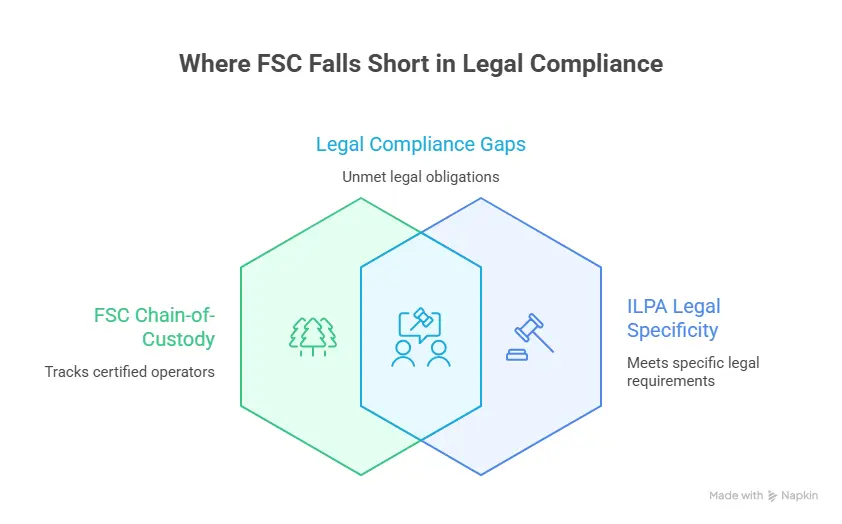
FSC Forest Management certification covers management practices not whether the specific timber consignment in your shipment was lawfully harvested under the origin country’s laws at the time of cutting. In high-risk source countries, this distinction matters enormously.
The FSC CoC standard tracks certified custody from forest to retailer but only for certified entities. If any actor in your supply chain between forest and your dock is not FSC-certified, CoC continuity is broken. Australian ILPA due diligence must cover the full chain, including non-certified processors, traders, and intermediaries.
The ILPA DDS demands species-level and region-of-harvest-level documentation per consignment. An FSC certificate is a credential issued to a business entity or forest area it doesn’t automatically generate the transaction-level evidence (species, volume, harvest location, applicable law) that a compliant DDS requires.
Many importers assume that importing FSC-certified timber from an FSC-certified supplier automatically qualifies as ‘negligible risk’ under the ILPA framework, requiring minimal DDS documentation. This is not correct.
The Department of Agriculture’s guidance states that risk assessment must be based on the importer’s own evaluation of the evidence and that the presence of certification is one factor, not a determinative one. In practice, if your documented DDS file contains only an FSC certificate with no supporting species, origin, or legality verification, you are not compliant.
Australia’s ILPA enforcement is conducted by the Department of Agriculture, Fisheries and Forestry (DAFF), with compliance actions ranging from record-keeping audits to criminal prosecution. Enforcement is deliberately scalable regulators can investigate without a formal criminal threshold.
| Enforcement Action | Trigger | Penalty Range |
|---|---|---|
| Record-Keeping Audit | Routine compliance check or tip-off | Infringement notices |
| Substantive Investigation | Suspected non-compliance, border intelligence | Civil penalty up to AU$222,000 |
| Criminal Prosecution | Deliberate or systemic ILPA breach | Individuals: AU$222K+ / Corps: AU$1.1M+ |
| Timber Seizure | Consignment lacks DDS documentation | Goods detained pending investigation |
Critically, the DAFF can require businesses to produce their due diligence records at any time not just at the point of import. If your DDS documentation is incomplete, inconsistent, or relies solely on third-party certificates without supporting evidence, you face exposure even if the timber itself was legally sourced.
The ILPA Regulation applies to a broad list of ‘regulated timber products’ defined by Customs Tariff classification. If you import any of the following, you need a compliant DDS for every consignment.
| High-Volume Regulated Categories | Risk Level (Based on Source Country) |
|---|---|
| Sawn timber and planed boards | HIGH – if sourced from SE Asia, Africa, or tropics |
| Plywood, MDF, particle board | HIGH – composite products obscure species origin |
| Wooden furniture and furniture parts | MEDIUM-HIGH – often processed through multiple countries |
| Wooden flooring and decking | HIGH – tropical hardwoods at elevated illegal logging risk |
| Paper and paperboard products | MEDIUM – pulp sourcing traceability varies widely |
| Structural timber and engineered wood | MEDIUM – depends on origin; plantation vs native forest |
The source country is the most critical risk variable. Timber imported from Indonesia, Malaysia, Papua New Guinea, the Democratic Republic of Congo, Brazil, or Myanmar, even with FSC certification, requires particularly thorough due diligence because these jurisdictions carry documented elevated illegal logging risk.
Building a compliant DDS is not a one-time paperwork exercise. It’s an ongoing operational workflow that must be applied to every regulated timber consignment. Here’s what a robust system looks like.
Before each import, collect and document the following. Every item must be traceable to a source document you hold on file:
Evaluate the collected information against known risk indicators. The DAFF and supporting guidance from the Illegal Logging Hub recommend assessing:
If your risk assessment determines the risk is not negligible, you must take mitigation measures before proceeding with the import. These may include:
Australia’s ILPA Regulation recognises specific ‘country assurance’ mechanisms as risk-reducing factors. Indonesian timber covered by a valid SVLK (Sistem Verifikasi Legalitas Kayu) licence and EU FLEGT-licensed timber both carry legal weight that reduces (but does not eliminate) DDS burden.
However, China the world’s largest processor of tropical timber, and Australia’s largest source of wood products has no equivalent bilateral assurance mechanism. Chinese-processed timber sourced from high-risk origin countries requires especially thorough due diligence, regardless of processing country certifications.
Below is a direct comparison of what each approach provides and where each leaves you exposed under Australian ILPA.
| Compliance Approach | FSC Certificate Only | IFPA Manual Due Diligence | TraceX Digital Compliance |
|---|---|---|---|
| Legal Protection Under IFPA | Not sufficient | Partial (manual gaps) | Full audit-ready trail |
| Supplier-Level Evidence | None | Inconsistent | GPS-verified and blockchain-backed |
| Species and Origin Tracking | Generic chain-of-custody | Manual/Excel-based | Species + plot-level traceability |
| Real-Time Risk Alerts | No | No | Satellite deforestation alerts |
| Audit-Ready Reporting | Partial (certificate only) | Time-intensive | One-click PDF/XML export |
| Scalable for 100s of Suppliers | No | Extremely difficult | Yes, via automated workflows |
| Meets Timber Importer Obligation | Legally insufficient | If done rigorously | Yes, by design |
The pattern is clear. FSC certification is a valuable quality signal but not a legal compliance instrument under Australian law. Manual DDS is legally viable but collapses under scale, complex supply chains, and audit pressure. TraceX’s AILPA compliance platform is purpose-built to automate the exact evidence trail DAFF auditors look for.
Manual due diligence spreadsheets, email chains, PDF archives creates compliance exposure at scale. When you’re managing 20 timber SKUs from 15 suppliers across 8 source countries, human error and documentation gaps are not a question of if but when.
TraceX’s Regulatory Compliance Platform is built for exactly this operating environment. Here’s what it automates for Australian ILPA compliance:
| ILPA DDS Requirement | How TraceX Addresses It |
|---|---|
| Species and Origin Documentation | GPS polygon-mapped harvest plots with species-level tagging; validated against JRC and Hansen satellite datasets |
| Supplier Information Capture | Digital supplier onboarding with KYC, contact records, and land tenure docs auto-extracted via Agentic AI from emails and PDFs |
| Legal Harvest Evidence | Document parsing and storage for concession permits, government licences, and export documentation per consignment |
| Risk Assessment | Automated risk scoring against source country profiles; real-time deforestation alerts |
| Chain-of-Custody Tracking | Blockchain-backed, tamper-proof transaction records from harvest point to Australian port of entry |
| Audit-Ready Reporting | One-click DDS export in PDF, XML, or CSV structured for DAFF audit review, ready in minutes, not days |
Critically, TraceX solution is built for the supplier realities of emerging market timber supply chains where smallholder concessions, offline field agents, and language barriers are the norm, not the exception. Offline-first mobile apps allow field data capture in remote logging areas; multilingual supplier portals reduce onboarding friction across Southeast Asian, African, and South American supply chains.
If you’re a timber importer operating in Australia whether based in Sydney, Melbourne, Brisbane, or Perth your ILPA obligations apply to every regulated shipment you bring in. Here’s a practical compliance checklist.
One practical note for importers sourcing from China: the country-of-processing is not the country that determines your ILPA risk the country of original harvest is. Timber processed in China but originally harvested in Myanmar, DRC, or Brazil carries the elevated risk profile of those origin countries. Your DDS must trace back to origin, not just to your direct supplier.
FSC certification is worth having. It signals responsible forest management and reduces supply chain risk. But it does not and cannot replace the independent due diligence obligation that Australian law places on every timber importer. That obligation is yours: per consignment, per supplier, per species.
The importers who will face enforcement action in Australia aren’t necessarily those sourcing the worst timber. They’re the ones who didn’t build documented, systematic, audit-ready due diligence processes because they assumed their certificates were enough.
TraceX’s ILPA Solutions exists precisely to close this gap, automating the evidence trail, risk scoring, supplier documentation, and reporting that DAFF auditors expect to see. If your current system is a folder of FSC certificates and supplier invoices, it’s time to upgrade.
Hidden risks in your timber imports? Find out now
Meet AILPA requirements with a structured due diligence approach
Understand why traceability is critical for AILPA compliance
No. FSC certification is a forest management and chain-of-custody standard, not a legal compliance instrument under Australian law. The ILPA requires importers to independently conduct a due diligence system per consignment. FSC documentation may inform your risk assessment, but does not substitute for a compliant DDS.
Penalties range from infringement notices for record-keeping failures to civil penalties of up to AU$222,000 per contravention and criminal fines exceeding AU$1.1 million for corporate entities in cases of deliberate or systemic non-compliance. Timber can also be seized pending investigation.
The ILPA covers a broad list of ‘regulated timber products’ defined by Customs Tariff classification including sawn timber, plywood, MDF, wooden furniture, wooden flooring, and paper products, not just raw logs. If you import any product in these categories, DDS obligations apply.
PEFC has the same legal status as FSC under the ILPA it may inform risk assessment as a positive factor but does not independently satisfy DDS obligations. The same gap applies: species-level, origin-level, and legality-of-harvest documentation must still be obtained and retained per consignment.
Jurisdictions flagged as high-risk in DAFF guidance and independent assessments include Indonesia (outside SVLK coverage), Papua New Guinea, the Democratic Republic of Congo, Brazil (Amazon-sourced species), Myanmar, and Cambodia. Timber from these origins processed in China and then imported to Australia still carries the origin country’s risk profile.









