
Quick summary: Understand how GTIN enables product-level traceability, improves supply chain visibility, supports compliance, and works with barcodes and QR codes for accurate product identification.

Product-level traceability has become critical as supply chains grow more complex and regulatory, recall, and transparency pressures intensify. GTIN for Product-Level Traceability refers to the use of Global Trade Item Numbers (GTINs) as standardized identifiers to uniquely identify products across the supply chain. Assigned by GS1, GTINs enable consistent tracking of products from manufacturing through distribution, retail, and post-sale processes.
Many organizations still struggle with fragmented product data, inconsistent identifiers, and limited visibility once products leave their facilities. Without a common identification standard, tracking products accurately across partners, geographies, and systems becomes costly and unreliable. This is where standardized identifiers play a vital role in global supply chains. The Global Trade Item Number (GTIN), governed by GS1, provides a universally recognized product identity, forming the foundation for reliable, scalable product-level traceability across manufacturing, logistics, retail, and compliance ecosystems.
When combined with batch, lot, or serial data, GTINs support accurate traceability, faster recalls, regulatory compliance, and system interoperability. As a globally recognized standard, GTIN for Product-Level Traceability forms the foundation for digital traceability systems, including barcodes, QR codes, and Digital Product Passports.
Key Takeaways
GTIN (Global Trade Item Number) is a globally standardized product identifier used to uniquely identify trade items across the supply chain. It enables consistent product identification across manufacturers, distributors, retailers, and regulators, forming the foundation of GTIN for Product-Level Traceability.
GTIN stands for Global Trade Item Number and is managed by GS1, the international standards organization responsible for global supply chain identification systems, including barcodes and data standards.
GTINs are globally accepted because they follow a single, interoperable standard that works across countries, industries, and digital systems. This standardization ensures accurate data exchange, reduces duplication and errors, and enables seamless tracking of products throughout their lifecycle from production and logistics to retail, recalls, and regulatory compliance.
Explore how GS1 standards create a common language for global traceability →
Understand GS1 identifiers and their role in regulatory compliance →
GTINs come in different formats to accommodate various product types, packaging levels, and retail requirements. All GTIN formats serve the same purpose unique product identification for product-level traceability but are used in different contexts.
GTIN-8 is the shortest GTIN format, consisting of 8 digits.
Use case: Small retail items with limited labelling space.
GTIN-12, commonly known as UPC (Universal Product Code), consists of 12 digits.
Use case: Retail products sold in the US and Canada.
GTIN-13, also known as EAN (European Article Number), consists of 13 digits.
Use case: Retail products sold in Europe and most international markets.
GTIN-14 consists of 14 digits and is used to identify higher-level packaging.
Use case: Trade units such as cartons or pallets in supply chain operations.
All GTIN formats support GTIN for Product-Level Traceability, but selecting the correct type ensures accurate identification, efficient scanning, and seamless interoperability across global supply chains.
GTIN enables product-level traceability by providing a standardized, globally recognized identifier that links a product to its associated data across the entire supply chain.
Each GTIN is assigned to a specific product configuration, including brand, product type, size, and packaging. This ensures that the same product is identified consistently across manufacturers, suppliers, distributors, and retailers, eliminating ambiguity and duplication in product records.
While a GTIN identifies the product type, it becomes traceability-ready when combined with batch, lot, or serial numbers. Batch/lot numbers enable traceability for groups of products, Serial numbers enable item-level traceability. This combination allows organizations to track production runs, manage recalls, and meet regulatory requirements.
GTIN functions as a product’s digital identity, serving as the anchor for all related data origin, manufacturing events, quality checks, certifications, and transactions. Digital traceability systems use GTINs to link lifecycle events into a single, auditable record.
GTIN-based traceability supports:
Manufacturing: Production tracking and quality control
Logistics: Shipment visibility and inventory accuracy
Retail: Point-of-sale scanning and omnichannel consistency
Post-sale: Recalls, returns, and regulatory reporting

Understanding the difference between GTIN and batch, lot, and serial numbers is essential for effective GTIN for Product-Level Traceability. Each identifier serves a distinct role and works together to enable full traceability.
A GTIN (Global Trade Item Number) identifies the product type, not an individual unit.
It defines what the product is including brand, variant, size, and packaging.
GTIN does not identify:
This is why GTIN alone is not sufficient for full traceability.
Batch or lot numbers identify a group of products produced under the same conditions.
When combined with a GTIN:
This pairing enables targeted recalls, quality investigations, and compliance reporting.
Serial numbers uniquely identify individual product units.
When used with a GTIN:
This enables item-level traceability, commonly required in regulated industries.
GTIN plays a foundational role in modern digital traceability systems by providing a standardized product identifier that connects physical products to their digital records across the supply chain. TraceX’s digital traceability platform leverages GTIN as the core product identity to link batch data, lifecycle events, and compliance records into a single, auditable view. By integrating GTINs with event-based tracking, TraceX enables scalable, interoperable, and regulation-ready product-level traceability across global supply networks.
Digital traceability platforms use GTIN as the core product identifier to link product data across multiple stakeholders. Once a GTIN is assigned, all related information manufacturing details, certifications, batch IDs, transactions, and compliance records is anchored to that GTIN. This allows traceability platforms to consolidate product data from disparate systems into a single, consistent view.
In event-based traceability models, every supply chain activity such as production, processing, shipment, receipt, or sale is recorded as a time-stamped event linked to a GTIN. These events create a chronological lifecycle record of the product, enabling real-time visibility, auditability, and rapid root-cause analysis during quality issues or recalls.
GTINs are encoded into various data carriers:
These carriers bridge the physical product and its digital traceability record.
Because GTIN is a globally recognized GS1 standard, it ensures interoperability across suppliers, geographies, ERP systems, and traceability platforms. All supply chain partners can exchange product data using the same identifier, reducing data mismatches, integration costs, and operational friction.
GTIN, SKU, and internal product codes are often used interchangeably, but they serve very different purposes. Understanding these differences is essential for effective GTIN for Product-Level Traceability.
Key Differences Explained
GTIN is designed for cross-company and cross-border traceability. Because it is globally recognized:
In contrast, SKUs and internal codes lose meaning outside the organization that created them.
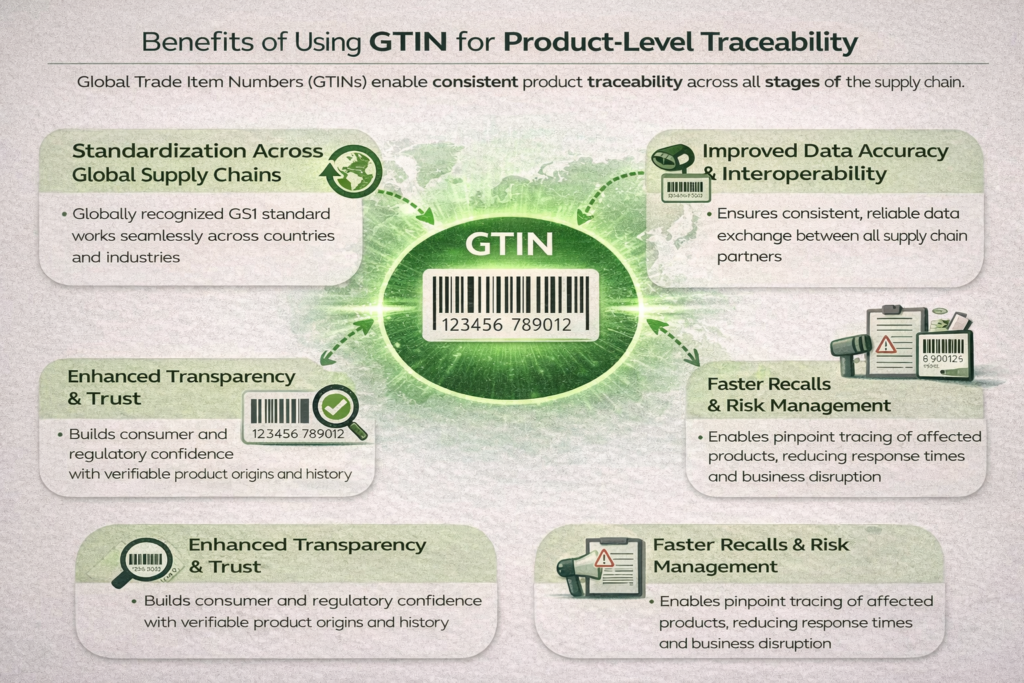
GTIN is a critical enabler of regulatory compliance across industries by providing a standardized, verifiable way to identify products and link them to required traceability and compliance data.
In food and FMCG supply chains, GTINs are used to uniquely identify products across production, distribution, and retail. When combined with batch or lot numbers, GTINs support:
Regulators and retailers rely on GTIN-based identification to ensure product safety and supply chain transparency.
In regulated healthcare sectors, GTINs form part of Unique Device Identification (UDI) and pharmaceutical serialization frameworks. They enable:
GTINs support strict regulatory requirements for tracking, verification, and reporting throughout the product lifecycle.
In textiles, GTINs are increasingly used to identify finished products and link them to Digital Product Passports (DPPs) where applicable. GTIN provides:
This supports emerging regulations focused on transparency and product-level disclosures.
GTIN-based traceability enables organizations to:
While GTIN is a powerful enabler of product-level traceability, its effectiveness depends on correct implementation and governance. Many organizations face challenges that limit the value of GTIN for Product-Level Traceability.
GTINs must be assigned based on specific GS1 rules tied to product attributes such as formulation, size, or packaging. Incorrect assignment such as failing to create a new GTIN when a product changes leads to misidentification, data conflicts, and compliance risks across the supply chain.
Reusing GTINs for different products or assigning the same GTIN to multiple product variants breaks the “one product, one GTIN” principle. This creates confusion for trading partners, disrupts traceability, and undermines recall accuracy and regulatory reporting.
When GTINs are not properly integrated into ERP, MES, WMS, or digital traceability platforms, they remain isolated identifiers. This limits event-level tracking, prevents real-time visibility, and forces manual data reconciliation across systems.
Traceability requires all supply chain partners to use GTINs consistently. When suppliers, manufacturers, or distributors use different identifiers or fail to capture GTINs at key process points end-to-end traceability breaks down.
As regulations evolve and transparency expectations rise, GTIN provides the standardized product identity needed to power Digital Product Passports, enabling reliable access to product, sustainability, and compliance data. In circular economy and recycling systems, GTIN helps identify materials, compositions, and treatment history, supporting better sorting, reuse, and recovery. Most importantly, GTIN anchors end-to-end supply chain transparency by connecting products to event-level data across manufacturing, logistics, retail, and post-use stages making traceability scalable, interoperable, and ready for the next generation of digital supply chains.
Explore the core architecture behind Digital Product Passports →
Learn how GS1 EPCIS enables interoperable DPP data exchange →
Understand the technology stack required to build a compliant DPP →
GTIN (Global Trade Item Number) uniquely identifies products, enabling accurate tracking and verification across the supply chain, from manufacturing to retail.
No, GTIN is not legally mandatory for traceability, but it is widely recommended and often required by retailers and industry standards to ensure consistent product identification.
No, GTIN identifies a product type, not individual units. For individual tracking, you need a serial number or serialised GTIN (SGTIN) combined with the GTIN.
GTIN can be embedded in QR codes (or barcodes) to allow fast scanning and automatic product identification in traceability systems. It can also be combined with batch numbers or serial numbers for more detailed tracking.
GTINs are issued by GS1, the global standards organization. Businesses can register with their local GS1 office to obtain GTINs for their products.