
Quick summary: Australia's Illegal Logging Prohibition Act carries fines up to AUD $1.05M. Learn how furniture brands can meet ILPA due diligence requirements and protect their supply chains.
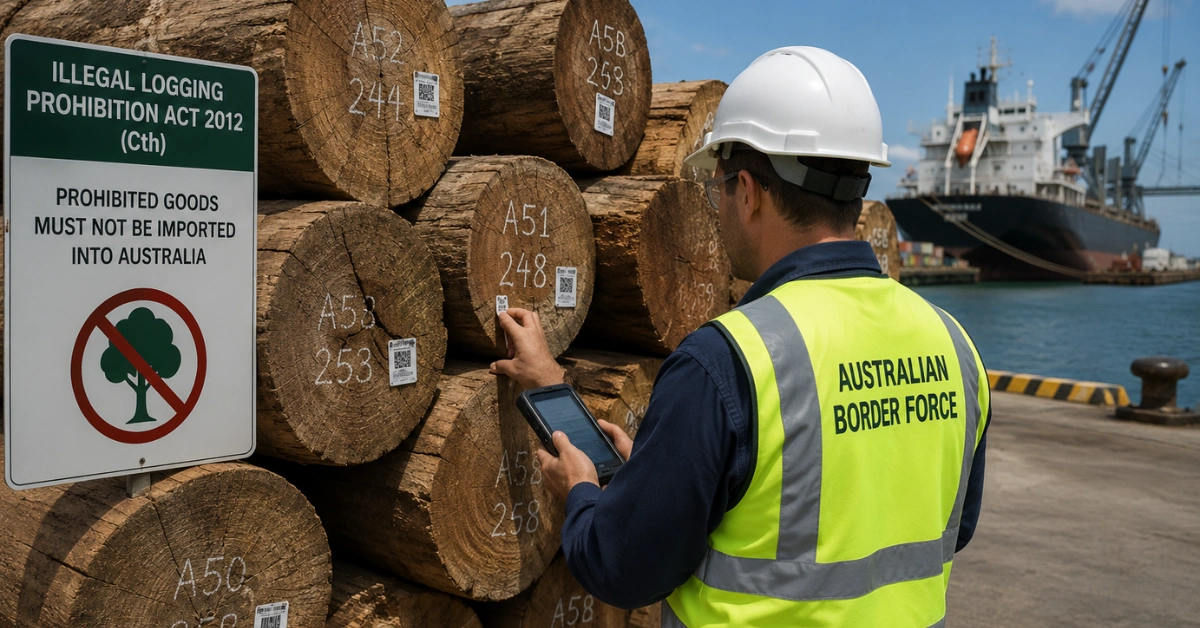
Illegal logging risk in the furniture industry arises when timber is sourced from forests where harvesting occurred without legal authorization, violating the laws of the country of origin. Under Australia’s Illegal Logging Prohibition Act 2012 (Cth) (ILPA), all businesses importing regulated timber products or processing domestically-harvested timber must implement a documented due diligence system to assess and address this risk. Failure to comply carries criminal penalties of up to AUD $1.05 million for corporations with enforcement led by the Department of Agriculture, Fisheries and Forestry (DAFF).
A timber pallet arrives at Melbourne’s port. The supplier documents check out. The FSC certificate looks right. The invoice lists the correct species. And yet somewhere upstream in a concession in Sumatra or a logging camp in Papua New Guinea the tree that produced that timber was felled illegally.
For furniture brands operating in Australia, this scenario is not hypothetical. It’s a documented pattern that Australia’s Illegal Logging Prohibition Act was designed to interrupt and one where the liability sits firmly with the importer, regardless of what documents the supplier provided.
This playbook covers everything compliance officers, procurement leads, and sustainability directors at Australian furniture businesses need to know: how the Act works, what due diligence actually requires, which supply chain risks matter most, and how to build a defensible compliance system at scale.
| Key Takeaways • Australia’s ILPA 2012 requires all furniture importers and domestic timber processors to conduct documented due diligence on their timber supply chains not just hold certifications. • The five core ICP compliance challenges are: multi-tier supplier opacity, fraudulent documentation, smallholder traceability gaps, inadequate risk assessment processes, and inability to demonstrate ongoing monitoring. • Digital traceability platforms with GPS origin mapping, AI-powered documentation, and blockchain audit trails — like TraceX — are now the only scalable way to meet ILPA’s due diligence standard at volume. |
Australia’s Illegal Logging Prohibition Act 2012 (Cth), implemented in November 2014 with regulations updated in 2017, is one of the world’s most comprehensive legislative frameworks targeting illegal timber in imported goods. Administered by the Department of Agriculture, Fisheries and Forestry (DAFF), the Act prohibits importing or processing illegally logged timber and imposes a legal obligation on businesses to exercise due diligence to prevent it.
The Act is not passive it does not simply prohibit handling illegal timber and leave companies to certify their way through. It mandates a proactive, documented process: businesses must assess the risk that their timber was illegally logged, and then take action to address that risk before the product enters the Australian market.
The ILPA applies to a broad range of timber products, all of which are directly relevant to the furniture industry:
Notably, the Act does not exempt small businesses by size. If you import a regulated product, ILPA applies regardless of revenue, headcount, or import volume.
Australian timber importers face increasing pressure to strengthen due diligence, supplier verification, and legality documentation.
Australia is one of the world’s top ten importers of timber and timber products by volume. That scale creates proportional exposure to the illegal logging supply chain — and the numbers are significant.
| AUD $1.05M Maximum corporate fine for ILPA breach (per offence) | 15–30% Estimated share of global timber trade involving illegal logging (UNEP, 2024) | ~$2.5B Annual value of Australian timber and furniture imports (DAFF, 2023) | 60%+ Furniture brands unable to trace timber beyond their Tier 1 supplier (WWF, 2023) |
Where is Australian furniture timber most exposed to illegal logging risk? The following risk table maps Australia’s primary import regions against ILPA enforcement intensity:
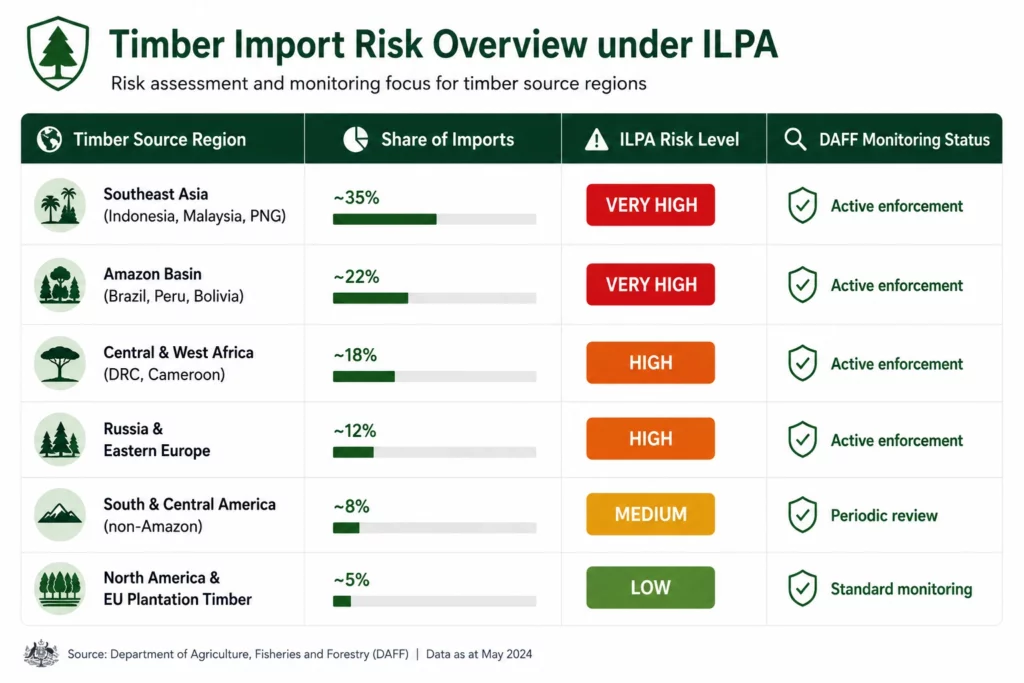
According to the INTERPOL-UNEP Environmental Crime Report (2024), illegal logging generates USD $51–152 billion annually in global criminal revenues making it the fourth-largest environmental crime category. For Australian furniture importers sourcing from Southeast Asia and the Amazon Basin, this means a material proportion of available supply carries a statistically significant risk of containing illegally harvested timber.
For compliance officers, procurement managers, and sustainability leads at furniture importers and manufacturers, ILPA risk doesn’t present as a single problem. It arrives as five overlapping operational failures:
Most furniture brands buy from trading intermediaries furniture factories, component suppliers, or trading houses not directly from logging concessions. This means Tier 1 supplier visibility tells you almost nothing about what’s happening at Tier 3 or Tier 4, where illegal timber most frequently enters the chain.
A 2023 WWF survey found that 60% of furniture brands could not trace their timber beyond their immediate supplier.
Under ILPA, this is not a valid defence. The Act requires businesses to take ‘all reasonable steps’ to assess risk in their supply chain including steps to identify upstream origins.
Supply chain traceability is a critical part of demonstrating due diligence under ILPA and reducing illegal timber sourcing risk.
FSC, PEFC, CITES, and country-of-origin permits are the industry’s primary compliance instruments and its most frequently forged documents. Europol documented over 1,200 fraudulent timber certification cases in 2023. Australian Border Force has identified systematic use of falsified phytosanitary certificates and country-of-origin declarations, particularly for Southeast Asian hardwoods transhipped through third countries.
Paper-based document collection the standard approach for most furniture importers cannot detect sophisticated forgeries. ILPA’s ‘all reasonable steps’ standard has been interpreted by DAFF to include digital verification measures where document fraud is a known risk in a given sourcing region.
In Indonesia, Papua New Guinea, the Solomon Islands, and parts of Africa that supply Australian furniture markets, a significant share of timber originates from smallholder, community, or artisanal forest operations. These sources have no digital records, no GPS plot data, and no compliance infrastructure. They’re where supply chain visibility collapses and where ILPA exposure concentrates.
ILPA does not simply require businesses to hold supplier certifications. It requires a documented risk assessment that considers: the legal framework of the country of harvest, levels of governance and law enforcement, the prevalence of illegal logging in that country and species, and complexity of the supply chain. Most furniture businesses’ existing due diligence is a supplier questionnaire and a filed FSC certificate which does not meet this standard.
ILPA also requires businesses to maintain their due diligence systems on an ongoing basis not as a one-time import checklist. Records must be retained for five years and be available to DAFF inspectors on request. Manual spreadsheet-based systems structurally cannot meet this obligation for businesses importing at scale.
| UNIQUE INSIGHT | Most ILPA guidance focuses on single-species, single-origin timber products. Furniture brands face a compounded version of the problem: a single product line often contains multiple timber species from multiple countries solid wood frame from one origin, plywood base from another, veneer from a third. Each origin triggers a separate ILPA risk assessment obligation. This multiplicative complexity is why manual compliance breaks down at furniture-sector scale. |
Risk assessment is a core requirement under Australia’s illegal logging laws and a critical step in identifying high-risk timber sourcing.
The Illegal Logging Prohibition Regulation 2012 sets out the specific due diligence system requirements. For regulated importers and processors, the system must include four components:
| Information Gathering | Collect information about the timber product country of harvest, species, supplier details, and any applicable laws of the harvesting country. This must go beyond Tier 1 to include the country of origin of the raw log. |
| Risk Assessment | Assess the risk that the timber was illegally logged, considering: governance quality in the country of origin, species-specific risk (CITES-listed or high-value species attract higher scrutiny), complexity of the supply chain, and prevalence of illegal logging in the source region. |
| Risk Mitigation | If the risk assessment identifies non-negligible risk, the business must take additional steps to reduce that risk to a negligible level before importing. This may include third-party audits, satellite verification of forest plots, or additional supplier documentation. |
| Record Keeping | Maintain records of the due diligence system and all supporting documentation for five years from the date of import. Records must be made available to DAFF on request within a reasonable timeframe. |
Penalties for non-compliance:
Understanding ILPA due diligence requirements is essential for managing timber legality, supplier verification, and import compliance in Australia.
What does illegal timber liability actually look like in practice? The following scenarios illustrate how compliance failures can emerge across furniture and timber supply chains even when companies believe their sourcing programs are compliant.
A large international furniture retailer sourced timber products through FSC-certified suppliers operating across Eastern Europe and Asia. On paper, the supply chain appeared compliant, supported by chain-of-custody certificates and supplier declarations.
However, a deeper investigation revealed that several subcontractors further upstream had mixed timber from unauthorized harvesting areas into certified supply streams. Although the direct supplier maintained certification, the upstream traceability chain had significant gaps.
For Australian importers, the lesson is clear:
Certification alone does not eliminate due diligence obligations under ILPA. Businesses are still expected to assess harvesting risk, country-level legality concerns, and supply chain integrity beyond Tier 1 suppliers.
An importer of engineered wood flooring relied heavily on supplier declarations and commercial invoices from overseas manufacturers to demonstrate timber legality. Internal compliance checks were minimal, and the company did not independently assess harvesting risks in the source country.
Following a regulatory investigation into illegal logging activity in the exporting region, authorities determined that the importer had failed to conduct adequate due diligence before placing products on the market.
The importer faced:
The key takeaway:
Under importer-liability frameworks like ILPA, responsibility ultimately rests with the importing business not solely with upstream suppliers.
An Australian timber importer sourced plywood products from a high-risk tropical timber region through multiple intermediaries. During a customs review, authorities identified inconsistencies between harvesting permits, species declarations, and shipment documentation.
The importer was issued a formal compliance notice requiring:
Because the company lacked a structured due diligence system, it was forced to rapidly implement supplier onboarding, document management, and traceability workflows under regulatory supervision.
This scenario highlights an important reality:
ILPA enforcement does not only target large multinational companies. Mid-sized importers and distributors can also face significant compliance exposure if documentation and risk assessment systems are inadequate.
In each scenario, the core issue was not simply illegal logging itself—it was the failure to demonstrate:
As illegal logging regulations strengthen globally, timber importers, furniture brands, and wood product businesses increasingly need systems capable of:
✔ Supplier traceability
✔ Risk-based due diligence
✔ Documentation validation
✔ Record retention
✔ Compliance audit readiness
Because under modern timber regulations, proving legality is becoming just as important as legality itself.
Building a due diligence system that genuinely meets the ILPA’s ‘all reasonable steps’ standard requires five interlocking capabilities most of which do not exist in traditional procurement workflows:
| 1 | Map Your Supply Chain to Country of Harvest Document the complete supply chain for every timber species in every product line: country of harvest, species (scientific name), logging concession or forest area, Tier 1–3 supplier details, and applicable harvesting laws. This baseline mapping is the foundation of a legally defensible risk assessment. |
| 2 | Digitise Supplier Onboarding and Document Collection Replace paper supplier declarations with structured digital onboarding capturing harvest permits, export licences, chain of custody certificates, land tenure documentation, and GPS coordinates of forest plots. Offline-first mobile tools are essential for remote forest sourcing contexts in PNG, Indonesia, and SE Asia. |
| 3 | Conduct a Documented Risk Assessment per Origin For each country of harvest, assess: governance quality and rule of law (use World Bank Governance Indicators), prevalence of illegal logging (use INTERPOL, FAO, and DAFF country risk data), species risk (CITES listings, TRAFFIC reports), and supply chain complexity. Record the assessment and the conclusion in writing. |
| 4 | Implement Risk Mitigation for Non-Negligible Risk Origins Where the risk assessment identifies elevated risk, take additional mitigation steps: request third-party verification, use satellite imagery to cross-check declared forest plots against deforestation databases, or request independent species DNA testing for high-value hardwoods. Document every mitigation action taken. |
| 5 | Maintain Audit-Ready Records for Five Years Store all due diligence records in a format that can be produced to DAFF within a reasonable notice period. Blockchain-backed record immutability ensures records cannot be altered after the fact a critical assurance for regulatory inspections. |
Timber traceability is becoming essential for proving legality, managing sourcing risk, and meeting evolving global compliance requirements.
Explore how traceability systems help timber businesses strengthen chain-of-custody visibility and build audit-ready supply chains.
TraceX’s ILPA Compliance Platform is purpose-built for supply chains where the last mile is fragmented, paper-based, and geographically dispersed exactly the conditions that define timber sourcing from Southeast Asia, Papua New Guinea, and Central Africa.
How TraceX maps to each ILPA due diligence requirement:
Capability comparison — ILPA compliance approaches:
| Capability | Manual Tracking | Certification-Only | TraceX Platform |
|---|---|---|---|
| Timber Origin Mapping | Manual / spreadsheet | Partial coverage | GPS polygon + blockchain |
| Due Diligence Documentation | Word docs, error-prone | Template-based | AI-auto-generated, audit-ready |
| ILPA Risk Assessment | Subjective, inconsistent | Limited scope | Structured, satellite-verified |
| Supplier Document Parsing | Manual review | Not available | Agentic AI, auto-extraction |
| Deforestation Verification | None | None | Real-time Sentinel-2 alerts |
| 5-Year Record Retention | File servers, fragile | Partial | Blockchain-immutable ledger |
| Scope 3 Emissions Tracking | Industry averages only | Not included | Primary supply chain data |
For procurement leads asking ‘can we afford this?’ consider the alternative. A single DAFF compliance notice requiring retrospective due diligence for 12 months of imports, at an average legal and consulting cost of AUD $80,000–$250,000, significantly exceeds the annual cost of a digital compliance platform. And that’s before any penalty assessment.
Australia’s Illegal Logging Prohibition Act is one of the most operationally demanding timber compliance frameworks in the world because it requires not just documentation but a systematic, repeatable, documented process that can be reproduced for any import on any day that DAFF asks.
For furniture businesses importing from Southeast Asia, the Pacific, Africa, or South America, the question is not whether your timber carries ILPA risk. It does. The question is whether your due diligence system is robust enough to assess that risk, mitigate it where it’s elevated, and demonstrate the whole process in a format that satisfies a regulatory inspector.
Paper-based compliance cannot do this at scale. Digital traceability GPS-verified origins, AI-powered documentation, blockchain-backed record integrity is the only operational path to genuine ILPA compliance for furniture importers managing multiple species, multiple origins, and multiple product lines simultaneously.
Yes. The ILPA applies to any business that imports a regulated timber product into Australia, regardless of size, revenue, or import volume. Small retailers who import furniture in their own name must maintain a due diligence system. The only complete exemption covers businesses sourcing exclusively from suppliers who have themselves already conducted ILPA-compliant due diligence and can provide documented proof.
A: No FSC certification is strong evidence but does not automatically satisfy ILPA on its own. The Act requires importers to independently assess risk based on the country of harvest, species, and supply chain complexity. FSC certification reduces risk and supports the assessment, but businesses must still document their own risk assessment process. DAFF has confirmed this position in its compliance guidance.
You must retain records of your due diligence system including information gathered, risk assessments conducted, mitigation actions taken, and supporting supplier documentation for five years from the date of import. Records must be available to DAFF within a reasonable timeframe on request. Digital records with tamper-proof audit trails are strongly advisable.
DAFF can request access to your due diligence records at any time. If your system is inadequate or if you have no documented system you may receive a formal compliance notice requiring you to implement one within a specified timeframe. Persistent non-compliance or evidence of importing illegally logged timber can result in criminal prosecution, fines of up to AUD $1.05 million per offence, and product seizure.
For high-risk origins, DAFF expects enhanced due diligence beyond standard document collection. This includes: cross-checking declared forest plots against satellite deforestation data, verifying concession permits against government licensing databases, requesting chain-of-custody documentation for every tier of the supply chain, and considering independent third-party forest audits. Digital traceability platforms automate much of this process